


 Top Rated Course

We may not have the course you’re looking for. If you enquire or give us a call on +44 1344 203999 and speak to our training experts, we may still be able to help with your training requirements.
Forex Trading Strategies: Complete Guide to Succeed in 2025
The Knowledge Academy 02 March 2026Forex Trading Strategies cover numerous approaches including technical and fundamental analysis, trend following, range trading, scalping, swing and day trading. Rather than relying on guesswork, these strategies help Traders can make more informed decisions based on technical analysis, market trends or economic indicators.

Training Outcomes Within Your Budget!
We ensure quality, budget-alignment, and timely delivery by our expert instructors.
Table of Contents

Forex Trading Strategies are the roadmap to success in the world’s largest financial market. With currencies constantly on the move, traders need smart, well-structured plans to capture profitable opportunities. From a beginner learning chart patterns to an experienced trader refining their edge, the right strategy can deliver transformative results.
From fundamental and Technical Analysis to Risk Management and timing, every decision counts. This blog explores the proven Forex Trading Strategies to help you trade confidently and achieve consistent success. So read on and choose the one that fits your trading speed!
Table of Contents
1) What is Forex Trading?
2) Top Forex Trading Strategies
3) Advanced Forex Trading Strategies
4) Creating a Forex Trading Strategy
5) What are Some Strategy Modifiers?
6) How to Choose the Best Forex Trading Strategy?
7) How to Compare Forex Strategies?
8) When is it Time to Change Strategies?
9) Conclusion
What is Forex Trading?
Forex Trading means buying and selling different currencies to earn money. It takes place in the global currency market, where people trade currencies like pounds, dollars, or euros. The main goal is to buy a currency when its price is low and sell it when the price goes up. Forex Trading always happens in pairs such as GBP/USD, which means British pound to US dollar.
It is the largest financial marketplace in the world and runs 24 hours a day, five days a week. People, banks, and companies use it for travel, business, and investment. Forex Trading can give good profits, but it also involves risks because currency prices keep changing all the time.

Top Forex Trading Strategies
Here are some popular and advanced Forex Trading Strategies you can apply to thrive in the competitive market.
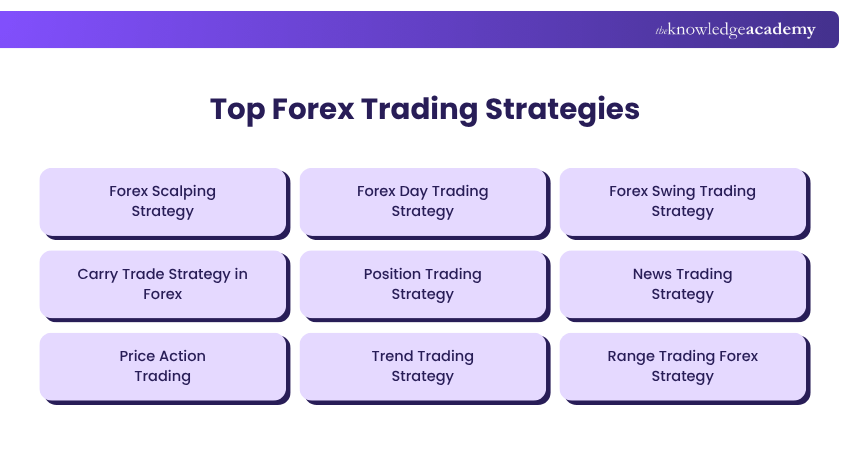
1) Forex Scalping Strategy
Scalping is one of the fastest-paced strategies in Forex Trading. It involves making dozens, or even hundreds of trades in a single day to profit from lessprice movements. Each trade may last just a few seconds to a few minutes.
Traders who scalp typically focus on the most liquid currency pairs and rely on tight spreads and fast execution. Scalping requires discipline, a reliable internet connection, and the ability to react fastly to market changes.
2) Forex Day Trading Strategy
Day trading is about buying and selling positions within a single trading day, preventing overnight risks such as news shocks or market gaps. Day Traders use technical analysis, price patterns, and indicators to make decisions.
This strategy suits Traders who want to benefit from intraday price movements and have time to watch the market throughout the day. It requires focus, planning, and a clear exit strategy to lock in profits.
3) Forex Swing Trading Strategy
Swing trading is a more relaxed style compared to day trading or scalping. Traders hold positions for many days or even weeks, aiming to capture price swings that occur over medium-term trends.
This strategy is ideal for those who can't monitor the market every hour but still want to trade actively. Swing Traders often use technical indicators like Fibonacci retracement, RSI, or MACD alongside fundamental analysis to find high-probability entry and exit points.
4) Carry Trade Strategy in Forex
The carry trade strategy takes advantage of the difference in interest rates between two currencies. You borrow a currency with a low interest rate (like the Japanese yen) and invest in one with a higher rate (like the New Zealand dollar).
The goal is to earn the interest rate differential, known as the "carry." While the strategy can offer steady returns during stable market conditions, it can be risky during volatile periods or sudden rate changes.
5) Position Trading Strategy
Position trading is a long-term approach where Traders hold onto their positions for weeks, months, or even years. It's less concerned with short-term fluctuations and more focused on the overall trend and economic indicators.
Traders use fundamental analysis to study interest rates, economic cycles, and global news. This strategy is best suited for patient Traders who are willing to wait for larger profits and are comfortable with slow-moving trades.
6) News Trading Strategy
News trading involves making trades based on key economic events, government policies, or Geopolitical Developments. Events like interest rate decisions, non-farm payrolls, or central bank statements can cause huge price swings within seconds.
Traders often place orders just before or immediately after a news release, aiming to capture the market’s reaction. While news trading can lead to big wins, it also carries high risk due to sharp volatility and potential slippage.
7) Price Action Trading
Price action trading focuses on analysing the movement of prices over time, without relying heavily on technical indicators. Traders study candlestick patterns, chart formations (like head and shoulders or triangles), and key support and resistance levels to make informed decisions.
This strategy is based on the idea that all market information is already reflected in the price. It’s favoured by experienced Traders who trust their chart-reading skills and prefer a clean trading setup.
8) Trend Trading Strategy
The trend is your friend, until it ends. Trend trading is one of the most popular strategies in Forex because it involves identifying and following the direction of the market.
Traders use tools like moving averages, trendlines, or the Average Directional Index (ADX) to confirm the trend and ride it until it shows signs of reversal. It works well in strongly directional markets and helps Traders avoid trading against momentum.
9) Range Trading Forex Strategy
Range Trading works particularly well in markets that are moving sideways without a clear trend. Traders identify support and resistance levels and buy at the range’s bottom and sell at the top.
Technical indicators like Bollinger Bands or RSI are commonly used to spot overbought or oversold conditions. The key to successful range trading is knowing when the market is genuinely in a range and being ready to exit if a breakout occurs.
Understand effective Risk Management strategies to protect your capital with our Day Trading Course – Register today!
Advanced Forex Trading Strategies
Now that you know about some basic strategies, it’s time to understand some of the advanced Forex Trading Strategies for professional Traders. Let's have a detailed look at each one of them:
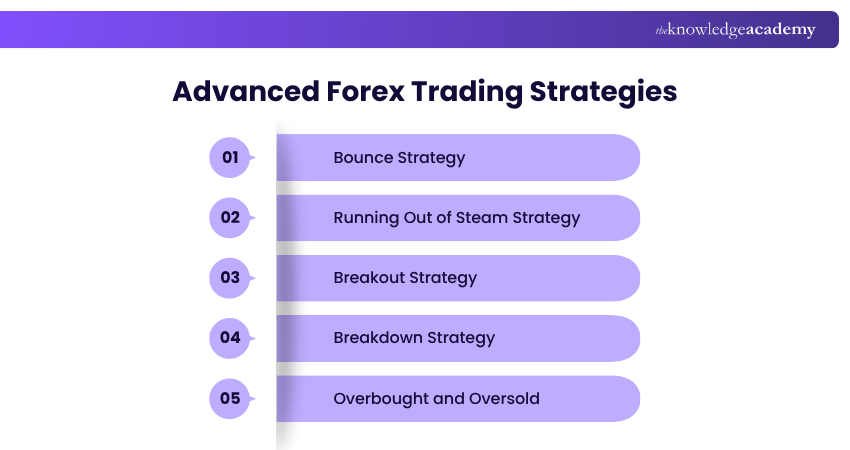
1) Bounce Strategy
The Bounce Strategy is employed in Trading financial markets, reliant on identifying pivotal levels of support and resistance on price charts. This approach capitalises on market behaviour, executing trades upon price rebounds from these established levels. The underlying premise rests on the inherent tendency of markets to revert to prior ranges following a significant movement.
Traders employing the Bounce Strategy must meticulously assess various factors, including market trends, the robustness of support and resistance levels, and the risk-reward ratio inherent in their trades. Successful implementation necessitates a comprehensive understanding of market dynamics and adept Risk Management strategies.
2) Running Out of Steam Strategy
The Running Out of Steam Strategy is a variation of the Bounce Strategy that targets temporary reversals or corrections in a trending market. The approach involves looking for signs of exhaustion or weakness in the price movement near a previous high or low and taking a position against the prevailing trend.
Traders who use this strategy must be precise and agile in timing their entries and exits, as the price could resume the trend at any moment. They must also use stop-loss orders and indicators to confirm the reversal signals.
3) Breakout Strategy
Resistance and support levels are dynamic and susceptible to price breakouts in either direction. If the price surpasses key support or resistance levels, a breakout is likely, which many Traders may interpret as a significant shift in market sentiment. If a Forex pair reaches a high and sellers intervene, causing the price to drop, it indicates an overvalued market.
However, if this previous high is breached, known as breakout resistance, it signifies a shift, with Traders now willing to buy at prices they previously considered too expensive. This can be an effective strategy for Forex Trading for identifying new trends. Every journey begins with a single step, and when market direction changes, the breakout trading strategy is often one of the first indicators.
4) Breakdown Strategy
Similar in function, but opposite to the breakout strategy, is the breakdown strategy. This Forex Trading approach aims to capitalise on a market move when it falls below a previous support level. Many Traders may interpret this as a shift in market sentiment.
A level where buyers were previously content to purchase, viewing the market as undervalued and expecting a rise, has now been breached. This break of the support level can be seen as an opportunity to short sell and potentially profit from further price declines.
5) Overbought and Oversold
The overbought and oversold strategy helps Forex Traders identify potential market reversals using indicators like the Relative Strength Index (RSI). A currency pair gets overbought when its price is significantly higher than its intrinsic value, often signalling a potential price drop. Traders look for RSI readings above 70 to consider selling.
Conversely, a currency pair is oversold when its price is well below its intrinsic value, indicating a possible rebound. RSI readings below 30 prompt Traders to consider buying. This strategy aids in making informed entry and exit decisions, but it’s crucial to use it alongside other methods to confirm signals and avoid false positives.
Understand market analysis techniques to make informed trading decisions with our Stock Trading Course – Join now!
Creating a Forex Trading Strategy
Creating a successful Forex Trading strategy often starts with simplicity. Forex Factory is a great resource for Traders looking to refine their approach by analysing market trends and economic news. Traders might observe that a particular currency pair consistently bounces back from a specific support or resistance level.
Over time, they refine their strategy by adding elements that enhance the accuracy of their trading signals. For instance, they might require the price to rebound from a support level by a certain percentage or number of pips.
An effective Forex Trading strategy includes several key components:
1) Market Selection: Choose the currency pairs you want to trade and become proficient in analysing them.
2) Position Sizing: Determine the size of each trade to manage the risk involved in every individual trade.
3) Entry Points: Develop rules for when to enter a short or long position in a currency pair.
4) Exit Points: Establish rules for when to exit a position, whether it's profitable or losing.
What are Some Strategy Modifiers?
When employing any of the aforementioned Forex Trading Strategies, it’s prudent to be aware of methods to adapt your approach. Let’s delve into them:
1) Hedging Forex
Traders can hold both long and short positions to protect against unfavourable moves in a currency pair. This offsets potential losses but limits profits. It buys time to observe market trends and adjust positions, useful during short-term volatility. Hedging is ideal for long-term Traders expecting a temporary adverse movement followed by a reversal.
2) Price Action Forex Trading Strategy
This strategy relies on analysing candlestick charts to identify trading opportunities based on price movements, without external factors like economic news. It should complement another strategy, such as swing or day trading, for better results. While it provides real-time insights, it’s subjective; different Traders may interpret trends differently.
How to Choose the Best Forex Trading Strategy?
When selecting the optimal Forex Trading Strategy, it's crucial to consider certain factors to align with your goals and Trading style. Let’s explore some of them:
1) Time Frame: Choose a strategy that matches your availability and Trading approach. For active engagement, short-term strategies like day Trading are suitable, requiring constant market monitoring. Conversely, long-term strategies like position Trading involve holding trades for weeks or months, which is suitable for a more passive approach.
2) Number of Trading Opportunities: Assess the frequency of Trading signals your strategy provides. High-frequency strategies, such as scalping, offer numerous trades daily, while low-frequency strategies, like Swing Trading, offer fewer, more selective trades.
3) Position Size: Carefully plan how much capital to allocate per trade. Effective position sizing is key to Risk Management, ensuring that losses on individual trades don’t disproportionately affect your overall capital. This includes considering your total capital, risk tolerance, and the stop-loss level for each trade.
Understand market trends and Risk Management with our Cryptocurrency Trading Training – Register now!
How to Compare Forex Strategies?
Comparing Forex strategies means checking which one best matches your trading goals and style. Begin by understanding what each strategy is designed for, quick profits, long-term growth, or lower risk. Also, look at the risk-to-reward ratio to see if it suits your comfort level and expected returns.
Some strategies need more time and focus, like scalping, while others, such as swing trading, require less attention. Always review a strategy’s past results and test it under different market conditions to see how reliable it is. Choose one that fits your skills, adapts to market changes, and uses tools or resources you can manage easily.
When is it Time to Change Strategies?
It’s time to change your Forex strategy when it consistently underperforms despite adjustments, indicating it no longer suits your trading goals or market conditions. Strategies that fail to adapt to evolving trends or volatility can quickly become obsolete.
Additionally, if a strategy causes excessive stress, feels overly complex, or deviates from your risk tolerance and objectives, a change is necessary. Regularly assess your approach to ensure it aligns with your financial goals, emotional well-being, and the dynamic nature of the Forex market. Adapting to change is crucial for sustained trading success.
Conclusion
Learning Forex Trading Strategies is the key to building confidence and consistency in the market. By learning different techniques, analysing trends, and managing risks wisely, Traders can make smarter decisions and improve results. Whether you prefer scalping, swing, or day trading, using the right strategy will help you stay ahead and achieve long-term trading success.
Become familiar with all crucial aspects of investing and trading. Join our Investment and Trading Training now!
Frequently Asked Questions
What are the Key Benefits of Implementing Forex Trading Strategies?

Implementing Forex Trading Strategies provides structure, reduces emotional decision-making, and improves consistency. It helps in Risk Management, identifying opportunities, and adapting to market conditions, enhancing your ability to achieve long-term trading goals effectively.
What Types of Analysis are Used to Analyse Forex Markets?
Forex markets are analysed using Technical Analysis (charts, patterns, indicators), fundamental analysis (economic data, interest rates), and Sentiment Analysis (market psychology, Trader behaviour). Combining these methods provides a comprehensive trading outlook.
What are the Other Resources and Offers Provided by The Knowledge Academy?
The Knowledge Academy takes global learning to new heights, offering over 3,000+ online courses across 490+ locations in 190+ countries. This expansive reach ensures accessibility and convenience for learners worldwide.
Alongside our diverse Online Course Catalogue, encompassing 17 major categories, we go the extra mile by providing a plethora of free educational Online Resources like Blogs, eBooks, Interview Questions and Videos. Tailoring learning experiences further, professionals can unlock greater value through a wide range of special discounts, seasonal deals, and Exclusive Offers.
What is The Knowledge Pass, and How Does it Work?
The Knowledge Academy’s Knowledge Pass, a prepaid voucher, adds another layer of flexibility, allowing course bookings over a 12-month period. Join us on a journey where education knows no bounds.
What are the Related Courses and Blogs Provided by The Knowledge Academy?
The Knowledge Academy offers various Investment and Trading Trainings, including Forex Trading Course, Cryptocurrency Trading Training and Day Trading Course. These courses cater to different skill levels, providing comprehensive insights into Forex Market Analysis.
Our Business Skills Blogs cover a range of topics related to Forex Trading, offering valuable resources, best practices, and industry insights. Whether you are a beginner or looking to advance your Trading skills, The Knowledge Academy's diverse courses and informative blogs have you covered.

The Knowledge Academy


Global Training Provider
The Knowledge Academy is a world-leading provider of professional training courses, offering globally recognised qualifications across a wide range of subjects. With expert trainers, up-to-date course material, and flexible learning options, we aim to empower professionals and organisations to achieve their goals through continuous learning.

Upcoming Business Skills Resources Batches & Dates
Date
 Cryptocurrency Trading Training
Cryptocurrency Trading Training
Fri 27th Mar 2026
Cryptocurrency Trading Training
Fri 22nd May 2026
Cryptocurrency Trading Training
Fri 24th Jul 2026
Cryptocurrency Trading Training
Fri 2nd Oct 2026

 If you wish to make any changes to your course, please


