




We may not have the course you’re looking for. If you enquire or give us a call on +44 1344 203 999 and speak to our training experts, we may still be able to help with your training requirements.
PRINCE2 Risk Management: A Comprehensive Guide
ByNilotpal SarmahLast updated on: 10 October 2026
PRINCE2 Risk Management is a framework for identifying, assessing and controlling risks across projects, improving decision-making and project success. It provides a clear approach to managing threats and opportunities throughout the project lifecycle. This helps organisations reduce uncertainty and deliver projects more successfully.
What You Should Know
1. PRINCE2 considers both threats and opportunities when addressing project uncertainty.2. Risks are assessed using factors such as likelihood, impact and proximity.3. Clear risk ownership helps ensure that agreed responses and actions are properly managed.4. Risk information should be reviewed and communicated regularly as project conditions change.5. Response options should be selected according to the nature and exposure of each risk.
Think about the last project you worked on. It may have started well, but then a deadline slipped, costs increased, or unexpected changes appeared. These challenges are common, but identifying and managing them early can prevent them from affecting the project's success. That's where PRINCE2 Risk Management comes in.
It helps identify risks early and keeps projects on track through a structured approach. Understanding what is risk management in PRINCE2 helps you manage project risks more effectively. This blog covers its purpose, risk categories, management procedure and benefits. Let's get started!
What is PRINCE2 Risk Management?
PRINCE2 Risk Management is the structured approach used within the PRINCE2 methodology to identify, assess, control and communicate risks throughout a project lifecycle. It focuses on managing both threats that could negatively affect the project and opportunities that could improve its outcomes.
By reducing the impact of threats and maximising the benefits of opportunities, PRINCE2 Risk Management supports better decision-making, protects the project's objectives and business case and improves the chances of successful project delivery.

Purpose of Risk Management in PRINCE2
The purpose of risk management in PRINCE2 is to identify, assess, and control uncertainties that could affect a project's objectives. It helps Project Managers reduce the impact of threats, make the most of opportunities and support informed decision-making throughout the project lifecycle.
Effective risk management also improves planning, protects the project's business case, increases stakeholder confidence and helps keep the project on time, within budget and aligned with its objectives.
PRINCE2 Risk Categories
PRINCE2 does not define a fixed list of risk categories. Organisations can choose categories that best suit their projects and industry. Grouping risks into categories helps Project Managers identify and manage risks more effectively. Some common risk categories include:
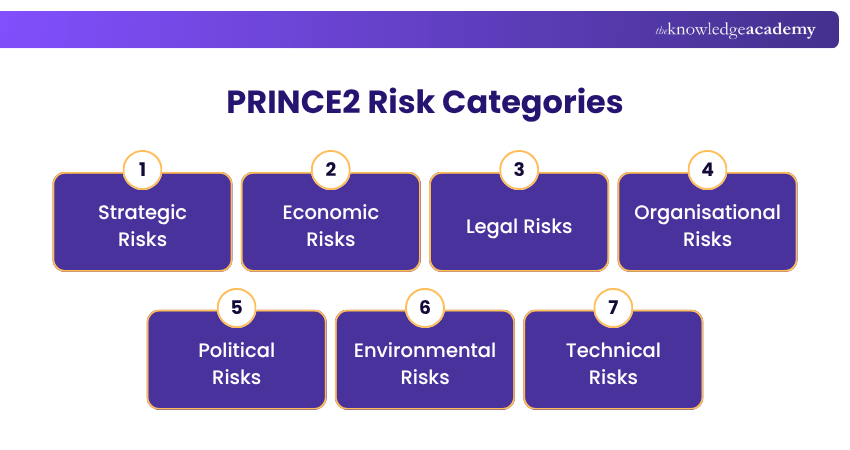
a) Strategic/Commercial Risks
These risks are related to the business case of the project, suppliers and contracts/business goals. For instance, a critical supplier not showing up.
b) Economic/Financial/Market Risks
These risks are budgetary, funding, inflation, exchange rates or market changes which could lead to greater project costs.
c) Legal/Regulatory/Compliance Risks
The risks are due to alterations in laws and regulations and can delay or cause penalties.
d) Organisational/Management/Human Risks
These risks include staffing, skills, resources, stakeholder involvement or project management risks that may impact project delivery.
e) Political Risks
These risks can result from changes in government policies, political leadership, political stability or public-sector priorities that may affect the project.
f) Environmental Risks
These risks are linked to environmental regulations, sustainability requirements, extreme weather or natural disasters.
g) Technical/Operational/Infrastructure Risks
These risks relate to technology, systems, equipment, operational processes or infrastructure that may affect project performance or delivery.
These are example categories that organisations may tailor to suit their own projects and industry.
Understand project roles, practices, principles and processes for better control with the PRINCE2® Foundation Training – Join today!
PRINCE2 Risk Management Procedure
PRINCE2 provides a structured procedure for identifying, assessing and responding to risks throughout the project lifecycle. The following steps help reduce uncertainty and support successful project delivery:
1) Identify
The first step is to determine potential threats and opportunities that could affect the project's objectives. Each identified risk is recorded with details such as its cause, potential impact and consequences. This provides a clear understanding of the risks that require further assessment.
Trainer’s Insight
Write risks using a cause → event → effect structure. For example: “Because a specialist supplier has limited capacity, delivery may be delayed, resulting in a later testing date.” This makes risks easier to understand, assess and assign.
2) Assess
The Assess stage helps determine the significance of each identified risk. It consists of two activities:
a) Estimate
Estimate the likelihood, impact and proximity of each risk to understand how it could affect the project if no action is taken.
b) Evaluate
Evaluate the estimated risks to identify their overall priority and decide which risks require immediate attention based on the project's risk tolerance.
3) Plan
During this stage, appropriate risk response actions are selected for each identified risk. The team also considers any residual or secondary risks that may arise after implementing the chosen response and ensures suitable actions are planned to manage them effectively.
4) Implement
During this stage, the planned risk responses are implemented. Each risk should have a Risk Owner responsible for managing the risk, while specific response actions can be assigned to Risk Action Owners. Progress should be reviewed regularly to ensure the planned responses remain effective.
5) Communicate
Risk communication is an ongoing activity throughout the project lifecycle. Relevant risk information should be shared through regular project reports so stakeholders understand the current risk status and planned actions.
Risk information may be communicated through the following PRINCE2 management reports:
a) Checkpoint Reports
b) Highlight Reports
c) End Stage Reports
d) End Project Report
e) Lessons Report
Types of Risk Responses Identified by PRINCE2
PRINCE2 provides several risk response options to help manage threats and opportunities. The appropriate response depends on the nature of the risk and its potential effect on the project's objectives. The following are the risk response types used in PRINCE2:
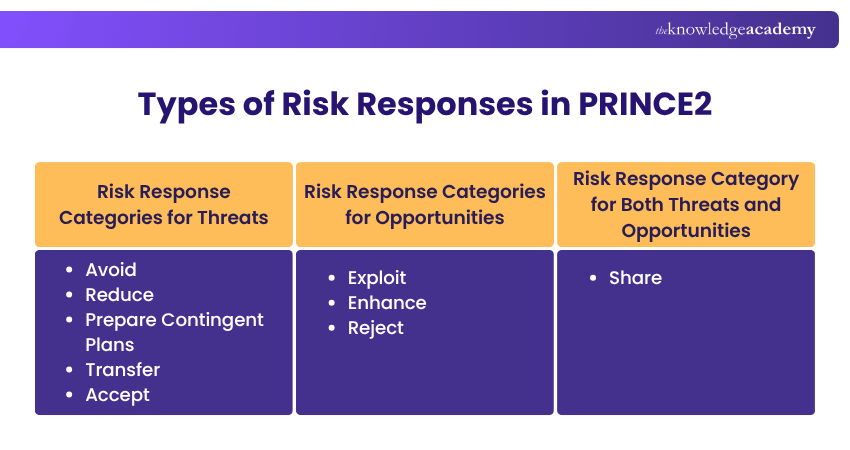
1) Risk Response Categories for Threats
Threats are uncertain events that could negatively affect a project's objectives. PRINCE2 provides five ways to respond to them:
a) Avoid
This response removes the threat by changing the project approach, eliminating the risk completely. For example, selecting a different supplier to avoid delivery-related issues.
b) Reduce
This involves taking preventive actions to lower either the chance of the risk occurring or its impact if it does occur. For example, providing additional staff training to reduce the chance of project errors.
c) Prepare Contingent Plans
A contingency plan is prepared in advance and implemented only if the risk occurs. It does not reduce the likelihood of the risk but helps minimise disruption when it happens. For example, having a backup supplier ready if the primary supplier fails to deliver.
d) Transfer
The financial or contractual responsibility for a risk is passed to another party. This is commonly done through insurance policies or contractual agreements with suppliers. Although the risk still exists, its financial impact on the project is reduced.
e) Accept
The project team either does not take any action or does not take immediate action, due to the fact that the risk is acceptable or the cost of responding is greater than the impact. However, the risk should continue to be monitored throughout the project.
2) Risk Response Categories for Opportunities
Opportunities are uncertain events that could have a positive effect on the project. PRINCE2 recommends three response strategies:
a) Exploit
This response aims to ensure that the opportunity definitely happens by taking proactive action. For example, assigning additional resources to complete the project early and secure a performance bonus.
b) Enhance
This approach increases the likelihood or positive impact of an opportunity. For example, investing in new technology enhances productivity and increases the chances of finishing ahead of schedule.
b) Reject
This response is a conscious decision not to pursue an opportunity, usually because the cost or effort required to exploit or enhance it outweighs the expected benefit. The opportunity isn't acted on, but it may still be worth monitoring in case circumstances change.
3) Risk Response Category for Both Threats and Opportunities
This response can be used for both positive and negative risks.
a) Share
A procurement agreement might feature a provision for pain/gain sharing, enabling suppliers and customers to share in the rewards or losses tied to a risk. This proactive measure is implemented before the risk manifests and can apply to either a threat or an opportunity.
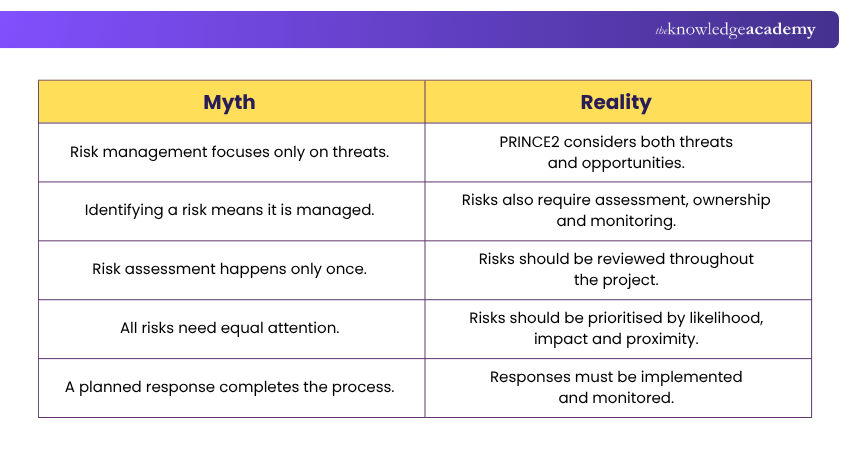
Myth vs Reality
Attain global recognition as a qualified Agile Project Manager through the PRINCE2 Agile® Foundation (Version 2) Training – Register now!
Benefits of PRINCE2 Risk Management
PRINCE2 Risk Management helps Project Managers identify and manage risks before they affect the project. It supports better planning, reduces uncertainty and improves the chances of delivering the project successfully.
Some key benefits include:
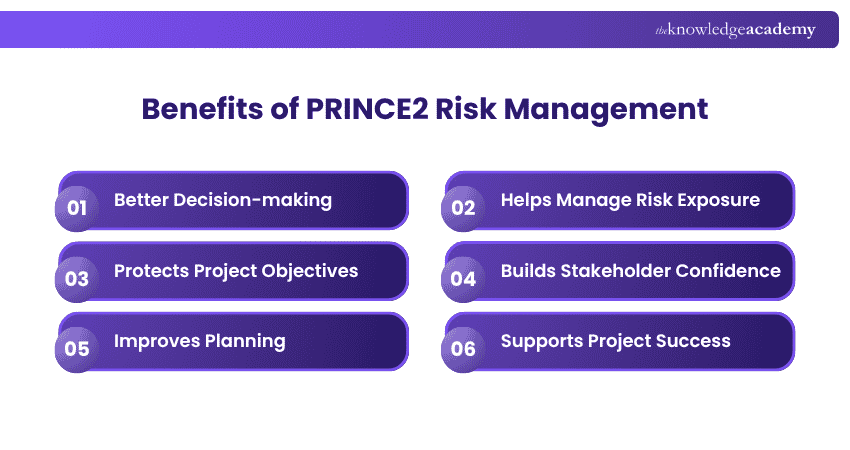
a) Better Decision-making
Helps Project Managers make better decisions by understanding potential risks and their impact.
b) Helps Manage Risk Exposure
Identifies risks early so teams can take action before they become bigger problems.
c) Protects Project Objectives
Helps keep the project on track by reducing delays, extra costs and other unexpected issues.
d) Builds Stakeholder Confidence
Shows stakeholders that risks are being managed properly, increasing trust in the project.
e) Improves Planning
Helps teams use their time, budget and resources more effectively to manage risks.
f) Supports Project Success
By reducing threats and making the most of opportunities, it improves the chances of delivering the project on time, within budget and to the required quality.
Challenges of PRINCE2 Risk Management
While PRINCE2 Risk Management helps improve project success, it can also present some challenges. Managing risks effectively requires time, resources and regular monitoring throughout the project.
Some common challenges include:
a) Time-consuming Process
Identifying, assessing and reviewing risks regularly can take considerable time, especially in large or complex projects.
b) Requires Skilled Teams
Effective risk management depends on experienced team members who can identify risks and assess them consistently. Without the right skills, risks may be overlooked or prioritised incorrectly.
c) Difficult to Predict All Risks
Some risks are unexpected and may arise during the project, making them difficult to identify in advance.
d) Requires Continuous Monitoring
Risks can change over time, so they must be reviewed and updated regularly throughout the project.
e) Additional Costs
Managing risks may require extra resources, training or contingency funds, which can increase project costs.
Quick Risk Review Checklist
Before completing a project risk review, check:
1. Have any new threats or opportunities emerged?2. Have existing risks changed in likelihood, impact or proximity?3. Does every significant risk have a clear owner?4. Are planned response actions progressing as expected?5. Have any responses created secondary risks?6. Are any risks ready to be closed?
Understand PRINCE2® processes to manage, control and deliver projects efficiently with the PRINCE2® Foundation & Practitioner Training - Join now!

Nilotpal Sarmah is a Senior Content Writer with 11+ years of overall experience spanning engineering, operations and content development. His technical knowledge and extensive writing experience enable him to simplify specialised topics across IT and Tech, Business Skills, Project Management, Health and Safety, and ISO and Compliance.
View Detail

 If you wish to make any changes to your course, please


