
C Programming

Online Instructor-led (2 days)

Online Self-paced (16 hours)

C Programming Course Outline

Module 1: Introduction to C

  • What is C Programming?
  • History of C
  • C Facts
  • C and Other Languages
  • Reasons to Use C
  • Features of C
  • Key Terms

Module 2: Constructing a Program

  • Introduction
    • stdio.h
    • printf() function
    • main() function
    • return statement
  • General Points to Remember When Coding in C
  • Basic Commands
  • Outputs
  • Compiling
  • Executing
  • Basic Structure of a C Program

Module 3: Constants and Variables

  • Data Types
  • Variables
  • Declaring Variables
  • Types of Variables
  • Constants
  • Types of Constants

Module 4: Operators and Terminologies

  • Operators
  • Types of Operators
    • Bitwise Operators
    • Arithmetic Operators
    • Logical Operators
    • Relational Operators
    • Assignment Operators
  • Terminologies
    • Terms Used in C
  • Escape Sequences

Module 5: Constructs

  • What are Constructs?
  • Types of Constructs
    • Sequence Constructs
    • Selection Constructs
    • Iteration Constructs
  • Conditional Constructs
  • Iterative Constructs

Module 6: Arrays

  • Introduction to Array
  • Declaring Arrays
  • Two-Dimensional Arrays
  • Sorting Arrays

Module 7: Strings

  • Strings Definition
  • Declaring and Initialising Strings
  • Passing Strings to a Function
  • String Methods
  • Library String Functions

Module 8: Functions

  • Describing Functions
  • User Defined Functions
  • Declaring Functions
  • Nesting Function Calls
  • Recursive Functions

Module 9: Pointers

  • Introduction to Pointers
  • Using Pointers
  • String Pointers
  • Pointers to Pointers
  • Array of Pointers
  • NULL Pointers

Module 10: Structures

  • Structures Definition
  • Designated Initialisation
  • Array of Structures
  • Using Structures with Pointers

Module 11: Operating Bigger Programs

  • Dividing Programs
  • Header Files
  • Using Several Files
  • Modular Approach

Show moredown

Who should attend this C Programming Training Course?

The C Programming Online Course is an extensive course designed to provide delegates with the skills and knowledge needed to proficiently write and develop programs using the C programming language. This course is tailored for individuals who want to gain a strong foundation in C programming. The course is useful for the following professionals:

  • Software Developers
  • Programmers
  • System Programmers
  • Embedded Systems Engineers
  • Algorithm Engineers
  • Data Structure Practitioners
  • Automation Engineers

Prerequisites of the C Programming Training Course

There are no formal prerequisites for the C Programming Course. However, a basic understanding of programming languages and C can be beneficial.

C Programming Course Overview

The C Programming Courses stand are a cornerstone in the realm of computer science, offering a deep dive into one of the most fundamental programming languages. Their relevance lasts decades, cementing their place as a vital tools in the development of various software and systems.

Mastering C Programming is essential for professionals aiming to excel in areas like system programming, embedded systems, and game development. C Programming training provides the bedrock upon which many modern languages are built, making it indispensable for aspiring and experienced programmers alike.

The Knowledge Academy’s 2-Day C Programming Training is meticulously designed to equip delegates with practical, industry-relevant skills. This intensive course bridges the gap between theoretical knowledge and real-world application, ensuring a comprehensive understanding of C Programming.

C Programming Course Objectives

  • To provide a comprehensive understanding of basic C Programming concepts
  • To enhance problem-solving skills using C language
  • To facilitate proficiency in writing efficient and error-free code
  • To introduce advanced topics like pointers, data structures, and algorithms
  • To develop skills in system-level programming and memory management
  • To prepare delegates for complex programming challenges in their professional careers

Upon completing this course, delegates will emerge with a robust skill set in C Programming, poised to tackle complex coding challenges and enhance their career prospects in various tech domains. Their newfound proficiency will be a significant asset in the ever-evolving landscape of software development.

Show moredown

What’s included in this C Programming Training Course?

  • World-Class Training Sessions from Experienced Instructors
  • C Programming Certificate
  • Digital Delegate Pack

Show moredown

Online Instructor-led (3 days)

Online Self-paced (24 hours)

C# Programming Course Outline

Module 1: XML Using LINQ

  • Introduction of C# 
  • Features of C# 
  • Advantages and Disadvantages of C# 
  • Applications
  • Introduction of XML
  • Introduction of LINQ
  • LINQ Overview
  • Advantages of LINQ

Module 2: Enterprise Development

  • Enterprise Applications
  • Building an Enterprise Application

Module 3: Windows Presentation Foundation Applications

  • What is WPF?
  • Why WPF?
  • Features of WPF
  • WPF Core Types, Infrastructures, and WPF Architecture
  • Type of Applications Built with WPF

Module 4: Errors and Exceptions

  • Types of Errors
  • Exceptions
  • Exception Hierarchy
  • Exception Classes Hierarchy
  • Different Exception Classes
  • Properties of the Exception Class
  • Exception Handling

Module 5: LINQ API and Query Patterns

  • Introduction of LINQ
  • LINQ API
  • Enumerable
  • Queryable
  • Query Syntax
  • Method Syntax

Module 6: Grouping and Joins

  • Grouping Data
  • Joins
  • String.Join

Module 7: Generic and Iterating Collections

  • Generic
  • Iterating

Module 8: Virtual, Override, and Sealed Modifiers

  • Virtual
  • Override
  • Sealed Modifiers

Module 9: Polymorphism

  • Introduction to Polymorphism
  • Output

Module 10: Visual Studio

  • Introduction to Visual Studio
  • How to Download and Install Visual Studio?
  • Visual Studio Key Features

Module 11: Conditional Constructs

  • Conditional Constructs Overview
  • if...else Statement
  • if...else if...else Statement
  • Switch Statement

Module 12: Namespaces and Assemblies

  • Namespaces
  • Assemblies

Module 13: Common Type System

  • Introduction
  • Types of Common Type System

Show moredown

Who should attend this C# Programming Training Course?

The C# Course is a comprehensive course designed to provide delegates with the skills and knowledge needed to proficiently write and develop programs using the C# Programming language. The course is useful for the following professionals:

  • Database Programmers
  • Web Developers
  • App Developers
  • Game Developers
  • Software Developers
  • System Architects
  • Software Engineers

Prerequisites of the C# Programming Training Course

There are no formal prerequisites for the C# Course. However, a basic understanding of programming languages and C# can be beneficial.

C# Programming Course Overview

C# is a powerful and versatile programming language used for developing desktop, web, and enterprise applications. With its object-oriented structure and integration with .NET, C# enables developers to create high-performance, scalable solutions across platforms. This course provides a hands-on introduction to the core concepts and features of C# programming.

Professionals in Software Development, Engineering, or Application Design will benefit from mastering C#. Whether you're building your first application or aiming to refine existing skills, this course is ideal for database programmers, app developers, and tech professionals looking to stay competitive in a rapidly evolving field.

The Knowledge Academy’s 3-Day C# Course blends theory with practical coding exercises. Delegates will explore object-oriented programming, exception handling, Visual Studio, LINQ, and more. By the end of the training, you’ll be able to write efficient code and contribute effectively to real-world software projects.

Course Objectives

  • To grasp the fundamentals of the C# Programming language
  • To understand the principles of object-oriented programming using C#
  • To acquire practical coding skills for efficient application development
  • To explore advanced features and functionalities of C#
  • To gain hands-on experience in building C# applications
  • To apply C# for efficient problem-solving in software development

Upon completion of this course, delegates will emerge with a solid understanding of C# programming, enabling them to create, enhance, and troubleshoot applications effectively. The training provides a pathway to harness the power of C# for innovative software development, enhancing delegates' capabilities in the dynamic field of programming and application building.

Show moredown

What’s included in this C# Programming Training Course?

  • World-Class Training Sessions from Experienced Instructors
  • C# Programming Certificate
  • Digital Delegate Pack

Show moredown

Online Instructor-led (1 days)

Online Self-paced (8 hours)

Introduction of Embedded C Programming Course Outline

Module 1: Introduction to Embedded Systems

  • What is an Embedded System?
  • Core Characteristics of Embedded Systems
  • Real-World Examples of Embedded Systems
  • Embedded System Hardware Architecture
  • Embedded Software Stack
  • Classification of Embedded Systems

Module 2: Microcontrollers Internals

  • What is a Microcontroller?
  • Microcontroller vs Microprocessor
  • CPU (Central Processing Unit) in a Microcontroller
  • Registers in a Microcontroller
  • Memory in a Microcontroller
  • Memory Map of a Microcontroller
  • Timers and Counters
  • Interrupt System in Microcontrollers
  • General-Purpose I/O (GPIO)
  • Serial Communication Interfaces
  • Peripheral Modules in Microcontrollers

Module 3: Embedded C Basics and Toolchain

  • What is Embedded C?
  • Standard C vs Embedded C
  • Structure of an Embedded C Program
  • Embedded C File Types
  • Embedded Development Toolchain Overview
  • Common IDEs for Embedded Development
  • Compilation and Linking Process
  • How a Program is Executed in Embedded Systems
  • Writing Your First Embedded C Program
  • Explanation of Key Instructions
  • LED Control Logic and GPIO Behaviour
  • Code Compilation and Upload (Conceptual Walkthrough)

Module 4: Data Types, Control Flow, and Functions

  • Standard Data Types in Embedded C
  • Fixed-Width Integer Types
  • Data Type Modifiers
  • Operators in Embedded C
  • Bit Manipulation for Register Access
  • Introduction to Control Structures
  • Using if and else Statements
  • switch-case Structure
  • Looping – for, while, do-while
  • Using break and continue
  • Functions in Embedded C
  • Scope, Lifetime, and Best Practices

Module 5: Pointers, Arrays, Structures, and Memory Access

  • What is a Pointer in C?
  • Pointer Declaration and Dereferencing
  • Pointer Arithmetic
  • Arrays in C
  • Relationship Between Arrays and Pointers
  • Accessing Registers Using Pointers
  • Introduction to Structures in C
  • Declaring and Using Structures
  • Nested Structures and Arrays of Structures
  • Enumerated Types (enum)
  • Introduction to Unions

Module 6: Register-Level Programming and I/O Control

  • Memory-Mapped I/O in Embedded Systems
  • GPIO Port Registers and Their Roles
  • Configuring GPIO as Output
  • Configuring GPIO as Input
  • Writing GPIO Control Functions
  • Using Macros for Register Access
  • Interfacing External Hardware
  • Toggling Bits with XOR
  • Cautions with Register-Level Programming

Module 7: Code Optimisation and Debugging Techniques

  • Why Code Optimisation Matters in Embedded Systems
  • Compiler Optimisation Levels
  • Manual Code Optimisation Techniques
  • Loop Optimisation
  • Using the volatile Keyword Correctly
  • Common Embedded Programming Bugs
  • Debugging Tools and Techniques
  • Best Practices for Embedded Debugging

Show moredown

Who should attend this Introduction of Embedded C Programming Training Course?

The Introduction of Embedded C Programming Online Course is designed to provide delegates with foundational knowledge and skills in programming embedded systems using the C programming language. The course is useful for the following professionals:

  • Embedded System Developers
  • Electronics Engineers
  • Embedded Software Engineers
  • Hardware Engineers
  • Firmware Developers
  • Robotics Experts
  • Automation Engineers

Prerequisites of the Introduction of Embedded C Programming Training Course

There are no formal prerequisites for the Introduction of Embedded C Programming Course. However, a basic understanding of programming languages, embedded systems, C and C++ can be beneficial.

Introduction of Embedded C Programming Course Overview

Embedded systems are a cornerstone of modern technology, making an understanding of Embedded C Programming essential. This course, part of our broader C Programming Courses, offers an in-depth look into the specialised field of embedded systems programming. It provides crucial insights into how software interacts with hardware, a key skill in today's tech-driven world.

Professionals in fields like electronics, automation, and IoT stand to gain significantly from mastering Embedded C Programming. This knowledge is not only fundamental but increasingly demanded in industries where efficiency and precision are paramount. Our C Programming training is tailored to equip engineers, developers, and tech enthusiasts with the necessary skills to excel in these dynamic sectors.

This 1-day training by the Knowledge Academy is designed to be a comprehensive introduction to Embedded C Programming. Delegates will gain hands-on practical and practical knowledge, crucial for tackling real-world challenges. The course bridges the gap between theoretical understanding and practical application, ensuring delegates leave with a robust foundation in Embedded C.

Course Objectives

  • To provide a comprehensive understanding of the basics of Embedded C
  • To demonstrate the integration of C programming with hardware components
  • To enhance skills in writing efficient and reliable embedded software
  • To cultivate problem-solving strategies specific to embedded systems
  • To introduce best practices and standards in Embedded C programming
  • To prepare delegates for advanced studies or career advancements in embedded systems

Upon completing this course, delegates will have a strong foundation in Embedded C Programming, enabling them to contribute effectively to embedded systems projects. This proficiency will not only broaden their skillset but also enhance their career prospects in a rapidly evolving technological landscape.

Show moredown

What’s included in this Introduction of Embedded C Programming Training Course?

  • World-class Training Sessions from Experienced Instructors
  • Introduction of Embedded C Programming Certificate
  • Digital Delegate Pack

Show moredown

Online Instructor-led (2 days)

Online Self-paced (16 hours)

C++ Course Outline

Module 1: Introduction to C++

  • Overview
  • OOPS (Object Oriented Programming)
  • Pillars of Object-Oriented Development
  • Features of C++
  • Syntax and Structure of C++ Program

Module 2: Basic Input/Output

  • Overview
  • I/O Library Header Files
  • Standard Output Stream (cout)
  • Standard Input Stream (cin)
  • Standard Error Stream (cerr)
  • Standard Log Stream (clog)

Module 3: C++ Data Types, Operators, and Expressions

  • C++ Data Types
  • Variables
  • Operators 
    • Arithmetic Operator
    • Relational Operator
    • Logical Operator
    • Bitwise Operator
    • Assignment Operator
    • Ternary or Conditional Operator
    • Comma Operator
    • Shift Operator

Module 4: Array

  • Introduction to Array
  • Initialising an Array
  • Advantages and Disadvantages
  • C++ Array Types
  • Arrays of Char and Strings

Module 5: Control Structure

  • Introduction
  • Conditional Structure: If and Else
  • Repetitive Structures or Loops
  • Jump Statements

Module 6: Pointer, Functions, and Structures

  • Overview
  • Advantage of Pointer
  • Symbols Used in Pointer
  • Declaring a Pointer
  • Types of Functions
  • Declaration of a Function
  • Declaration of Structure

Module 7: Function and Operator Overloading

  • Overview
  • Ways to Overload a Function
    • Number of Arguments
    • Different Datatype of Arguments
  • Types of Operator Overloading
  • Rules of Operator Overloading

Module 8: Function Templates and Class Templates

  • Function Templates
  • Class Templates

Module 9: Constructors, Destructors, and Inheritance

  • Constructor
  • Types of Constructors
  • Destructor
  • Base and Derived Classes
  • Access Control and Inheritance
  • Types of Inheritance

Module 10: Polymorphism, Abstract Classes, and Pure Virtual Functions

  • Polymorphism in C++
  • Abstract Classes Function
  • Pure Virtual Function

Module 11: Data Errors, Exception Handling, and Standard Template Library

  • Data Errors
  • Exception Handling
  • Components of STL
  • STL Headers

Module 12: Vectors, Maps, Sets, and Valarrays

  • Vectors
  • Maps
  • Sets
  • Valarrays

Show moredown

Who should attend this C++ Course?

The C++ Programming Language Course is a comprehensive course designed to provide delegates with the skills and knowledge needed to proficiently write and develop programs using the C++ Programming Language. The course is useful for the following professionals:

  • Software Developers
  • Programmers
  • Game Developers
  • Embedded Systems Engineers
  • System Programmers
  • Algorithm Designers
  • Automation Engineers

Prerequisites of the C++ Course

There are no formal prerequisites for the C++ Training. However, a basic understanding of programming languages and C++ can be beneficial.

C++ Course Overview

The programming world has continuously evolved, and C++ remains a cornerstone in this dynamic field.  C++ is a key player in software development, recognised for its versatility and efficiency. C Courses provide an in-depth understanding of this language, which is fundamental in both academic learning and professional application.
 
Mastering C++ is crucial for software engineers, game developers, and system programmers, as it lays the groundwork for understanding complex programming paradigms. This training equips professionals with the skills to develop efficient, high-performance software, making it an essential step for those aspiring to excel in the technology sector.
 
The Knowledge Academy’s 2-Day C++ Programming Training is designed to impart comprehensive knowledge and practical skills in C++. This intensive course bridges theoretical concepts with real-world applications, preparing delegates to tackle programming challenges efficiently and effectively.

C++ Course Objectives

  • To provide a solid foundation in C++ syntax and functions
  • To enhance understanding of object-oriented programming concepts
  • To develop skills in writing efficient and error-free code
  • To facilitate hands-on experience with practical programming exercises
  • To equip delegates with problem-solving techniques in C++
  • To prepare delegates for advanced studies or professional roles requiring C++ expertise

Upon completing this C++ Training, delegates will possess a robust understanding of C++ and its applications. This will not only boost their technical skills but also enhance their career prospects in the competitive field of programming.

Show moredown

What’s included in this C++ Course?

  • World-class Training Sessions from Experienced Instructors
  • C++ Programming Certificate
  • Digital Delegate Pack

Show moredown

Not sure which course to choose?

Speak to a training expert for advice if you are unsure of what course is right for you. Give us a call on +44 1344 203 999 or Enquire.

Key Concepts Covered in C Programming Courses

C Programming courses offered by The Knowledge Academy give learners a solid foundation in procedural programming, helping them understand how software interacts with memory, hardware and system resources. This training covers essential concepts that prepare learners for advanced programming and software development. Below are the key concepts of C Programming Courses:

  • Introduction to C Programming: Learners explore the history of C, its programme structure, and how it fits into modern computing environments, building the base needed for more advanced concepts.
  • Fundamental Syntax and Data Handling: Courses cover essential programming elements such as variables, data types, constants, operators, input and output functions, and storage classes to develop core coding skills.
  • Control Flow and Decision Making: Professionals learn how decision-making works in programs through conditional statements and loops such as if, else, switch, for, while, and do-while, along with break and continue.
  • Functions, Arrays, and Pointers: Training includes user defined and built in functions, recursion, one dimensional and multi-dimensional arrays, pointer arithmetic, memory addresses and efficient data manipulation using functions from the standard library.
  • Memory Management and File Handling: Professionals gain practical experience with dynamic memory allocation using functions such as malloc, calloc, realloc, and free, along with reading from and writing to files using standard I/O functions.
     

Benefits of C Programming Courses

The Knowledge Academy’s C Programming courses help learners build a solid base in one of the most fundamental and widely used programming languages. These courses focus on practical, industry-relevant skills that support both technical growth and career development. Below are the key benefits learners gain from C Programming Courses:

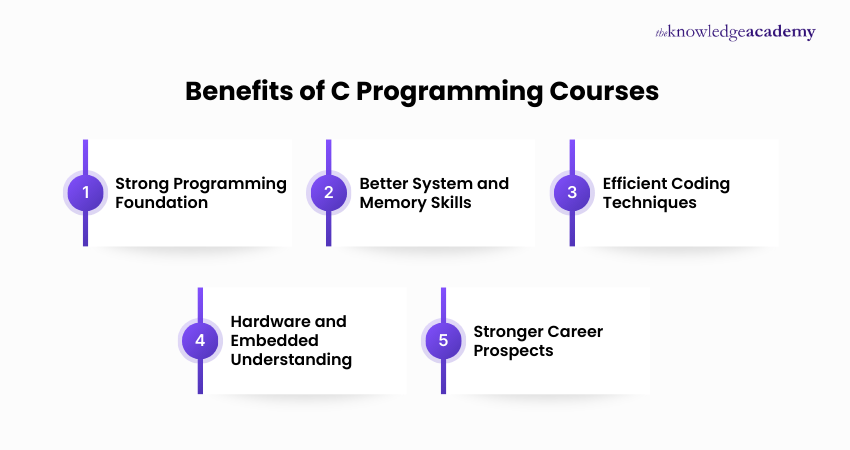
Benefits of C Programming Courses

  • Strong Programming Foundation: Build a solid understanding of essential programming concepts that underpin many modern languages and systems.
  • Better System and Memory Skills: Develop deeper insight into system architecture and memory management, helping learners to write more efficient and reliable programmes.
  • Efficient Coding Techniques: Learn techniques for writing optimised, performance-focused code suitable for demanding applications.
  • Hardware and Embedded Understanding: Gain awareness of how software interfaces with hardware, which is especially useful for embedded systems and IoT development.
  • Stronger Career Prospects: Open pathways into roles in software development, systems programming and game development where C remains highly valued.
Show more blue-arrow

C Programming FAQs

There hasn't been any questions asked about this Topic

Please see our available in Uganda

The Knowledge Academy is one of the Leading global training provider for .

The training fees for in Uganda starts from $3539

Show more down

Why we're the go to training provider for you

icon

Best price in the industry

You won't find better value in the marketplace. If you do find a lower price, we will beat it.

icon

Trusted & Approved

Recognised by leading certification bodies, we deliver training you can trust.

icon

Many delivery methods

Flexible delivery methods are available depending on your learning style.

icon

High quality resources

Resources are included for a comprehensive learning experience.

barclays Logo
deloitte Logo
Thames Water Logo

"Really good course and well organised. Trainer was great with a sense of humour - his experience allowed a free flowing course, structured to help you gain as much information & relevant experience whilst helping prepare you for the exam"

Joshua Davies, Thames Water

santander logo
bmw Logo
Google Logo

Looking for more information on C Programming

cross

Exclusive Deals Big Savings This March!

Grab up to 40% OFF and level up your skills this spring! march-madness

WHO WILL BE FUNDING THE COURSE?

close

close

Thank you for your enquiry!

One of our training experts will be in touch shortly to go over your training requirements.

close

close

Press esc to close

close close

Back to course information

Thank you for your enquiry!

One of our training experts will be in touch shortly to go overy your training requirements.

close close

Thank you for your enquiry!

One of our training experts will be in touch shortly to go over your training requirements.