
Animation and Design Training

Online Instructor-led (1 days)

Online Self-paced (8 hours)

Animation Course Outline

Module 1: Animate CC Interface

  • Getting Started
  • Creating a New Animate CC Document
  • Exploring the Panels in the Animate CC Interface
  • Using Layers

Module 2: Graphics in Animate CC

  • Tools Panel
  • Selection and Subselection Tools
  • Drawing in Animate CC
  • Pencil Tool
  • Paint Brush Tool
  • Brush Tool
  • Eraser Tool
  • Pen Tool
  • Working with Colour in Animate CC

Module 3: Symbols

  • Symbol Essentials
  • Symbol Types

Module 4: Audio and Video in Animate CC

  • Animate CC and Audio Formats
  • Adding Audio to Animate CC
  • How to Add a Video in Animate?

Module 5: Animation and Fonts in Animate CC

  • Shape Tweening
  • Classic Tweening
  • Using Animation
  • Working with Web Fonts from Adobe Fonts

Module 6: UI Components

  • Building Content with UI Components
    • Working with ActionScript 3.0 UI Components
    • Skinning ActionScript 3.0 Components
    • Steps to Work with Component Button
  • Assembling the UI Components

Show moredown

Who Should Attend this Animation Course?

The Animation Course is designed for aspiring animators, multimedia artists, storytellers, and individuals passionate about bringing characters and scenes to life through animation. The following professionals can greatly benefit from attending this course:

  • Animators
  • Multimedia Artists
  • Web Designers
  • 3D Artists
  • Graphic Designers
  • App developers
  • Game Developers
  • Marketing Professionals

Prerequisites for the Animation Course

There are no formal prerequisites for this Animation Course.

Animation Course Overview

Animation Training introduces delegates to study Animation and design principles used across modern creative industries. It focuses on visual storytelling, character development, motion design, and animation techniques for professional content creation.

Upskilling in Animation enhances creative capability and opens opportunities across media, marketing, and digital content roles. Delegates strengthen visual communication skills, improve creativity, and gain confidence in producing compelling animated visuals.

This 1-Day Animation Course offered by The Knowledge Academy supports delegates in applying animation principles confidently in real-world scenarios. Delegates gain practical insight to create engaging animated content that supports creative projects and long-term career growth.

Animation Course Objectives

  • To introduce the foundational concepts of animation and design
  • To enhance skills in various animation design software
  • To integrate artistic and technical aspects in project work
  • To provide insights into current industry practices and trends
  • To prepare delegates for professional challenges in animation

Upon completion, delegates will have gained a robust understanding of animation principles, software proficiency, and creative techniques. This foundation will enable them to apply their skills across various sectors, innovating and enhancing digital content with their newfound expertise in animation and design.

Show moredown

What’s Included in this Animation Course?

  • World-Class Training Sessions from Experienced Instructors
  • Animation Certificate
  • Digital Delegate Pack

Show moredown

Online Instructor-led (1 days)

Online Self-paced (8 hours)

Articulate Storyline Training Course Outline

Module 1: Getting Started with Storyline

  • Introduction to Articulate Storyline and Its Features
  • Navigating the Storyline Interface
  • Understanding Stories, Scenes, and Slides
  • Creating, Opening, and Saving Projects
  • Importing Content (PowerPoint, Templates, and Media)

Module 2: Building and Customising Slides

  • Adding and Managing Slides
  • Using Slide Masters and Layouts
  • Working with Text, Shapes, and Images
  • Applying Themes, Backgrounds, and Design Styles
  • Formatting and Aligning Objects

Module 3: Interactivity and Navigation

  • Adding Buttons, Hotspots, and Markers
  • Using Triggers to Create Interactive Elements
  • Understanding Object States and Motion Paths
  • Creating Branching Scenarios and Conditional Navigation

Module 4: Multimedia and Screen Recordings

  • Adding and Editing Audio and Video
  • Recording and Importing Screen Recordings
  • Creating Software Simulations and Tutorials
  • Syncing Audio and Animations for Better Engagement

Module 5: Assessments and Advanced Interactions

  • Creating Quiz Slides (Multiple Choice, Drag-and-Drop, Fill-in-the-Blank)
  • Customising Quiz Feedback and Scoring Options
  • Understanding Variables and Conditions for Dynamic Interactions
  • Using Data Entry and Personalisation Techniques

Module 6: Publishing and Accessibility

  • Customising the Player and Navigation Settings
  • Publishing for Web, LMS, SCORM, and xAPI
  • Ensuring Accessibility (Alt Text, Tab Order, and Screen Reader Support)
  • Testing and Debugging Published Courses

Show moredown

Who Should Attend this Articulate Storyline Training?

This Articulate Storyline Training is an in-depth course designed to equip delegates with advanced skills and expertise in using Articulate Storyline, a leading e-learning authoring tool. This course is useful for the following professionals:

  • E-Learning Developers
  • Instructional Designers
  • Trainers
  • Educators
  • Content Creator
  • Learning and Development Specialists
  • Business Intelligence Professionals

Prerequisites of the Articulate Storyline Training

There are no formal prerequisites for the Articulate Storyline Training. However, a basic understanding of e-learning and interactive designing can be beneficial.

Articulate Storyline Training Overview

Articulate Storyline focuses on creating interactive and engaging eLearning content using one of the industry’s leading authoring tools. This course covers slide-based design, triggers, and multimedia.

Upskilling in Articulate Storyline strengthens instructional design, creativity, and technical development skills. Delegates gain the ability to design responsive interactions, assessments, and scenarios that enhance learner engagement and knowledge retention.

This 1-Day Articulate Storyline Training Course offered by The Knowledge Academy provides practical guidance on building, publishing, and managing Storyline projects.

Articulate Storyline Training Course Objectives

  • To understand the fundamentals of Articulate Storyline
  • To create interactive eLearning modules
  • To incorporate quizzes, assessments, and multimedia
  • To design courses using templates and custom elements
  • To publish content for various platforms
  • To enhance learner engagement through interactive design

Upon completion of this Articulate Storyline Training, delegates will not only have a thorough understanding of Articulate Storyline but also be equipped with practical skills. This course is an investment in their professional growth, enabling them to create compelling and effective e-learning modules.

Show moredown

What’s Included in this Articulate Storyline Training?

  • World-class Training Sessions from Experienced Instructors
  • Articulate Storyline Certificate
  • Digital Delegate Pack

Show moredown

Online Instructor-led (1 days)

Online Self-paced (8 hours)

Maxon Cinema 4D Training Course Outline

Module 1: Basics of Maxon Cinema 4D

  • Introduction
  • Navigating the Interface
  • Customising the Workspace
  • Setting Up a Project

Module 2: Modelling Objects

  • Modelling Basics
  • NURBS
  • Splines
  • Polygon Tools
  • Importing Paths from Adobe Illustrator

Module 3: Adding Textures

  • Choosing the Correct File Format
  • Choosing Materials
  • Using Shaders
  • Reflection and Transparency Effects
  • Area Lights and Shadows
  • Ambient Occlusion Automatic Shadows

Module 4: Animation

  • Animation Basics
  • Creating Motion Paths
  • Camera Animations

Module 5: Rendering Your Model

  • 3D Rendering
  • Choosing Rendering Settings
  • Customising Lighting and Shadows

Show moredown

Who Should Attend this Maxon Cinema 4D Training?

The Maxon Cinema 4D Course is designed for individuals seeking to elevate their skills in using Maxon Cinema 4D, a versatile 3D modelling and animation software. The following professionals can greatly benefit from attending this course:

  • Motion Graphics Designers
  • Visual Effects Artists
  • 3D Artists
  • Graphic Designers
  • Engineers
  • Video Game Designers
  • Marketing Professionals
  • Animators

Prerequisites of the Maxon Cinema 4D Training

There are no formal prerequisites for this Maxon Cinema 4D Course. However, familiarity with CAD and 3D modelling can be beneficial for the delegates.

Maxon Cinema 4D Training Course Overview

The Maxon Cinema 4D Course familiarises you with cutting-edge techniques in 3D modelling, animation, and Rendering. It covers essential tools for making passionate visual content, including motion graphics and realistic simulations.

This training offers valuable insights into creating high-quality 3D animations with creativity. It improves design precision, visual storytelling, and rendering speed. The course also supports creative experimentation and elevates delegates to high professional standards.

The Knowledge Academy’s 1-Day Animation Training equips delegates with practical skills and insights. This intensive design provides an in-depth dive into fundamental concepts while maximising learning in a quick timeframe.

Maxon Cinema 4D Training Course Objectives

  • To introduce the fundamentals of Cinema 4D in animation and design
  • To enhance skills in 3D modelling, texturing, and lighting techniques
  • To develop proficiency in animation and rendering workflows
  • To provide insights into real-world applications in various industries
  • To foster creative and technical growth in animation and design

Upon completing this Maxon Cinema 4D Course, delegates will gain a strong understanding of 3D animation and design principles, practical experience with modern tools, and the confidence to apply these skills professionally across Animation Courses and related fields.

Key Principles of Maxon Cinema 4D

Key Principles of Maxon Cinema 4D

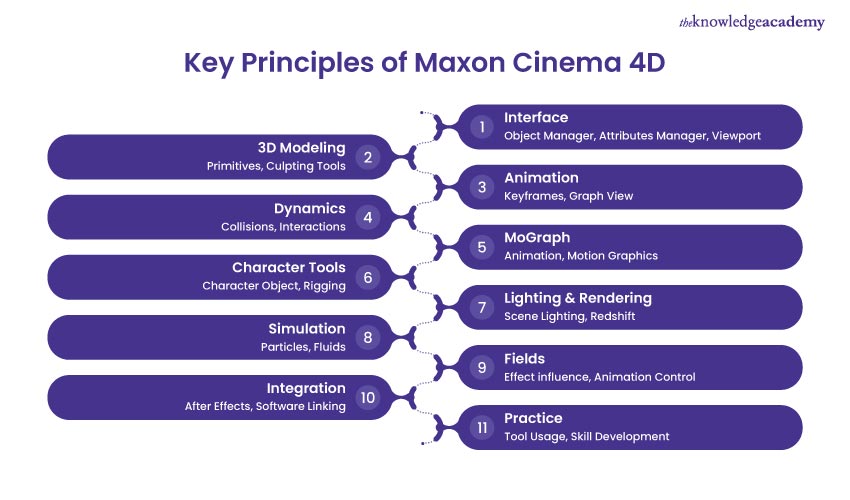
Maxon Cinema 4D is a powerful 3D modelling and animation tool used across design, VFX, and motion graphics industries. Here are the core concepts that professionals and learners alike should understand to fully harness the software's capabilities.

  • Interface: Navigate the Object Manager, Attributes Manager, and Viewport with ease.
  • 3D Modeling: Use primitives, sculpting tools, and mesh techniques to build complex models.
  • Animation: Animate objects using keyframes and manage timing with the Graph View.
  • Dynamics: Simulate realistic collisions and interactive physical behaviour.
  • MoGraph: Create dynamic motion graphics using Cinema 4D’s signature tools.
  • Character Tools: Rig and animate characters with tools like Character Object and advanced rigging systems.
  • Lighting & Rendering: Light scenes effectively and render with tools like Redshift for high-quality visuals.
  • Simulation: Incorporate fluid, smoke, or particle effects for advanced realism.
  • Fields: Control and fine-tune animations using effectors and field systems.
  • Integration: Link Cinema 4D with software like After Effects for seamless post-production.
  • Practice: Build proficiency through consistent tool usage and creative experimentation.

Show moredown

What’s Included in this Maxon Cinema 4D Training?

  • World-Class Training Sessions from Experienced Instructors
  • Maxon Cinema 4D Certificate
  • Digital Delegate Pack

Show moredown

Online Instructor-led (2 days)

Online Self-paced (16 hours)

CorelDRAW Training Course Outline

Module 1: Introduction to CorelDRAW

  • What is CorelDRAW?
  • CorelDRAW Workspace
  • Basics of CorelDRAW
    • Vector Graphics and Bitmaps
    • Starting and Opening Drawings
    • Previewing Drawings
    • Viewing Modes
    • Saving and Closing Drawings
  • Creative Tools and Content
  • Touchscreen and Wheel Devices

Module 2: Lines, Shapes, and Outlines

  • Lines, Outlines, and Brushstrokes
  • Shapes and Shape Objects
  • Symmetrical Drawing

Module 3: Working with Objects, Symbols, and Layers

  • Introduction to Objects
  • Linking Pages
  • Embedding Objects
  • Layers and Symbols
  • Tracking Projects

Module 4: Colour, Fills, and Transparencies

  • Colour
    • Colour Models and Depth
    • Choosing Colours
    • Creating and Editing Colour Palettes
  • Fills
    • Uniform Fills and Fountain Fills
    • Vector and Bitmap Pattern Fills

Module 5: Exploring Special Effects

  • Lenses
  • Adding 3D Effects
  • Mosaics
  • Export Bitmaps for the Web

Module 6: Working with Text

  • Formatting Text
  • Managing Fonts
  • Writing Tools

Module 7: Templates and Styles

  • Templates
    • Using and Finding Templates
    • To Finding Templates
    • Managing Templates
    • Creating and Editing Templates

Module 8: Pages and Layout

  • Pages and Layout Tools
    • Page Layout and Background
    • Selecting the Page Background
    • Adding and Deleting Pages
  • Tables
    • Adding Tables
    • Selecting and Moving Table Components
    • Inserting and Deleting Table Rows and Columns
    • Inserting Data

Module 9: File Formats

  • Importing a Files
  • Exporting to PDF
  • Supported File Formats

Module 10: Customising and Automating

  • Setting Basic Preferences
    • Disabling Warning Messages
    • Viewing System Information
  • Customizing CorelDRAW

Show moredown

Who Should Attend this CorelDRAW Training Course?

This CorelDRAW Course is designed for Graphic Designers, Illustrators, Artists, and individuals interested in creating digital graphics and designs. This training is essential for individuals seeking to develop their skills in using CorelDRAW, a powerful vector graphics software. The following professionals can greatly benefit from attending this course:

  • Graphic Designers
  • Illustrators
  • Digital Artists
  • Print Designers
  • Animators
  • Multimedia Artists
  • App Developers
  • Marketing and Advertising Professionals

Prerequisites of the CorelDRAW Training Course

There are no formal prerequisites for this CorelDRAW Course. However, familiarity with graphic designing can be beneficial for the delegates.

CorelDRAW Training Course Overview

CorelDRAW, a pivotal tool that stands at the forefront of digital creativity and communication. It is a vector graphics editor used for creating vector illustrations. CorelDRAW has many advanced tools that can be used for creating artwork or professional projects.

This CorelDRAW Course is crucial for professionals in Graphic Design Animation and Animation Design Course fields. It's particularly vital for those involved in Design Animation, Game Design Courses, and Graphic Animation Courses, as it enhances their creative repertoire and marketability.

The Knowledge Academy's 2-day CorelDRAW Training enriches delegates from Animation Training backgrounds. Delegates will be equipped with the skills to work with different colour palettes and make use of object transparency. It provides practical skills, industry insights, and a deeper understanding of design principles, elevating their proficiency in this powerful software.

CorelDRAW Training Course Objectives

  • To introduce CorelDRAW's interface and tools
  • To explore vector graphic creation and manipulation
  • To enhance skills in layout, typography, and colour theory
  • To apply CorelDRAW in practical design scenarios
  • To develop proficiency for professional application in various design fields

Upon completion of this CorelDRAW Course, delegates will have acquired a comprehensive skill set in CorelDRAW, enabling them to create sophisticated designs and illustrations. This training not only sharpens their technical abilities but also broadens their creative horizons in the dynamic field of design and animation.

Show moredown

What’s included in this CorelDRAW Training?

  • World-Class Training Sessions from Experienced Instructors
  • CorelDRAW Certificate
  • Digital Delegate Pack

Show moredown

Online Instructor-led (1 days)

Online Self-paced (8 hours)

GIMP Training Course Outline

Module 1: Introduction to GIMP

  • Introduction to GIMP – Overview and Capabilities
  • Key Features and Benefits
  • Downloading and Installing GIMP
  • Understanding the GIMP Interface 
  • Navigating the Canvas 
  • Creating, Opening, and Saving Images
  • File Formats Supported in GIMP
  • Exporting and Importing Files
  • Hands on: Setting Up Your First GIMP Project

Module 2: Basic Tools and Image Operations 

  • Introduction to Basic Image Editing Tools  
  • Selection Tools Overview
  • Making Precise Selections in GIMP  
  • Transform Tools Overview
  • Using Crop, Resize, and Canvas Adjustment  
  • Painting Tools: Brush, Pencil, Airbrush, Ink
  • Filling Tools: Bucket Fill and Gradient  
  • Paths Tool: Creating and Editing Paths  
  • Aligning and Distributing Elements
  • Using the Text Tool
  • Undo, Redo, and Working with History  
  • Editing a Basic Image Using Selection and Transformation Tools 

Module 3: Working with Layers and Masks

  • Understanding Layers
  • Creating, Duplicating, and Deleting Layers
  • Layer Modes: Blending Options
  • Step by Step: Using Blending Modes
  • Introduction to Layer Masks
  • Applying Layer Masks
  • Grouping, Merging, and Organising Layers
  • Using Adjustment Layers
  • Creating a Multi-Layer Composition
  • Designing a Simple Poster
  • Troubleshooting Common Layer Issues

Module 4: Color Adjustments and Image Retouching

  • Introduction to Color Adjustments    
  • Adjusting Brightness, Contrast, and Exposure    
  • Working with Levels and Curves    
  • Hue, Saturation, and Color Balance Adjustments    
  • Selective Color Adjustments  
  • Retouching Tools Overview    
  • Removing Blemishes and Skin Retouching    
  • Dodge and Burn Tools for Light and Shadow    
  • Noise Reduction and Sharpening Techniques    
  • Changing Backgrounds Using Precise Selections    
  • Exercise: Retouching a Portrait Image    

Module 5: Filters, Effects, and Advanced Editing

  • Introduction to Filters and Effects    
  • Applying Blur, Sharpen, and Noise Filters   
  • Artistic Filters
  • Adding Light and Shadow Effects    
  • Applying Texture Effects    
  • Simulating Photo Effects    
  • Customising and Stacking Filters    
  • Creating a Double Exposure Effect    
  • Exercise: Applying Artistic Filters    
  • Troubleshooting Common Issues with Filters    
  • Best Practices for Creative Editing

Module 6: Advanced Image Compositing and Text Effects

  • Understanding Non-Destructive Editing    
  • Creating Multi-Layer Compositions    
  • Using Layer Masks for Seamless Compositing    
  • Working with Paths and Custom Shapes    
  • Advanced Text Effects: Outlines, Shadows, and Warping    
  • Creating and Editing Custom Brushes    
  • Designing Posters, Flyers, and Social Media Graphics    
  • Introduction to Animation in GIMP    
  • Exercise: Creating a Digital Artwork    
  • Common Mistakes in Graphic Design   
  • Industry Applications of GIMP for Designers 

Module 7: Exporting, Optimisation, and File Management

  • Understanding Image Formats    
  • Exporting High Quality Images 
  • Optimising Images for Faster Web Loading    
  • Automating Tasks
  • Exercise: Exporting and Optimising a Web Banner 
  • Best Practices for File Management and Workflow Efficiency 

Show moredown

Who Should Attend this GIMP Course?

The GIMP Course is designed for photographers, graphic designers, digital artists, and individuals interested in image editing and manipulation. This training is essential for individuals seeking to enhance their skills in using GIMP (GNU Image Manipulation Program), a versatile and free image editing software. The following professionals can greatly benefit from attending this course:

  • Photographers
  • Graphic Designers
  • Digital Artists
  • Web Designers
  • Animators
  • App Developers
  • Product Designers
  • Marketing Professionals

Prerequisites of the GIMP Training Course

There are no formal prerequisites for this GIMP Training Course. However, familiarity with graphic  design can be beneficial for the delegates.

GIMP Training Course Overview

GIMP Training equips delegates with the skills to create, edit, and enhance digital images using the GIMP image editing software. The training focuses on photo editing tools, layers, colour adjustments, and graphic design techniques for producing high-quality visuals.

Upskilling in GIMP strengthens image editing and visual design capabilities. Delegates improve creative editing skills, enhance image quality, and gain confidence in producing professional-looking graphics and photographs.

This 1-Day course offered by The Knowledge Academy provides hands-on guidance in using GIMP effectively. Delegates learn through practical exercises and real examples to confidently edit, retouch, and create digital images.

GIMP Training Course Objectives

  • To introduce the basics of GIMP and its interface
  • To enhance skills in image manipulation and editing
  • To explore creative graphic design techniques
  • To impart knowledge in animation basics within GIMP
  • To develop proficiency in GIMP for professional use

Upon completion of GIMP Training, delegates will possess a comprehensive understanding of GIMP’s capabilities, enabling them to apply their skills in various Animation and Design Courses. They will be equipped to create sophisticated digital artwork, enhance images, and develop basic animations, significantly contributing to their professional growth in the field of digital design and animation.

Show moredown

What’s Included in this GIMP Course?

  • World-Class Training Sessions from Experienced Instructors
  • GIMP Certificate
  • Digital Delegate Pack

Show moredown

Online Instructor-led (1 days)

Online Self-paced (8 hours)

Introduction to QuarkXPress​ Course Outline

Module 1: QuarkXPress User Interface

  • Tools
  • Menus
  • Context Menus
  • Palettes
  • Layout Controls
  • Views and View Sets

Module 2: Projects and Layouts

  • Working with Projects
  • Working with Layouts and Guides
  • Undoing and Redoing Actions

Module 3: Content Variables

  • Edit Content Variables
  • Create Custom Content Variable
  • Insert Content Variable

Module 4: Boxes, Lines, and Tables

  • Understanding Items and Content
  • Basics of Handles
  • Boxes and Lines
  • Manipulating Items
  • Working with Callouts and Tables

Module 5: Text and Typography

  • Editing, Importing, and Exporting Text
  • Working with Footnotes and Endnotes
  • Applying Character and Paragraph Attributes
  • Text Shading
  • Control Kerning, Hyphenation, Justification, and Tracking
  • Working with Style Sheets and Conditional Styles
  • Bullets and Numbering
  • Position Text in Text Boxes
  • Using Text Run-around and Anchored Boxes
  • Working with Design Grid and Rubi Text
  • Introduction to Hanging Characters
  • Mojigumi Sets and Classes

Module 6: Pictures

  • Working with Pictures
  • Clipping Paths
  • Alpha Masks
  • PSD Pictures

Module 7: Colour, Opacity, and Drop Shadows

  • Working with Colours and Opacity
  • Colour Management
  • Drop Shadows

Module 8: Custom Bleeds and Item Styles

  • Use Custom Bleeds
  • Use Clips at Bleed Edge
  • Use Item Style Palette
  • Create Item Style

Module 9: Document Construction

  • Use Automatic Page Numbering
  • Working with Master Pages
  • Layers, Lists, Indexes, Books, and Libraries
  • Guides Palette

Module 10: Collaboration and Single-Sourcing

  • Working with Shared Content
  • Composition Zones
  • Placing a Composition Zones Item

Show moredown

Who Should Attend this Introduction to QuarkXPress Course?

The Introduction to QuarkXPress Training Course is designed for graphic designers, layout artists, publishing professionals, and individuals interested in desktop publishing and layout design. This course is essential for individuals seeking to learn the fundamentals of using QuarkXPress, a powerful desktop publishing software. The following professionals can greatly benefit from attending this course:

  • Graphic Designers
  • Layout Artists
  • Web Designers
  • Technical writers
  • Publishing Professionals
  • Print Designers
  • Marketing and Communication Specialists

Prerequisites of the Introduction to QuarkXPress Course

There are no formal prerequisites for this Introduction to QuarkXPress Training Course.

Introduction to QuarkXPress Course Overview

Introduction to QuarkXPress Training equips delegates with the skills to create professional page layouts using QuarkXPress. The training focuses on layout design, typography, image placement, and document formatting for producing high-quality print and digital publications.

Upskilling in QuarkXPress strengthens desktop publishing and graphic design capability. Delegates improve layout design skills, enhance visual presentation techniques, and gain confidence in creating polished publication materials.

This 1-Day course offered by The Knowledge Academy provides hands-on guidance in using QuarkXPress effectively. Delegates learn through practical exercises and examples to confidently design and format professional page layouts.

Introduction to QuarkXPress Course Objectives

  • To provide an in-depth understanding of QuarkXPress fundamentals
  • To enhance skills in layout design and text formatting
  • To facilitate proficiency in digital publishing techniques
  • To develop expertise in integrating graphics and text creatively
  • To empower learners with the ability to produce professional-grade design work

Upon completion of this course, delegates will have a clear understanding of the QuarkXPress interface and essential publishing tools. They will be able to create, format, and manage professional page layouts for print and digital publishing projects.

Show moredown

What’s Included in this Introduction to QuarkXPress Course?

  • World-Class Training Sessions from Experienced Instructors
  • Introduction to QuarkXPress Certificate
  • Digital Delegate Pack

Show moredown

Online Instructor-led (1 days)

Online Self-paced (8 hours)

Inkscape Training Course Outline

Module 1: Introduction to Inkscape

  • Panning the Canvas
  • Zooming in or Out
  • Inkscape Tools
  • Create and Manage Documents
  • Create Shapes
  • Moving, Scaling, and Rotating
  • Transforming by Keys
  • Multiple Selections
  • Grouping
  • Fill and Stroke
  • Duplication, Alignment, and Distribution
  • Z-Order
  • Selecting Under and Dragging Selected

Module 2: Working with Shapes

  • Rectangles
  • Ellipses
  • Stars
  • Spirals

Module 3: Advanced Concepts of Inkscape

  • Pasting Techniques
  • Draw Freehand and Regular Paths
  • Edit Paths
  • Subpaths and Combining
  • Converting to Path
  • Boolean Operations
  • Inset and Outset
  • Simplification
  • Create Text

Module 4: Overview of Tracing

  • Tracing Bitmaps
  • Tracing Pixel Art.

Module 5: Introduction to Calligraphy

  • Hardware
  • Calligraphy Tool Options
  • Width and Thinning
  • Angle and Fixation
  • Tremor
  • Wiggle and Mass

Module 6: Introduction to Interpolate

  • Interpolation Between Two Identical and Different Paths
  • Interpolation Method
  • Exponent
  • Interpolate Style
  • Using Interpolate to Fake Irregular-Shaped Gradients

Module 7: Exploring Elements of Design

  • Elements of Design
  • Principles of Design

Show moredown

Who Should Attend this Inkscape Training Course?

The Inkscape Course is designed for graphic designers, illustrators, artists, and individuals interested in vector graphics and digital illustration. This training is essential for individuals seeking to develop their skills in using Inkscape, a free and open-source vector graphics software. The following professionals can greatly benefit from attending this training course:

  • Graphic Designers
  • Illustrators
  • Digital Artists
  • Logo Designers
  • Web Designers
  • App Developers
  • Product Designers
  • Animators

Prerequisites of the Inkscape Training Course

There are no formal prerequisites for this Inkscape Course. However, familiarity with graphic design can be beneficial for the delegates.

Inkscape Training Overview

Inkscape Training equips delegates with the skills to create and edit vector graphics using Inkscape. The training focuses on drawing tools, shapes, paths, text handling, and design techniques used to produce scalable graphics for digital and print media.

Upskilling in Inkscape strengthens visual design capability and supports creative and marketing roles. Delegates improve graphic design skills, enhance visual communication, and gain confidence in producing professional-quality vector illustrations.

This 1-Day course offered by The Knowledge Academy provides hands-on guidance in using Inkscape effectively. Delegates learn through practical exercises and examples to confidently design, edit, and export high-quality vector graphics.

Inkscape Training Course Objectives

  • To introduce the foundational elements of Inkscape and its interface
  • To develop skills in creating and manipulating vector graphics
  • To explore advanced features for complex design tasks
  • To enhance understanding of integration with other design software
  • To equip delegates with practical, project based Inkscape skills

Upon completion, delegates will possess a robust understanding of Inkscape, enabling them to efficiently produce high-quality vector graphics. This newfound expertise will significantly augment their capabilities in the fields of animation and graphic design, positioning them favourably within the dynamic digital media industry.

Show moredown

What’s Included in this Inkscape Course?

  • World-Class Training Sessions from Experienced Instructors
  • Inkscape Course Certificate
  • Digital Delegate Pack

Show moredown

Online Instructor-led (1 days)

Online Self-paced (8 hours)

Logo Design Course Outline

Module 1: Introduction to Logo

  • What is Logo?
  • Purpose of a Logo
  • Importance of Logo
  • Most Important Logo Elements
  • Different Logo Uses

Module 2: Types of Logo Design

  • Wordmark Logos
  • Monogram Logos
  • Abstract Logo Marks
  • Mascots Logos
  • Emblem Logos

Module 3: Elements of Iconic Design

  • Make it Simple and Relevant
  • Incorporate Tradition
  • Aim for Distinction
  • Commit to Memory
  • Focus on One Thing

Module 4: Laying the Groundwork

  • Getting Preliminary Information
  • Amazing Ways to Get a New Logo Design
  • Principles of Logo Design
  • Goals for Small Business Logo Design
  • Pro Research and Development Logos

Module 5: Pricing Design

  • What to Expect When Paying for a Logo?
  • Clients Choose Who Will Design Their Logo
  • Determining Minimum Level of Engagement for Logo Design Pricing
  • Logo Design Pricing Model
  • Talk Price with Clients
  • Price Anchoring
  • Price Bracketing
  • Raise Logo Design Pricing

Module 6: Logo Design Tips

  • Know the Brand
  • Reflects Nature of Business
  • Make Sketches
  • Get Inspiration
  • Pick Design Style
  • Make it Stand Out
  • Use Colours in a Planned Way
  • Pick Fonts Carefully
  • Think of Using Negative Space
  • Get Feedback

Show moredown

Who Should Attend this Logo Design Course?

This Logo Design Training Course is designed for individuals interested in creating impactful and memorable logos. This training is essential for individuals seeking to master the art of Logo Design and develop their visual communication skills. The following professionals can greatly benefit from attending this training:

  • Graphic Designers
  • Illustrators
  • Digital Artists
  • Logo Designers
  • Web Designers
  • App Developers
  • Product Designers
  • Animators

Prerequisites of the Logo Design Course

There are no formal prerequisites for this Logo Designing Course. However, familiarity with graphic designing can be beneficial for the delegates.

Logo Design Course Overview

Logo Design is the process of creating a unique visual symbol that represents a brand’s identity, values, and purpose. It combines typography, colour, and imagery to make a lasting impression and build recognition.

Upskilling is essential to stay competitive in a rapidly evolving job market driven by technology and innovation. It helps professionals enhance their knowledge, adapt to new roles, and achieve long-term career growth.

The Knowledge Academy’s 1-day training in Logo Design in the United Kingdom provides practical skills and industry insights. This intensive session focuses on logo creation with creativity and industry insights.

Logo Design Course Objectives

  • To understand the fundamentals of Logo Design and brand identity
  • To develop skills in using design software and tools
  • To enhance creativity and conceptual thinking
  • To learn about current trends in Logo Design
  • To apply theoretical knowledge in practical, real-world projects

Upon course completion, delegates will have gained a thorough understanding of Logo Design principles, practical skills in design software, and the ability to create visually engaging and effective logos. This training is a stepping stone to becoming proficient in the dynamic field of Logo Design.

Show moredown

What’s Included in this Logo Design Course?

  • World-Class Training Sessions from Experienced Instructors
  • Logo Design Certificate
  • Digital Delegate Pack

Show moredown

Online Instructor-led (1 days)

Online Self-paced (8 hours)

Sketchbook Essential Training Course Outline

Module 1: Get Started with Sketchbook

  • Introduction to SketchBook
  • Advantages of Digital Sketching

Module 2: Learning the Interface and Tools

  • Interface Overview
  • Exploring
    • File and Edit Menus
    • Image Menu

Module 3: Working with Colours in Sketchbook Pro

  • Working with the Colour and Brush Pucks
  • Introduction to System Programming
  • Understanding the Colour Editor
  • Introducing Copic Markers
  • Utilising the Copic Library

Module 4: Understanding Brushes and their Properties

  • Understanding Brushes
  • Brush Palette Fundamentals
  • Modifying Brush Properties
  • Workflow with Synthetic Brushes

Module 5: Working with Layers

  • Understanding Layers
  • Layers
    • Adding
    • Deleting
    • Locking

Module 6: Learning the Interface: Toolbar and Lagoon

  • Introducing Transform and Select
  • Manipulating Flood Fill
  • Working with Crop and Adding Text
  • Ruler, Ellipse, and French Curves Tools
  • Creating Perspective
  • Working with Symmetry
  • Utilising the Steady Stroke and Shape Tools
  • Understanding the Lagoon

Module 7: Customising Sketchbook

  • Creating Do-It-Yourself Brushes
  • Working with Brush Sets
  • Creating Custom Icons

Module 8: Typical Workflow

  • Shading Using Grayscale

Module 9: Blend Modes and Exporting Images

  • Introducing Blend Modes
  • Options
    • Darken
    • Lighten
  • Blend Modes
    • Contrast
    • Colour Glow
    • Soft Glow

Show moredown

Who Should Attend this Sketchbook Essential Training Course?

The Sketchbook Essential Training Course is designed for artists, illustrators, designers, and individuals interested in digital drawing and illustration. This training is essential for individuals seeking to enhance their digital art skills and unleash their creativity using Autodesk SketchBook, a versatile digital drawing software. The following professionals can greatly benefit from attending this training:

  • Graphic Designers
  • Illustrators
  • Digital Artists
  • Concept Artists
  • Web Designers
  • App Developers
  • Product Designers
  • Animators

Prerequisites of the Sketchbook Essential Training Course

There are no formal prerequisites for this Sketchbook Essential Training Course.

Sketchbook Essential Training Course Overview

Sketchbook Essential Training is a cornerstone in the realm of Animation Courses, catering to the growing demand for artistic expertise in the digital age. Its relevance extends across various creative fields, harnessing the power of visual storytelling and conceptual design.

Understanding Sketchbook is crucial for professionals in the Animation Course and Graphic Design Courses. It's especially beneficial for those in Animation and Game Design Courses, equipping them with the skills needed to bring imaginative concepts to life in a dynamic industry.

This 1-Day training by the Knowledge Academy is designed to enhance the skills of delegates in the Design Training landscape. Delegates will gain practical knowledge and hands-on experience, crucial for excelling in Design Animation and Graphic Design Animation.

Sketchbook Essential Training Course Objectives

  • To introduce the fundamental principles of sketchbook techniques
  • To enhance creativity and conceptual thinking in design
  • To provide hands-on experience with various sketching tools
  • To develop a strong foundation for advanced animation and design projects
  • To bridge the gap between traditional art skills and digital design

Upon completion, delegates will possess a comprehensive understanding of Sketchbook tools and techniques. They will be equipped to apply their enhanced skills in various Design Courses, contributing significantly to creative projects and professional advancements.

Show moredown

What’s Included in this Sketchbook Essential Course?

  • World-Class Training Sessions from Experienced Instructors
  • Sketchbook Essential Certificate
  • Digital Delegate Pack

Show moredown

Online Instructor-led (1 days)

Online Self-paced (8 hours)

Design Patterns Training Course Outline

Module 1: Introduction to Design Patterns

  • Design Patterns
  • Pattern Description
  • Usage of Design Patterns
  • Types of Design Patterns
  • Benefits

Module 2: Creational Design Patterns

  • Abstract Factory
  • Builder
  • Factory Method
  • Object Pool
  • Prototype
  • Singleton

Module 3: Structural Design Patterns

  • Adapter
  • Bridge
  • Composite
  • Decorator
  • Façade
  • Flyweight
  • Private Class Data
  • Proxy

Module 4: Behavioural Design Patterns

  • Chain of responsibility
  • Command
  • Interpreter
  • Iterator
  • Mediator
  • Memento
  • Null Object
  • Observer
  • State
  • Strategy
  • Template Method
  • Visitor

Module 5: Concurrency Design Patterns

  • Introduction
  • Benefits
  • Active Object
  • Balking
  • Messaging Design Pattern
  • Double-Checked Locking
  • Event-Based Asynchronous
  • Guarded Suspension
  • Lock
  • Monitor Object
  • Reactor
  • Read-Write Lock
  • Scheduler
  • Thread Pool
  • Thread-Specific Storage

Module 6: AntiPatterns

  • What is AntiPattern?
  • Software Development AntiPatterns
  • Software Architecture AntiPatterns
  • Software Project Management AntiPatterns

Module 7: Refactoring

  • Bad Code Smells
  • Techniques

Show moredown

Who Should Attend this Design Patterns Training Course?

The Design Patterns Training Course is designed for software developers, programmers, and individuals involved in software design and architecture. This training is essential for individuals seeking to understand and apply design patterns to create modular, maintainable, and efficient software solutions. The following professionals can greatly benefit from attending this training course:

  • Software Developers
  • Software Engineers
  • System Architects
  • Technical Leads
  • QA Engineers
  • DevOps Engineers
  • Systems Engineers
  • Data Scientists

Prerequisites of the Design Patterns Training Course

There are no formal prerequisites for this Design Patterns Course. However, familiarity with Object-Oriented Programming (OOP) can be beneficial for the delegates.

Design Patterns Training Course Overview

Design Patterns Training equips delegates with the knowledge to apply proven software design patterns for building scalable and maintainable applications. The training focuses on common design patterns, object-oriented design principles, and structured approaches to solving recurring software design challenges.

Upskilling in design patterns strengthens software development capability and improves code quality. Delegates enhance problem-solving skills, improve application architecture, and gain confidence in designing efficient and reusable software components.

This 1-Day course offered by The Knowledge Academy provides practical guidance in understanding and applying design patterns. Delegates learn through real examples and structured exercises to confidently implement design patterns in software development projects.

Design Patterns Training Course Objectives

  • To introduce the fundamental concepts of design patterns
  • To demonstrate the application of patterns in software design
  • To enhance problem-solving skills in software development
  • To integrate design patterns into existing development processes
  • To prepare professionals for advanced concepts in design and animation

Upon completion, delegates will have a robust understanding of various design patterns, their applications, and their role in software development. This knowledge will empower them in their respective fields, be it in animation, game design, or software architecture, ensuring they are well-equipped to tackle complex design challenges.

Show moredown

What’s Included in this Design Patterns Training Course?

  • World-Class Training Sessions from Experienced Instructors
  • Design Patterns Essential Certificate
  • Digital Delegate Pack

Show moredown

Online Instructor-led (1 days)

Online Self-paced (8 hours)

Essentials of Professional VLSI Design Course Outline

Module 1: Introduction to Digital VLSI Systems Design

  • Evolution of VLSI Systems
  • Applications of VLSI Systems
  • Processor-Based Systems
  • Embedded Systems
  • FPGA Based Systems
  • Reconfigurable Systems Using FPGAs

Module 2: Review of Digital Systems Design 

  • Numbering Systems
  • Twos Complement Addition/Subtraction
  • Boolean Algebra
  • Combination Circuits
  • Arithmetic Logic Unit
  • Digital System Design Using SSI/MSI Components

Module 3: Design of Combinational and Sequential Circuits Using Verilog

  • Introduction to Hardware Design Language
  • Verilog Modeling of Sequential Circuits
  • Coding Organisation

Module 4: Writing a Test Bench for the Design 

  • Modelling a Test Bench
  • Test Bench for Sequential Circuits

Module 5: RTL Coding

  • Separation of Combinational and Sequential
  • Synchronous Logic
  • Synchronous Flip-Flop
  • Realisation of Time Delays
  • RTL Coding Style

Module 6: Simulation of Designs – Modalism Tool 

  • VLSI Design Flow
  • Design Methodology
  • Simulation Using Modalism

Module 7: Power Optimisation and Testing Techniques in VLSI Design

  • Low-Power Design Techniques in VLSI Systems
  • Power Estimation and Analysis in VLSI Designs
  • Static and Dynamic Fault Models in VLSI Testing

Module 8: Arithmetic Circuit Designs

  • Digital Pipelining
  • Partitioning of a Design
  • Signed Adder Design
  • Multiplier

Show moredown

Who Should Attend this Essentials of Professional VLSI Digital Design Course?

The Essentials of Professional VLSI Digital Design Training Course is designed for individuals in the field of Very Large Scale Integration (VLSI) design. This training is essential for individuals seeking to gain a comprehensive understanding of VLSI digital design principles and techniques. The following professionals can greatly benefit from attending this training:

  • VLSI Engineers
  • Digital Designers
  • Hardware Engineers
  • Electronics Engineers
  • FPGA Designers
  • System Architects
  • Test Engineers
  • ASIC Designers

Prerequisites of the Essentials of Professional VLSI Digital Design Course

There are no formal prerequisites for this Essentials of Professional VLSI Digital Design Training Course. However, familiarity with VLSI design can be beneficial for the delegates.

Essentials of Professional VLSI Design Course Overview

Essentials of Professional VLSI Design Training equips delegates with foundational knowledge of Very Large Scale Integration (VLSI) design and semiconductor systems. The training focuses on digital circuit design concepts, VLSI architecture, design flow, and verification techniques used in modern chip development.

Upskilling in VLSI design strengthens technical expertise in semiconductor and electronics engineering. Delegates enhance analytical skills, improve understanding of integrated circuit design processes, and gain confidence in working with VLSI design principles.

This 1-Day course offered by The Knowledge Academy provides practical insight into professional VLSI design practices. Delegates learn through structured examples and guided exercises to confidently understand and apply VLSI design concepts in engineering environments.

Essentials of Professional VLSI Design Course Objectives

  • To understand VLSI system evolution and design principles
  • To master digital system design using Boolean algebra and circuits
  • To develop Verilog coding skills for combinational and sequential circuits
  • To implement and optimise power-efficient digital circuits
  • To design arithmetic circuits using pipelining and partitioning techniques
  • To apply test bench modeling for verifying VLSI designs

After completing this training, delegates will have the skills to design, test, and optimise VLSI systems for real-world applications. They will be able to write Verilog code for both combinational and sequential circuits, and implement efficient power optimisation strategies. Delegates will be proficient in creating arithmetic circuits, including multipliers and signed adders, and using simulation tools to validate and refine their designs.
 

Show moredown

What’s Included in this Essentials of Professional VLSI Digital Design Course?

  • World-Class Training Sessions from Experienced Instructors
  • Essentials of Professional VLSI Digital Design Certificate
  • Digital Delegate Pack

Show moredown

Online Instructor-led (1 days)

Online Self-paced (8 hours)

Video Editing Training Course Outline

Module 1: Introduction to Video Editing

  • What is Video Editing?
  • Goal of Editing
  • Importance of Video Editing
  • Stages of Making a Video

Module 2: Getting Organised

  • Creating a New Project
  • Bins
  • Saving a Project

Module 3: Ingest

  • How to Ingest Video Clips?
  • Media Management

Module 4: Drag and Drop Editing

  • Performing the First Edit
  • Overwriting a Clip onto the Timeline
  • Replacing a Shot in the Timeline

Module 5: Refining the Sequence

  • Moving Segments in the Timeline
  • Deleting Segments from the Timeline Using Extract/Splice-in
  • Automatic Selection of Segment Modes

Module 6: Transition Effects

  • Creating Visual Transition Effect
  • Accessing Effects from the Effects Palette
  • Working with Tracks

Module 7: Assembling and Trimming Dialogue Scene

  • Understanding Trim
  • Using Ripple Trim to Adjust Pacing
  • Maintaining Sync

Module 8: Segment Effects and Other Important Features

  • Stabilising Shaky Footage
  • Using Colour Correction to Improve the Footage
  • Morph Cut
  • Resizing a Shot
  • Using Standard Keyframes
  • Combining Multiple Effects
  • Exporting the Video

Show moredown

Who Should Attend this Video Editing Course?

This Video Editing Training Course is suitable for individuals seeking to enhance their editing skills, whether for personal projects or career advancement. It caters to those eager to explore creative possibilities in video production and storytelling techniques. This course is especially beneficial for the following professionals:

  • Content Creators
  • Social Media Managers
  • Marketing Specialists
  • Film Students
  • YouTubers
  • Educators
  • Graphic Designers
  • Freelance Videographers

Prerequisites of the Video Editing Training Course

There are no formal prerequisites for this Video Editing Training Course. However, basic Video Editing knowledge would be beneficial for the delegates.

Video Editing Training Course Overview

Video Editing Training focuses on the principles and techniques used to create clear, engaging, and professional video content. The training covers editing workflows, visual storytelling, audio integration, and enhancement methods to produce polished video outputs.

This training strengthens creative and technical skills required to edit videos effectively across digital platforms. Delegates build confidence in structuring narratives, refining visuals, and improving audience engagement through practical editing techniques.

This 1-Day Video Editing Course offered by The Knowledge Academy enables delegates to apply video editing skills confidently in real-world projects. Delegates gain hands-on experience with industry-relevant tools, supporting creativity, consistency, and professional video production standards.

Video Editing Training Course Objectives

  • To understand the fundamentals of video editing
  • To navigate video editing software effectively
  • To learn techniques for cutting and trimming footage
  • To enhance videos with sound and visual effects
  • To apply best practices in video production
  • To build a portfolio of edited projects

Upon completing the Video Editing Course, delegates will have the skills necessary to create high-quality video content, enhancing their professional capabilities and increasing their marketability in the digital media landscape.

Show moredown

What’s Included in this Video Editing Course?

  • World-Class Training Sessions from Experienced Instructors
  • Video Editing Certificate
  • Digital Delegate Pack

Show moredown

Online Instructor-led (1 days)

Online Self-paced (8 hours)

Blender Creator Training​ Course Outline

Module 1: Introduction to Blender

  • Overview
  • Features of Blender
  • Blender Installation    

Module 2: User Interface

  • Window System
  • Keymap
  • Interface Controls
  • Tools and Operators

Module 3: Editors

  • 3D Viewport
  • Image and UV Editor
  • Video Sequencer
  • Graph Editor
  • Drivers Editor
  • Non-Linear Animation
  • File and Asset Browser

Module 4: Modelling

  • Meshes
  • Surfaces
  • Metaball
  • Text
  • Volume
  • Empties
  • Modifier
  • Geometry Nodes

Module 5: Animation and Rigging

  • Keyframes
  • Armatures
  • Lattice
  • Constraints
  • Markers
  • Shape Keys
  • Motion Paths

Module 6: Motion, Tracking, and Masking

  • Introduction to Motion Tracking
  • Masking

Module 7: Video Editing

  • Introduction
  • Sequencer
  • Preview

Module 8: Assets, File, and Data Systems

  • Blender File
  • Data-Blocks
  • Libraries
  • Media Formats

Module 9: Importing and Exporting Files

  • Alembic
  • Collada
  • Universal Scene Description
  • Wavefront OBJ
  • STL
  • SVG as Grease Pencil
  • PDF as Grease Pencil

Show moredown

Who Should Attend this Blender Creator Training Course?

The Blender Creator Course is designed for a diverse audience interested in 3D modelling, animation, and visual effects.  The professionals who will benefit from this course are:

  • Graphic Designers
  • Fine Arts
  • VFX Artists
  • Animators
  • 3D Art Hobbyists
  • Content Creators
  • Indie Game Developers

Prerequisites of the Blender Creator Training Course

Before attending the Blender Creator Course, delegates should possess basic computer literacy and familiarity with graphic design principles. Prior experience with any digital art software is beneficial, though not mandatory.

Blender Creator Training Course Overview

Blender Creator Training is an essential part of Design Courses, offering in-depth insights into the dynamic world of 3D modelling and animation. Its relevance spans across various industries, highlighting the critical role of digital creativity in today's technological landscape.

This course is paramount for professionals delving into Design Course, and Animation and Game Design Courses. This Complete Blender Creator Course is particularly beneficial for those in Graphic Design field, equipping them with the skills needed to excel in the rapidly evolving field of digital art and design.

The 1-Day training by the Knowledge Academy maximises the potential of delegates in Design Training. This Complete Blender Creator Course provides hands-on experience, industry insights, and practical skills essential for mastering Blender, a cornerstone tool in animation and design.

Blender Creator Training Course Objectives

  • To introduce the fundamentals of Blender and its interface
  • To enhance skills in 3D modelling and texturing
  • To provide insights into realistic rendering techniques
  • To teach animation principles and character rigging
  • To offer guidance on integrating Blender into professional workflows

Upon completion, delegates will have a thorough understanding of Blender's capabilities, enabling them to produce high-quality animations and designs. They will be well-equipped to apply these skills in various sectors, significantly boosting their professional value and creative expertise.

Show moredown

What’s Included in this Blender Creator Training Course?

  • World-Class Training Sessions from Experienced Instructors
  • Blender Creator Certificate
  • Digital Delegate Pack

Show moredown

Online Instructor-led (1 days)

Online Self-paced (8 hours)

Blender 3D Modelling for Unity Training Course Outline

Module 1: Melding Unity and Blender

  • What is Unity?
  • What is Blender?

Module 2: Gathering Resources

  • Creating Unity Project
  • Using Asset Store

Module 3: Entering the Blender Zone for the First Time

  • Blender Interface
  • Entering the Edit Mode

Module 4: Making Modular Scenery

  • Understanding Modular Level Design
  • Creating Floors
  • Creating a Wall
  • UV Mapping and Materials

Module 5: Adding Fun with Animation

  • Understanding Basic Animation Concepts
  • Introducing Timeline
  • Animating in Blender
  • Creating Animated and Texturing Blastdoors
  • Exporting Goodies

Module 6: Materials, Grids, and Snapping

  • Collecting Great Stuff in Utility
  • Snapping and the Scene Grid

Module 7: Laying Out the Level

  • Adding a Skybox
  • Adding Audio Effects

Module 8: Deploying ProBuilder

  • Introduction to ProBuilder
  • Installing ProBuilder
  • Exploring the ProBuilder Toolbar

Module 9: Animating with Timeline

  • Blender Command Review
  • Prepping for the Marine
  • Modeling the Marine
  • Texturing the Marine
  • Exporting the Marine
  • Advanced Modification in Marine

Show moredown

Who Should Attend this Blender 3D Modelling for Unity Training?

The Blender 3D Modelling for Unity Training is ideal for a range of individuals who want to learn how to create 3D models in Blender and integrate them into Unity, a popular game development platform. Here are the key groups of people who should consider attending this training:

  • Game Developers
  • 3D Artists
  • Unity Developers
  • Virtual Reality (VR) and Augmented Reality (AR) Developers
  • Animation Artists
  • Graphic Designers
  • Product Designers

Prerequisites of the Blender 3D Modelling for Unity Training

There are no formal prerequisites to attend this Blender 3D Modelling for Unity Course.

Blender 3D Modelling for Unity Course Overview

Blender 3D Modelling for Unity Course equips delegates with the skills to create and optimise 3D models using Blender for integration into Unity projects. The training focuses on modelling techniques, asset creation, texturing, and preparing models for use in game development and interactive environments.

Upskilling in Blender and Unity strengthens 3D design capability and expands opportunities in game development and digital media. Delegates enhance creative and technical skills, improving their ability to design and implement high-quality 3D assets.

This 1-Day course offered by The Knowledge Academy provides practical guidance in creating and preparing 3D models for Unity. Delegates learn through hands-on exercises and real examples to confidently develop and integrate 3D assets into interactive projects.

Blender 3D Modelling for Unity Training Course Objectives

  • To introduce the fundamentals of Blender 3D modelling for Unity
  • To enhance skills in Animation and Design relevant to current industry standards
  • To offer hands-on experience with real-time projects and scenarios
  • To bridge the gap between Graphic Design Animation Courses and practical implementation
  • To prepare delegates for advanced learning and professional application in the field

Upon completion, delegates will possess a robust understanding of Blender 3D Modelling, making them well-equipped to integrate these skills into Unity projects. This proficiency will open new avenues in Animation and Design, significantly benefiting their professional growth and creative expression.

Show moredown

What's Included in this Blender 3D Modelling for Unity Training?

  • World-Class Training Sessions from Experienced Instructors
  • Blender 3D Modelling for Unity Certificate
  • Digital Delegate Pack

Show moredown

Online Instructor-led (1 days)

Online Self-paced (8 hours)

Motion Graphics Course Outline

Module 1: Introduction

  • What is Motion Graphics?
  • Motion Graphics Vs Animation
  • Motion Graphics Vs Visual Effects
  • Tools of Motion Graphics

Module 2: Image

  • Pixel
  • Tone
  • Color
  • Rasters and Vectors
  • Text and Type
  • Design Principles

Module 3: Space

  • Aspect Ratio
  • 2.5 Dimensions
  • Immersive and Augmented Environments

Module 4: Time

  • Frames
  • Frame-Rate
  • Frame-By-Frame Animation
  • Keyframing

Module 5: Compositing Techniques

  • Layer Management for Effective Compositing
  • Color Correction and Grading Fundamentals
  • Working with Green Screens and Chroma Keying
  • Using Adjustment Layers and Effects
  • Advanced Compositing Techniques

Module 6: Planning

  • Message and Audience
  • Sketchbooks
  • Collecting Inspiration
  • Design Process
  • Production Pipeline

Module 7: Production

  • Shooting Video
  • Media Management
  • Prototyping
  • Working with Others

Show moredown

Who Should Attend this Motion Graphics Course?

The Motion Graphics Training Course is tailored for individuals interested in the art of visual storytelling through animation and graphics. The professionals who will benefit the most from this course are:

  • Graphic Designers
  • 2D Animators
  • Video Editors
  • Marketing Specialists
  • Advertising Creatives
  • Web Designers
  • Media Production Professionals

Prerequisites of the Motion Graphics Course

There are no formal prerequisites for this Motion Graphics Training Course. However, a basic understanding of graphic design concepts and familiarity with design software might be beneficial.

Motion Graphics Course Overview

Motion Graphics Training explores visual storytelling through animation and digital design within Design Courses, focusing on creative and technical integration. Delegates learn to apply graphic design principles and animation techniques to produce engaging motion content for digital platforms.

This training enhances delegates’ creative and technical skills, enabling them to communicate complex ideas with clarity and impact. By developing practical workflows and animation expertise, delegates strengthen professional readiness for multimedia and interactive projects.

This 1-Day course offered by The Knowledge Academy supports delegates in applying motion graphics principles confidently in real-world contexts. Delegates gain structured, practical insight to create impactful content within today’s evolving digital media landscape.

Motion Graphics Course Objectives

  • To introduce the fundamentals of motion graphics
  • To enhance skills in animation and graphic design
  • To explore advanced techniques in visual storytelling
  • To provide practical experience in animation tools and software
  • To prepare delegates for professional challenges in animation and design

Upon completing this Motion Graphics Course, delegates will have acquired a robust understanding of motion graphics, enabling them to create compelling visual narratives. This skill set is essential in today's digital landscape, where engaging and effective communication through visual media is paramount.

Show moredown

What’s Included in this Motion Graphics Course?

  • World-Class Training Sessions from Experienced Instructors
  • Motion Graphics Certificate
  • Digital Delegate Pack

Show moredown

Online Instructor-led (1 days)

Online Self-paced (8 hours)

Digital Painting Course Outline

Module 1: Introduction to Digital Painting

  • Understanding Digital Painting as an Art Form
  • Digital Tools and Mediums for Painting
  • Role of Creativity in Digital Painting

Module 2: Digital Painting Techniques

  • Mastering Brush Techniques
  • Layer Management and Blending Modes
  • Working with Different Brush Types
  • Texture and Brushstroke Control

Module 3: Composition and Visual Storytelling

  • Principles of Composition in Digital Painting
  • Creating Strong Visual Narratives
  • Perspective and Depth in Digital Art
  • Balancing Elements in a Composition

Module 4: Colour Theory in Digital Painting

  • Colour Basics and Terminology
  • Colour Harmonies and Schemes
  • Using Colour to Convey Emotion and Mood
  • Colour Grading and Post-Processing

Module 5: Character Design and Portraiture

  • Anatomy and Proportions for Characters
  • Facial Features and Expressions
  • Costume Design and Personal Style
  • Creating Unique and Memorable Characters

Module 6: Environment and Background Painting

  • Setting the Scene with Backgrounds
  • Landscape and Environmental Elements
  • Creating Atmosphere and Ambiance
  • Lighting and Weather Effects

Module 7: Digital Painting Styles and Genres

  • Exploring Different Painting Styles
  • Genre Specialisation
  • Building a Personal Artistic Style
  • Navigating Artistic Trends

Module 8: Portfolio Development

  • Preparing and Organising Your Art Portfolio
  • Online Presence and Social Media for Artists
  • Freelance Vs Studio Work

Show moredown

Who Should Attend this Digital Painting Course?

The Digital Painting Training Course is a training course designed to provide individuals with the skills and techniques needed to create digital artworks using Digital Painting tools and software. This course can benefit a wide range of professionals, including:

  • Illustrators
  • Digital Artists
  • Graphic Designers
  • Concept Artists
  • Storyboard Artists
  • Art Directors
  • Game Designers

Prerequisites of the Digital Painting Course

There are no formal prerequisites for this Digital Painting Training Course.

Digital Painting Course Overview

Digital Painting Training equips delegates with the skills to create artwork using digital painting tools and techniques. The training focuses on colour theory, brush techniques, composition, and layering methods to produce expressive and detailed digital illustrations.

Upskilling in digital painting strengthens creative and visual storytelling abilities. Delegates improve artistic techniques, enhance digital art workflows, and gain confidence in creating professional-quality digital artwork.

This 1-day course offered by The Knowledge Academy provides hands-on guidance in digital painting techniques and tools. Delegates learn through practical exercises and guided examples to confidently create and refine digital paintings.

Digital Painting Course Objectives

  • To introduce the basics of Digital Painting and its applications
  • To enhance understanding of digital tools and software used in Digital Painting
  • To develop skills in creating detailed textures and realistic shadows
  • To explore the principles of colour theory and its application in digital art
  • To improve techniques in brush selection and customisation for various effects
  • To encourage creativity and individual style development

Upon completion, delegates receive a certification in Digital Painting, validating their creative expertise. This credential enhances portfolios and boosts career opportunities in the visual and creative industries.

Show moredown

What’s Included in this Digital Painting Course?

  • World-Class Training Sessions from Experienced Instructors
  • Digital Painting Certificate
  • Digital Delegate Pack

Show moredown

Online Instructor-led (1 days)

Online Self-paced (8 hours)

Dimensional Modelling Foundations Training Course Outline

Module 1: Data Modelling Techniques

  • E/R Modelling
  • Dimensional Modelling

Module 2: Data Modelling Life Cycle

  • Modelling Components
  • Data Warehousing
  • Conceptual Design
  • Logical Data Modelling
  • Physical Data Modelling

Module 3: Identify Business Process Requirements

  • Create and Study Enterprise Business Process List
  • Identify Business Process
  • Identify High Level Entities and Measures for Conformance
  • Identify Data Sources
  • Select Requirements Gathering Approach
  • Requirements Gathering

Module 4: Identify the Grain

  • Fact Table Granularity
  • Multiple and Separate Gains
  • Fact Table Types
  • Check Grain Atomicity
  • High Level Dimensions and Facts from Grain
  • Final Output of the Identify the Grain Phase

Module 5: Identify the Dimensions

  • Dimensions
  • Degenerate Dimensions
  • Conformed Dimensions
  • Dimensional Attributes and Hierarchies
  • Date and Time Granularity
  • Slowly Changing Dimensions
  • Fast Changing Dimensions
  • Cases for Snowflaking
  • Other Dimensional Challenges

Module 6: Identify the Facts

  • Facts
  • Conformed Facts
  • Fact Types
  • Year-to-Date Facts
  • Event Fact Tables
  • Composite Key Design
  • Fact Table Sizing and Growth

Module 7: Verify the Model

  • User Verification Against Business Requirements

Module 8: Physical Design Considerations

  • Aggregations
  • Aggregate Navigation
  • Indexing
  • Partitioning

Module 9: Meta Data Management

  • Identifying the Meta Data

Show moredown

Who Should Attend this Dimensional Modelling Foundations Training?

The Dimensional Modelling Foundations Training is aimed at equipping professionals with the fundamental concepts and skills necessary to design dimensional data models for Business Intelligence (BI) and Data Warehousing purposes. This can benefit a wide range of professionals, including:

  • Data Architects
  • BI Developers
  • Data Analysts
  • Information Managers
  • IT Professionals in Data-related Roles
  • Database Administrators
  • Analytics Consultants

Prerequisites of the Dimensional Modelling Foundations Training

There are no formal prerequisites for this Dimensional Modelling Foundations Course.

Dimensional Modelling Foundations Training Overview

Dimensional Modelling Foundations Training equips delegates with the knowledge to design effective data models for data warehousing and analytics. The training focuses on dimensional modelling concepts, fact and dimension tables, schema design, and structuring data to support business intelligence and reporting.

Upskilling in Dimensional Modelling strengthens data management and analytical capabilities. Delegates enhance their understanding of data structures, improve data organisation for reporting, and gain confidence in supporting business intelligence initiatives.

This 1-day course offered by The Knowledge Academy provides practical insight into dimensional modelling principles and techniques. Delegates learn through structured examples and guided exercises to design data models that support efficient data analysis and decision-making.

Dimensional Modelling Foundations Training Course Objectives

  • To understand the fundamentals of dimensional modelling
  • To apply dimensional modelling techniques in design projects
  • To enhance data structuring skills for animation design
  • To integrate dimensional modelling in game and graphic design
  • To develop efficient and effective data models for various design applications

Upon completion of this course, delegates will have a clear understanding of dimensional modelling concepts used in data warehousing and analytics. They will be able to design effective data models that support efficient data analysis and business intelligence reporting.

Show moredown

What’s Included in this Dimensional Modelling Foundations Training?

  • World-Class Training Sessions from Experienced Instructors
  • Dimensional Modelling Foundations Certificate
  • Digital Delegate Pack

Show moredown

Online Instructor-led (1 days)

Online Self-paced (8 hours)

Drawing Course Outline

Module 1: Fundamentals of Drawing

  • Perspective
  • Proportion
  • Linework
  • Light and Shadow – Rendering, Values and Rendering Texture
  • Composition (Focus and Space)
  • Knowledge of Subject Matter
  • Shape Language
  • Colour and Edge
  • Form and Rhythm
  • Techniques and Simplification
  • Narrative and Emotional Direction

Module 2: Drawing Materials

  • Quality Drawing Pencils
  • Sketchbook
  • Quality Drawing Surfaces
  • Charcoal
  • Variety of Erasers
  • Good Pencil Sharpener
  • Pens/Ink
  • Blending Stumps/Tortillons
  • Quality Coloured Pencils
  • Artwork Storage/Portfolio

Module 3: Steps to Improve Drawing Skills

  • Focusing on Fundamentals
  • Using Drawing Exercises
  • Building Discipline

Module 4: Compose

  • Draw a Form
  • Draw Graphic Space
  • Draw Spatial
  • Relationships
  • Principles of Composition
  • Drawing Prompts

Module 5: Advanced Drawing

  • Concept
  • Art in History Concepts
  • Formulating Processes
  • Patterns
  • Abstract Thinking
  • Object Drawing
  • New Avenues
  • Creative Thinking, Problem Solving, and Paradigms
  • Thesis Focused

Module 6: Drawing Styles

  • Portrait
  • Landscape
  • Metallic Objects
  • Still-life
  • Figure
  • Architecture
  • Animal
  • Dreams
  • Memory
  • Imagination and Multi Reference

Show moredown

Who Should Attend this Drawing Course?

This Drawing Course covers a wide range of drawing techniques, styles, and subjects, providing a foundation for both beginners and those looking to refine their existing skills. It can be beneficial for many professionals, including:

  • Illustrators
  • Graphic Designers
  • Architects
  • Animators
  • Fashion Designers
  • Fine Artists
  • Interior Designers
  • Art Teachers

Prerequisites of the Drawing Course

There are no formal prerequisites for this Drawing Training.

Drawing Course Overview

Drawing Training explores the principles of visual expression through lines, shapes, and textures. Delegates learn how sketches and illustrations communicate ideas, emotions, and creative concepts across visual art forms.

This training helps delegates strengthen artistic skills while adapting to evolving creative and industry trends. By developing drawing techniques and visual awareness, delegates enhance creative confidence and professional relevance.

This 1-Day Drawing Course offered by The Knowledge Academy enables delegates to apply drawing techniques confidently. Delegates gain practical insight to develop artistic skills and express ideas clearly through visual design.

Drawing Course Objectives

  • To understand the fundamental principles of drawing
  • To develop observational skills for accurate representation
  • To learn various drawing techniques and styles
  • To explore different materials and tools used in drawing
  • To create compositions that communicate ideas effectively
  • To gain confidence in personal artistic expression
  • To receive constructive feedback on individual work
  • To develop a personal drawing practice for ongoing improvement

Upon completion of the Drawing Course , delegates will possess the skills to create visually engaging artwork, enhancing their creative expression and professional opportunities in various artistic fields.

Show moredown

What’s Included in this Drawing Course?

  • World-Class Training Sessions from Experienced Instructors
  • Drawing Training Certificate
  • Digital Delegate Pack

Show moredown

Online Instructor-led (1 days)

Online Self-paced (8 hours)

2D Animation Course Outline

Module 1: Introduction to 2D Animation

  • What is 2D Animation?
  • Types of 2D Animation
  • Key Principles of Animation
  • Overview of Animation Process

Module 2: Character Design

  • Importance of Character Design in Animation
  • Anatomy and Proportion
  • Developing a Character's Personality and Backstory
  • Creating a Model Sheet
  • Tips and Tricks for Designing Appealing Characters

Module 3: Storyboarding

  • What is Storyboarding?
  • Why is Storyboarding Important?
  • Elements of Good Storyboard
  • Techniques for Creating Effective Storyboards
  • Tips for Working Efficiently in Storyboard Phase

Module 4: Animation Techniques

  • Keyframe Animation Vs Twining
  • Frame-By-Frame Animation
  • Cut-Out Animation
  • Tips for Smooth and Natural-Looking Animation

Module 5: Sound Design

  • Role of Sound in Animation
  • Types of Sound Effects
  • Music to Enhance Emotional Impact of Scenes
  • Adding Background Music to Animations
  • Basic Audio Editing Techniques

Module 6: Post-Production

  • Cleaning Up and Optimising Animation Files
  • Adding Special Effects
  • Compositing
  • Colour Grading
  • Exporting Animation Files for Distribution

Show moredown

Who Should Attend this 2D Animation Course?

This 2D Animation Training Course equips learners with essential skills and techniques to create engaging two-dimensional animations for films, television, advertisements, and digital media platforms. This course is beneficial for the following professionals:

  • Animators
  • Graphic Designers
  • Video Editors
  • Web Designers
  • Game Developers
  • Digital Artists
  • Content Creators

Prerequisites of the 2D Animation Training Course

There are no formal prerequisites for this 2D Animation Course. However, basic artistic skills and visual storytelling skills would be beneficial for the delegates.

2D Animation Course Overview

2D Animation Training provides delegates with a clear foundation in creating engaging animations by combining creative and technical principles. It covers core elements such as timing, spacing, squash and stretch, anticipation, storyboarding, and scene composition.

Upskilling through this training strengthens artistic judgement, digital capability, and visual storytelling skills. Delegates gain practical experience that enhances readiness for animation workflows and supports the development of high‑quality creative output.

This 1‑Day course offered by The Knowledge Academy enables delegates to apply 2D animation principles confidently in real‑world creative projects. It supports portfolio development through practical exercises that build both technical proficiency and stylistic versatility.

2D Animation Course Objectives

  • To understand the key principles and processes of 2D animation
  • To create dynamic characters and smooth motion sequences
  • To use animation tools and techniques with industry software
  • To develop storyboards and animated scenes for various platforms
  • To enhance creativity, timing, and storytelling through practice

Upon completing this 2D Animation Course, you will have the skills and confidence to design and produce visually engaging 2D animations suitable for a variety of media platforms. You will also be equipped to bring your creativity to life as you begin your journey into the world of digital animation.

Show moredown

What’s Included in this 2D Animation Training Course?

  • World-Class Training Sessions from Experienced Instructors
  • 2D Animation Certificate
  • Digital Delegate Pack

Show moredown

Online Instructor-led (1 days)

Online Self-paced (8 hours)

3D Printing Training Course Outline

Module 1: Introduction to 3D Printing

  • Overview of 3D Printing Technology
  • Types of 3D Printing Processes
    • Fused Deposition Modelling
    • Stereolithography
  • Importance of 3D Printing in Various Industries

Module 2: 3D Printing Materials

  • Types of 3D Printing Materials
    • Plastics
    • Metals
    • Ceramics
  • Material Properties and Selection Criteria
  • Filaments, Powders, and Resins
  • Recycled and Sustainable Materials
  • Material Handling and Storage

Module 3: 3D Printing Hardware and Equipment

  • Components of a 3D Printer
  • Choosing the Right 3D Printer for Your Needs
  • Calibration and Maintenance
  • Print Bed Preparation
  • Troubleshooting Common 3D Printing Issues
  • Design Considerations for 3D Printing
  • Preparing 3D Models for Printing

Module 4: 3D Printing Workflow

  • Slicing 3D Models for Printing
  • Understanding G-code
  • Print Speed and Layer Resolution
  • Supports and Rafts
  • Post-Processing Techniques
    • Sanding
    • Painting

Module 5: Advanced 3D Printing Techniques

  • Multi-Material and Multi-Colour Printing
  • Printing with Flexible and Composite Materials
  • Industrial and Large-Scale 3D Printing
  • Bioprinting and Medical Applications
  • Additive Manufacturing Innovations

Module 6: Applications of 3D Printing

  • 3D Printing in Aerospace and Automotive Industries
  • Healthcare and Medical Applications
    • Prosthetics
    • Dental
    • Organ Printing
  • Architecture and Construction
  • Consumer Products and Customisation
  • Art and Sculpture

Module 7: Quality Control and Troubleshooting

  • Ensuring Print Accuracy and Precision
  • Identifying and Rectifying Print Defects
  • Quality Inspection and Testing
  • Post-Printing Finishing Techniques
  • Regulatory Compliance and Safety

Show moredown

Who Should Attend this 3D Printing Training Course?

This 3D Printing Course is designed to equip delegates with in-depth knowledge of 3D printing technology, its practical applications, and its impact across various industries. It provides valuable insights into how the technology is used and how it continues to transform manufacturing and design. This training is particularly beneficial for the following professionals:

  • Product Designers
  • Engineers
  • Architects
  • Medical Professionals
  • Entrepreneurs
  • Artists and Sculptors
  • Automotive Industry Professionals

Prerequisites for the 3D Printing Training Course

There are no formal prerequisites for this 3D Printing Training Course. However, a basic understanding of 3D Printing technology and technical aptitude would be beneficial for the delegates.

3D Printing Training Course Overview

The 3D Printing Course introduces innovative approaches to modern manufacturing and design. Delegates explore how this technology combines creativity with practical application, transforming traditional production methods across industries.

This training equips delegates with essential knowledge of digital fabrication and practical design techniques. By developing skills in 3D modelling, material selection, and printing processes, delegates strengthen their capability across design, engineering, and product development sectors.

This 1-Day course offered by The Knowledge Academy enables delegates to bridge theory and practical implementation confidently. Delegates gain structured, hands-on insight to apply 3D printing principles effectively.

3D Printing Training Course Objectives

  • To provide a comprehensive understanding of 3D printing technology
  • To develop skills in designing for 3D Printing
  • To enhance knowledge in material selection and application
  • To offer practical experience in 3D Printing techniques
  • To bridge the gap between animation, design, and practical fabrication

Upon completing this 3D Printing Course, delegates will possess a robust foundation in 3D Printing, equipping them with the skills to innovate and excel in their respective fields. This training is not just about learning a technology; it's about embracing a future where design and digital fabrication converge, opening new possibilities for creative and technical growth.

Show moredown

What’s Included in this 3D Printing Training Course?

  • World-Class Training Sessions from Experienced Instructors
  • 3D Printing Certificate
  • Digital Delegate Pack

Show moredown

Online Instructor-led (1 days)

Online Self-paced (8 hours)

Architectural Design and Animation in Blender Training Course Outline

Module 1: Blender 3D

  • Interface
  • Windows and Menus
  • Multiple Windows
  • Merge Windows
  • Header
  • Active Windows
  • Keyboard Shortcuts
  • 3D Visualisation
  • Selecting Objects
  • Selecting by Name
  • Renaming Objects
  • 3D Cursor
  • Cursor Snap
  • Modes
  • Creating Objects
  • Duplicating Objects
  • Transforming Objects
  • Cameras
  • Render Basics

Module 2: Modelling

  • Types of Objects
  • Mesh Primitives
  • Mesh Editing
  • Extrude
  • Modifiers
  • Groups
  • Proportional Editing

Module 3: Modelling for Architecture

  • Architecture Modeling
  • Planning is the Key to Success
  • Precision Modeling
  • Collections

Module 4: Animation for Architectural Visualisation

  • Animation
  • Keyframes
  • Timeline
  • IPO Curves
  • Adding a Target
  • Effects
  • Meta Strips
  • Exporting the Video from the Sequencer
  • Walkthrough

Show moredown

Who Should Attend this Architectural Design and Animation in Blender Training Course?

The Architectural Design & Animation in Blender Training Course is designed for individuals who want to get better at understanding Blender and implementing methodologies and techniques to streamline Architectural Design. This course can particularly benefit the following professionals:

  • Architects and Designers
  • Interior Designers
  • 3D Artists
  • CG Artists
  • Project Managers
  • Visualisation Specialists
  • Real Estate Professionals

Prerequisites of the Architectural Design and Animation in Blender Training Course

There are no formal prerequisites for this Architectural Design & Animation in Blender Training Course.

Architectural Design and Animation in Blender Training Course Overview

Architectural Design and Animation in Blender Training equips delegates with the skills to create architectural models and animated visualisations using Blender. The training focuses on 3D modelling, scene setup, lighting, materials, and animation techniques used for architectural presentations.

Upskilling in Blender for architectural design enhances visualisation capabilities in the architecture and design fields. Delegates improve 3D modelling skills, strengthen creative presentation techniques, and gain confidence in producing realistic architectural visual content.

This 1-Day course offered by The Knowledge Academy provides practical guidance in architectural modelling and animation using Blender. Delegates learn through hands-on exercises and real examples to confidently create and present architectural visualisations.

Architectural Design and Animation in Blender Training Course Objectives

  • To introduce Blender's interface and basic functions
  • To explore advanced modelling techniques for architectural design
  • To teach effective animation methods for architectural presentations
  • To demonstrate the integration of lighting and texturing in designs
  • To enable delegates to create a complete architectural animation project

Upon completion, delegates will possess the skills to independently create detailed architectural designs and animations. They will have a thorough understanding of Blender's tools, enabling them to translate architectural concepts into visually captivating animations, enhancing their professional capabilities in various sectors.

Show moredown

What’s Included in this Introduction to Architectural Design and Animation in Blender Training Course?

  • World-Class Training Sessions from Experienced Instructors
  • Architectural Design and Animation in Blender Certificate
  • Digital Delegate Pack

Show moredown

Online Instructor-led (1 days)

Online Self-paced (8 hours)

Photo Retouching Training Course Outline

Module 1: Introduction to Photoshop

  • How to Retouch a Photo
  • Create your First Design
  • Instantly Share your Photo and Designs
  • Create an Image for Social Media
  • Create a Web Banner
  • Create a Poster

Module 2: Tools for Colour and Colour Channels

  • Tools for Colour and Colour Channels
  • Changing Colours Using Pantone Colour Codes 
  • Recolour an Object
  • Channels Panel Overview
  • Show or Hide a Channel
  • Select and Edit Channels
  • Rearrange and Rename Alpha and Spot Channels
  • Delete a Channel

Module 3: Preparing Images for Web or Print

  • Finding and Opening Photoshop
  • Creating the Correct Image Size
  • Preparing Images for Web
  • Preparing Images for Print
  • File Format & DPI Guide

Module 4: Advanced Retouching

  • How to make a complex selection?
  • Understanding colour management System

Module 5: Adobe Lightroom Classic

  • How to Organise your Photos in Lightroom?
  • Print Photos
  • Creating Slideshows
  • Plan your Backup

Show moredown

Who Should Attend this Photo Retouching Training Course?

The Photo Retouching Training Course is designed for individuals who want to learn the art and techniques of enhancing and manipulating digital photographs to achieve desired visual effects. This course will benefit the following professionals:

  • Photographers
  • Graphic Designers
  • Digital Artists
  • Photo Editors
  • Portrait and Wedding Photographers
  • Marketing and Advertising Professionals

Prerequisites of the Photo Retouching Training Course

There are no formal prerequisites for this Photo Retouching Training Course.

Photo Retouching Training Overview

Photo Retouching Training equips delegates with practical skills to enhance and refine digital images using professional retouching techniques. The training focuses on colour correction, blemish removal, lighting adjustments, and image enhancement for high-quality visual results.

Upskilling in Photo Retouching strengthens creative and visual editing capabilities. Delegates improve image enhancement techniques, develop attention to detail, and gain confidence in producing polished, professional-quality photographs.

This 1-day course offered by The Knowledge Academy provides hands-on guidance in photo retouching techniques and tools. Delegates learn through practical exercises and examples to confidently edit and refine images for professional use.

Photo Retouching Training Course Objectives

  • To enhance understanding of advanced photo retouching techniques
  • To develop skills in image enhancement for various mediums
  • To equip delegates with industry-standard software proficiency
  • To foster creativity in visual storytelling through imagery
  • To ensure practical application of skills in professional settings

Upon completion, delegates will possess a comprehensive skillset in photo retouching, a critical component of Design Training. This knowledge will not only refine their artistic abilities but also significantly boost their career prospects in various creative industries.

Show moredown

What’s Included in this Photo Retouching Training Course?

  • World-Class Training Sessions from Experienced Instructors
  • Photo Retouching Certificate
  • Digital Delegate Pack

Show moredown

Online Instructor-led (1 days)

Online Self-paced (8 hours)

Figma Training Course Outline

Module 1: Introduction to Figma

  • Get Started with Figma and Explore Figma Design
  • Create Shapes & Layer Properties
  • Copy and Duplicate Layers
  • Groups and Frames
  • Create a Menu Page
  • Exploring Iterations
  • Share Designs for Feedback

Module 2: Create Designs

  • Use Pages, Grids and Margins
  • Place Image and Image Fills, Corner Radius
  • Text, Styles, Color Styles and Accessibility
  • Use Auto Layout
  • Explore, Create and Use Components
  • Create Icons with Vector Networks

Module 3: Design Systems

  • Styles in Figma, Manage and Share Styles
  • Create Color, Text, Effect and Layout Grid Styles
  • Create Components to Reuse in Designs
  • Prepare, Create and Use Variants
  • Create Interactive Components with Variants
  • Explore Component Properties
  • Name and Organize Components
  • Create and Manage Component Properties
  • Overview of Variables, Collections, and Modes
  • Create and Manage Variables
  • Modes for Variables
  • Apply Variables to Designs

Module 4: Build Prototypes

  • Create Prototypes
  • Create Connections
  • Set Interaction
  • Share Prototypes
  • Comment on Prototypes

Module 5: Prepare for Handoff

  • Custom File Thumbnails
  • Invites and Sharing Permissions
  • View Only Editor
  • Inspect Tab, Documentation, and Code
  • Set Up Exports and Exporting

Module 6: Dev Mode

  • Enter Dev Mode
  • Navigate Designs
  • Inspect Designs
  • Use Dev Mode Extensions

Module 7: Figma for VS Code

  • Open Figma Designs in VS Code
  • Inspect Figma Designs in VS Code
  • Auto-Complete Code Suggestions
  • View Comment Notifications
  • Log Out of Figma for VS Code

Show moredown

Who Should Attend this Figma Training Course?

The Figma Course is designed for individuals who want to learn how to use Figma, a popular collaborative design tool used for interface design, User Experience (UX) design, and prototyping. This course will benefit the following professionals:

  • UI/UX Designers
  • Web Designers and Developers
  • Graphic Designers
  • Product Designers
  • Visual Designers
  • Front-end Developers
  • User Experience Professionals

Prerequisites of the Figma Training Course

There are no formal prerequisites for this Figma Training Course.

Figma Training Course Overview

Figma Training equips delegates with the skills to design user interfaces and collaborate on digital product designs using Figma. The training focuses on layout creation, prototyping, design components, and collaborative workflows for efficient UI and UX design.

Upskilling in Figma strengthens digital design capability and improves team collaboration. Delegates enhance interface design skills, streamline design workflows, and gain confidence in creating interactive and visually consistent designs.

This 1-day course offered by The Knowledge Academy provides hands-on guidance in using Figma for interface design. Delegates learn through practical exercises and real examples to confidently design, prototype, and collaborate on digital products.

Figma Training Course Objectives

  • To familiarise participants with the core principles and tools of Figma
  • To showcase how Figma can be utilised for animation and visual design projects
  • To develop expertise in building interactive and user-friendly designs with Figma
  • To share knowledge on current trends and best practices in digital design
  • To equip learners for higher-level Animation and Design Courses

Upon completing this Figma Course, delegates will have a comprehensive understanding of Figma’s capabilities, enabling them to craft engaging designs and animations. They will gain practical skills to advance their career in animation and design.

Show moredown

What’s Included in this Figma Training Course?

  • World-Class Training Sessions from Experienced Instructors
  • Figma Training Certificate
  • Digital Delegate Pack

Show moredown

Online Instructor-led (1 days)

Online Self-paced (8 hours)

Sketchup Course Outline

Module 1: Introduction to SketchUp

  • SketchUp and Its Applications
  • SketchUp Interface and Workspace
  • Differences: SketchUp Free vs. SketchUp Pro

Module 2: Getting Started with Basic Tools

  • Navigating within the SketchUp Environment Orbit, Pan, and Zoom
  • Selection Techniques
    • Selecting Edges
    • Faces
    • Entities
  • Basic Drawing Tools
    • Lines
    • Rectangles
    • Circles
    • Polygons

Module 3: Building Basic 3D Models

  • Moving, Rotating, and Scaling Objects

Module 4: Working with Components and Groups

  • Benefits of Grouping Objects
  • Creating, Editing, and Importing Components
  • Utilising the 3D Warehouse

Module 5: Materials and Textures

  • Applying Materials to Objects
  • Editing Brightness and Opacity
  • Importing Custom Textures

Module 6: Cameras and Views

  • Setting Up and Saving Views
  • Creating Scenes for Presentations
  • Using the Walk-through and Look-around Camera Tools

Module 7: Lighting and Shadows

  • Adjusting Time of Day and Year for Realistic Shadows
  • Introduction to Artificial Lighting and Effects

Module 8: Tips, Tricks, and Shortcuts

  • Efficient Modelling Techniques
  • Using Keyboard Shortcuts for Faster Work
  • Addressing Common Mistakes and Challenges

Show moredown

Who Should Attend this SketchUp Course?

This SketchUp Course is designed for anyone interested in exploring the world of 3D design and visualisation using SketchUp. However, this training is more beneficial for the following professionals:

  • Architects
  • Interior Designers
  • Landscape Architects
  • Urban Planners
  • Construction Managers
  • Product Designers
  • 3D Modelers
  • Visual Merchandisers

Prerequisites of the SketchUp Course

There are no formal prerequisites for attending this SketchUp Training.

SketchUp Course Overview

SketchUp is a leading 3D modelling tool for architects, designers, and engineers. Its user-friendly interface helps professionals visualise and refine projects efficiently.

This SketchUp Course in Uganda teaches 3D modeling, design visualisation, rendering, and CAD integration. Enhances creativity, builds a portfolio, and opens career paths in architecture, interior, and engineering design.

The 1-Day certification by The Knowledge Academy teaches key SketchUp skills. Participants learn to model, visualise, and collaborate for better project outcomes.

SketchUp Course Objectives

  • To understand the fundamentals of SketchUp
  • To navigate the SketchUp interface efficiently
  • To create and edit 3D models with precision
  • To apply materials and textures to designs
  • To develop skills in layout and presentation
  • To use advanced modelling techniques
  • To collaborate effectively within teams
  • To troubleshoot common issues in SketchUp

Upon completion of the SketchUp Training course, delegates will possess practical skills in 3D modelling, empowering them to enhance their design capabilities and contribute to successful project implementations in real-world scenarios.

Show moredown

What’s Included in this SketchUp Training Course?

  • World-Class Training Sessions from Experienced Instructors   
  • SketchUp Certificate  
  • Digital Delegate Pack 

Show moredown

Online Instructor-led (1 days)

Online Self-paced (8 hours)

Video Production Training Course Outline

Module 1: Overview of Video Production

  • What is Video Production?
  • First Step in Video Production
  • Technicalities
  • Video Production Crew Jobs

Module 2: Production Techniques

  • Single- and Multicamera Production
  • Multicamera ISO
  • Camera as an Observer
  • Persuasive Camera
  • Beginning and Ending
  • Production Methods

Module 3: Writing for Video

  • Script’s Purpose
  • Is a Script Needed?
  • Basic Script Formats
  • Full Script
  • Drama Script
  • Suggestions on Scriptwriting

Module 4: Camera

  • Range of Models
  • Cameracraft
  • Camera Features
  • Controlling the Camera
  • Using the Camera

Module 5: Working with Talent

  • Talent and Production Styles
  • Interview: Go Beyond the Obvious
  • Selecting Talent
  • Inexperienced Talent
  • Presenting the Information
  • Importance of People in the Scene

Module 6: Audio for Video

  • Essential Component
  • Nature of Sound
  • Acoustics
  • Popular Types of Microphones
  • Supporting the Microphone
  • Directional Featuresx

Module 7: Lighting for Video

  • Lighting for Everyone
  • Key Factors
  • Light’s Intensity
  • Hard Light Quality
  • Soft Light Quality
  • Bounce Light

Module 8: Background

  • Importance of the Background
  • Impact of the Background
  • Real and Unreal Backgrounds
  • Location as a Background

Show moredown

Who Should Attend this Video Production Training Course?

This Video Production Course is designed for anyone who wants to enhance their skills and knowledge in video production. However, this training will be particularly beneficial for the following professionals:

  • Videographers
  • Video Editors
  • Content Videographers
  • Photographers
  • Videographers

Prerequisites of the Video Production Training Course

There are no formal prerequisites for attending this course. However, having basic knowledge of production of video will be beneficial for learners.

Video Production Training Course Overview

Video Production Training equips delegates with the skills to plan, create, and produce professional video content for digital platforms. The training focuses on video planning, shooting techniques, lighting, audio setup, and editing to deliver clear and engaging visual stories.

Upskilling in video production enhances creative communication and digital content creation skills. Delegates improve visual storytelling, develop technical production knowledge, and gain confidence in producing high-quality video content for various purposes.

This 1-Day course offered by The Knowledge Academy provides practical guidance in video production techniques and tools. Delegates learn through hands-on exercises and real examples to confidently plan, shoot, and edit professional videos.

Video Production Training Course Objectives

  • To learn about various effective techniques used in production
  • To understand the technical aspects and crew roles in video production
  • To acquire the ability to write effective scripts for different video formats
  • To become proficient in using different camera models and understanding their features
  • To enhance skills in talent management and presentation in video production

After attending this course, delegates will be able to create high-quality video productions, applying their understanding of video production's technicalities and crew roles. They will skilfully use single- and multicamera setups, manage audio elements with a keen understanding of sound nature, acoustics, and microphone types.

Show moredown

What’s Included in this Video Production Training Course?

  • World-Class Training Sessions from Experienced Instructors
  • Video Production Certificate
  • Digital Delegate Pack

Show moredown

Online Instructor-led (1 days)

Online Self-paced (8 hours)

Cinematography Course for Crafting Visual Stories Course Outline

Module 1: Introduction to Cinematography

  • Art and Science of Cinematography
  • Understanding the Role of a Cinematographer
  • Visual Storytelling: Concepts and Principles
  • Relationship Between Director and Cinematographer
  • Overview of Camera Systems and Lenses

Module 2: Lighting Techniques

  • Fundamentals of Lighting in Film
  • Natural vs Artificial Lighting
  • Creating Mood and Atmosphere with Lighting
  • Key Light, Fill Light, and Backlight
  • Advanced Lighting Techniques
  • Lighting for Different Genres

Module 3: Composition and Framing

  • Basics of Composition in Film
  • Rule of Thirds and Other Compositional Guidelines
  • Understanding and Using Depth of Field
  • Power of Camera Angles and Movement
  • Framing for Different Screen Formats
  • Creating Dynamic Visual Sequences

Module 4: Colour Theory in Cinematography

  • Understanding Colour and its Emotional Impact
  • Colour Palettes and their Usage in Film
  • Techniques for Colour Grading
  • Role of Colour in Storytelling
  • Creating Visual Continuity Through Colour
  • Exploring Symbolism and Themes with Colour

Module 5: Cinematic Techniques for Storytelling

  • Mastering the Art of Visual Narration
  • Using Camera Movements to Enhance Stories
  • Role of Editing in Cinematography
  • Utilising Shot Sizes and Types Effectively
  • Creating Tension and Release with Cinematography
  • Innovations and Trends in Visual Storytelling

Module 6: Psychology of Visual Perception

  • How Audiences Perceive Visual Information?
  • Impact of Visual Cues on Emotion
  • Storytelling Through the Viewer's Eye
  • Cognitive Processes in Understanding Film
  • Creating Immersive and Engaging Visuals

Module 7: Genre-Specific Cinematography

  • Cinematography in Action and Adventure Films
  • Crafting Visuals for Drama and Romance
  • Unique Techniques in Horror and Thriller Cinematography
  • Aesthetics of Science Fiction and Fantasy
  • Cinematography in Documentary Filmmaking
  • Comedy and Satire: Visual Approach

Module 8: Future of Cinematography

  • Emerging Technologies in Film
  • Impact of Digital Cinematography
  • Virtual Reality and Augmented Reality in Film
  • Ethical Considerations in Modern Cinematography
  • Role of the Cinematographer in the Digital Age
  • Preparing for a Career in Cinematography

Show moredown

Who Should Attend this Cinematography Course for Crafting Visual Stories?

This Cinematography Course for Crafting Visual Stories is perfect for individuals passionate about exploring the art and craft of visual storytelling through film. It offers significant benefits to:

  • Aspiring and Established Cinematographers
  • Film Directors and Producers
  • Camera Operators
  • Film Crew Members
  • Visual Effects Artists
  • Content Creators and Video Bloggers
  • Advertising and Media Professionals

Prerequisites of the Cinematography Course for Crafting Visual Stories Training

There are no formal prerequisites for attending the Cinematography Course for Crafting Visual Stories Training.

Cinematography Course for Crafting Visual Stories Training Overview

Cinematography Course for Crafting Visual Stories Training equips delegates with the skills to capture compelling visuals that support powerful storytelling. The training focuses on camera techniques, shot composition, lighting, and visual narrative methods used in professional video production.

Upskilling in cinematography enhances visual storytelling and creative production capabilities. Delegates improve camera handling skills, strengthen understanding of cinematic techniques, and gain confidence in producing visually engaging content.

This 1-Day course offered by The Knowledge Academy provides practical guidance in cinematography techniques and visual storytelling. Delegates learn through hands-on exercises and real examples to confidently craft compelling visual narratives.

Cinematography Course for Crafting Visual Stories Training Course Objectives

  • To attain knowledge of cinematography's fundamental principles and techniques
  • To understand the concept about lighting's role and impact in film
  • To get familiar with composition, framing, and their narrative importance
  • To learn about colour theory and its practical use in cinema
  • To attain in-depth knowledge of various cinematic storytelling techniques
  • To get familiar with genre-specific cinematography and its unique approaches
  • To learn about emerging trends and future technologies in cinematography

After attending this training, delegates will be able to apply advanced cinematographic techniques to enhance visual storytelling and understand the psychological impact of their work on audiences. They will also be able to innovate in various film genres, effectively utilising lighting, composition, and colour to create compelling narratives.

Show moredown

What’s Included in this Cinematography Course for Crafting Visual Stories Training?

  • World-class Training Sessions from Experienced Instructors
  • Cinematography Course for Crafting Visual Stories Certificate
  • Digital Delegate Pack

Show moredown

Not sure which course to choose?

Speak to a training expert for advice if you are unsure of what course is right for you. Give us a call on +44 1344 203 999 or Enquire.

Essential Skills You'll Gain from Animation and Design Courses

The Knowledge Academy’s Animation and Design Courses develop creative, technical, and digital design expertise essential for modern media and visual communication. Here are the skills you will develop with our courses:

  • Animation and Motion Graphics: Professionals learn how to create attractive animations and give life to visual thoughts with natural effects.
  • Video Editing and Post-production: Gain knowledge in cutting, sequencing, and refining videos using compelling editing tools and storytelling methods.
  • Logo and Brand Design: Strengthen your skills in designing powerful, visually appealing logos that convey the individuality and purpose of the brands.
  • Graphic Design Tools: Develop your technical skills with software including Maxon Cinema 4D, Inkscape, and CorelDRAW to create trending and industry-standard designs.
  • Digital Illustration and Sketching: Learners gain a strong foundation in their artistic drawing and digital design abilities with software such as GIMP and Sketchbook Essentials.
  • Interactive and UI Design Development: Develop interactive experiences with Figma and Articulate Storyline to produce effective digital and e-learning resources.
     

Career Opportunities After Animation and Design Courses

Career Opportunities After Animation and Design Courses

Proficiency in Animation and Design provides opportunities across many technical and creative job positions. Below are the roles you can pursue post certification:

  • Graphic Designer: Learn to use digital design tools to develop graphic concepts for marketing, branding, and promotional materials.
  • Animator: Create 2D and 3D animations for movies, TV shows, video games, and websites.
  • Video Editor: Editing, refining, polishing, and compiling video sequences for social media campaigns, digital marketing, and filmmaking.
  • Illustrator: Create both digital and traditional artwork for multimedia assessments, books, and advertisements.
  • Motion Graphics Artist: Merge animation, design, and sound to create lively graphics for digital storytelling.
  • E-Learning Designer: Use design tools and animation software to create visually attractive and interactive learning materials.
Show more blue-arrow

Animation and Design Training FAQs

Animation and Design Courses are oriented at creative and technical development of the skills which are used to create engaging visual material. They include techniques in animation, principles in graphic design and computer tools in design.

The prerequisites for our Animation and Design Training may vary depending on the specific course selected. Many of our courses are designed to be accessible and may not require prior experience in animation or design. Each course page provides detailed information on any specific requirements to help learners choose the most suitable option.

Although drawing ability can prove to be an advantage, it is not a compulsory requirement to be an animator simply because of the digital age. Animation Graphic Design Courses often impart the required skills, such as 3D modelling as well as computer animation, in which traditional drawing skills are of a lesser concern. Nevertheless, some simple knowledge about the basics of art can be a beneficial factor.

Yes, our Animation and Design Training can be pursued with no prior experience. Many of our courses are designed to introduce fundamental animation and design concepts in a clear and structured way. This allows beginners to gradually develop creative and technical skills in animation and digital design.

Yes, we provide corporate training for these Animation and Design Courses, tailored to fit your organisation’s requirements.

Beginners can start learning animation by joining in introductory Animation Graphic Design Courses. These courses often cover basics like animation principles, software tutorials, and project-based learning. Starting with simple projects and progressively moving to complex ones helps in building a solid foundation in animation techniques.

Yes, The Knowledge Academy offers 24/7 support via phone & email before attending, during, and after the Animation and Design Training. Our customer support team is available to assist and promptly resolve any issues you may encounter.

Yes, an Animation and Design certification may be very valuable. It can also offer you professional character design, motion graphics and digital art production experience, as well as enhance your credibility and lead you to creative career opportunities in a competitive industry.

An individual with a passion for being creative, for visual storytelling, and for digital design is in a good position to be an animator. People who have a good imagination, a keen eye for detail, and are interested in visual media can perform well in this field. These technical and creative skills can be selected with the help of our Animation and Design Training, which is recommended for people who want to work in animation.

Yes, The Knowledge Academy can be a reliable source of Animation and Design Training. The drawing courses are taught by professionals and incorporate practical learning to enable the development of practical skills in animation and design. We are also very flexible and provide training globally to help professionals develop creative expertise and career opportunities.

Taking Animation Graphic Design Courses offers a pathway to mastering technical skills in various software, fostering creative expression, and enabling the creation of compelling visuals. It opens doors to diverse career opportunities across industries like film, gaming, and digital marketing.

Our Animation and Design Courses include training on key animation techniques, graphic design principles, and digital design tools. They also cover visual storytelling, creative design concepts, and practical exercises to build hands-on skills. These courses help develop the abilities needed to create engaging visual content for digital media and creative industries.

Animators can experience salary increases of around 10% to 30% as they gain new skills, certifications, and professional experience in animation and design. Developing expertise in animation tools and creative techniques can improve career opportunities and earning potential.

The duration of our Animation and Design Training Courses depends on the specific course selected. Many of our courses are designed as intensive 1-day training that provides focused learning on animation techniques and design tools. For exact duration details, each course page provides complete information about the schedule and delivery format.

Animation offers diverse career options, including roles as an animator, storyboard artist, 3D modeller, visual effects artist, and game designer. The field spans various industries like film, television, gaming, and advertising, providing a wide range of opportunities for skilled animators.

To secure a job in animation, build a strong portfolio showcasing your skills and creativity. Networking, internships, and participating in industry events can also be beneficial. Continuously improving your technical skills through training in design and animation, and staying updated with industry trends, are crucial steps in advancing your career.

Animation and Design Courses can be challenging, but they are designed to be engaging and rewarding for learners at different skill levels. Our courses introduce concepts in a structured way, helping participants gradually build creative and technical skills. With practice and guidance, learners can develop confidence in animation and design techniques.

Our Animation and Design Courses cover the fundamentals of drawing, storytelling, 3D modelling, and computer-generated animation. Additionally, it will take you through graphic design principles, software proficiency, and often include portfolio development.

The Knowledge Academy stands out as a prestigious training provider known for its extensive course offerings, expert instructors, adaptable learning formats, and industry recognition. It's a dependable option for those seeking Animation and Design Courses.

The Knowledge Academy is one of the Leading global training provider for Animation and Design Training.

The training fees for Animation and Design Training in Uganda starts from $1295

Show more down

Why we're the go to training provider for you

icon

Best price in the industry

You won't find better value in the marketplace. If you do find a lower price, we will beat it.

icon

Trusted & Approved

Recognised by leading certification bodies, we deliver training you can trust.

icon

Many delivery methods

Flexible delivery methods are available depending on your learning style.

icon

High quality resources

Resources are included for a comprehensive learning experience.

barclays Logo
deloitte Logo
Thames Water Logo

"Really good course and well organised. Trainer was great with a sense of humour - his experience allowed a free flowing course, structured to help you gain as much information & relevant experience whilst helping prepare you for the exam"

Joshua Davies, Thames Water

santander logo
bmw Logo
Google Logo
cross

Exclusive Deals Big Savings This March!

Grab up to 40% OFF and level up your skills this spring! march-madness

WHO WILL BE FUNDING THE COURSE?

close

close

Thank you for your enquiry!

One of our training experts will be in touch shortly to go over your training requirements.

close

close

Press esc to close

close close

Back to course information

Thank you for your enquiry!

One of our training experts will be in touch shortly to go overy your training requirements.

close close

Thank you for your enquiry!

One of our training experts will be in touch shortly to go over your training requirements.