


 Top Rated Course

We may not have the course you’re looking for. If you enquire or give us a call on +44 1344 203 999 and speak to our training experts, we may still be able to help with your training requirements.
ISO 27001 Information Security Policy Explained
The Knowledge Academy 07 April 2026ISO 27001 Information Security Policy outlines key requirements, implementation steps, and compliance measures to protect data and ensure audit readiness. The policy addresses numerous aspects of information security, including access control, data classification, Incident Management, and business continuity planning.

Training Outcomes Within Your Budget!
We ensure quality, budget-alignment, and timely delivery by our expert instructors.
Table of Contents
Information is one of the most valuable assets for any organisation. From customer records to financial data, businesses handle large amounts of sensitive information. Without clear rules on how this data should be protected, organisations may face security breaches and legal issues. This is why many organisations implement an ISO 27001 Information Security Policy to establish clear guidelines for protecting important information.
It helps organisations define how information should be handled, accessed, and secured across teams. It provides employees with clear responsibilities and security practices that support safe data management. In this blog, you will learn about ISO 27001 Information Security Policy, its importance, requirements, and more.
Table of Contents
1) What is the ISO 27001 Information Security Policy?
2) Why is the ISO 27001 Information Security Policy Important?
3) Common List of ISO 27001 Information Security Policies
4) What are the Requirements for an ISO 27001 Information Security Policy?
5) ISO 27002 Information Security Policy Outline
6) How Long Should an ISO 27001 Information Security Policy Be?
7) What are the 3 Principles of Information Security?
8) What are the 7 Security Domains of Information Security?
9) Conclusion
What is the ISO 27001 Information Security Policy?
An ISO 27001 Information Security Policy is a formal document that explains how an organisation protects its information and manages security risks. It establishes clear guidelines for handling data and defines the acceptable use of information systems, such as networks, databases, and applications.
Also, the ISO 27001 Information Security Policy ensures that organisational data remains secure by maintaining its confidentiality, integrity, and availability. By setting clear rules and responsibilities, it supports organisations in protecting sensitive information and maintaining effective information security practices.
Why is the ISO 27001 Information Security Policy Important?
The ISO 27001 Information Security Policy plays a crucial role in guiding how an organisation manages and protects its information. Let’s look at the key reasons that emphasise its importance below:
1) Provides Clarity and Consistency: The ISO 27001 Information Security Policy establishes a clear understanding of how information security is handled across the organisation, helping employees and stakeholders follow the same security standards.
2) Forms the Foundation of the ISMS: The policy serves as the backbone of the Information Security Management System (ISMS), guiding how risks are managed and information assets are protected.
3) Aligns Security with Daily Operations: Defining responsibilities and objectives clearly enables the policy to ensure that information security becomes part of everyday business activity.
4) Supports Audit and Compliance Requirements: The policy demonstrates commitment to information security and provides key evidence during ISO 27001 audits that proper security practices are in place.
Common List of ISO 27001 Information Security Policies
Implementing ISO 27001 creates several supporting policies to manage different areas of information security. Let's look at some of the common ones below:
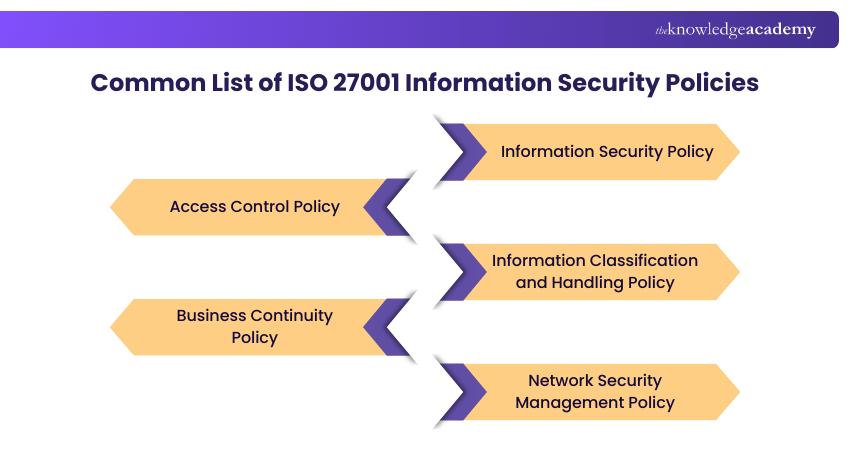
1) Information Security Policy
This is the main policy that explains how the organisation protects its data. It covers who is responsible, what the goals are, and how risks are managed. It sets the rules for all other security policies.
a) Data Protection Policy
This policy explains how the organisation keeps personal and sensitive data safe. It makes sure the company follows laws like GDPR when collecting and handling personal information.
b) Data Retention Policy
This tells how long different types of data should be kept and how they should be safely deleted after that time.
Learn how to be the mastermind behind the shield in our ISO 27001 Lead Implementer Course - Register now!
2) Access Control Policy
This policy sets rules about who can access systems and data. It explains how access is given, changed, or taken away so only the right people can use certain information.
a) Asset Management Policy
This covers how the company keeps track of its equipment, software, and data. It includes how these assets are used, protected, and properly disposed of.
b) Risk Management Policy
This policy explains how to find, assess, and reduce risks to the company’s information and systems.
3) Information Classification and Handling Policy
This policy helps sort data into categories like public or confidential. It gives rules for storing, sharing, and handling information based on how sensitive it is.
a) Information Security Awareness and Training Policy
This policy ensures all employees are trained in basic security practices and understand their responsibilities. Regular training reduces human errors and builds a strong culture of information security awareness.
b) Acceptable Use Policy
This policy outlines the permitted and prohibited activities for employees regarding the organisation’s computers, internet, and other resources.
4) Business Continuity Policy
This explains how the company will keep running during unexpected problems, like cyberattacks or natural disasters. It helps protect key business activities.
a) Backup Policy
This ensures that data is regularly backed up and that backups are tested for reliability. It helps in recovery after data loss incidents and is essential for maintaining service continuity.
b) Malware and Antivirus Policy
This helps protect systems from harmful software. It includes using antivirus tools and checking for threats regularly.
c) Change Management Policy
This policy sets steps to follow when updating or changing systems. It helps avoid mistakes and keeps things secure during changes.
5) Network Security Management Policy
Network Security Management outlines the measures to secure the organisation’s network, such as firewalls, intrusion detection systems, and access restrictions. It protects data as it moves across the network and guards against cyberattacks.
a) Information Transfer Policy
This gives safe ways to send information inside and outside the company, whether by email, cloud services, or other methods.
b) Secure Development Policy
This is for teams building software. It includes steps to make sure systems are secure from the start.
Lead the Charge in Cyber Confidence with our comprehensive ISO 27001 Lead Auditor Training - Sign up now!
What are the Requirements for an ISO 27001 Information Security Policy?
ISO 27001 2026 Latest Version, does not expand too much on the policy, but it does stipulate the following requirements and elements to consider when writing the policy:
1) Adapt the Policy to the Organisation: The policy needs to be adapted to the organisation. This essentially means that one cannot simply copy the policy from a large organisation and use it in a much smaller organisation.
2) Define the Framework for Setting Objectives: The policy needs to define the framework for setting up ISO 27001 physical security objectives. In simpler terms, the policy needs to define how the Information Security objectives are proposed, approved, and reviewed.
3) Establish a Commitment Statement for the Top Management: The policy must demonstrate the commitment of upper management to help fulfil the requirements of all interested parties and continuously improve the ISMS. This is usually done through a statement included as part of the policy.
4) Define Responsibilities for Communication: The policy must be communicated within the organisation and to interested parties, e.g., customers and suppliers, whenever appropriate. The best practice is clearly defining who is responsible for such communication and ensuring they regularly communicate with all relevant parties.
5) Ensure Regular Reviews by Defining the Owner of the Policy: Lastly, the policy must be reviewed on a regular basis (e.g., annually). The owner of the policy should be clearly defined, and the person concerned is held responsible for keeping the policy up to date.
Become the Guardian of Compliance and Keep Your Security success Story flowing! Sign up for our ISO 27001 Internal Auditor Course now!
ISO 27001 Information Security Policy Outline
The ISO 27001 Information Security Policy provides a structured outline that explains how an organisation manages and protects its information assets. Let’s look at the outline below:
1) Purpose: This section explains the objective of the policy and the organisation’s approach to information security. It defines why the policy exists and establishes responsibilities for protecting organisational data.
2) Scope: The scope describes which systems, data, locations, employees, and contractors are covered by the ISMS. It may also clarify any exclusions if certain areas are not included.
3) Information Security Principles: This section outlines the core principles the organisation follows, such as a risk-based approach, least privilege access, and continual improvement in information security practices.
4) Information Security Objectives: This part defines high-level goals for protecting information assets, including maintaining the confidentiality, integrity, and availability of organisational data.
5) Roles and Responsibilities: This section specifies the roles responsible for implementing, managing, and monitoring the ISMS. It clarifies who oversees compliance with the ISO 27001 requirements.
6) Requirements: Here, the organisation identifies legal, regulatory, and contractual requirements that apply to its information security practices, such as data protection regulations or industry standards.
7) Communication: This section explains how the information security policy is communicated to employees, contractors, and third-party vendors to ensure awareness and understanding.
8) Support: The support section describes the resources, tools, and supporting policies that strengthen information security, such as acceptable use policies, data retention policies, or security awareness programmes.
9) Review and Maintenance: This section confirms that the policy will be reviewed regularly, typically annually or after major organisational changes, to ensure it remains effective and aligned with security requirements.
How Long Should an ISO 27001 Information Security Policy Be?
An ISO 27001 Information Security Policy should generally be concise, usually no longer than a few pages. A short and clear policy makes it easier for employees across the organisation to read, understand, and follow the organisation’s approach to information security.
The policy should refer to separate topic-specific policies, such as access control or data protection. Also, keeping the main policy brief makes it easier for senior management to review and approve it without frequent updates.
What are the 3 Principles of Information Security?
The three basic principles of information security are confidentiality, integrity and availability. Every element of an Information Security program must be designed to implement these principles.
What are the 7 Security Domains of Information Security?
A standard IT infrastructure is divided into seven domains: User Domain, Workstation Domain, LAN Domain, LAN-to-WAN Domain, Remote Access Domain, WAN Domain, and System/Application Domain. Each domain represents a possible entry point for cyber attackers if proper security measures are not in place.
Conclusion
Protecting organisational information is essential in today’s digital environment, where data breaches and security risks are increasingly common. Implementing a well-structured ISO 27001 Information Security Policy helps organisations set clear security guidelines, manage risks effectively, and build trust with customers and stakeholders, while strengthening overall information security practices.
Take Your First Step Toward Unbreakable Information Security! Sign up for our ISO 27001 Foundation Course now!
Frequently Asked Questions
What are the 7 P's of Information Security Management?

The 7 P’s of Information Security Management are:
a) Planning
b) Policy
c) Programs
d) Protection
e) People
f) Processes
g) Project Management
Is Information Security the Same as Cyber Security?
No. While both protect systems and data from threats, Cyber Security and Information Security have a key distinction. Cybersecurity focuses on keeping computer systems safe from hackers, theft, and online attacks. Information security is primarily about protecting data and ensuring it remains private, accurate, and accessible when needed.
What are the Other Resources and Offers Provided by The Knowledge Academy?
The Knowledge Academy takes global learning to new heights, offering over 3,000+ online courses across 490+ locations in 190+ countries. This expansive reach ensures accessibility and convenience for learners worldwide.
Alongside our diverse Online Course Catalogue, encompassing 17 major categories, we go the extra mile by providing a plethora of free educational Online Resources like Blogs, eBooks, Interview Questions and Videos. Tailoring learning experiences further, professionals can unlock greater value through a wide range of special discounts, seasonal deals, and Exclusive Offers.
What is The Knowledge Pass, and How Does it Work?
The Knowledge Academy’s Knowledge Pass, a prepaid voucher, adds another layer of flexibility, allowing course bookings over a 12-month period. Join us on a journey where education knows no bounds.
What are the Related Courses and Blogs Provided by The Knowledge Academy?
The Knowledge Academy offers various ISO 27001 Training including the ISO 27001 Foundation Course, ISO 27001 Lead Implementer Course, and the ISO 27001 Lead Auditor Course. These courses cater to different skill levels, providing comprehensive insights into ISO 27001 Framework.
Our ISO & Compliance Blogs cover a range of topics related to ISO 27001, offering valuable resources, best practices, and industry insights. Whether you are a beginner or looking to advance your Compliance and Regulatory skills, The Knowledge Academy's diverse courses and informative blogs have got you covered.

The Knowledge Academy


Global Training Provider
The Knowledge Academy is a world-leading provider of professional training courses, offering globally recognised qualifications across a wide range of subjects. With expert trainers, up-to-date course material, and flexible learning options, we aim to empower professionals and organisations to achieve their goals through continuous learning.

Upcoming IT Security & Data Protection Resources Batches & Dates
Date
 ISO 27001 Foundation
ISO 27001 Foundation
Mon 6th Jul 2026
ISO 27001 Foundation
Mon 3rd Aug 2026
ISO 27001 Foundation
Mon 7th Sep 2026
ISO 27001 Foundation
Mon 5th Oct 2026
ISO 27001 Foundation
Mon 2nd Nov 2026
ISO 27001 Foundation
Mon 7th Dec 2026

 If you wish to make any changes to your course, please


