


 Top Rated Course

We may not have the course you’re looking for. If you enquire or give us a call on 44 1344 203 999 and speak to our training experts, we may still be able to help with your training requirements.
What is Shift Left Testing in Agile? A Complete Guide
David Evans 01 April 2026Shift Left Testing in Agile is the practice of moving testing activities earlier in the Software Development, ideally starting from the requirements gathering. This helps identify defects sooner, reducing costly fixes later in the cycle. It encourages collaboration between Developers, Testers, and stakeholders from the very beginning.

Training Outcomes Within Your Budget!
We ensure quality, budget-alignment, and timely delivery by our expert instructors.
Table of Contents

In the world of Agile, waiting to test until the end is like proofreading a book after it’s printed. This is where Shift Left Testing comes in, which flips the traditional testing approach by bringing it earlier into the Agile Development process. Instead of finding bugs late in the cycle, teams catch issues early, thus saving time, money and stress. This blog explores what Shift Left Testing in Agile really means, why it matters, and how you can adopt it to create smoother, more efficient Software Development from day one. So read on and elevate your Software Development Lifecycle (SDLC)!
Table of Contents
1) What is Agile Shift Left Testing?
2) Types of Shift Left Testing in Agile
3) How to implement Shift Left Testing in Agile?
4) Best practices for Agile Shift Left Testing
5) Benefits of Agile Shift Left Testing
6) Best Practices for Shift Left Testing in Agile Development
7) Is Shift Left Always Appropriate?
8) What Changes After you Shift to the Left?
9) Conclusion
What is Agile Shift Left Testing?
Agile Shift Left Testing is a proactive approach that involves performing testing activities as early as possible in the Software Development lifecycle. Traditionally, testing was done at the end of development, but in Agile, Shift Left Testing moves it closer to the beginning. It often starts during requirement analysis or even planning stages.
Here are the key aspects of Agile Shift Left testing:
1) Early Involvement of QA: Testers collaborate with Developers and Product Owners from the outset, helping to define clear, testable requirements and acceptance criteria.
2) Faster Feedback Loops: By testing early and often, teams catch bugs sooner, speeding up the delivery process and reducing rework.
3) Automation Friendly: Shift Left Testing supports test automation from the start, integrating with CI/CD pipelines for continuous validation.
4) Improved Quality: Continuous collaboration and early defect detection lead to more stable, reliable software.

Types of Shift Left Testing in Agile
This approach helps detect and fix issues sooner, improves collaboration, and ensures a higher quality product. Below are the main types of Shift Left Testing used in Agile:
1) Unit Testing
Unit testing focuses on validating individual units or components of code, such as functions or methods. In Agile, Developers write these tests alongside or even before the code using Test-Driven Development (TDD).
Goal: Catch logic errors early and ensure that each piece of code performs as expected.
Frequency: Every sprint, integrated into CI pipelines.
Example: Testing a calculator function to ensure it returns the correct result before using it in a bigger application.
2) Integration/API Testing
Once individual units are tested, integration testing ensures that these components work together correctly. In modern Agile systems, especially microservices, this often involves API testing.
Goal: Verify that interactions between services, databases, and APIs are functioning as intended.
Tools: Postman, SoapUI, REST Assured.
Example: Testing whether the user login service communicates correctly with the authentication database.
3) UI Testing
UI Testing focuses on the frontend or user interface. By shifting this left, teams can validate the functionality and design of user interactions early using automated UI testing tools.
Goal: Ensure buttons, forms, flows, and visuals behave correctly across browsers and devices.
Tools: Selenium, Cypress, BrowserStack.
Example: Testing the responsiveness of a shopping cart interface during an early sprint.
4) Model-based Testing
This is the most proactive type, testing before code is even written. It involves building models (like flowcharts or requirement diagrams) and using those to design tests.
Goal: Catch flaws in logic, requirements, or design during planning.
Best for: Complex systems with many rules or paths.
Example: Testing a banking loan approval process using a decision model to validate every possible outcome.
Learn how to adopt Agile principles and practices in your organisation with our Agile Training!
How to implement Shift Left Testing in Agile?
Shift Left Testing is about moving testing earlier in the Software Development Lifecycle, starting as early as the planning or requirement phase. In Agile, this approach aligns perfectly with iterative development and continuous feedback. Here’s how to effectively implement Shift Left Testing within your Agile framework:
1) Define Clear Goals and Testing Scope Early
Before writing any code, define what success looks like for your testing efforts.
1) Identify the key business risks, critical features, and potential pain points.
2) Set clear test coverage targets, automation goals, and expected outcomes.
3) Use sprint planning sessions to map user stories with associated testing efforts.
Why it Matters: A clear scope ensures that your early testing focuses on what truly impacts delivery and user satisfaction.
2) Involve QA from the Beginning
Instead of bringing QA in after development, involve them during backlog grooming and sprint planning.
1) QA can help write better acceptance criteria and catch ambiguous requirements.
2) Collaborate on defining testable user stories using Behaviour-driven Development (BDD) or Acceptance Test-Driven Development (ATDD).
3) Encourage shared responsibility for quality between Developers, Testers, and Product Owners.
Why it Matters: Early QA involvement prevents misunderstandings and sets the stage for automation and robust test coverage.
3) Test Within Each Sprint
Move beyond end-of-cycle testing by integrating it into the sprint workflow.
1) Encourage Developers to write unit tests and adopt Test-Driven Development (TDD).
2) Pair unit tests with API/integration testing as modules are built.
3) Test features incrementally as they're developed, not after the sprint ends.
Why it Matters: In-sprint testing shortens feedback loops and reduces the risk of discovering bugs too late.
4) Automate Early and Often
Start automation from the beginning and make it part of the development process.
1) Automate regression tests, smoke tests, and integration tests using tools like Selenium, JUnit, Cypress, or BrowserStack.
2) Integrate automated tests into your Continuous Integration/Continuous Deployment (CI/CD) pipelines.
3) Ensure every code change triggers automated tests, providing immediate feedback.
Why it Matters: Automation saves time, increases test accuracy, and supports rapid releases without sacrificing quality.
5) Enable Developer-tester Collaboration
Break up silos between Developers and Testers to foster knowledge sharing and joint problem-solving.
1) Encourage pair testing where Testers and Developers work together to test features.
2) Train testers in basic scripting and automation so they can contribute more effectively.
3) Use shared tools (like Jira, Git, TestRail) for better visibility and collaboration.
Why it Matters: Cross-functional teams with shared ownership improve communication and build better products.
6) Shift Security and Performance Left Too
Quality isn’t just about functionality, it also includes security, performance, and usability.
1) Integrate static code analysis and security scanning tools (e.g., SonarQube, Snyk) into early stages.
2) Run performance testing early for critical APIs or user flows.
3) Use exploratory and usability testing during sprint demos or design reviews.
Why it Matters: Detecting non-functional issues early prevents major failures post-deployment.
7) Monitor, Refine, and Improve Continuously
Treat Shift Left Testing as an evolving practice, not a one-time setup.
1) Review test metrics regularly: test pass/fail rates, defect leakage, automation coverage, etc.
2) Identify and remove flaky or redundant tests.
3) Refactor and improve test cases as features evolve and new risks emerge.
Why it Matters: Continuous improvement ensures your testing efforts remain effective and aligned with business goals.
Best practices for Agile Shift Left Testing
Implementing Shift Left Testing in Agile requires a proactive and collaborative approach. Here are the key steps to effectively incorporate it into your Agile Development process:
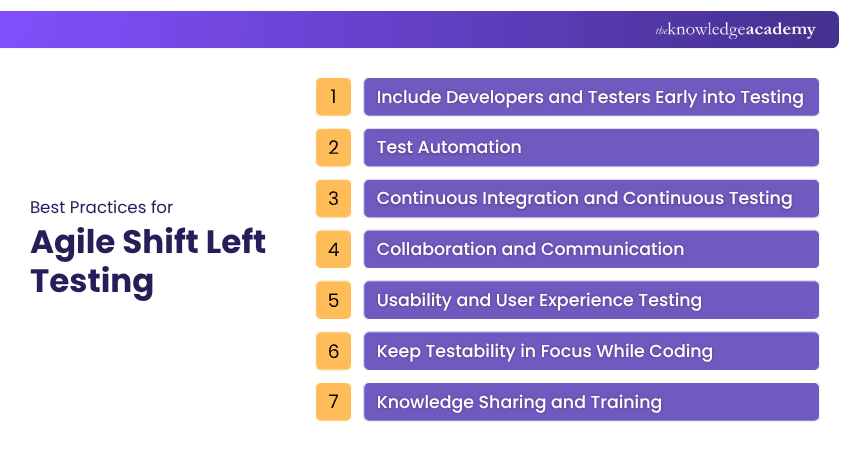
1) Include Developers and Testers Early into Testing
Involve Testers and Developers from the outset, starting with requirements gathering and refinement. Maintain their active participation throughout the development process to ensure early identification of potential issues.
2) Test Automation
Automate testing processes wherever possible to achieve faster feedback and reduce manual effort. Incorporate automated unit tests, integration tests, and regression tests into the development pipeline for efficient and reliable testing.
3) Continuous Integration and Continuous Testing
Integrate testing into the Continuous Integration (CI) process to enable frequent and automated execution of tests with each code commit. This ensures defects are caught early and provides rapid feedback to the development team.
4) Collaboration and Communication
Foster close collaboration between Developers, Testers, and stakeholders throughout development. Encourage regular meetings, feedback sessions, and open communication channels to ensure shared understanding and alignment.
5) Usability and User Experience Testing
Pay attention to usability and User Experience by incorporating user-centric testing techniques early on. Conduct usability tests, gather user feedback, and iterate on design and functionality to enhance the end-user experience.
6) Keep Testability in Focus While Coding
Developers should prioritise writing code that is easily testable. It involves adhering to coding best practices, decoupling dependencies, and designing modular and reusable components, facilitating efficient and comprehensive testing.
7) Knowledge Sharing and Training
Promote knowledge sharing among team members to ensure a collective understanding of testing practices and techniques. Provide training and upskilling opportunities to enhance Developers' and Testers' testing skills and knowledge.
Get your team up to speed on Agile and take your products to the market faster with the Agile for Teams Course – Sign up now!
Benefits of Agile Shift Left Testing
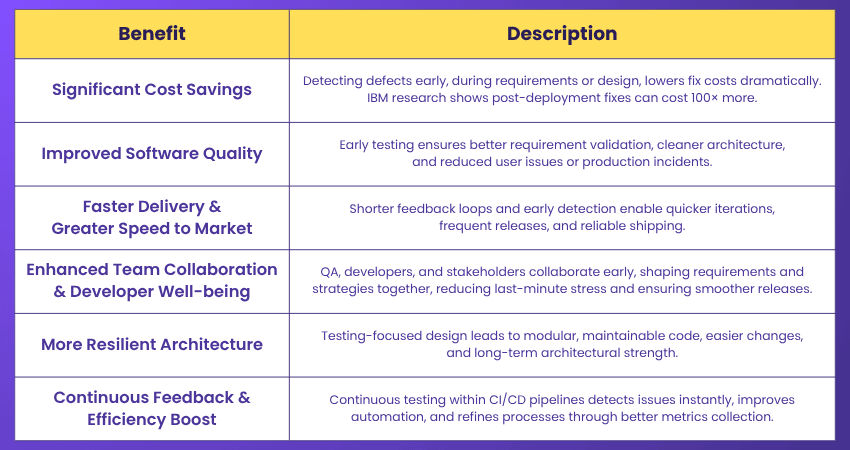
Here are some of the advantages of Agile Shift Left Testing:
Learn the AgileSHIFT methodology and improve your organisation’s productivity with our AgileSHIFT Training!
Best Practices for Shift Left Testing in Agile Development
To implement Shift‑left Testing effectively in Agile, teams must embrace a mindset where testing is a shared responsibility and quality is built in from the very beginning. Here are some best practices to consider:
1) Involve QA early in planning and requirement discussions to define clear, testable user stories.
2) Automate tests from the start, focusing on unit, API, and regression testing.
3) Integrate testing into CI/CD pipelines for continuous feedback and faster issue resolution.
4) Use TDD and continuous testing to catch defects early in development.
5) Encourage Developer–tester collaboration to foster shared quality ownership.
6) Include non-functional testing early, such as security, performance, and usability.
7) Track and analyse testing metrics to refine your strategy and improve efficiency.
Is Shift Left Always Appropriate?
A Shift Left Testing approach might only sometimes achieve optimal performance and functionality in a real-world setting. In such scenarios, a Shift Right Testing strategy may prove beneficial by:
1) Improving customer experience.
2) Allowing for the implementation of test automation.
3) Ensuring more comprehensive test coverage.
Shift Right involves commencing testing from the right, i.e., after production. In this Shift Right practice, you will assess a fully developed and operational application to guarantee its performance and usability. Reviews and feedback from targeted users further enhance the software's quality.
One of the most crucial aspects of the Shift Right approach is a readiness to:
1) Validate hypotheses by experimenting with new solutions.
2) Collaborate with customers to ascertain what is effective (rather than relying on assumptions).
Continuous feedback from users can aid in responding more effectively to software failures.
What Changes After you Shift to the Left?
In practical terms, what does life look like once your organisation embraces Shift Left Testing? What are some changes that are likely to be observed? Given below is a list of probable observations that can be made:
1) Reduced Waiting Time in Testing Activities: Typically, one anticipates a decrease in waiting times associated with testing activities after making the Shift Left. In conventional, non-Agile settings, Testers must wait until Developers complete the implementation of their features before they can commence testing activities. By Shifting Left, testing becomes an early and frequent activity, occurring before, during, and after development.
2) Increased Customer Involvement: Many Agile methodologies emphasise the importance of customer involvement for the success of a software project.
Behaviour-driven Development (BDD) and extreme programming (XP) are two methodologies that necessitate customer participation, especially in creating test cases or specifications. Even if you adopt Shift Left without explicitly embracing BDD and XP, it is advantageous to incorporate customer involvement in the testing process.
3) A Diverse Team Engaged in Software Testing: We are no longer in the 90s but well into the 21st century, where it has become increasingly common for everyone in a software organisation to participate in testing. This is not only beneficial but also essential for genuine Shift Left Testing. To make testing a pervasive, continual activity, it is imperative to leverage all available help.
Fortunately, contemporary tools enable even professionals with coding skills to author robust tests, a capability that was not feasible in the past. Highlighting this in your Software Tester Resume can demonstrate your adaptability and proficiency with modern testing tools.
4) Increased Test Coverage: An unsurprising outcome of Shift Left Testing is an elevation in test coverage. The logic is straightforward: with more individuals writing tests more frequently and starting the process earlier, a more significant portion of the application is naturally covered by tests.
A less inevitable but probable consequence of Shift Left Testing is increased code coverage. This is not guaranteed, as Shift Left does not inherently imply a surge in the creation of unit tests, although it is likely the case.
Conclusion
Shift Left Testing in Agile is a powerful approach that brings early testing, collaboration, and quality assurance to the forefront of Software Development. By implementing Shift Left Testing and following best practices, Agile teams can deliver higher quality software, enhance customer satisfaction, and achieve faster time-to-market. Embrace the principles of Shift Left Testing, adapt them to your specific project needs, and elevate the quality of your Software Development process.
Master the art of writing Agile user stories and see your team's productivity improve with our Agile User Stories Course – Sign up now!
Frequently Asked Questions
Why is Shift Left Important?

Shift Left Testing is important because it helps detect and fix defects quite early in the development cycle, reducing costs, improving software quality, and accelerating delivery. It promotes collaboration, continuous feedback, and a culture of quality from the very beginning.
What is the Impact of Shift Left Testing?
Shift Left Testing improves speed, reduces bugs, and lowers rework costs by catching issues early. It enhances team collaboration, ensures better test coverage, and leads to faster, higher-quality releases, aligning perfectly with Agile and DevOps goals.
What are the Other Resources and Offers Provided by The Knowledge Academy?
The Knowledge Academy takes global learning to new heights, offering over 3,000+ online courses across 490+ locations in 190+ countries. This expansive reach ensures accessibility and convenience for learners worldwide.
Alongside our diverse Online Course Catalogue, encompassing 17 major categories, we go the extra mile by providing a plethora of free educational Online Resources like Blogs, eBooks, Interview Questions and Videos. Tailoring learning experiences further, professionals can unlock greater value through a wide range of special discounts, seasonal deals, and Exclusive Offers.
What is The Knowledge Pass, and How Does it Work?
The Knowledge Academy’s Knowledge Pass, a prepaid voucher, adds another layer of flexibility, allowing course bookings over a 12-month period. Join us on a journey where education knows no bounds.
What are the Related Courses and Blogs Provided by The Knowledge Academy?
The Knowledge Academy offers various Agile Training, including the AgilePM® Foundation & Practitioner (AgilePM® V3), Agile Project Management Foundation (AgilePM® V3) and the SAFe® DevOps Certification. These courses cater to different skill levels, providing comprehensive insights into What is Risk Assessment.
Our Project Management Blogs cover a range of topics related to Shift Left Testing, offering valuable resources, best practices, and industry insights. Whether you are a beginner or looking to advance your Project Management skills, The Knowledge Academy's diverse courses and informative blogs have got you covered.

David Evans


Certified Project Trainer and Agile Delivery Expert
David Evans brings over a decade of hands-on experience in project delivery, Agile transformation, and team leadership. With a background in technology and business consulting, David has led cross-functional teams through Agile and Waterfall projects in both public and private sectors. He combines technical knowledge with practical insights to help readers navigate the challenges of modern project environments.

Upcoming Project Management Resources Batches & Dates
Date
 Agile Software Testing
Agile Software Testing
Mon 27th Jul 2026
Agile Software Testing
Thu 10th Sep 2026
Agile Software Testing
Mon 19th Oct 2026
Agile Software Testing
Thu 17th Dec 2026

 If you wish to make any changes to your course, please


