


 Top Rated Course

We may not have the course you’re looking for. If you enquire or give us a call on 44 1344 203 999 and speak to our training experts, we may still be able to help with your training requirements.
PRINCE2 Portfolio Management: Why Do Organisations Need One?
Grace Mitchell 03 June 2026Portfolio Management is key to aligning projects and programmes with an organisation's goals. This blog explores PRINCE2 Portfolio Management, covering how it helps optimise resources, manage risks, and ensure successful outcomes. Understanding these principles can improve how businesses manage their portfolios and achieve better results.

Training Outcomes Within Your Budget!
We ensure quality, budget-alignment, and timely delivery by our expert instructors.
Table of Contents

Organisations today manage a growing number of projects, programmes, and change initiatives. Without a clear structure, it becomes difficult to prioritise what truly matters. This is where PRINCE2® Portfolio Management, formerly known as Management of Portfolios (MoP)®, plays a crucial role. It helps organisations select the right investments, align them with business objectives, and ensure every initiative delivers measurable value.
In an environment where change is constant and decisions must be made quickly, having a structured portfolio approach is essential. PRINCE2® Portfolio Management enables better visibility, stronger governance, and smarter resource allocation across the organisation. In this blog, you will learn its best practices, importance, benefits, and more. Let's begin!
Table of Contents
1) What is PRINCE2 Portfolio Management?
2) Why Organisations Need Portfolio Management?
3) PRINCE2 Portfolio Management Practices
4) PRINCE2 Portfolio Management Principles
5) Benefits of PRINCE2 Portfolio Management
6) How Programmes and Projects Contribute to Portfolios?
7) Conclusion
What is PRINCE2 Portfolio Management?
PRINCE2 Portfolio Management is a structured approach for managing an organisation’s portfolio of projects and programmes. It aligns the organisation’s projects with its strategic objectives, ensuring that resources are effectively allocated and that projects deliver maximum value.
By using PRINCE2 principles, Portfolio Management helps organisations prioritise projects, manage risks, and achieve business goals efficiently. It focuses on balancing project investments, monitoring performance, and making informed decisions to optimise overall portfolio outcomes.

Why Organisations Need Portfolio Management?
Without a structured approach to Portfolio Management, organisations often face overloaded teams, duplicated efforts, and projects that compete with each other. Decisions are frequently made in isolation, driven by short-term needs instead of long-term value, leading to inefficiencies and reduced overall impact.
PRINCE2 Portfolio Management addresses these challenges by introducing consistency, transparency, and control at the portfolio level. It helps leaders understand where resources are invested, what value is being delivered, and whether initiatives remain aligned with strategic goals. This enables stronger governance, accountability, and confident decision-making.
PRINCE2 Portfolio Management Practices
PRINCE2 Portfolio Management practices define the key disciplines needed to manage a portfolio effectively. They provide a structured and flexible approach to ensure better decision-making, prioritisation, and alignment with organisational goals. Let’s look at them below:
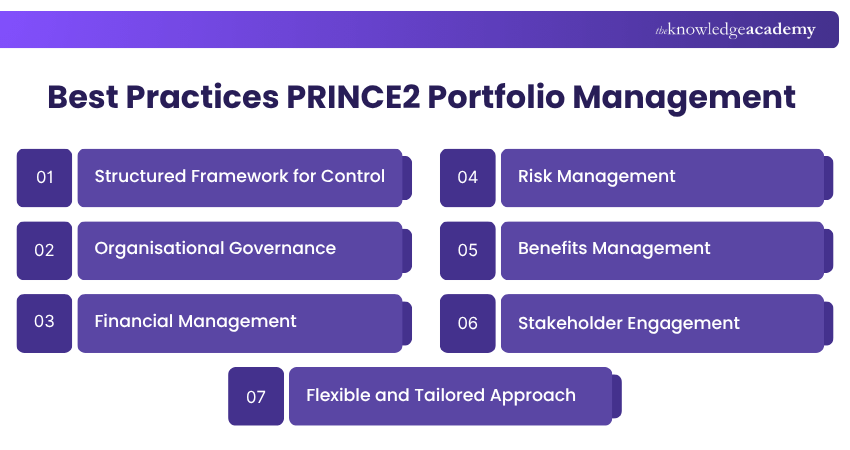
a) Structured Framework for Control: Provides key disciplines to manage portfolios effectively, ensuring the right structures, information, and controls support decision-making and prioritisation.
b) Organisational Governance: Establishes clear oversight, roles, and responsibilities to guide portfolio direction and maintain alignment with business strategy.
c) Financial Management: Tracks investments, budgets, and returns to ensure resources are allocated efficiently and deliver maximum value.
d) Risk Management: Identifies and manages risks across initiatives, helping organisations balance uncertainty with opportunity.
e) Benefits Management: Focuses on measuring and realising value from projects to ensure outcomes support strategic objectives.
f) Stakeholder Engagement: Ensures effective communication and involvement of key stakeholders for better alignment and support.
g) Flexible and Tailored Approach: Encourages adapting practices based on organisational needs, ensuring a practical and context-driven portfolio management process.
Develop strong Project Management fundamentals with the PRINCE2® Foundation Training – Join now!
PRINCE2 Portfolio Management Principles
PRINCE2 Portfolio Management principles provide a foundation for aligning investments with strategy and ensuring effective oversight. Let’s look at them below:
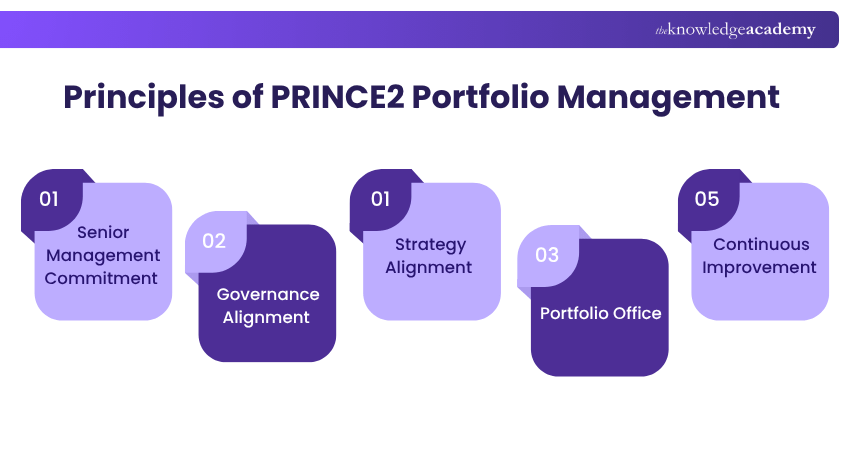
Principle 1: Senior Management Commitment
Active involvement from senior leaders ensures clear direction and strong accountability. It provides visibility for decision-making and helps align portfolio activities with organisational priorities.
Principle 2: Governance Alignment
A consistent project governance structure ensures transparency, control, and effective oversight. It supports informed decisions while maintaining alignment between strategy and execution.
Principle 3: Strategy Alignment
All project initiatives are selected and prioritised based on their contribution to strategic objectives. This ensures resources are wisely allocated and focused on delivering maximum business value.
Principle 4: Portfolio Office
The portfolio office enables coordination, performance tracking, and reporting across initiatives. It provides the necessary support for maintaining control and improving decision-making.
Principle 5: Continuous Improvement
PRINCE2 Portfolio Management encourages adaptability and continuous improvement across the organisation. It helps teams respond effectively to change while keeping the portfolio aligned with evolving business goals.
Elevate your Project Management expertise with the PRINCE2® Practitioner Training – Join today!
Benefits of PRINCE2 Portfolio Management
PRINCE2 Portfolio Management helps organisations gain greater confidence in how they plan, prioritise, and invest in change. Let’s look at their key benefits below:
a) Improved Strategy Alignment: Ensures all projects and programmes directly support organisational goals, creating stronger links between planning and delivery.
b) Greater Transparency: Provides clear visibility into investments, risks, and performance, enabling informed and timely decision-making.
c) Better Prioritisation and Resource Allocation: Helps organisations focus on high-value initiatives while using resources efficiently across the portfolio.
d) Enhanced Decision-making: Enables leaders to stop, adjust, or reshape initiatives that no longer deliver expected value.
e) Stronger Governance and Adaptability: Improves oversight and control, allowing organisations to respond effectively in complex and fast-changing environments.
How Programmes and Projects Contribute to Portfolios?
Programmes and projects act as the core building blocks of a portfolio, each contributing to broader organisational goals. Every initiative is selected and managed based on its alignment with strategy, ensuring that efforts are focused on delivering meaningful value .
Projects deliver specific outputs, while programmes drive broader outcomes and benefits. Together, their combined performance determines the overall success of the portfolio, helping organisations achieve strategic objectives through coordinated and well-managed change initiatives.
Conclusion
PRINCE2 Portfolio Management provides organisations witha structured way to align projects with strategic goals, optimise resources, and maximise value from every initiative. By improving visibility, governance, and decision-making, it helps leaders prioritise the right investments and adapt to change with confidence. This enables organisations to drive consistent success and achieve long-term business growth.
Build end-to-end Project Management expertise and lead projects confidently with the PRINCE2® Foundation & Practitioner Training – Sign up now!
Frequently Asked Questions
What is the Difference Between a Programme and a Portfolio?

A programme is a group of coordinated projects that are engaged to deliver a particular goal in a given period. A portfolio, on the other hand, is a set of Programmes, projects, schemes, or other work that is combined to deliver business, corporate or organisational strategies.
What is the difference Between a Project Process and a Portfolio?
A project process revolves around a set of procedures that needs to be followed in order to successfully finish the work of a particular project. A portfolio, however, is focused on managing a set of projects and programmes so that they align with the strategic plan and bring the greatest value.
What are the Other Resources and Offers Provided by The Knowledge Academy?
The Knowledge Academy takes global learning to new heights, offering over 3,000+ online courses across 490+ locations in 190+ countries. This expansive reach ensures accessibility and convenience for learners worldwide.
Alongside our diverse Online Course Catalogue, encompassing 17 major categories, we go the extra mile by providing a plethora of free educational Online Resources like Blogs, eBooks, Interview Questions and Videos. Tailoring learning experiences further, professionals can unlock greater value through a wide range of special discounts, seasonal deals, and Exclusive Offers.
What is The Knowledge Pass, and How Does it Work?
The Knowledge Academy’s Knowledge Pass, a prepaid voucher, adds another layer of flexibility, allowing course bookings over a 12-month period. Join us on a journey where education knows no bounds.
What are the Related Courses and Blogs Provided by The Knowledge Academy?
The Knowledge Academy offers various PRINCE2® Training, including the PRINCE2® Foundation Training, PRINCE2® Practitioner Training, and PRINCE2® Foundation & Practitioner Training. These courses cater to different skill levels, providing comprehensive insights into the Benefits of Portfolio Management.
Our Project Management Blogs cover a range of topics related to PRINCE2 Portfolio Management, offering valuable resources, best practices, and industry insights. Whether you are a beginner or looking to advance your Project Management skills, The Knowledge Academy's diverse courses and informative blogs have got you covered.

Grace Mitchell


Senior Project Management Consultant and Author
Grace Mitchell is a highly experienced project management professional with over 15 years of expertise in leading large-scale projects across industries, including construction, IT, and finance. With qualifications in PRINCE2®, PMP®, AgilePM®, and MSP®, Grace specialises in delivering complex programmes with precision and clarity. Her writing is grounded in real-world application and focuses on helping learners build confidence in project delivery and stakeholder management.
View Detail
Upcoming Project Management Resources Batches & Dates
Date
 PRINCE2® Foundation & Practitioner Training Course
PRINCE2® Foundation & Practitioner Training Course
Mon 6th Jul 2026
PRINCE2® Foundation & Practitioner Training Course
Mon 3rd Aug 2026
PRINCE2® Foundation & Practitioner Training Course
Mon 7th Sep 2026
PRINCE2® Foundation & Practitioner Training Course
Mon 5th Oct 2026
PRINCE2® Foundation & Practitioner Training Course
Mon 2nd Nov 2026
PRINCE2® Foundation & Practitioner Training Course
Mon 7th Dec 2026

 If you wish to make any changes to your course, please


