


 Top Rated Course

We may not have the course you’re looking for. If you enquire or give us a call on 44 1344 203 999 and speak to our training experts, we may still be able to help with your training requirements.
What is Intelligent Automation: Benefits and Use Cases Explained
Scarlett Adams 30 April 2026Intelligent Automation uses AI and automation to streamline processes, reduce costs, boost efficiency, and improve decision-making across business operations. It helps in handling repetitive tasks with greater accuracy and speed. It also enables faster workflows, allowing teams to focus on strategic work and achieve consistent outcomes.
Home
 Resources
Data, Analytics & AI
What is Intelligent Automation: Benefits and Use Cases Explained
Resources
Data, Analytics & AI
What is Intelligent Automation: Benefits and Use Cases Explained
Resources
Data, Analytics & AI
What is Intelligent Automation: Benefits and Use Cases Explained

Training Outcomes Within Your Budget!
We ensure quality, budget-alignment, and timely delivery by our expert instructors.
Table of Contents
The future of business is not just automation, it is Intelligent Automation (IA). Relying only on manual work or basic automation is no longer enough when you want speed, accuracy, and efficiency. Businesses need smarter systems that can handle complexity, reduce errors, and keep operations running smoothly.
Intelligent Automation makes this possible and creates systems that can learn and act with minimal human input. It shifts the focus from simply getting work done to getting it done in a more efficient way. In this blog, we will explore what it is, how it works, and how it can transform everyday business operations. Let's dive in!
Table of Contents
1) What is Intelligent Automation (IA)?
2) How Does Intelligent Automation Work?
3) Components of Intelligent Automation
4) Benefits of Intelligent Automation
5) Challenges of Intelligent Automation
6) Use Cases of Intelligent Automation
7) How to Implement Intelligent Automation?
8) Difference Between Intelligent Automation and Robotic Process Automation
9) Conclusion
What is Intelligent Automation (IA)?
Intelligent Automation (IA) is a process of using smart technologies like Artificial Intelligence (AI), Machine Learning (ML), and Robotic Process Automation (RPA) to complete tasks automatically. Unlike basic automation that only follows fixed instructions, IA can learn from data, adapt to changes, and make decisions on its own.
It essentially brings a layer of intelligence to automation, allowing systems to handle tasks that once required human judgment. Whether it is handling customer queries, processing invoices, or forecasting business trends, IA provides a smarter, more responsive approach to automation.

How Does Intelligent Automation Work?
Intelligent Automation works by integrating multiple technologies into a unified system that can sense, think, and act. Here is how it works:
1) Data Collection: IA starts by gathering data from multiple sources such as emails, databases, applications, and customer interactions. This data forms the foundation for all further processing and decision-making.
2) Data Processing and Analysis: Once the data is collected, AI and ML models analyse it to identify patterns, trends, and insights. This helps the system understand the context and determine the best course of action.
3) Decision-making: Based on the analysed data, the system makes informed decisions using predefined rules and learned patterns. Unlike basic automation, it can adapt its decisions over time as it learns from new data.
4) Task Execution: After making decisions, automation tools like RPA carry out the required tasks. These can include actions such as updating records, sending emails, processing transactions, or routing requests.
5) Continuous Learning: IA systems learn from outcomes and feedback. This allows them to improve accuracy and efficiency over time, making the process smarter with each cycle.
6) Integration With Systems: IA connects with existing business systems and applications to ensure smooth workflow execution. This integration helps automate processes across different departments without disruption.
7) Monitoring and Optimisation: The system continuously monitors performance and identifies areas for improvement.
Components of Intelligent Automation
Intelligent Automation is not built on a single technology but rather a combination of multiple tools and systems working together. Let's check those components:
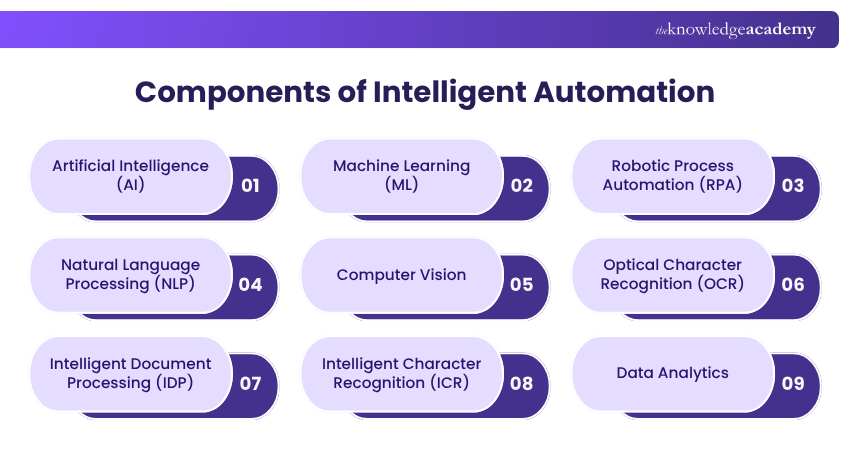
1) Artificial Intelligence (AI)
AI is the core of Intelligent Automation, enabling systems to think, analyse data, and make decisions. It helps machines handle complex tasks that normally require human intelligence.
2) Machine Learning (ML)
Machine Learning allows systems to learn from data and improve over time. Instead of being manually updated, the system becomes more accurate and efficient as it processes more information.
3) Robotic Process Automation (RPA)
RPA is responsible for handling repetitive and rule-based tasks such as data entry, report generation, and transaction processing. It ensures tasks are completed quickly and with minimal errors.
4) Natural Language Processing (NLP)
NLP helps machines understand and interpret human language. It is used in chatbots, virtual assistants, and email automation to interact with users effectively.
5) Computer Vision
Computer vision enables systems to interpret and analyse visual data such as images and scanned documents. It is useful for tasks like document verification and image recognition.
6) Optical Character Recognition (OCR)
OCR is used to convert printed or scanned text into digital, editable data. It allows systems to read information from documents such as invoices, receipts, and forms, making it easier to store and process data automatically.
7) Intelligent Document Processing (IDP)
IDP is used to extract, process, and manage data from documents like invoices, forms, and contracts. It combines AI, OCR, and ML to convert unstructured data into structured, usable information.
8) Intelligent Character Recognition (ICR)
ICR, as an advanced form of OCR, can read and interpret handwritten text. It improves data extraction accuracy, especially when dealing with forms or documents that include handwritten inputs.
9) Data Analytics
Data Analytics is used to analyse large amounts of data and uncover meaningful insights. These insights support better decision-making and improve overall business performance.
Enhance your customer support skills with our AI Automation Training for Customer Services – Register today!
Benefits of Intelligent Automation
Intelligent Automation gives a wide range of benefits that enable businesses to operate more effectively. Below are the benefits of IA:
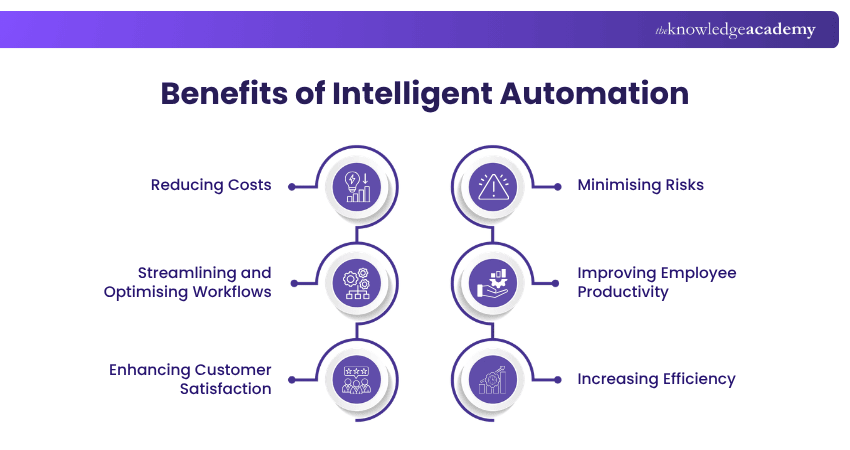
1) Reducing Costs
One of the main advantages of Intelligent Automation is that it helps businesses save money. By automating repetitive and time-consuming tasks, companies do not need as much manual labour, which reduces costs. In addition, IA reduces mistakes that can lead to financial losses.
2) Streamlining and Optimising Workflows
Intelligent Automation makes workflows smoother and faster by removing unnecessary steps. Tasks that used to take a long time can now be finished quickly and with fewer errors. This helps businesses run more smoothly and meet deadlines on time.
3) Enhancing Customer Satisfaction
Customers expect quick and helpful responses and IA helps businesses meet these expectations. Automated systems can handle customer queries instantly, reducing waiting times and improving service quality. This results in better customer experiences and satisfaction.
4) Minimising Risks
Intelligent Automation helps reduce risks by ensuring tasks are performed accurately and consistently. Since automated systems follow set rules, there is less chance of human error. IA can also detect unusual patterns or issues in real time, which prevents bigger problems from occurring.
5) Improving Employee Productivity
By taking over repetitive tasks, IA allows employees to focus more on strategic work. This not only improves productivity but also enhances job satisfaction, as employees can engage in activities that require creativity and critical thinking. It also makes work more engaging and less stressful.
6) Increasing Efficiency
Efficiency is at the core of Intelligent Automation. By automating end-to-end processes, IA eliminates delays and ensures that tasks are completed accurately. This leads to improved performance and better utilisation of resources. It helps businesses achieve consistent results.
Improve code quality and speed with our AI Automation for Software Development Course – Sign up soon!
Challenges of Intelligent Automation
While Intelligent Automation offers many benefits, it also comes with certain challenges that businesses need to consider. Here are the challenges that you need to consider:
1) High Implementation Costs: Requires investment in tools, infrastructure, and skilled professionals.
2) Complex Integration: Difficult to align with existing systems and workflows.
3) Data Quality Issues: Poor quality in data leads to inaccurate results and decisions.
4) Security and Privacy Concerns: Handling sensitive data raises risks related to security and privacy.
5) Skill Gaps: Lack of skilled professionals to manage and implement IA systems.
6) Resistance to Change: Employees may be hesitant to adopt new technologies due to fear and uncertainty.
Use Cases of Intelligent Automation
Intelligent Automation is used across various industries from customer service to operations and strategic planning to deliver faster results and better outcomes. Here are the most common use cases of IA:
1) Customer Service
In customer service, IA is widely used to enhance support and improve response times. Chatbots and Virtual Assistants (VAs) can answer common questions, solve basic problems, and guide customers quickly. This minimises the workload on human agents and ensures faster responses.
2) Business Planning
Intelligent Automation is very useful in business planning. It can analyse past data, market trends, and external factors to predict future outcomes. This helps organisations make informed decisions and develop effective strategies.
3) Business Operations
In daily business operations, IA helps in optimising processes and improving efficiency. From supply chain management to finance and marketing, it can automate many tasks, reduce manual effort and improve accuracy. This enables better use of time and resources.
Build efficient and scalable processes with our AI Automation Course for Operations – Join now!
How to Implement Intelligent Automation?
To implement Intelligent Automation, businesses need to follow a clear approach. Let's check it out below:
1) Identify Suitable Processes: Start by identifying repetitive, time-consuming tasks that can be automated. Focus on processes that have clear rules and a high impact on efficiency.
2) Define Objectives and Goals: Set clear goals for what you want to achieve with IA, such as cost reduction, improved accuracy, or faster workflows.
3) Assess Current Systems: Analyse your current systems and processes to understand how IA can be integrated without causing disruption.
4) Identify the Right Tools and Technologies: Select tools and platforms that align with your business needs, scalability requirements, and technical capabilities.
5) Develop and Test Solutions: Design and test automation workflows, so that they operate smoothly and deliver reliable results.
6) Train Employees: Provide proper training to employees so they can understand, use, and manage the new automated systems effectively.
7) Implement Gradually: Roll out Intelligent Automation in phases rather than all at once. This helps manage risks and ensures smoother adoption.
8) Monitor and Optimise: Continuously track performance, get feedback, and make improvements to increase efficiency and effectiveness over time.
Difference Between Intelligent Automation and Robotic Process Automation
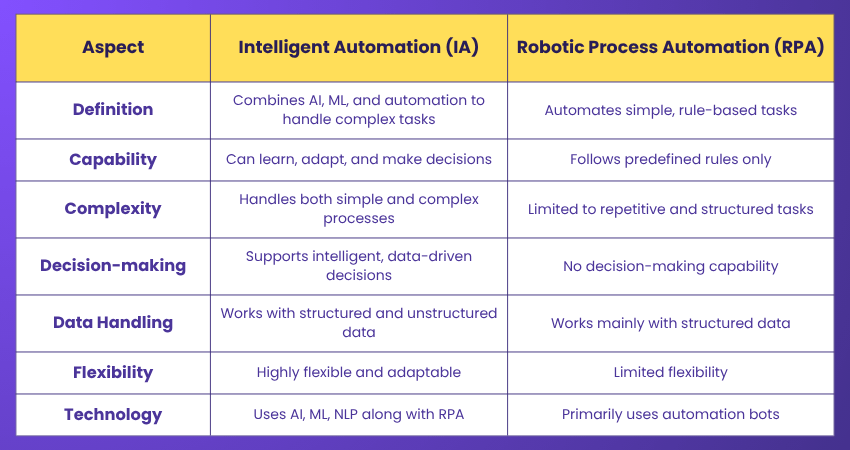
While Intelligent Automation and Robotic Process Automation are closely related, they are not the same. RPA focuses on automating rule-based tasks that follow predefined instructions. It is highly effective for repetitive processes but lacks the ability to learn and adapt.
On the other hand, Intelligent Automation combines RPA with AI and ML to create more advanced systems. It can handle complex tasks, make decisions, and improve over time. In simple terms, RPA is a subset of IA, and IA represents a more comprehensive and intelligent approach to automation. Below is a detailed view of Intelligent Automation vs RPA:
Conclusion
Intelligent Automation is more than just a technological upgrade. It is a smarter way of running modern businesses. From improving efficiency to enhancing customer experiences, its impact can be seen across every part of an organisation. When implemented correctly, it not only streamlines operations but also motivates your team to focus on strategic and high-impact work.
Turn automation into your competitive advantage with our AI Automation Training – Begin now!
Frequently Asked Questions
What are the Top 5 Automation Testing Tools?

Some of the popular automation testing tools are Selenium, Appium, Playwright, TestComplete, and Cypress. These tools help test software automatically, save time and improve accuracy.
What is the Difference Between AI and Intelligent Automation?
Artificial Intelligence allows machines to think, learn, and make decisions. Intelligent Automation uses AI along with automation tools to perform tasks automatically. In simple words, AI provides the intelligence, while IA uses that intelligence to complete tasks and improve workflows.
What are the Other Resources and Offers Provided by The Knowledge Academy?
The Knowledge Academy takes global learning to new heights, offering over 3,000+ online courses across 490+ locations in 190+ countries. This expansive reach ensures accessibility and convenience for learners worldwide.
Alongside our diverse Online Course Catalogue, encompassing 17 major categories, we go the extra mile by providing a plethora of free educational Online Resources like Blogs, eBooks, Interview Questions and Videos. Tailoring learning experiences further, professionals can unlock greater value through a wide range of special discounts, seasonal deals, and Exclusive Offers.
What is The Knowledge Pass, and How Does it Work?
The Knowledge Academy’s Knowledge Pass, a prepaid voucher, adds another layer of flexibility, allowing course bookings over a 12-month period. Join us on a journey where education knows no bounds.
What are the Related Courses and Blogs Provided by The Knowledge Academy?
The Knowledge Academy offers various AI Automation Training, including AI Automation Course for Product Management, AI Automation Course for Operations and AI Automation for Software Development Course. These courses cater to different skill levels, providing comprehensive insights into the Differences Between AI and RPA Technologies.
Our Data Analytics & AI Blogs cover a range of topics related to Intelligent Automation, offering valuable resources, best practices, and industry insights. Whether you are a beginner or looking to advance your Data Analytics & AI skills, The Knowledge Academy's diverse courses and informative blogs have got you covered.
Upcoming Data, Analytics & AI Resources Batches & Dates
Date
 AI Automation Course for Product Management
AI Automation Course for Product Management
Fri 31st Jul 2026
AI Automation Course for Product Management
Fri 30th Oct 2026

 If you wish to make any changes to your course, please


