


 Top Rated Course


We may not have the course you’re looking for. If you enquire or give us a call on 44 1344 203 999 and speak to our training experts, we may still be able to help with your training requirements.
What is Blockchain Security? A Complete Guide
The Knowledge Academy 22 April 2026Blockchain Security ensures data integrity, prevents fraud, and protects transactions through encryption, decentralisation, and consensus mechanisms. The applications of Blockchain technology extend beyond Cryptocurrencies like Bitcoin. It impacts numerous industries, including Supply Chain Management and healthcare.

Training Outcomes Within Your Budget!
We ensure quality, budget-alignment, and timely delivery by our expert instructors.
Table of Contents
Hackers are always on the lookout for weak points to exploit, making online systems highly vulnerable. To counter this, we need a technology strong enough to protect every transaction. Blockchain provides that strength. First developed to support Cryptocurrencies like Bitcoin, it has since expanded into industries ranging from finance to healthcare.
But what are the key elements of Blockchain Security that make it such a powerful defence against fraud and tampering? This blog answers this question comprehensively. So read on and learn how cryptography, decentralisation and transparency help Blockchain rewrite the rules of digital trust.
Table of Contents
1) Understanding Blockchain Security
2) Features of Blockchain Security
3) Different Types of Blockchains
4) Common Blockchain Security Threats
5) Blockchain Security in Enterprise Applications
6) Cyber Security Advantages of Blockchain
7) Essential Best Practices for Blockchain Security
8) Blockchain Security Standards & Regulatory Compliance
9) Real-world Examples of Blockchain Security
10) Conclusion
Understanding Blockchain Security
Blockchain Security is the set of practices and technologies used to protect Blockchain networks from threats like fraud, cyberattacks and operational risks. It combines established cybersecurity methods with Blockchain’s own unique features to create a strong defence system.
At its core, Blockchain is a digital ledger that stores information in blocks. Each block contains one or more transactions and is securely linked to the previous one using cryptography. This creates an unchangeable chain of records, making it extremely difficult for anyone to tamper with the data.

Features of Blockchain Security
Blockchain Security is based on a few characteristics that are combined to provide a strong platform. Here are its most exciting features:
1) Cryptographic Security
Advanced mathematical algorithms and digital signatures allow tamper-proof transactions and data. These cryptographic foundations protect every individual transaction and uphold the integrity of the entire Blockchain.
2) Decentralisation
By distributing control across numerous nodes, Blockchain can drastically reduce single points of failure. This distributed architecture boosts resilience, ensuring that even if some nodes are compromised, the network remains secure and operational.
3) Consensus Mechanisms
Network participants can use structured protocols to agree on the Blockchain’s state. Such collective agreement prevents fraudulent transactions and ensures the network’s integrity. It creates a democratic security model where changes require consensus from multiple actors.
Different Types of Blockchains
Blockchains differ in who can and can’t access the data in their networks. These are the main types of Blockchains:
1) Public Blockchains
1) Public Blockchain networks are also called open or permissionless networks.
2) They are accessible to anyone who wishes to join.
3) All members (typically anonymous) can participate in validating transactions.
4) Transactions are verified using public cryptographic keys through internet-connected computers.
5) Public keys serve as the main means of identification and data access within these networks.
2) Private Blockchains
1) Private Blockchains require membership and verified identities to access the network data.
2) They are also called permissioned Blockchain networks.
3) Consensus is achieved through selective endorsement, where only authorised members can verify the transactions.
4) Special permissions allow selected members to validate data within the distributed ledger.
5) These networks usually consist of trusted entities or organisations.
3) Hybrid Blockchains
1) A hybrid Blockchain combines the power of private and public Blockchains in an interoperable structure.
2) It leverages the strengths of both Blockchain types to create a balanced system.
3) Organisations can keep specific data private while sharing other information publicly.
4) This approach enhances control, scalability, and security for various applications.
Become the go-to security architect with our up-to-date CISSP Training – Sign up now and shape the future of Cyber Security.
Common Blockchain Security Threats
Fraudsters and hackers can exploit Blockchain networks through four primary methods as detailed below:
1) Sybil Attacks
In a Sybil attack, attackers create multiple fake network identities to overwhelm the system. By flooding the network with these identities, they can disrupt operations. It echoes the concept of multiple identities from the famous book character “Sybil.”
2) 51% Attacks
When a single miner or group of miners controls more than half of a network’s computing power, they can manipulate the Blockchain. With this majority, attackers can alter the ledger, reverse transactions and compromise the network's integrity.
3) Phishing Attacks
Phishing involves tricking the users into revealing their credentials. Fraudsters send deceptive emails that look like legitimate sources, which direct users to fake links to collect wallet keys and sensitive data. Once obtained, this information can lead to significant losses for both users and the network.
4) Routing Attacks
Since Blockchains depend on large, real-time data transfers, hackers can intercept information as it moves through internet service providers. These attacks are often invisible to participants while fraudsters secretly extract confidential data or digital assets.
Blockchain Security in Enterprise Applications
When developing enterprise Blockchain applications, security must be involved across every layer of the technology stack along with careful governance and permission management. A strong security strategy combines traditional security measures with Blockchain-specific controls. Key security considerations include:
1) Key management
2) Data privacy
3) Secure communication
4) Smart contract security
5) Transaction endorsement
6) Identity and access management
Engaging experienced professionals is the key to creating a secure and compliant Blockchain solution that aligns with business objectives. It’s also important to pick a production-grade platform that can be deployed flexibly.
Go for endless possibilities in tech and innovation with our Blockchain Courses - Sign up now!
Cyber Security Advantages of Blockchain
Collectively, Blockchain’s protective layers create a trustworthy system that boosts security for consumers while fighting cyber threats. Here are other ways Blockchain can improve Cyber Security:
1) IoT Device Protection
1) Integrating Blockchain encryption allows IoT systems to distribute data across a decentralised network.
2) This minimises single points of failure.
3) Each IoT device can securely store and transmit data within the network.
4) Multiple nodes verify the data, ensuring its authenticity and integrity.
5) This approach makes data tamper-proof and strengthens the overall security of the IoT ecosystem.
2) Identity Verification and Management
1) Traditional identity verification methods are slow and highly susceptible to risks like identity theft and fraud.
2) Blockchain uses encryption to offer a more efficient way to manage identities.
3) It allows users to create and control self-sovereign identities without relying on central authorities.
4) Removing the centralised identity repositories reduces potential hacker targets.
5) Blockchain-based systems simplify and accelerate identity verification processes.
3) Ensuring Data Integrity
1) The transparent structure of Blockchain allows every party to verify data accuracy in real time. This minimises discrepancies.
2) Each transaction is encrypted and linked to the preceding one through a cryptographic hash.
3) This chaining mechanism prevents any single entity from altering data without the consensus of the network.
4) Modifying one block would require changing all subsequent blocks. This makes fraud practically impossible.
4) Enhancing Data Authenticity
1) Blockchain elevates data authenticity by removing complex and unreliable traditional verification processes.
2) Public and private keys are used to sign transactions. This ensures that only the authorised participants can make changes.
3) This streamlined approach offers a higher level of trust and security.
4) It is especially useful for sectors like healthcare, finance and supply chain, where data integrity is critical.
Essential Best Practices for Blockchain Security
You must consider the following best practices when embracing Blockchain Security:
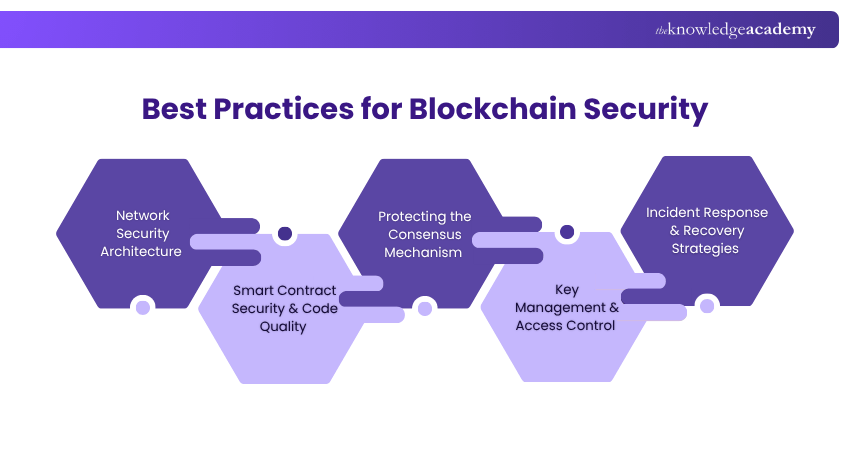
1) Network Security Architecture
1) A layered security approach should include network segmentation, encrypted communications, and secure node configurations.
2) Organisations should deploy geographically distributed nodes with redundancy, strong firewalls and intrusion detection systems.
3) API endpoints must be secured with authentication and rate limiting to reduce misuse.
2) Smart Contract Security & Code Quality
1) Comprehensive audits, formal verification, and thorough testing are crucial before deploying smart contracts,
2) Development teams should follow secure coding standards, use reliable libraries, and implement rate limiting and access controls.
3) Both automated vulnerability scanners and manual reviews should be employed
4) There should be upgrade mechanisms in place for patching discovered flaws.
3) Protecting the Consensus Mechanism
1) Consensus mechanisms must be designed with defined confirmation times and strong finality guarantees.
2) Checkpointing techniques help establish secure reference points within the Blockchain.
3) Stake-based validation adds an extra layer of security by requiring commitment from participants.
4) Detecting and penalising malicious activity reinforces the network’s defence against manipulation and attacks.
4) Key Management & Access Control
1) Organisations must use multi-signature wallets, hardware security modules (HSMs) and cold storage to protect private keys.
2) Access must follow the principle of least privilege, with role-based permissions and approval workflows for sensitive transactions.
3) Regular key rotation and secure backups are key to preventing unauthorised access while maintaining operational continuity.
5) Incident Response & Recovery Strategies
1) Clear incident response plans should be documented for different attack scenarios.
2) This covers compliance and configuration aspects.
3) This includes secure communication channels, system snapshots and regular testing of recovery procedures.
4) Organisations should conduct security drills, review incidents, and update security protocols constantly to stay ahead of evolving threats.
Dive into smart contracts, dApps and decentralised innovation with our comprehensive Ethereum Developer Training - Register now!
Blockchain Security Standards & Regulatory Compliance
Blockchain solutions must comply with both industry-specific security standards and regulatory frameworks across different jurisdictions. Here are the key points to remember:
1) The Financial Action Task Force (FATF) outlined the KYC procedures and transaction monitoring and reporting requirements for virtual asset service providers.
2) Key regulators like the SEC and ESMA have established security standards for Blockchain-based financial solutions. The cover asset custody, system reliability, data privacy, and investor protection.
3) Organisations must prove compliance through regular audits, security assessments, and detailed documentation of their control frameworks.
4) ISO has created Blockchain Security standards such as ISO/TR 23244 for privacy and PII protection and ISO/TC 307 for Blockchain and DLT concepts, key management, and interoperability.
5) NIST IR 8202 provides guidance on Blockchain Security architecture. This includes cryptographic key management, access control systems and secure network protocols, serving as a baseline for organisational security policies.
6) Industry consortium like the Enterprise Ethereum Alliance (EEA) and Hyperledger Foundation develop best practices and technical standards.
Real-world Examples of Blockchain Security
Here are some prominent examples of Blockchain Security that highlight the widespread adoption of this revolutionary technology:
1) Cisco
Cisco sees Blockchain as a powerful tool for securing the Internet of Things (IoT). By removing single points of failure and encrypting sensitive data, Blockchain strengthens IoT networks. As IoT expands, Cisco’s adoption of Blockchain highlights its growing importance in securing connected systems.
2) Hashed Health
Hashed Health focuses on using Blockchain in the healthcare sector. Working with hospitals and healthcare organisations, it builds powerful Blockchain networks for sharing patient information and maintaining confidential communication channels.
3) J.P. Morgan
J.P. Morgan, one of the biggest financial institutions, has built Quorum. It's its own enterprise version of Ethereum. Quorum uses Blockchain to handle private transactions. Smart contracts on the network ensure transparent, secure, and verifiable transactions.
4) Lockheed Martin
Lockheed Martin is the first defence contractor to adopt Blockchain Security. Partnering with Guardtime Federal, it has implemented Blockchain protocols across engineering, software development and Supply Chain Management.
5) Mobilecoin
Mobilecoin has a secure and easy-to-use Cryptocurrency for businesses that lack their own ledger security systems. Mobilecoin uses privacy techniques (CryptoNote, zero-knowledge proofs, SGX enclaves) to obscure transaction details. It also integrates with apps like Facebook Messenger, WhatsApp and Signal.
6) Coinbase
Coinbase is a leading digital currency exchange. It relies on encryption to store wallets and passwords securely. To improve security, employees undergo strict background checks. This ensures a trusted environment for Cryptocurrency transactions.
Conclusion
Blockchain Security represents a paradigm shift in how we protect and trust digital information. By blending cryptography and decentralisation, it creates a tamper-proof ecosystem that’s revolutionising industries. As cyber threats evolve, Blockchain continues to stand firm and redefine the future of security. Embracing it today means building a safer, smarter tomorrow.
Learn how to weave security into the fabric of Enterprise Architecture with our ISSAP Training & Certification - Register now!
Frequently Asked Questions
Is Blockchain the Solution for Privacy?

Blockchain can significantly improve privacy, thanks to its core elements like encryption, decentralisation and permissioned access. However, it isn’t a complete solution on its own. Additional measures like secure key management and privacy protocols are needed to achieve full data confidentiality.
How Much do Blockchain Security Professionals Make?
The salary of a Blockchain Security specialist in the UK can range from £36K to £66K a year. The average salary is £49K. Blockchain Security professionals are in high demand, and the salaries can vary based on role, experience and region.
What are the Other Resources and Offers Provided by The Knowledge Academy?
The Knowledge Academy takes global learning to new heights, offering over 3,000+ online courses across 490+ locations in 190+ countries. This expansive reach ensures accessibility and convenience for learners worldwide.
Alongside our diverse Online Course Catalogue, encompassing 17 major categories, we go the extra mile by providing a plethora of free educational Online Resources like Blogs, eBooks, Interview Questions and Videos. Tailoring learning experiences further, professionals can unlock greater value through a wide range of special discounts, seasonal deals, and Exclusive Offers.
What is The Knowledge Pass, and How Does it Work?
The Knowledge Academy’s Knowledge Pass, a prepaid voucher, adds another layer of flexibility, allowing course bookings over a 12-month period. Join us on a journey where education knows no bounds.
What are the Related Courses and Blogs Provided by The Knowledge Academy?
The Knowledge Academy offers various Blockchain Courses, including Bitcoin and Cryptocurrency Course, Blockchain Training and the Ethereum Developer Training. These courses cater to different skill levels, providing comprehensive insights into How to Buy Bitcoin.
Our Advanced Technology Blogs cover a range of topics related to Blockchain Security, offering valuable resources, best practices, and industry insights. Whether you are a beginner or looking to advance your Blockchain expertise, The Knowledge Academy's diverse courses and informative blogs have got you covered.

The Knowledge Academy


Global Training Provider
The Knowledge Academy is a world-leading provider of professional training courses, offering globally recognised qualifications across a wide range of subjects. With expert trainers, up-to-date course material, and flexible learning options, we aim to empower professionals and organisations to achieve their goals through continuous learning.


 If you wish to make any changes to your course, please


