


 Top Rated Course

We may not have the course you’re looking for. If you enquire or give us a call on 44 1344 203 999 and speak to our training experts, we may still be able to help with your training requirements.
Bitcoin vs Ethereum: What is the Difference?
Richard Harris 28 February 2026Curious about Bitcoin vs Ethereum? Bitcoin is a digital currency for peer-to-peer transactions, while Ethereum enables Decentralised Applications. This blog breaks down their key differences, uses, and what sets each apart in the crypto world. Read ahead to know more and make informed decisions in the crypto space!

Training Outcomes Within Your Budget!
We ensure quality, budget-alignment, and timely delivery by our expert instructors.
Table of Contents
Picture this: you're at a digital marketplace, with two distinct stalls catching your eye. One offers the promise of a secure, unchanging treasure, while the other buzzes with the energy of endless possibilities. This defines the core of the Ethereum vs Bitcoin debate.
Ethereum vs Bitcoin isn't just a comparison; it's a choice between two visions of the future. In this blog, we'll delve into their key differences, uses, and what makes each unique in the ever-evolving world of Cryptocurrency. Ready to explore and decide which path suits your investment goals? Let's dive in!
Table of Contents
1) What is Bitcoin?
2) What is Ethereum?
3) Bitcoin vs Ethereum: Key Differences
4) Bitcoin vs Ethereum: Pros and Cons
5) Bitcoin vs Ethereum: Which one is Better to buy for Long-Term Investment?
6) How to Invest in Bitcoin and Ethereum?
7) Conclusion
What is Bitcoin?
Bitcoin, regularly called digital gold, is the primary and most well-known Cryptocurrency. Created in 2009 with the aid of an unknown individual or group referred to as Satoshi Nakamoto, Bitcoin operates on a decentralised network known as Blockchain. This approach, however, is not controlled by any relevant authority, such as a financial institution or government.
Bitcoin allows users to transfer value securely and transparently without relying on intermediaries, making it a popular choice for global transactions. Its limited supply and decentralised structure contribute to its appeal as both an investment asset and a store of value.
Features of Bitcoin
Here are the features of Bitcoin:
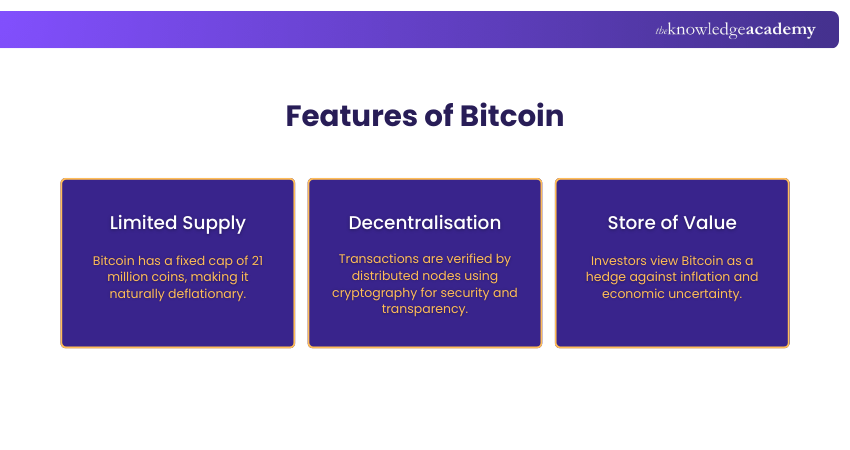
a) Limited Supply: There will only ever be around 21 million Bitcoins, making it a deflationary asset.
b) Decentralisation: Transactions are tested by network nodes via Cryptography, ensuring protection and transparency.
c) Store of Value: Many buyers see Bitcoin as a hedge in contrast to inflation and financial instability.

What is Ethereum?
Ethereum, launched in 2015 by Vitalik Buterin, is more than just a Cryptocurrency. It's a decentralised platform, which allows developers to create and deploy Smart Contracts and Decentralised Applications (dApps). It revolutionises industries beyond finance through its innovative blockchain technology. As more people explore Trading Ethereum, they are participating in a network that transcends traditional financial systems.
Features of Ethereum
Here are the features of Ethereum:
a) Smart Contracts: Ethereum allows you to create and use Smart Contracts, which are self-executing agreements written into code.
b) Decentralised Applications (dApps): You can run Decentralised Applications on Ethereum, which operate without central control.
c) Ether (ETH): Ethereum has its Cryptocurrency called Ether (ETH). It is used to pay for transactions and computational services on the network.
Learn the principles of Blockchain 101 and Ethereum with our Ethereum Developer Training – join us today!
Bitcoin vs Ethereum: Key Differences
Ethereum vs Bitcoin are two well-known Cryptocurrencies, but they serve different purposes. Here are some key differences:
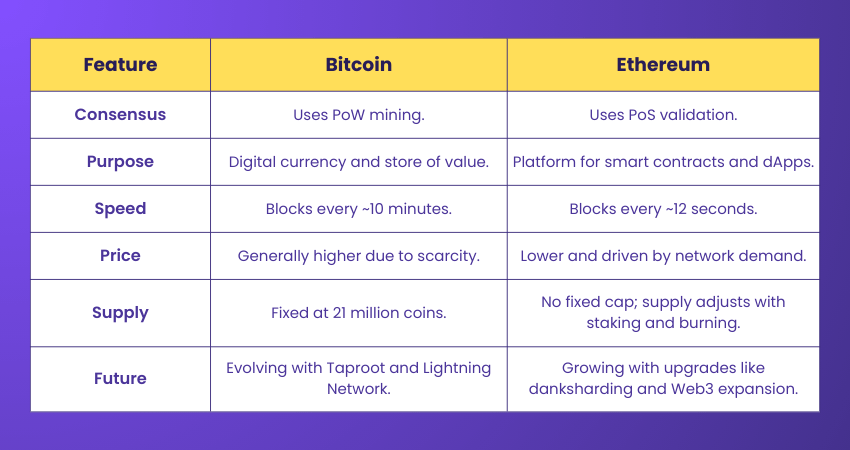
1) Proof of Work vs Proof of Stake
Bitcoin utilises Proof of Work (PoW), where miners compete to solve cryptographic puzzles, making it highly secure. Ethereum shifted to Proof of Stake (PoS) in 2022, replacing miners with validators who stake ETH. Also, future upgrades, such as danksharding, aim to enhance Ethereum’s performance.
2) Purpose
Created as a decentralised digital currency to act as peer-to-peer money and a long-term store of value. Ethereum serves a broader purpose as a smart contract and dApp platform. This enables automated agreements, decentralised apps, and Web3 innovation.
3) Transaction Speed & Scalability
Bitcoin adds new blocks every 10 minutes, making transactions slower. At the same time, Ethereum blocks about every 12 seconds to support faster confirmations and higher throughput. With thousands of daily blocks, Ethereum manages more transactions and aims for greater scalability.
Future-proof your career by joining our expert-led Blockchain Course – book your spot now!
4) Price
Generally, Bitcoin is priced higher due to its scarcity and strong store-of-value. On the other hand, Ethereum is lower in price, widely used for network activity and applications. It moves with demand for smart contracts, such as DeFi (Decentralised Finance) and NFTs (Non-fungible Tokens).
5) Supply and Monetary Policy
Bitcoin follows a strict monetary policy with fixed issuance and a predictable security. In contrast, Ethereum’s monetary system evolves based on the needs of the network, with fee burning to reduce supply and staking influencing issuance.
6) Future
Ethereum continues to expand through upgrades, such as danksharding and growing ecosystems in DeFi or NFTs. Bitcoin is evolving with features, such as the Taproot upgrade and the Lightning Network for faster and cheaper payments.
Explore the world of Cryptocurrencies by investing in our Bitcoin And Cryptocurrency Course now!
Bitcoin vs Ethereum: Pros and Cons
Here is a list of the advantages and disadvantages of Bitcoin and Ethereum.
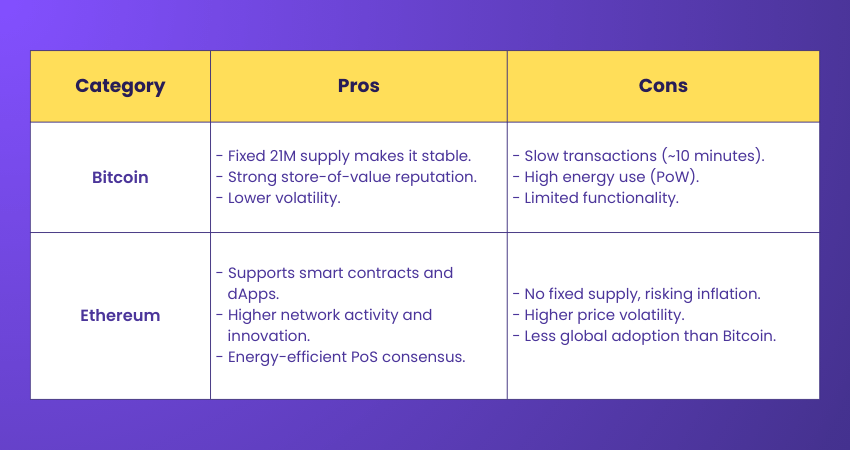
Bitcoin Pros:
1) Limited Supply: Has a fixed cap of 21 million coins, it is a stable and deflationary asset
2) Store of Value: Strong brand, high market capitalisation, and steady adoption make it a preferable choice
3) Lower Volatility: Tends to have more price stability
Bitcoin Cons:
1) Slow transaction Speed: New blocks are created roughly every 10 minutes, making it less efficient
2) High Energy Use: Relies on PoW, consuming significantly more electricity than PoS systems
3) Limited Functionality: Primarily designed for value transfer, not application building
Ethereum Pros:
1) Smart Contracts & dApps: Supports decentralised apps, automated contracts, and the Web3 ecosystem
2) Higher Transaction Activity: Broader functionality leads to more network usage and innovation opportunities
3) Efficient Consensus: Utilises PoS to reduce energy consumption and improve scalability
Ethereum Cons:
1) No Fixed Supply: Ethereum has no hard cap, which poses inflationary risks.
2) Higher Volatility: Prince often moves with activity in DeFi, NFTs, and dApps, causing sharper fluctuations
3) Not Yet Widely Adopted: Despite heavy use, Bitcoin maintains greater global recognition and adoption
Bitcoin vs Ethereum: Which One is Better to Buy for Long-Term Investment?
Both Bitcoin and Ethereum have their unique strengths and potential for long-term Investing in cryptocurrency. Your choice should depend on your investment objectives, risk tolerance, and interest in the underlying technology. Here are key factors to consider when deciding between Bitcoin and Ethereum for long-term investment:
a) Market Position: Consider the market dominance and reputation of each Cryptocurrency.
b) Use Cases: Evaluate the primary uses and applications of Bitcoin and Ethereum.
c) Technology: Understand the underlying technology and Blockchain capabilities.
d) Adoption and Community: Look at the size and activity of the user and developer communities.
e) Investment Potential: Assess the stability, growth potential, and risks associated with each.
f) Future Developments: Keep an eye on upcoming upgrades and improvements in their networks.
How to Invest in Bitcoin and Ethereum?
Investing in Bitcoin and Ethereum can be executed via numerous strategies:
a) Cryptocurrency Exchanges: Platforms like Coinbase, Binance, and Kraken enable you to shop for and promote Bitcoin and Ethereum.
b) Wallets: Use steady wallets like hardware wallets (e.g., Ledger Nano S) or software program wallets (e.g., Exodus) to save your Cryptocurrencies effectively.
c) Dollar-cost Averaging (DCA): It refers to buying small quantities of funding often rather than abruptly. This facilitates lessening the danger from marketplace ups and downs.d) Research and Education: Understand the technology, risks, and market trends before investing.
Conclusion
In the Cryptocurrency realm, knowing the nuances of Ethereum vs Bitcoin is critical for making informed funding decisions. Whether you value Bitcoin's balance or Ethereum's progressive capacity, both offer unique long-term period boom opportunities. Dive deeper into their differences and select the only one that aligns with your financial desires and threat appetite.
Boost your blockchain skills with Blockchain Courses today!
Frequently Asked Questions
How Many Bitcoins and Ethereum are Currently Circulating?

As of now, Bitcoin (BTC) has around 19.95 million coins in circulation out of a capped total of 21 million. Meanwhile, Ethereum (ETH) has about 120.7 million tokens circulating with no fixed upper limit.
What are Some Similarities Between Bitcoin and Ether?
Both Bitcoin and Ether run on decentralised blockchain networks, rely on cryptography for security, and allow peer-to-peer transactions without intermediaries. They are also widely traded digital assets used for investment, transfers, and powering the wider crypto ecosystem.
What are the Other Resources and Offers Provided by The Knowledge Academy?
The Knowledge Academy takes global learning to new heights, offering over 3,000+ online courses across 490+ locations in 190+ countries. This expansive reach ensures accessibility and convenience for learners worldwide.
Alongside our diverse Online Course Catalogue, encompassing 17 major categories, we go the extra mile by providing a plethora of free educational Online Resources like Blogs, eBooks, Interview Questions and Videos. Tailoring learning experiences further, professionals can unlock greater value through a wide range of special discounts, seasonal deals, and Exclusive Offers.
What is Knowledge Pass, and How Does it Work?
The Knowledge Academy’s Knowledge Pass, a prepaid voucher, adds another layer of flexibility, allowing course bookings over a 12-month period. Join us on a journey where education knows no bounds.
What are Related Courses and Blogs Provided by The Knowledge Academy?
The Knowledge Academy offers various Blockchain Training, including Ethereum Developer Training, Blockchain Training and Bitcoin and Cryptocurrency Course. These courses cater to different skill levels, providing comprehensive insights into various Blockchain Developer Skills.
Our Advanced Technology Blogs covers a range of topics related to Blockchain Training, offering valuable resources, best practices, and industry insights. Whether you are a beginner or looking to advance your Blockchain knowledge, The Knowledge Academy's diverse courses and informative blogs have you covered.

Richard Harris


Senior Full Stack Developer and Technology Educator
Richard Harris is a highly experienced full-stack developer with deep expertise in both frontend and backend technologies. Over his 12-year career, he has built scalable web applications for startups, enterprises and government organisations. Richard’s writing combines technical depth with clear explanations, ideal for developers looking to grow in modern frameworks and tools.

Upcoming Business Skills Resources Batches & Dates
Date
 Bitcoin and Cryptocurrency Course
Bitcoin and Cryptocurrency Course
Thu 9th Jul 2026
Bitcoin and Cryptocurrency Course
Thu 12th Nov 2026

 If you wish to make any changes to your course, please


