


 Top Rated Course


We may not have the course you’re looking for. If you enquire or give us a call on + 1-866 272 8822 and speak to our training experts, we may still be able to help with your training requirements.
What is Quantum Computing? Meaning, Uses and Benefits
The Knowledge Academy 15 July 2026Quantum Computing uses qubits, superposition, and entanglement to solve complex problems beyond classical computers in fields like AI, medicine, and finance. By processing many possibilities at once, it boosts speed for optimisation, cryptography, and data-heavy tasks. Though evolving, it signals a major shift in computing.

Training Outcomes Within Your Budget!
We ensure quality, budget-alignment, and timely delivery by our expert instructors.
Table of Contents
Think about how often we rely on computers to make life easier, from finding the fastest route home to predicting market trends or supporting medical research. Now imagine a computer that can take this much further, solving problems that today’s machines cannot. This is where Quantum Computing comes in, offering faster processing and opening the door to groundbreaking possibilities.
In this blog, we explore What is Quantum Computing in a clear and relatable way. You will learn how Quantum Computers work, the principles and types of quantum technology, and their real-world applications, along with the key benefits driving global interest.
Table of Contents
1) What is Quantum Computing?
2) How Does a Quantum Computer Work?
3) What are the Principles of Quantum Computing?
4) Types of Quantum Technology
5) How Can Companies Use Quantum Computing?
6) Classical Computing Versus Quantum Computing
7) Applications of Quantum Computing
8) Benefits of Quantum Computing Across Industries
9) Future of Quantum Computing
10) Conclusion
What is Quantum Computing?
Quantum Computing is a modern form of computing that uses principles of quantum mechanics, like superposition and entanglement, to carry out calculations. Unlike classical computers and even the most powerful supercomputers, which process information using bits that are either 0 or 1, Quantum Computers use qubits that can exist as 0, 1, or both at the same time.
This unique capability highlights the concept of Quantum Computing by enabling the solution of complex problems far faster than classical computers. By exploring vast solution spaces simultaneously, it shows strong potential in medicine, materials science, finance, and cryptography, though the technology remains experimental with challenges around errors, stability, and reliability.
How Does a Quantum Computer Work?
Quantum Computers work differently from classical computers by using qubits as their basic units of information. Unlike classical bits, qubits can exist as 0, 1, or both at the same time through superposition and can be entangled to process many possibilities simultaneously. Unlike classical machines that rely on traditional Operating Systems, Quantum Computers use specialised control software to manage qubit operations.
Quantum Computers use quantum gates and algorithms to manipulate qubits and amplify correct results through interference. After computation, qubits are measured to produce an outcome. Although powerful for complex tasks like cryptography and drug discovery, qubits are highly sensitive and require controlled, near-absolute-zero environments and error-correction to reduce decoherence.
What are the Principles of Quantum Computing?
Quantum Computing operates on fundamental principles of quantum mechanics, offering unique capabilities compared to classical computing.
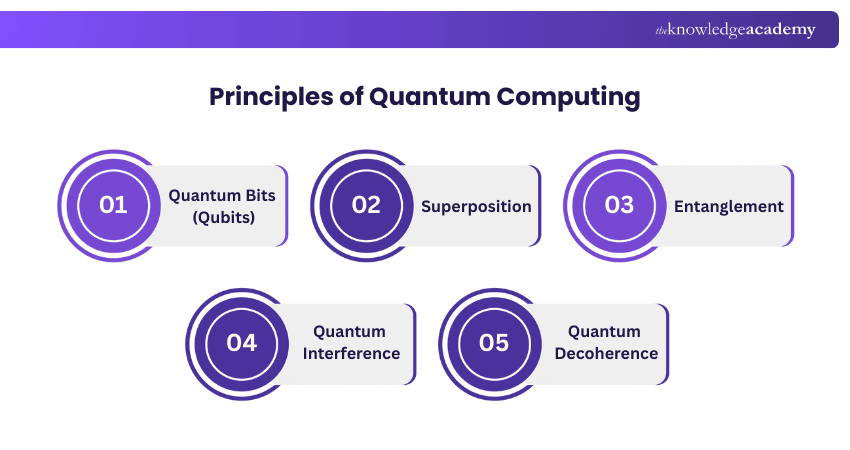
Here are some of the key principles:
a) Quantum Bits (Qubits):
Unlike classical bits, which can be either 0 or 1, qubits can exist in a superposition of states, meaning they can be both 0 and 1 at the same time. This property allows Quantum Computers to process a large amount of information in parallel.
b) Superposition:
This principle allows qubits to be in multiple states at once. It’s like being able to explore many possible solutions to a problem simultaneously.
c) Entanglement:
When qubits become entangled, the state of one qubit is directly related to the state of another, in spite of how far apart they are. This property enables Quantum Computers to perform complex calculations more efficiently than classical computers.
e) Quantum Interference:
This principle is used to amplify the probability of correct solutions and cancel out incorrect ones, enhancing the accuracy of quantum computations.
f) Quantum Decoherence:
This is the loss of quantum coherence, where qubits lose their quantum properties due to interaction with the environment. Managing decoherence is one of the major challenges in building practical Quantum Computers.
Types of Quantum Technology
Quantum Technology encompasses various approaches to harnessing the principles of quantum mechanics for practical applications. Here are the types of Quantum Technology:
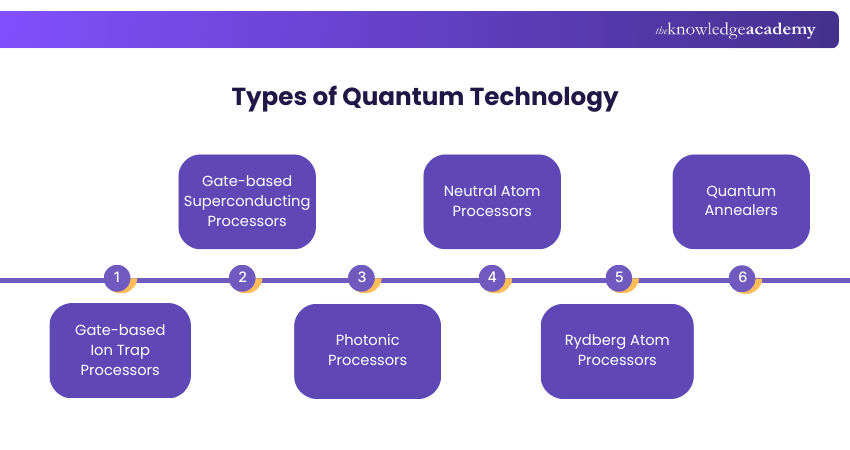
1) Gate-based Ion Trap Processors
These systems use ions (charged atoms) held in place by electromagnetic fields as Qubits. Quantum information is manipulated through the application of laser pulses and microwave fields. Ion trap processors offer long coherence times and high-fidelity operations, making them promising candidates for quantum computation and quantum simulation tasks.
2) Gate-based Superconducting Processors
Superconducting Qubits are fabricated from superconducting materials and manipulated using microwave pulses. They are scalable and relatively easy to control, making them one of the leading platforms for Quantum Computing research. However, superconducting Qubits are susceptible to noise and decoherence, posing challenges for achieving fault-tolerant quantum computation.
3) Photonic Processors
Photonic Qubits are encoded in photons, the fundamental particles of light. These processors manipulate Qubits using optical elements such as beam splitters and phase shifters. Photonic processors offer low decoherence rates and compatibility with long-distance quantum communication. They are particularly suitable for tasks involving quantum communication and quantum cryptography.
4) Neutral Atom Processors
Neutral atom Qubits are atoms with balanced numbers of protons and electrons, manipulated using laser beams. They offer long coherence times and high-fidelity operations, similar to ion trap processors. Neutral atom processors have potential applications in quantum simulation and quantum metrology tasks.
5) Rydberg Atom Processors
Rydberg atoms are highly excited atoms with electrons in high-energy states, manipulated using laser fields. These processors offer strong interactions between Qubits, enabling the implementation of entangling gates with high fidelity. Rydberg atom processors are being explored for quantum simulation and quantum communication tasks.
6) Quantum Annealers
Quantum annealers are specialised quantum processors designed to solve optimisation problems. They exploit quantum annealing, a quantum optimisation technique inspired by Simulated Annealing in classical computing. Quantum annealers are particularly effective for solving combinatorial optimisation problems, such as finding the optimal configuration of a complex system.
Unlock your potential and stay ahead in the rapidly evolving world of technology with our Advanced Technologies Courses - Join now!
How Can Companies Use Quantum Computing?
Quantum Computers possess four key capabilities that distinguish them from classical computers and can be useful for businesses in the coming years:
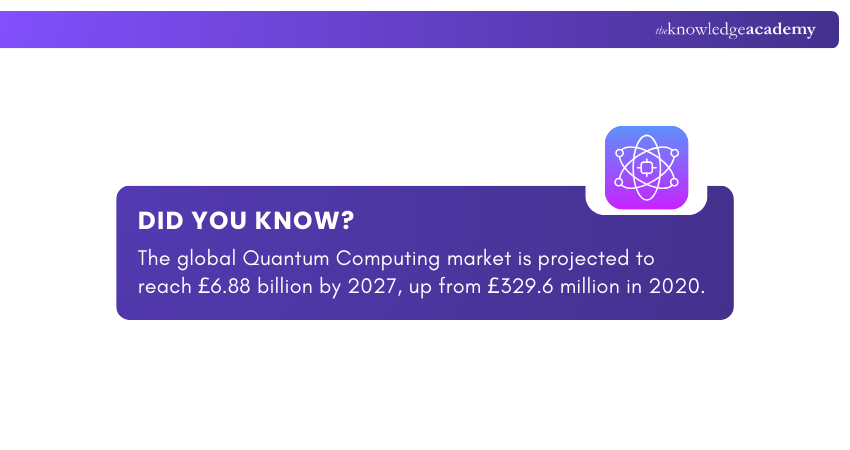
1) Quantum Simulation
Quantum Computers excel at modelling complex molecules, offering potential chemical and pharmaceutical research benefits. Quantum Computers could expedite drug development processes by accurately simulating molecular interactions, leading to faster discoveries and transformative medical breakthroughs.
2) Optimisation and Search
Quantum Computing enables rapid optimisation across various industries. Unlike classical computers, which perform sequential calculations, Quantum Computers can simultaneously explore multiple variables, efficiently narrowing down the range of possible solutions. This capability streamlines decision-making processes, enhancing efficiency and value creation.
3) Quantum AI
Quantum Computers hold the promise of revolutionising Machine Learning algorithms. Their ability to handle complex calculations with numerous variables simultaneously accelerates the training of Artificial Intelligence (AI) systems. Applications range from pharmaceutical research to automotive technology, with the potential to advance fields like self-driving vehicles.
4) Prime Factorisation
Quantum Computers can solve complex prime factorisation problems, which is crucial for encryption in cybersecurity. While classical computers struggle with large prime numbers, quantum algorithms like Shor's algorithm have the potential to solve these challenges efficiently. As Quantum Computing advances, new encryption technologies will be necessary to secure online services, driving the development of quantum cryptography.
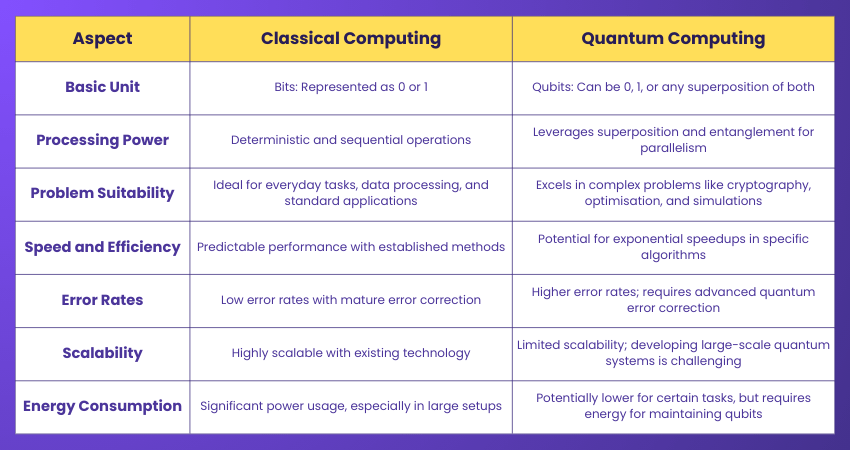
Classical Computing Versus Quantum Computing
Here are the differences between Classical Computing and Quantum Computing:
Applications of Quantum Computing
Quantum Computing is showing strong potential across many industries. Its ability to process vast Data and explore multiple solutions simultaneously makes it ideal for complex tasks. These are the main areas where it is set to make the biggest impact:
1) Healthcare and Medicine: Speeds up drug discovery and medical research by simulating molecular interactions more accurately.
2) Materials Science: Helps design advanced materials by analysing atomic and molecular structures.
3) Finance: Improves risk analysis, portfolio optimisation, and fraud detection using complex data models.
4) Cryptography and Cybersecurity: Supports the development of quantum-safe encryption and challenges existing security methods.
5) Artificial Intelligence & Machine Learning: Accelerates AI training, improves pattern recognition, and enables advanced algorithms for natural language processing and image recognition.
6) Optimisation Problems: Solves complex scheduling, logistics, and resource allocation challenges more efficiently.
Learn about the contributions of Nanotechnology to environmental solutions. Join our Nano Technology Training now!
Benefits of Quantum Computing Across Industries
Quantum Computing delivers unique advantages by handling complex problems that traditional computers struggle with. Its impact can be seen across many sectors:
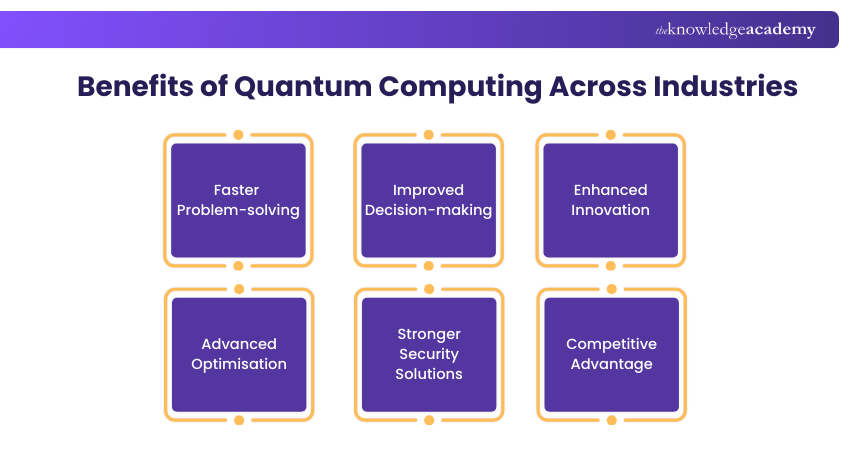
1) Faster Problem-solving: Processes multiple possibilities at once, significantly reducing the time needed for complex calculations.
2) Improved Decision-making: Analyses vast datasets more effectively, leading to more accurate predictions and insights.
3) Enhanced Innovation: Enables breakthroughs in areas like drug discovery, materials development, and scientific research.
4) Advanced Optimisation: Improves efficiency in logistics, supply chains, scheduling, and resource allocation.
5) Stronger Security Solutions: Supports the development of quantum-safe encryption and next-generation cybersecurity methods.
6) Competitive Advantage: Helps organisations solve problems faster, innovate sooner, and stay ahead in rapidly evolving markets.
Future of Quantum Computing
Quantum Computing is moving from research to real-world use as systems become more reliable. This shift is expected to solve problems beyond the capabilities of classical computers and even the most powerful supercomputers, driving innovation across industries. Here are the key areas of impact:
1) Healthcare & Science: Faster drug discovery and advanced material design
2) Artificial Intelligence: More powerful and efficient Machine Learning
3) Cybersecurity: New quantum-safe encryption and risks to current security
4) Business & Finance: Better optimisation, modelling, and decision-making
Conclusion
Understanding What is Quantum Computing reveals its transformative potential in solving complex problems beyond classical capabilities. As technology advances, overcoming current challenges will unlock new applications, driving innovation across industries. Embracing Quantum Computing promises to revolutionise the future of technology and problem-solving.
Unlock the potential of 5G technology with our comprehensive 5G Wireless Training. Register today!
Embark on your Quantum Computing journey and unlock the future of technology with our comprehensive Quantum Computing Training - sign up today!
Frequently Asked Questions
What is the Main Goal of Quantum Computing?

The main goal of Quantum Computing is to harness quantum mechanics principles, such as superposition and entanglement. This enables solving complex problems more efficiently than classical computers in fields like cryptography, optimisation, and material science.
What are Some of the Challenges and Limitations of Quantum Computing?
Quantum Computing faces challenges, including qubit stability, high error rates, and scalability. Additionally, maintaining quantum coherence, developing effective error correction, and creating practical quantum algorithms are significant limitations that need to be addressed.

The Knowledge Academy


Global Training Provider
The Knowledge Academy is a world-leading provider of professional training courses, offering globally recognised qualifications across a wide range of subjects. With expert trainers, up-to-date course material, and flexible learning options, we aim to empower professionals and organisations to achieve their goals through continuous learning.


 If you wish to make any changes to your course, please


