


We may not have the course you’re looking for. If you enquire or give us a call on 01344203999 and speak to our training experts, we may still be able to help with your training requirements.
Top 15 Lean Tools and Techniques for Process Improvement
ByThe Knowledge AcademyLast updated on: 27 October 2026
Explore 15 essential Lean tools and techniques that help organisations identify waste, improve efficiency and support continuous improvement. From 5S and Kanban to value stream mapping and A3 problem-solving, discover how they streamline processes, reduce errors and address operational challenges.
Imagine a workplace where tasks move smoothly, errors are identified early, and employees spend less time dealing with unnecessary delays. Achieving this requires more than working faster. Organisations need practical ways to understand their processes and address inefficiencies. This is where Lean tools and techniques can help.
They are used to identify waste, solve problems and improve the flow of work while maintaining customer value. In this blog, we'll explore 15 important Lean tools and techniques and explain how they support process improvement.
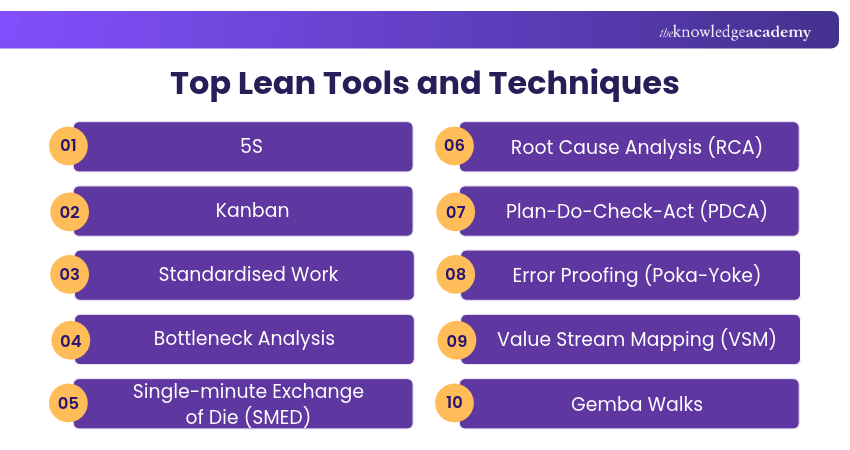
Top 15 Lean Tools and Techniques
Lean tools and techniques help organisations analyse processes, identify inefficiencies and implement practical improvements. Each tool serves a specific purpose, from organising workspaces and managing workflows to identifying the root causes of problems.
The following 15 tools and techniques explain their key functions, practical applications and when organisations should consider using them.
1) 5S
5S is a workplace organisation method that stands for Sort, Set in Order, Shine, Standardise and Sustain. This tool helps create a clean and organised work environment by removing clutter, arranging items logically, maintaining cleanliness and standardising procedures.
The five stages of 5S are:
a) Sort: Remove unnecessary items from the workspace to reduce clutter and improve accessibility.
b) Set in Order: Arrange essential tools and materials so they are easy to identify, access and return.
c) Shine: Clean and inspect the workplace regularly to identify abnormalities and maintain suitable working conditions.
d) Standardise: Establish consistent practices that help employees maintain the first three stages.
e) Sustain: Reinforce the established standards through regular checks, training and ongoing participation.
When to Use: Apply 5S when workspaces are disorganised, employees waste time locating materials or inconsistent arrangements affect daily activities.

2) Kanban
Kanban is a visual workflow management technique that uses signals to authorise the production or movement of items in a pull system. In production settings, a Kanban signal indicates when materials should be replenished based on downstream consumption. Kanban is also used to visualise tasks, manage work in progress and improve workflow efficiency in service-based environments.
Common elements of Kanban systems, depending on their application, include:
a) Visual Signals: Use cards, electronic notifications or other indicators to communicate when work or replenishment is required.
b) Pull-based Replenishment: Trigger production or material movement according to downstream needs rather than producing solely to forecasts.
c) Work-in-progress Limits: In workflow-based Kanban systems, limits can help teams control the amount of work being handled simultaneously.
When to Use: Choose Kanban when teams struggle with excess work in progress, unclear task status or replenishment coordination.
Trainer's Insight
Starting more tasks does not always mean completing more work. Excessive work in progress can increase waiting and make it harder to identify priorities. Visualising workflow and applying appropriate work-in-progress limits can help teams manage tasks more effectively.
3) Standardised Work
Standardised work involves establishing a clearly defined, repeatable method for performing activities. In Lean production, it provides a stable baseline from which teams can identify variation and make improvements.
Traditional standardised work incorporates three essential elements:
a) Takt Time: The production pace required to meet customer demand.
b) Work Sequence: The specific order in which an operator performs tasks.
c) Standard Work-in-process Inventory: The minimum necessary inventory, including items within machines, required to maintain the process.
When to Use: Apply standardised work when task performance varies between employees or shifts, causing inconsistent results.
4) Bottleneck Analysis
Bottleneck analysis is a Lean technique used to identify points in a process where work slows down, delays occur, or resources become overloaded. It helps organisations understand what limits productivity, investigate process constraints and prioritise improvements that can increase overall throughput.
The analysis typically involves:
a) Mapping the process to understand how work moves between activities.
b) Identifying stages where work queues, delays or processing constraints occur.
c) Investigating the causes of the constraint and testing appropriate improvements.
When to Use: Apply bottleneck analysis when tasks accumulate at stages or overall output is restricted by a process constraint.
Quick Scenario
Scenario: A manufacturer operates three stages: assembly, inspection and packaging. Assembly completes 100 units per hour; inspection handles 60, and packaging handles 90.Analysis: Inspection has the lowest processing capacity and may constrain overall output. Improving assembly speed alone will not resolve this issue if inspection remains the limiting stage.Takeaway: Bottleneck analysis helps teams identify where improvement efforts may have the greatest effect on process throughput.
5) Single-minute Exchange of Die (SMED)
SMED is a Lean technique that focuses on reducing equipment setup and changeover times. The term single-minute refers to the traditional goal of completing a changeover in a single-digit number of minutes, typically less than ten. It does not mean that every changeover must take exactly one minute.
SMED involves three important activities:
a) Separate Internal and External Setup: Identify tasks that require equipment to stop and those that can be completed while it is operating.
b) Convert Internal Activities to External Activities: Where safe and practical, prepare tools, materials and other resources before the equipment stops.
c) Simplify Changeover Procedures: Use improved arrangements, quick-change mechanisms and standardised instructions to reduce unnecessary setup time.
When to Use: Use SMED when frequent equipment changeovers cause excessive downtime or encourage unnecessarily large production batches.
Spot inefficiencies, solve problems and make every improvement count with the Lean Six Sigma Yellow Belt Training - Register today!
6) Root Cause Analysis (RCA)
Root Cause Analysis (RCA) is a problem-solving approach used to identify the underlying causes of an issue. Rather than addressing symptoms, RCA seeks to investigate why a problem occurred and determine corrective actions that can reduce the likelihood of recurrence. Techniques such as 5 Whys and fishbone diagrams can support this investigation by helping teams explore potential causes.
The process generally includes:
a) Define the Problem: Describe the issue and its effect on the process.
b) Collect Evidence: Gather relevant observations, records and process data.
c) Investigate Possible Causes: Examine contributing factors using appropriate techniques.
d) Verify the Causes: Evaluate evidence to determine which factors contributed to the problem.
e) Implement and Review Actions: Address verified causes and assess whether the issue has been resolved.
When to Use: Apply RCA when defects, delays or operational failures recur, and the underlying causes are unclear.
7) Plan-Do-Check-Act (PDCA)
PDCA is a cyclical method used for continuous improvement and problem-solving. It involves four stages: Plan, Do, Check and Act.
The stages are:
a) Plan: Identify an improvement opportunity, define the desired outcome and develop a plan.
b) Do: Test the proposed change, preferably on a manageable scale when practical.
c) Check: Compare the observed results with the intended objectives and examine what was learned.
d) Act: Standardise successful improvements or revise the approach and begin another cycle.
When to Use: Choose PDCA when an organisation wants to test a process improvement systematically before adopting it more widely.
8) Error Proofing (Poka-Yoke)
Error proofing, also known as poka-yoke, is a Lean technique used to prevent mistakes or detect them before they result in defects being passed to the next stage. It helps organisations design processes and equipment in ways that reduce the likelihood or consequences of human error.
Common error-proofing approaches include:
a) Physical Design Features: Use shapes or fittings that prevent components from being installed incorrectly.
b) Detection Sensors: Use sensors that identify missing or incorrectly positioned components.
c) Interlocks: Prevent equipment from operating when required conditions are not satisfied.
d) Warning Signals: Alert employees when an abnormal condition is detected.
When to Use: Apply poka-yoke when recurring mistakes can be prevented through changes to equipment, product design or process controls.
Trainer's Insight
Error prevention and error detection serve different purposes. A connector designed to fit only one way prevents incorrect assembly, while a sensor identifying a missing component detects a problem. Both approaches can reduce defects, but prevention is preferable when practical.
9) Value Stream Mapping (VSM)
Value stream mapping is a visual Lean tool used to examine how materials and information move through the activities required to deliver a product or service to customers. It helps organisations identify delays, unnecessary activities and improvement opportunities across the wider value stream.
VSM generally involves:
a) Create a Current-state Map: Document how materials, information and work flow through the existing process.
b) Identify Waste: Examine waiting time, excess inventory, unnecessary movement and other non-value-adding activities.
c) Develop a Future-state Map: Design a more effective flow based on identified improvement opportunities.
d) Plan Improvements: Determine the actions needed to move from the current state towards the desired future state.
When to Use: Choose VSM when delays or waste occur across multiple process stages, and the organisation needs to understand the complete workflow.
Bonus Tip
Map the process as it operates, not how it is supposed to work. Use observations and available process data to identify waiting times, unnecessary handovers and activities that do not add customer value.
10) Gemba Walks
Gemba is a Japanese term meaning 'the actual place'. In Lean, gemba walks involve visiting the location where work happens to observe processes and understand actual operating conditions.
A gemba walk generally involves:
a) Observe the Process: Examine how work is performed rather than relying only on reports or assumptions.
b) Ask Questions: Speak with employees to understand difficulties, process requirements and improvement opportunities.
c) Identify Differences: Compare actual practices with expected working conditions.
d) Follow Up: Use observations and employee insights to investigate problems and support improvement activities.
When to Use: Conduct gemba walks when process conditions need direct observation or when reported information does not fully explain operational challenges.
Build a strong Lean foundation and eliminate waste with confidence by joining the Certified Lean Foundation Training today!
11) Heijunka (Production Levelling)
Heijunka is a Lean production levelling method that aims to smooth production by distributing work more evenly over time. It involves levelling both the overall production volume and the mix of different products where practical.
Common elements include:
a) Volume Levelling: Distribute production quantities more evenly instead of responding to every short-term fluctuation with large changes in output.
b) Product Mix Levelling: Schedule different products in a balanced sequence to reduce excessive batching.
c) Smaller Production Batches: Use suitably sized batches and manageable changeovers to support smoother production.
When to Use: Apply heijunka when uneven scheduling or large production batches create fluctuations in workload and material requirements.
12) Andon
Andon is a visual management tool that alerts workers and supervisors to abnormalities in a process. It typically involves lights, display boards, buttons, cords or electronic signals that communicate production status or the need for assistance.
Andon systems support:
a) Problem Visibility: Make process abnormalities easy to identify.
b) Timely Communication: Notify the appropriate employees when an issue requires attention.
c) Rapid Response: Help teams investigate problems before they affect subsequent operations.
d) Process Improvement: Provide information about recurring abnormalities that may require further investigation.
When to Use: Use andon when production teams need a clear way to communicate abnormalities and request timely support.
13) 5 Whys
5 whys is a problem-solving technique that involves repeatedly asking 'Why?' to investigate the underlying causes of a problem. The technique encourages teams to look beyond the immediate symptom and follow the cause-and-effect relationships that contributed to the issue.
Despite its name, the method does not require exactly five questions. The investigation should continue until the underlying causes are sufficiently understood and supported by evidence.
A typical approach involves:
a) Define the Problem: State clearly what went wrong.
b) Ask Why It Happened: Identify a possible direct cause.
c) Continue Investigating: Question the preceding answer to explore deeper contributing factors.
d) Verify the Findings: Check whether the proposed explanations are supported by evidence.
e) Address the Cause: Implement suitable corrective actions and assess the results.
When to Use: Apply 5 Whys when investigating a clearly defined problem with a reasonably traceable cause-and-effect chain.
14) Fishbone Diagram (Ishikawa Diagram)
A fishbone diagram, also called an Ishikawa diagram or cause-and-effect diagram, is a visual tool used to organise and investigate possible causes of a problem. The diagram places the problem at one end of a central line, with branches representing different categories of potential causes.
Common categories include:
a) People: Skills, communication or human factors.
b) Methods: Procedures, instructions and working practices.
c) Machines: Equipment, tools or technology-related issues.
d) Materials: Inputs, supplies or material quality.
e) Measurement: Data collection, measurement methods or monitoring issues.
f) Environment: Workplace conditions or external influences.
When to Use: Choose a fishbone diagram when a problem may have several contributing factors and the team needs a structured way to investigate them.
15) A3 Problem-solving
A3 problem-solving is a structured Lean approach used to investigate problems, develop countermeasures and communicate improvement plans. The term A3 refers to the paper size traditionally used to present the analysis, but the approach is more than a report or template. It encourages clear, evidence-based thinking and collaboration throughout the improvement process.
A typical A3 problem-solving process includes:
a) Define the Problem: Explain the issue and why it matters.
b) Understand the Current Condition: Gather relevant observations and performance data.
c) Establish the Target Condition: Identify the improvement the organisation wants to achieve.
d) Analyse Root Causes: Investigate the factors contributing to the performance gap.
e) Develop Countermeasures: Identify practical actions intended to address verified causes.
f) Implement and Monitor: Assign responsibilities, test actions and measure results.
g) Review and Standardise: Reflect on the outcomes and incorporate successful improvements into working practices.
When to Use: Apply A3 problem-solving when a recurring or complex issue requires coordinated analysis, clear accountability and a documented improvement plan.
Keep This in Mind
Lean tools and techniques are most effective when selected according to the specific challenges and needs of an organisation. Rather than applying every tool, focus on identifying the root causes of inefficiencies and choosing methods that address them. Regularly reviewing results, involving employees and making adjustments can help sustain improvements and build a culture of continuous improvement.
Build your Lean mindset and make everyday improvements matter with the Lean Awareness Training - Sign up now!

The Knowledge Academy develops accessible learning content across Project Management, IT, Cybersecurity, Data Science, Business Analysis, HR, Accounting and Finance, Leadership and Health and Safety. Its resources combine subject research with clear explanations to help professionals build practical knowledge across a wide range of disciplines.
View Detail

 If you wish to make any changes to your course, please


