


We may not have the course you’re looking for. If you enquire or give us a call on +61 1-800-150644 and speak to our training experts, we may still be able to help with your training requirements.
Top Machine Learning Algorithms: A Comprehensive Overview
ByThe Knowledge AcademyLast updated on: 12 October 2026
Machine learning algorithms help systems analyse complex data, identify patterns, and make accurate predictions with minimal human intervention. Understanding these algorithms enables organisations to automate processes, improve decision-making, and build intelligent data-driven solutions across various industries and applications.

What's in This Blog
1. Understand how different machine learning algorithms process data and make predictions.2. Explore supervised and unsupervised approaches used across common ML tasks.3. See where popular algorithms perform well and what types of problems they can solve.4. Compare methods for classification, regression, dimensionality reduction, and ensemble learning.5. Build a clearer foundation for choosing suitable algorithms for different data-driven applications.
Data is growing rapidly across industries, making it increasingly difficult for organisations to process and interpret information manually. Machine Learning (ML) algorithms help simplify complex data by identifying patterns, making predictions, and supporting faster, more accurate decision-making.
In this blog, you will learn about machine learning algorithms and how they work with complex datasets. It explores different types of algorithms, their applications and how they help businesses build intelligent, data-driven solutions across various industries. Let's dive in!
What is an Algorithm in Machine Learning?
In machine learning, an algorithm is a set of mathematical or logical instructions that enables a computer to identify patterns in data, learn from examples, and generate predictions without being explicitly programmed for every task.
The process begins by feeding relevant training data into the algorithm, which analyses the data to identify underlying patterns and relationships. These patterns are then used to create a model that can make accurate predictions or decisions when presented with new data.

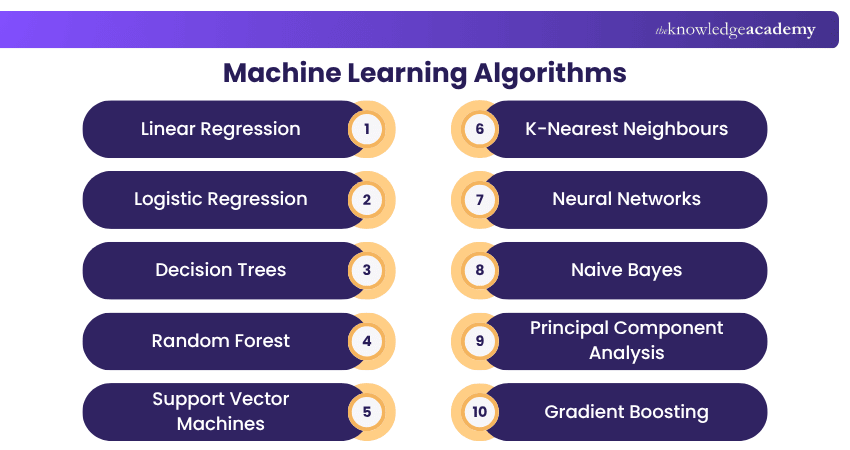
What are 10 Commonly Used Machine Learning Algorithms?
Machine learning algorithms hold immense importance across diverse fields. They are designed to handle various types of tasks, such as classification, regression and dimensionality reduction. Each algorithm has its strengths and weaknesses, making it suitable for specific problem domains. Some algorithms that drive innovation and empower industries are explained below:
1) Linear Regression
Linear regression is one of the fundamental supervised machine learning algorithms widely used in various fields. Its primary purpose is to model the linear relationship between a dependent variable and one or more independent variables. The model estimates a linear relationship that best fits the observed data.
Linear regression finds extensive applications in predicting numerical values, such as stock prices, temperature forecasts, or sales projections. Its simplicity, interpretability, and ease of implementation make it a prominent choice for both beginners and experienced data scientists in predictive modelling tasks. Here is a Python program for linear regression algorithm:
import numpy as np
from sklearn.linear_model import LinearRegression# Sample dataX = np.array([[1], [2], [3], [4], [5]])y = np.array([3, 5, 7, 9, 11])# Create a linear regression modelmodel = LinearRegression()# Fit the model to the datamodel.fit(X, y)# Make predictionsnew_data = np.array([[6], [7]])predictions = model.predict(new_data)print(predictions)
2) Logistic Regression
Logistic regression is another vital supervised learning algorithm, particularly suited for binary classification problems. Unlike linear regression, it predicts the probability of an event occurring based on input features. The predicted probability lies between 0 and 1 and can be used to classify outcomes into categories such as 0 or 1.
This makes it valuable in various applications, including disease prediction, customer churn analysis, credit risk assessment, and email spam detection. Logistic regression's interpretability and efficient computation make it a go-to choice when dealing with binary outcomes and probability estimation tasks. Here is a Python program for logistic regression algorithm:
from sklearn.linear_model import LogisticRegression
# Sample dataX = [[-2], [-1], [0], [1], [2]]y = [0, 0, 1, 1, 1]# Create a logistic regression modelmodel = LogisticRegression()# Fit the model to the datamodel.fit(X, y)# Make predictionsnew_data = [[-3], [3]]predictions = model.predict(new_data)print(predictions)
3) Decision Trees
Decision trees are versatile and widely used supervised machine learning algorithms in the field of data mining. These algorithms make decisions in the form of a tree-like structure. In this structure, each internal node represents a test based on a feature, each branch represents the outcome of that test, and each leaf node corresponds to a specific prediction or output.
Decision trees excel in both classification and regression tasks. They are particularly favoured for their simplicity, interpretability, and ability to handle non-linear relationships in data. Decision trees have numerous applications in areas such as customer segmentation, fraud detection, and medical diagnosis. Here is a Python program for decision tree algorithm:
from sklearn.tree import DecisionTreeClassifier
# Sample dataX = [[1, 2], [2, 3], [3, 4], [4, 5]]y = [0, 1, 1, 0]# Create a decision tree classifiermodel = DecisionTreeClassifier()# Fit the model to the datamodel.fit(X, y)# Make predictionsnew_data = [[5, 6], [1, 1]]predictions = model.predict(new_data)print(predictions)
4) Random Forest
Random forest is an ensemble learning technique built on the foundation of decision trees. This technique combines multiple decision trees to create a more robust and accurate prediction model. Each decision tree in this model is trained on a random data subset and features, reducing overfitting and enhancing generalisation.
The final prediction is an aggregation of the predictions made by the individual trees. Random forest is widely used in various domains, including finance, marketing, healthcare, and ecology, due to its ability to handle complex data, high dimensionality, and noisy datasets. Here is a Python program for random forest algorithm:
from sklearn.ensemble import RandomForestClassifier
# Sample dataX = [[1, 2], [2, 3], [3, 4], [4, 5]]y = [0, 1, 1, 0]# Create a random forest classifiermodel = RandomForestClassifier(random_state=42)# Fit the model to the datamodel.fit(X, y)# Make predictionsnew_data = [[5, 6], [1, 1]]predictions = model.predict(new_data)print(predictions)
5) Support Vector Machines
Support Vector Machines (SVM) are powerful supervised machine learning algorithms used for classification and regression tasks. For classification, they aim to find the optimal hyperplane that best separates data points of different classes in a high-dimensional feature space while maximising the margin between classes.
This algorithm is particularly useful in scenarios where data is not linearly separable, as SVM can employ kernel functions to model non-linear decision boundaries by working in higher-dimensional feature spaces. SVM is widely applied in image recognition, text classification, sentiment analysis, and bioinformatics. Let's check the Python program for Support Vector Machines algorithm
from sklearn.svm import SVC
# Sample dataX = [[1, 2], [2, 3], [3, 4], [4, 5]]y = [0, 1, 1, 0]# Create a support vector classifiermodel = SVC()# Fit the model to the datamodel.fit(X, y)# Make predictionsnew_data = [[5, 6], [1, 1]]predictions = model.predict(new_data)print(predictions)
6) K-Nearest Neighbours
K-Nearest Neighbours (KNN) is a simple yet effective supervised machine learning algorithm. The idea behind KNN is straightforward: for a given data point, it looks for the k-nearest data points in the training set based on a distance metric (e.g., Euclidean distance).
The majority class of these k-nearest neighbours determines the class of the new data point (for classification), or their average value determines the predicted value (for regression). KNN is particularly valuable in recommendation systems, collaborative filtering, anomaly detection, and pattern recognition tasks. Here is a Python program for k-nearest neighbours algorithm:
from sklearn.neighbors import KNeighborsClassifier
# Sample dataX = [[1, 2], [2, 3], [3, 4], [4, 5]]y = [0, 1, 1, 0]# Create a KNN classifiermodel = KNeighborsClassifier(n_neighbors=3)# Fit the model to the datamodel.fit(X, y)# Make predictionsnew_data = [[5, 6], [1, 1]]predictions = model.predict(new_data)print(predictions)
Pro Tip
Standardise or normalise features before using distance- or margin-based methods, as differences in scale can strongly influence results.
7) Neural Networks
Neural networks are inspired by the human brain's neural structure. These complex machine learning algorithms consist of layers of interconnected nodes, each node performing a mathematical operation. Neural networks can handle complex and unstructured data such as images, texts, and audio.
They excel in tasks like image and speech recognition, Natural Language Processing (NLP), sentiment analysis, and autonomous driving. Deep learning models, often constructed using neural networks, have demonstrated remarkable results in many fields, such as computer vision and game playing. Let's check the Python program for a simple neural network used for regression:
import tensorflow as tf
import numpy as np# Sample dataX = np.array([[1], [2], [3], [4], [5]], dtype=float)y = np.array([3, 5, 7, 9, 11], dtype=float)# Create a neural network modelmodel = tf.keras.Sequential([tf.keras.Input(shape=(1,)),tf.keras.layers.Dense(8, activation="relu"),tf.keras.layers.Dense(1)])# Compile the modelmodel.compile(optimizer="adam", loss="mean_squared_error")# Train the modelmodel.fit(X, y, epochs=200, verbose=0)# Make predictionsnew_data = np.array([[6], [7]], dtype=float)predictions = model.predict(new_data)print(predictions)
Strengthen your deep learning expertise with Neural Networks with Deep Learning Training - Join now!
8) Naive Bayes
Naive Bayes is a supervised machine learning algorithm based on Bayes' theorem, which assumes that features are conditionally independent of one another given the class being predicted. Despite its "naive" assumption, Naive Bayes has proven to be surprisingly effective in text classification tasks, such as spam filtering, sentiment analysis, and document categorisation.
Naive Bayes is computationally efficient and can work well with relatively small training datasets. It is particularly useful for high-dimensional classification problems, although its performance depends on the data and how well its assumptions fit the task. Here is a Python program demonstrating the Naive Bayes classification algorithm:
from sklearn.naive_bayes import GaussianNB
# Sample dataX = [[1, 2], [2, 3], [3, 4], [4, 5]]y = [0, 1, 1, 0]# Create a Naive Bayes classifiermodel = GaussianNB()# Fit the model to the datamodel.fit(X, y)# Make predictionsnew_data = [[5, 6], [1, 1]]predictions = model.predict(new_data)print(predictions)
9) Principal Component Analysis
Principal Component Analysis (PCA) is an unsupervised Machine Learning Algorithm used for dimensionality reduction and feature extraction. In high-dimensional datasets, PCA identifies new variables called principal components that capture the maximum variance in the data. It then transforms the data into a lower-dimensional space while retaining as much variance as possible.
PCA is widely used in data preprocessing, visualisation, and pattern recognition. By reducing the number of dimensions, PCA simplifies the complexity of data and can improve the computational efficiency of subsequent Machine Learning algorithms. It has applications in image processing, genetics, finance, and various other domains where dimensionality reduction is essential for analysis and interpretation. Here is a Python program for the principal component analysis algorithm:
from sklearn.decomposition import PCA
# Sample dataX = [[1, 2, 3], [4, 3, 6], [7, 8, 5]]# Create a PCA model with 2 componentsmodel = PCA(n_components=2)# Fit the model to the datamodel.fit(X)# Transform the data into a lower-dimensional spacenew_data = model.transform(X)print(new_data)
10) Gradient Boosting
Gradient boosting is a powerful ensemble machine learning algorithm that combines the strengths of weak learners, typically decision trees, to create a strong predictive model. It works by sequentially adding new trees that correct the errors made by previous trees, leading to increasingly accurate predictions.
Gradient boosting is widely used in both regression and classification tasks and has gained popularity for its high predictive performance and ability to handle complex, high-dimensional datasets. Here is a Python program for the gradient boosting classification algorithm:
from sklearn.ensemble import GradientBoostingClassifier
# Sample dataX = [[1, 2], [2, 3], [3, 4], [4, 5]]y = [0, 1, 1, 0]# Create a Gradient Boosting classifiermodel = GradientBoostingClassifier()# Fit the model to the datamodel.fit(X, y)# Make predictionsnew_data = [[5, 6], [1, 1]]predictions = model.predict(new_data)print(predictions)
Take your first step into AI-powered language technologies with Natural Language Processing (NLP) Fundamentals with Python Course – Join now!

The Knowledge Academy develops accessible learning content across Project Management, IT, Cybersecurity, Data Science, Business Analysis, HR, Accounting and Finance, Leadership and Health and Safety. Its resources combine subject research with clear explanations to help professionals build practical knowledge across a wide range of disciplines.
View Detail

 If you wish to make any changes to your course, please


