


 Top Rated Course

We may not have the course you’re looking for. If you enquire or give us a call on +61 1-800-150644 and speak to our training experts, we may still be able to help with your training requirements.
How to Improve Public Speaking Skills?
Charlotte Wilson 27 March 2026Learning How to Improve Public Speaking Skills involves practice, knowing your audience and using confident body language to turn anxiety into engaging delivery. It's about connecting with the audience rather than just memorising a script. The goal is to deliver a message that resonates with listeners and influences their perspective.

Training Outcomes Within Your Budget!
We ensure quality, budget-alignment, and timely delivery by our expert instructors.
Table of Contents
Public Speaking doesn’t have to feel like standing on a cliff edge. With the right approach, you can turn stage fright into a memorable flair and transform every speech into a powerful connection. Whether you’re addressing a small team or a packed auditorium, improving your speaking skills is easier than you think.
In this blog, we’ll share practical tips and simple strategies on How to Improve Public Speaking Skills. These tips will help you speak with greater clarity, confidence and charisma. From practising your delivery to connecting with your audience, the smallest changes can make a big difference. So read on and get ready to own the stage!
Table of Contents
1) How to Improve Public Speaking Skills?
2) The Importance of Developing Your Public Speaking Skills
3) What Should be Avoided Before Your Speech?
4) What do the Five P's of Public Speaking Stand for?
5) Conclusion
How to Improve Public Speaking Skills?
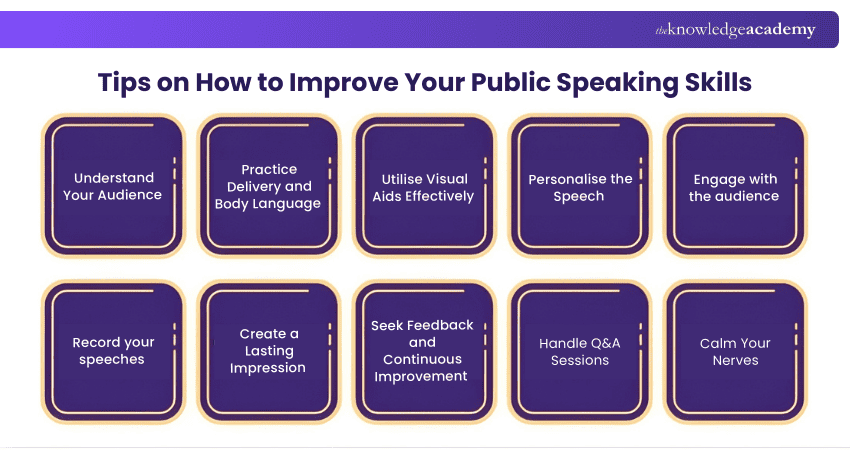
Following the 3 P's Of Public Speaking, namely Preparation, Practice, and Performance, can significantly enhance your confidence and delivery. The following 10 tips will show you How to Improve your Public Speaking Skills:
1) Understand Your Audience
This is the first step in learning How to Improve your Public Speaking Skills. Acknowledging the people you are speaking to is very important. Pay attention to the sociodemographic details of your audience, their age and backgrounds in specific. That way you may appropriate your speech accordingly for it to resonate better.
2) Practice Delivery and Body Language
Everyone experiences physical signs of nervousness, such as a racing heartbeat or shaky hands. Try not to interpret these sensations as a sign that you will perform badly. A little nervous energy can be helpful; the same adrenaline that makes you sweat also sharpens your focus and boosts your performance. Consider the following:
a) Rehearse your presentation to become familiar with the content and flow
b) Use vocal variety to engage your audience and emphasise key points
c) Maintain eye contact to connect with your audience and build rapport
d) Use gestures and body language to enhance your message and express Confidence in Public Speaking
e) Be aware of your posture in order to convey authority and presence
f) Practice controlling nervous habits and facial expressions for a composed delivery

3) Utilise Visual Aids Effectively
This is among the most effective tips to improve Public Speaking Skills. Visual aids can enhance the impact and understanding of your message. Use PowerPoint slides, charts, or props to support your speech, but use them sparingly and strategically. Visual aids should complement your speech, not overshadow it. Keep them simple, uncluttered, and visually appealing. Here are some additional ways to improve Public Speaking skills and help you implement Visual Communication aids effectively:
a) Choose appropriate visual aids that align with your message and presentation style
b) Keep visual aids simple and clear, avoiding clutter and using concise text
c) Use visuals to enhance understanding, clarify complex information
d) Incorporate visual aids strategically to reinforce key messages or emphasise important concepts
e) Interact with visual aids to increase engagement and create a dynamic experience
f) Practice using visual aids and ensure proper timing for their introduction
Unlock the power of effective communication and elevate your skills with our comprehensive Effective Communication Skills Training – sign up now!
4) Personalise the Speech
Engaging with your audience is more effective when you let your personality and unique flair shine through. Whether you’re naturally humorous or empathetic, being authentic can make your message more impactful. When using a PowerPoint presentation, avoid reading it word for word. Instead, use images and videos to make your content more dynamic and engaging. Conclude your presentation with your contact information, allowing your audience to reach out to you afterwards.
5) Engage with the audience
Engaging with the audience helps create a connection and keeps their attention. Eye contact with the individuals in the room is important. Shift your gaze naturally. Involve the audience by asking rhetorical questions, encouraging participation, or incorporating interactive elements. Involving them in your speech creates a more dynamic and memorable experience. The following additional tips on how to build Public Speaking Skills will help you out:
a) Start with a strong opening to capture their attention
b) Encourage audience participation through questions or interactive elements
c) Use storytelling to connect with their emotions and make your message relatable
d) Incorporate visuals and multimedia to enhance engagement
e) Pause for audience reactions and feedback
f) Maintain a conversational tone and address individuals directly
g) Adapt your presentation based on their reactions and level of understanding
6) Record your speeches
Remember to film your speeches for future references. This will help you revisit the speech to see yourself from a third person view and identify the parts that you need to further work on. If you are doing it over a videocall setting, you will have the option to record the call as well.
Learn the art of effective communication and master the skill of Assertiveness. Join our Assertiveness Skills Training – Sign up today for achieving a better career.
7) Create a Lasting Impression
Once you're off the pedestal, make sure the words you have said remain in the minds of your audience. Prepare your speech in a way that you perfectly conclude it with all the highlights of the speech for your audience to take back from it.
8) Seek Feedback and Continuous Improvement
Feedback is invaluable as far as improving your Public Speaking Skills is concerned. Seek feedback from trusted colleagues, mentors, or even audience members after your speeches. Analyse their input, identify areas for improvement, and incorporate their suggestions into your future speeches.
Actively seek opportunities to practice your speaking skills, whether it's through joining speaking clubs, attending workshops, or volunteering for speaking engagements. Continuously striving for improvement will ensure steady progress over time. This process is an essential part of How to Improve Verbal Communication.
9) Use Humour, Tell Stories, and Use Effective Language
Adding a light-hearted anecdote can instantly capture your audience’s attention. People naturally connect with personal stories because they make your message more relatable and memorable. Well-chosen language improves clarity and impact, helping your ideas resonate more strongly. Sharing experiences that feel genuine builds trust and keeps listeners engaged throughout your presentation.
10) Have Coping Skills in Place for when Nerves Hit
Even with thorough preparation, it’s completely natural to feel anxious during your presentation. If nerves strike, pause and take a deep breath and remember that your audience does not expect perfection.
Put your focus on creating a genuine connection rather than delivering the most flawless performance. Maintaining perspective helps you stay grounded and, as mentioned above, a touch of humour can ease tension and remind your audience that you’re human too.
The Importance of Developing Your Public Speaking Skills
Strong Public Speaking skills are important because they support growth in many areas of life. Beyond advancing your career, being able to communicate confidently and clearly helps you accomplish the following:
a) Strengthen teamwork and collaboration
b) Express ideas and suggest solutions
c) Gain respect from colleagues and leaders
d) Build connections that open new opportunities
e) Improve your listening skills to show the same respect you seek
These abilities carry over into many other personal and professional settings, thus boosting relationships and overall success.
Design messages that speak louder than text. Learn how in our comprehensive Visual Communication Course - Sign up now!
What Should be Avoided Before Your Speech?
Here are some things to be considered before your speech:
a) Avoid Skipping Rehearsal Before Your Speech: Insufficient practice often results in unclear delivery, awkward pauses or a lack of confidence when presenting your main ideas.
b) Do not Rely Entirely on Your Slides: Overcrowded or text-heavy visuals can distract the audience and dampen the impact of your spoken message.
c) Avoid Speaking too Quickly or too Slowly: Improper pacing can make it difficult for the listeners to understand your points or stay engaged throughout the presentation.
d) Do not Avoid Eye Contact with Your Audience: Failing to make eye contact can make the speaker appear disconnected. This can reduce trust and audience engagement.
e) Avoid Giving a Speech Without a Clear Structure: A disorganised presentation makes it harder for people to follow your ideas and remember key takeaways.
What do the Five P's of Public Speaking Stand for?
Here are the five P's of Public Speaking:
a) Planning: Define your purpose, audience and key message to build a strong foundation for your speech.
b) Preparation: Gather information and organise your content for clarity and impact.
c) Practice: Rehearse your delivery multiple times to build confidence and smooth out the transitions.
d) Performance: Deliver your message with confidence to engage your audience effectively.
e) Passion: Speak with genuine enthusiasm and authenticity to inspire and hold your audience’s attention.
Conclusion
Learning How to Improve Public Speaking is a journey built on small, steady improvements. With thoughtful preparation, persistent practice and a willingness to step outside your comfort zone, Public Speaking becomes far easier than you imagine. So embrace your unique voice, connect with your audience and let your message shine.
Want to take your communication skills to new heights? Explore our Communication Skills Courses now and become a successful Public Speaker!
Frequently Asked Questions
Why is it Important to Prepare for a Presentation?

If you are unprepared for a presentation, you are likely to make errors in your delivery that may end up conveying the wrong message. Besides, it is considered very unprofessional not to prepare for a presentation.
What is the 5/5/5 Rule for Better Presentation?
The 5/5/5 rule suggests that your presentation should have five slides that convey your message. Each slide must have five lines that consist of 5 words in each line. This helps keep the presentation short and simple.
What are the Other Resources and Offers Provided by The Knowledge Academy?
The Knowledge Academy takes global learning to new heights, offering over 3,000+ online courses across 490+ locations in 190+ countries. This expansive reach ensures accessibility and convenience for learners worldwide.
Alongside our diverse Online Course Catalogue, encompassing 17 major categories, we go the extra mile by providing a plethora of free educational Online Resources like Blogs, eBooks, Interview Questions and Videos. Tailoring learning experiences further, professionals can unlock greater value through a wide range of special discounts, seasonal deals, and Exclusive Offers.
What is The Knowledge Pass, and How Does it Work?
The Knowledge Academy’s Knowledge Pass, a prepaid voucher, adds another layer of flexibility, allowing course bookings over a 12-month period. Join us on a journey where education knows no bounds.
What are Related Courses and Blogs Provided by The Knowledge Academy?
The Knowledge Academy offers various Communication Skills Courses including the Assertiveness skills Training, Public Speaking Course and the Effective Communication Skills Training. These courses cater to different skill levels, providing comprehensive insights into Types of Communication Skills.
Our Business Skills Blogs cover a range of topics related to Public Speaking, offering valuable resources, best practices, and industry insights. Whether you are a beginner or looking to advance your Public Speaking skills, The Knowledge Academy's diverse courses and informative blogs have got you covered.

Charlotte Wilson


Soft Skills and Business Training Manager
Charlotte Wilson is an expert in soft skills development, with over 14 years of experience helping individuals and teams improve communication, productivity and emotional intelligence in the workplace. Her training content is focused on enhancing interpersonal effectiveness and fostering positive, collaborative environments across all levels of an organisation.
View Detail
Upcoming Business Skills Resources Batches & Dates
Date
 Public Speaking Course
Public Speaking Course
Fri 17th Jul 2026
Public Speaking Course
Fri 16th Oct 2026

 If you wish to make any changes to your course, please


