


We may not have the course you’re looking for. If you enquire or give us a call on 01344203999 and speak to our training experts, we may still be able to help with your training requirements.
Storytelling Techniques for Better Audience Engagement
ByCharlotte WilsonLast updated on: 27 October 2026
Storytelling techniques are structured ways of shaping ideas, experiences, and messages into engaging narratives. Different approaches can create tension, curiosity, contrast, or emotional connection, helping storytellers choose a structure that suits their audience and purpose.

In This Blog
1) Understand how storytelling techniques can improve audience engagement.2) Explore eight storytelling approaches with practical examples and applications.3) Discover the key elements that give stories structure and meaning.4) Learn best practices for creating clear and engaging narratives.5) Identify common storytelling mistakes that can weaken audience interest.
Stories can make ideas easier to follow, remember, and relate to. Whether used in writing, presentations, marketing, education, or leadership, the way a story is structured can influence how effectively the audience connects with its message.
Storytelling techniques help shape this connection by building suspense, revealing information gradually, showing transformation or connecting several perspectives. In this blog, we will explore eight storytelling techniques, best practices and mistakes to avoid. Let's get started!
8 Classic Storytelling Techniques
Different storytelling techniques shape how a narrative unfolds and how the audience experiences it. Some create suspense, some highlight transformation, and others connect different ideas around one message. Understanding these approaches can help you choose the most effective structure for your message, audience, and purpose.
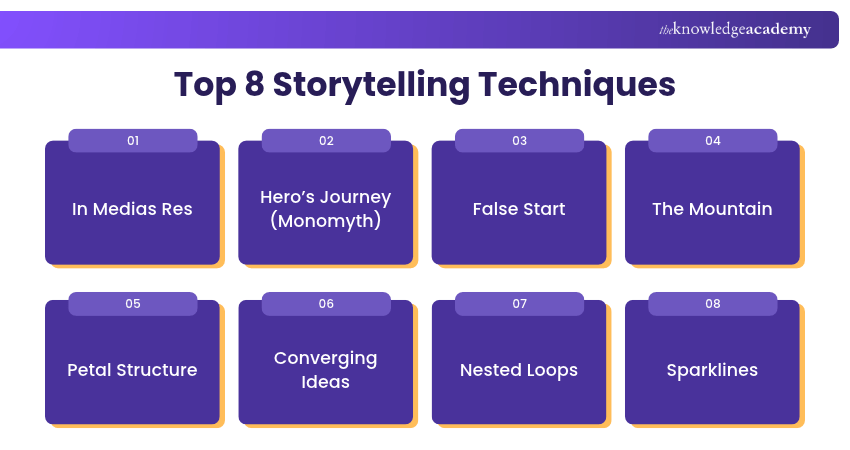
1) In Medias Res
In this technique, the story starts in the middle of an important event rather than explaining everything from the beginning. To use it effectively, open with a moment of tension, urgency, or conflict, then gradually reveal the events that led to that point.
Best Used For: Thrillers, presentations, short-form videos, campaign stories, and suspense-driven content.
Scene Example: A presentation opens with a project team watching a system fail minutes before launch. The speaker then moves back three months to explain the decisions and warning signs that led to the crisis.

2) Hero’s Journey (Monomyth)
Hero’s Journey or Monomyth follows a character who leaves a familiar situation, faces challenges, learns from the experience, and returns changed. To apply it, focus on the transformation created by the journey rather than simply describing a sequence of events.
Best Used For: Leadership journeys, personal development stories, brand transformation, and motivational storytelling.
Scene Example: In Harry Potter and the Philosopher’s Stone, Harry leaves his unhappy life with the Dursleys to enter the wizarding world. At Hogwarts, he forms friendships, faces challenges and confronts Voldemort. He returns to the Dursleys with greater confidence, a sense of belonging and a new understanding of his identity.
3) False Start
A false start leads the audience in an expected direction before interrupting the narrative and restarting it from a different perspective. Use it by establishing an assumption early, then introducing new information that prompts you to revisit the story and explain what really happened.
Best Used For: Brand stories, awareness campaigns, lessons learned, and creative presentations.
Scene Example: “We launched the app, gained 10,000 downloads and thought we had succeeded. This should be a success story. It isn’t. Let me start again.” The founder returns to the first customer interviews, explaining how the team ignored concerns that later caused users to abandon the app.
Trainer’s Pro Tip
Choose a storytelling technique based on the effect you want to create, not just the format you prefer. For example, use immediate action to spark curiosity, contrast to encourage change, or an unexpected shift to challenge audience assumptions.
4) The Mountain
The Mountain develops a story through a series of increasingly difficult challenges that build towards a climax. To use it effectively, raise the stakes gradually so that each obstacle feels more significant than the last.
Best Used For: Personal journeys, case studies, motivational talks, and project stories.
Scene Example: A startup first struggles to attract customers, then loses a major investor, faces a technical failure, and finally reaches the breakthrough that allows the business to survive.
5) Petal Structure
The petal structure uses several separate stories that all connect to one central idea. To apply it, present different experiences or viewpoints independently and bring each one back to the same core message.
Best Used For: Panel discussions, interviews, campaign content, and multi-perspective storytelling.
Scene Example: A leadership event features employees from sales, operations, and customer service sharing different experiences, with every story showing how collaboration improved results.
6) Converging Ideas
The converging ideas technique begins with separate narrative threads that gradually come together. Use this approach when different events, people, or perspectives need to connect at a shared conclusion.
Best Used For: Documentaries, innovation stories, organisational case studies, and collaborative projects.
Scene Example: One storyline follows changing customer expectations, another explores new technology, and a third focuses on internal process problems. By the end, all three explain why the organisation launched a new digital service.
7) Nested Loops
Nested loops layer several stories within one another around a central message. To use this technique, begin with an outer story, open another narrative before completing it, and place the core insight in the innermost story. Then finish the stories in reverse order, returning to the opening narrative last.
Best Used For: Educational content, reflective speeches, founder stories, and thought leadership.
Scene Example: A CEO starts with the story of the company's founding, introduces customer and employee success stories along the way, and then returns to the original story to reinforce the organisation's mission.
8) Sparklines
Sparklines build a story by contrasting the current situation with a more desirable future. To apply this technique, move between what exists now and what could be possible, helping the audience recognise the gap and understand why change matters.
Best Used For: Leadership communication, change initiatives, motivational speeches, and persuasive presentations.
Scene Example: A marketing campaign highlights the gap between customers' current struggles with personal finance and the ease they could achieve using a budgeting app, motivating them to take action.
Quick Match: Choose the Technique
a) Start in the middle of the action → In Medias Resb) Personal transformation → Hero’s Journeyc) Unexpected change of direction followed by a restart → False Startd) Gradually increasing tension → The Mountaine) Multiple stories around one theme → Petal Structuref) Separate narratives meeting later → Converging Ideasg) Stories within stories, completed in reverse order → Nested Loopsh) Present vs possible future → Sparklines
Communicate more effectively through memorable narratives with our Storytelling for Marketers Training – Join today!
Best Practices for Effective Storytelling
Strong storytelling depends not only on the structure you choose but also on how clearly and deliberately you develop the narrative. The following practices can help maintain audience interest:
1) Define the Core Message: Know the main idea or takeaway before developing the story.
2) Choose the Right Structure: Select a storytelling technique that fits the purpose, audience, and message.
3) Create Audience Relevance: Use situations, examples, and language that connect with the people you are addressing.
4) Use Strong Narrative Progression: Make sure each part of the story moves naturally towards the next.
5) Balance Detail and Pace: Include enough detail to create interest without slowing the story unnecessarily.
6) Use Emotion Purposefully: Build an emotional connection where it supports the message rather than forcing it.
7) End With Meaning: Close with a takeaway, reflection, or outcome that reinforces the story’s purpose.
Common Storytelling Mistakes to Avoid
Even a good idea can lose impact if the story is difficult to follow or disconnected from its audience. Watch for these mistakes when reviewing your narrative:
1) Leaving Out Essential Context: Failing to explain who is involved or what is at stake can make the story difficult to understand.
2) Introducing Details Without Following Them Up: Giving an object, character or event particular importance without explaining its relevance can leave the audience expecting an unresolved development.
3) Relying on Stereotypes: Using familiar assumptions about people or groups can make characters feel one-dimensional and alienate the audience.
4) Changing Timelines Without Clear Signals: Moving between past and present without clear cues can make the sequence of events confusing.
5) Presenting Fiction as Fact: Sharing invented events or dialogue as genuine experiences can undermine credibility. Clearly identify fictional or illustrative scenarios.
6) Overexplaining the Lesson: Repeatedly stating what the audience should learn can weaken the ending. Let the events and outcome help communicate the message.
Strengthen your storytelling skills and turn ideas into compelling narratives with our Creative Writing Course – Join today!
Storytelling Checklist
Before finalising a story, check whether it has:a) A clear purpose or central messageb) Characters or perspectives the audience can followc) A logical narrative structured) Meaningful conflict or tensione) Relevant details and settingf) A consistent point of viewg) A conclusion that reinforces the theme

Charlotte Wilson creates Business Skills content that helps professionals communicate more effectively, manage workplace pressures and collaborate with others. Her practical resources support stronger professional relationships, individual effectiveness and positive team behaviour.
View Detail

 If you wish to make any changes to your course, please


