


 Top Rated Course

We may not have the course you’re looking for. If you enquire or give us a call on + 1-866 272 8822 and speak to our training experts, we may still be able to help with your training requirements.
What is Revenue Management: Stages, Strategies, and Best Practices
The Knowledge Academy 10 February 2026Revenue Management uses data and forecasting to optimise pricing, availability and distribution, maximising profit from fixed inventory in dynamic markets. It uses data analysis to predict consumer behaviour, manage demand, and allocate capacity. It reduces waste, improves accuracy and enhances operational efficiency.

Training Outcomes Within Your Budget!
We ensure quality, budget-alignment, and timely delivery by our expert instructors.
Table of Contents

As customers, we’ve all noticed how prices can change overnight. Hotel rooms that cost more on weekends or flights that jump in price after a few clicks. Behind these shifts lies a smart system called Revenue Management, quietly shaping every purchase decision we make. For businesses, it’s not just about charging more.
It is about aligning price, demand, and timing to maximise profit without losing customer trust. It helps businesses forecast demand, identify market trends, and make smart pricing decisions. In this blog, you can explore What is Revenue Management, its key stages, and best practices you can adopt to enhance your organisation’s profitability. Let's dive in!
Table of Contents
1) What is Revenue Management?
2) Importance of Revenue Management
3) Eight Stages of Revenue Management
4) Strategies for Effective Revenue Management
5) Revenue Management KPIs and Metrics
6) Differences Between Revenue Management and Yield Management
7) Tips for Successful Revenue Management
8) What are the Seven Core Principles of Revenue Management?
9) How to Choose a Revenue Management System?
10) Conclusion
What is Revenue Management?
Revenue Management is the process of using data analysis to predict customer demand and set the best prices to earn the most revenue. It is often called the art and science of “selling the right product to the right customer at the right price.” It means adjusting how and when you sell a product or service to match what customers want and how much they’re willing to pay.
You need to find the perfect balance between price, timing, and demand to make the most out of what your business offers. This helps you increase profits, fill capacity, and stay competitive in changing markets. Key aspects of Revenue Management include:
1) Demand forecasting
2) Dynamic pricing
3) Market segmentation
4) Inventory control
5) Performance analysis

Importance of Revenue Management
Revenue Management is important because it helps businesses earn more money, make smarter choices, and keep customers happy. Below are some of its other benefits:
1) Better Decisions With Data: It uses data analytics to understand customer behaviour and set the right prices instead of relying on guesses.
2) Steady Business Growth: Businesses can focus on things they can control, like pricing and timing to achieve steady and reliable revenue.
3) Accurate Demand Prediction: It helps companies predict when customers will buy more or less so they can plan ahead and make the most of busy seasons.
4) Higher Profits: By adjusting prices based on demand, businesses can earn more during peak times and reduce losses during slow periods.
5) Happier Customers: When prices and offers match what customers need, they feel understood and valued, which builds trust and loyalty.
6) Smarter Use of Resources: It ensures that staff, inventory and capacity are used efficiently, avoiding waste and improving performance.
7) Staying Competitive: Companies that use Revenue Management can quickly respond to market changes and stay ahead of competitors.
Eight Stages of Revenue Management
Here are the eight simple stages that make up the process of Revenue Management:
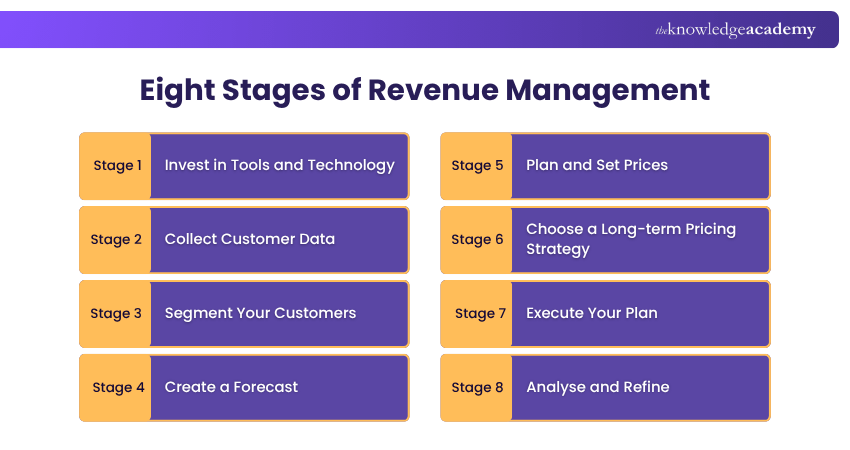
1) Invest in Tools and Technology
To manage revenue effectively, businesses need the right Revenue Management Systems, software and tools. Modern software can collect and analyse data faster and more accurately than spreadsheets. It also helps automate tasks and provide real-time insights.
2) Collect Customer Data
The next step is to gather useful data about your customers and the market. You can focus on:
1) Past Data: Previous sales and inventory records
2) Buying Habits: How often and when customers make purchases
3) Market Trends: Seasonal changes or competitor pricing
3) Segment Your Customers
Once you have the data, you need to divide your customers into smaller groups based on common specifications like location, spending habits or timing. This helps you create personalised offers and pricing for your customers.
4) Create a Forecast
Forecasting means predicting the future demands of the people. This can be done by studying past data and current trends. With that, you can also estimate when sales will rise or fall. This will make you plan your inventory better.
5) Plan and Set Prices
Use your data and forecasts to decide on the best pricing plan. Be flexible so you can adjust when market conditions change. Avoid setting prices too low or too high since both can affect your revenue and customer trust.
6) Choose a Long-term Pricing Strategy
Select a pricing approach that fits your goals. Common pricing strategies include:
1) Dynamic Pricing: Prices change in real time based on demand
2) Inventory Management: Adjusting stock levels based on customer demand
3) Competitive Pricing: Matching or slightly undercutting competitors
4) Bundle Pricing: Selling products together at a discount
5) Cost-plus Pricing: Adding a set margin to production costs
6) Price Skimming: Starting high, then lowering prices over time
7) Penetration Pricing: Offering very low prices to attract new customers
7) Execute Your Plan
Once your plan is ready, you can share it with your Sales and Marketing teams. After that, you have to train them on new prices, offers and how to handle customer questions or objections to the new price levels.
8) Analyse and Refine
After implementing new prices, review your results. Look at sales numbers, customer feedback and performance data. Make changes where you need to improve the next time. For that, you can use metrics such as revenue growth, conversion rates and customer feedback.
Analyse markets to build a strong foundation in finance with our Investment Management Course – Register today!
Strategies for Effective Revenue Management
Let’s explore some of the most effective Revenue Management techniques for increasing profits:
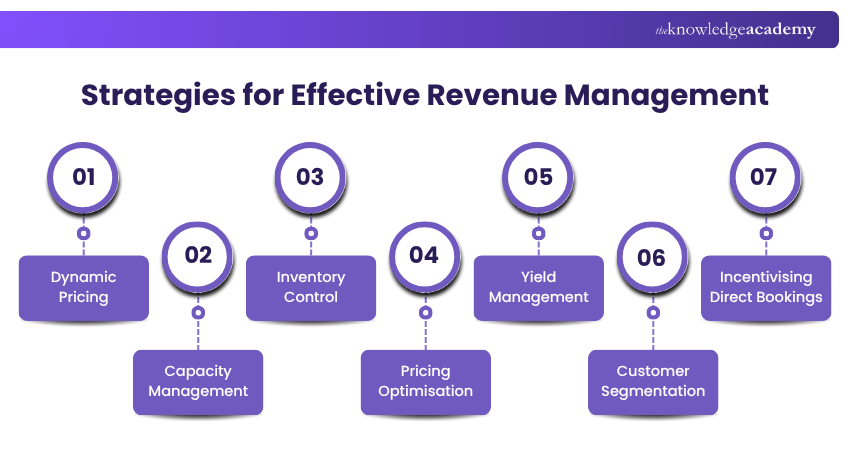
1) Dynamic Pricing
Dynamic Pricing is also termed demand-based pricing. In this pricing technique, companies usually adjust their product pricing to compensate for real-time demand.
For example, an airline will use demand-based pricing to increase ticket prices during peak hours of demand, such as major events or holidays.
2) Capacity Management
Capacity Management is the computation of how much of a service or product a business can manufacture for sale. This is done to ensure their services and products are sufficient, which could lead to happy customers and loss of revenue.
To manage capacity effectively, businesses should have a sound understanding of their production abilities and customer demand. To create additional revenue streams, they can identify a non-productive area and capitalise it.
3) Inventory Control
Inventory control allows businesses to have the right combination of services and products in stock to manage customer demand. This helps them minimise costs, enhance customer satisfaction, and double profits.
Inventory control is primarily seen in the hospitality industry because it deals with factors like supplier delivery schedules, customer demand, etc.
Grow and protect your wealth effectively with our Investment and Portfolio Management Course – Join now!
4) Pricing Optimisation
Pricing optimisation helps calculate the optimal price for a service or product. It analyses various factors like production costs, price elasticity, competitor prices, and customer demand.
By implementing this strategy, businesses can achieve Profit Maximisation and Wealth Maximisation, ensuring they strike the right balance between competitive pricing and maximising revenue.
5) Yield Management
Yield Management is another pricing strategy designed for businesses with time-sensitive or perishable inventory. It focuses on adjusting prices based on demand, availability and timing to maximise revenue from limited resources.
This approach relies heavily on Data Analysis and forecasting to understand customer purchasing patterns. For example, businesses might raise prices when demand is high or offer discounts during slower periods to fill capacity.
6) Customer Segmentation
Customer segmentation divides your target audience into groups based on factors like needs, behaviour, and demographics. It allows businesses to have a better understanding of their customer so that they can create customised messages well. It also sets prices for maximum profits.
This targeted approach not only increases customer satisfaction but also improves conversion rates and brand loyalty. You can tailor your offers, communication and promotions more effectively to the customers' needs.
7) Incentivising Direct Bookings
Some businesses allow direct booking rather than through a third-party site. This strategy helps them save on fees and offer a good experience to their customers. Some of the ways a business incentivises direct booking include offering exclusive deals, loyalty rewards, and discounts.
Direct booking incentives also strengthen customer relationships by keeping communication within the brand’s ecosystem. Over time, this approach gives the business more control over customer data and service quality.
Revenue Management KPIs and Metrics
To measure the success of Revenue Management strategies, businesses rely on Key Performance Indicators (KPIs) and metrics that track performance, efficiency and profitability. Here are some of the most important KPIs and metrics used in Revenue Management:

a) Average Daily Rate: This refers to the average revenue per unit for a single day. It doesn’t include unrented periods and other income sources. It can serve as a good indicator of the pricing power of an offering.
b) Occupancy: It refers to the percentage of units rented over a given period. For example, how full a hotel is during the day or night.
c) Revenue Per Available Room (RevPAR): It works in accordance with average daily rate and occupancy. Using RevPAR, hotels can find out how much each room is generating. This metric can be generalised for any rental business.
d) Average Revenue Per Account (ARPA): This refers to the revenue per customer, which is calculated monthly.
e) Profit Per Unit: It can take up many forms, like per vehicle, per airplane, or profit per room, depending on the industry type. For example, in the hotel industry, Gross Operating Profit Per Available Room (GOPPAR) is used.
f) Customer Acquisition Cost (CAC): It calculates how much it costs to acquire a new customer, helping assess marketing efficiency.
g) Booking Pace: Tracks how quickly bookings are being made over time. It helps businesses identify demand patterns and adjust pricing early.
h) Cancellation Rate: Measures the percentage of reservations or purchases that are cancelled before fulfilment, highlighting potential forecasting or pricing issues.
Learn how to navigate currency markets with our Foreign Exchange Training – Sign up soon!
Differences Between Revenue Management and Yield Management
Yield Management and Revenue Management are two widely discussed approaches when it comes to maximising revenue. However, both aim to boost the profitability of a business. Let’s understand both one by one via an example of a hotel:

Understanding Yield Management
Yield Management emphasises boosting revenue by selling rooms to the right customers at a reasonable price. The Yield Management System will assess internal data like demand levels, room segments, pricing, and historical data.
Using this data, the system will make decisions on pricing and grab revenue opportunities. Since the system depends on a rule-based model, it has limited adaptability to market dynamics.
Understanding Revenue Management
Revenue Management utilises systems to maximise revenue instead of getting into internal Data Analysis. It will integrate real-time data from the external market to calculate accurate prices that align with supply/demand fluctuations.
In general, RMS uses Artificial Intelligence Algorithms to gather, assess, and process market data about local events, demand, pricing, etc. After careful consideration, RMS will offer precise pricing advice.
Tips for Successful Revenue Management
Let’s explore some of the tips to succeed in Revenue Management and thrive in your industry:
a) Flex Room Rates: Practice dynamic pricing to increase the price when the demand is high and decrease the rates when the demand is low. This can boost the occupancy rates and overall revenue.
b) Limit Stay Restrictions: Optimise your Inventory Management and tighten the stay restrictions when the demand is high. Similarly, the stay restrictions should be loosened when the market is low.
c) Diversify: Don’t rely on specific types of guests. Try to have a balanced mix by targeting different customers.
d) Manage Booking Channels: To achieve high occupancy levels, manage multiple booking channels like bed banks, social media sites, Wholesalers, websites, and metasearch engines.
e) Use Management Technology: A Revenue Management system will help businesses save time, grab revenue opportunities, and improve decision-making. It can gather and sort real-time data.
What are the Seven Core Principles of Revenue Management?
The seven core principles of Revenue Management help businesses understand and respond to customer demand to earn more and stay competitive. They include:
1) Understanding how the market works
2) Grouping customers by their value
3) Predicting demand accurately
4) Managing product availability
5) Using flexible pricing
6) Tracking performance with key metrics
7) Improving strategies regularly using data and feedback
How to Choose a Revenue Management System?
While choosing a Revenue Management System (RMS), choose one that fits your business type and industry. It should be easy to use, work well with your existing tools and match your business goals. Go for features you actually need instead of paying for complex ones you won’t use. A good RMS helps you track demand, adjust prices quickly and make smart decisions based on real-time data.
Conclusion
Revenue Management is about understanding customers, predicting demand and using data to make smarter business decisions. By applying its core principles and tracking the right performance metrics with a clear understanding of What is Revenue Management, companies can optimise revenue and improve efficiency in an evolving market.
Make confident financial decisions in any market with our Investment and Trading Training – Explore immediately!
Frequently Asked Questions
What is an Example of Revenue Management?

A common example of Revenue Management is airlines adjusting ticket prices based on demand, season and booking time. They will be charging higher fares during peak travel periods and offering discounts during slower seasons.
What is the Role of a Revenue Manager?
The Revenue Manager implements their financial knowledge to evaluate the impact of evolving market conditions on a company’s revenue. They apply pricing strategies to enhance the performance of a business.
What are the Other Resources and Offers Provided by The Knowledge Academy?
The Knowledge Academy takes global learning to new heights, offering over 3,000+ online courses across 490+ locations in 190+ countries. This expansive reach ensures accessibility and convenience for learners worldwide.
Alongside our diverse Online Course Catalogue, encompassing 19 major categories, we go the extra mile by providing a plethora of free educational Online Resources like Blogs, eBooks, Interview Questions and Videos. Tailoring learning experiences further, professionals can unlock greater value through a wide range of special discounts, seasonal deals, and Exclusive Offers.
What is The Knowledge Pass, and How Does it Work?
The Knowledge Academy’s Knowledge Pass, a prepaid voucher, adds another layer of flexibility, allowing course bookings over a 12-month period. Join us on a journey where education knows no bounds.
What are the Related Courses and Blogs Provided by The Knowledge Academy?
The Knowledge Academy offers various Investment and Trading Training, including the Revenue Management Training, Real Estate Financial Modelling Training, and Bookkeeping Course. These courses cater to different skill levels, providing comprehensive insights into Bonds.
Our Business Skills Blogs cover a range of topics related to Revenue Management, offering valuable resources, best practices, and industry insights. Whether you are a beginner or looking to advance your Revenue Management skills, The Knowledge Academy's diverse courses and informative blogs have got you covered.

The Knowledge Academy


Global Training Provider
The Knowledge Academy is a world-leading provider of professional training courses, offering globally recognised qualifications across a wide range of subjects. With expert trainers, up-to-date course material, and flexible learning options, we aim to empower professionals and organisations to achieve their goals through continuous learning.

Upcoming Business Skills Resources Batches & Dates
Date
 Revenue Management Training
Revenue Management Training
Fri 3rd Apr 2026
Revenue Management Training
Fri 15th May 2026
Revenue Management Training
Fri 17th Jul 2026
Revenue Management Training
Fri 13th Nov 2026

 If you wish to make any changes to your course, please


