




We may not have the course you’re looking for. If you enquire or give us a call on 800969236 and speak to our training experts, we may still be able to help with your training requirements.
What is a Matrix Organisational Structure: A Complete Guide
The Knowledge Academy 21 April 2026A Matrix Organisational Structure is a model where employees report to Functional and Project Managers, allowing employees to work across multiple teams. It enhances flexibility, resource sharing, and collaboration. When implemented well, it can significantly improve productivity and project outcomes for smoother workflows.

CIPD Level 5 Associate Diploma in Organisational Learning and Development Course
 Top Rated Course
Top Rated Course
Exclusive 40% OFF
Training Outcomes Within Your Budget!
We ensure quality, budget-alignment, and timely delivery by our expert instructors.
Table of Contents
In modern organisations, teams work across departments, handle multiple projects, and report to more than one leader. That is where Matrix Organisational Structure comes into the picture. This structure connects people by both function and project, assisting businesses to stay flexible and use their skillset effectively.
Understanding this structure helps managers, team members, and business owners to eliminate confusion and improve collaboration. It explains who reports to whom, how decisions are made, and how resources are shared across teams. In this blog, you will learn about Matrix Organisational Structure, how it works, its types, benefits, and more!
Table of Contents
1) What is a Matrix Organisational Structure?
2) How Do Matrix Organisations Work?
3) Types of Matrix Organisational Structure
4) Advantages of a Matrix Organisational Structure
5) Disadvantages of Matrix Organisational Structure
6) Can Small Companies Use a Matrix Structure?
7) What is the Most Difficult Thing About Working in a Matrix Organisation?
8) Conclusion
What is a Matrix Organisational Structure?
A Matrix Organisational Structure is a type of organisational model that combines both functional and project-based structures. In this structure, employees report to two managers instead of one. Generally, one manager oversees their functional role, while the other manages the specific projects they are working on. This dual reporting system helps organisations use specialised skills while focusing on broader project goals.

How do Matrix Organisations Work?
Matrix Organisational Structure operate by assigning employees with dual reporting lines, typically one based on their functional role (such as HR, finance, or engineering) and another based on the project or initiative they support.
Functional managers oversee long-term development, training, and workload, while Project Managers focus on day-to-day tasks and deliverables. Here, work is coordinated through regular communication, shared planning, and resource allocation to ensure projects meet deadlines without compromising functional responsibilities.
Types of Matrix Organisational Structure
A Matrix Organisational Structure exists on a spectrum based on how much authority Functional Managers and Project Managers hold. Each type changes how decisions are made, how resources are controlled, and how employees receive direction. Let’s look at its types below:

1) Weak Matrix Structure
In this type of Matrix Organisational Structure, Functional Managers hold most of the authority. Project Managers act mainly as coordinators and have limited control over budgets, timelines, or team members. Team members remain strongly aligned with their functional departments.
Key Takeaways:
1) Functional Managers control budgets, priorities, and performance reviews.
2) Project Managers support scheduling and communication.
3) Department goals come before the project authority.
Why It Works Best:
It works best for organisations moving from a traditional hierarchy because it adds collaboration without major power changes.
Most Suitable For:
1) Small or early-stage organisations.
2) Short-term or low-risk projects.
3) Teams where functional expertise is the primary focus.
2) Balanced Matrix Structure
In this type of Matrix Organisational Structure, authority is shared between Functional Managers and Project Managers. Both leaders guide employees, allocate resources, and make decisions collaboratively. Power and responsibility are distributed more evenly in this structure.
Key Takeaways:
1) Functional and Project Managers share decision-making power.
2) Employees receive direction from both leaders.
3) Decisions are made through collaboration.
Why It Works Best:
It supports companies that require strong project delivery while keeping functional leadership important and active.
Most Suitable For:
1) Mid-sized organisations.
2) Teams running multiple complex projects.
3) An Environment that needs cross-functional teamwork.
3) Strong Matrix Structure
In this Matrix Organisational Structure type, Project Managers have greater authority than Functional Managers. They control budgets, staffing, and daily execution. Here, Functional Managers mainly provide technical guidance and skill development.
Key Takeaways:
1) Project Managers lead decisions and execution.
2) Functional Managers act as subject experts and mentors.
3) Employees are aligned with project goals rather than departmental tasks.
Why It Works Best:
It enables faster decision-making and clear accountability, which is useful when project results directly impact business success.
Most Suitable For:
1) IT, consulting, construction, and engineering sectors.
2) Large pr high-stakes projects,
3) Organisations that require fast and decisive project delivery.
Elevate your People Management strategies and boost organisational excellence with our CIPD Level 7 Advanced Diploma in Strategic People Management – Lead effortlessly!
Advantages of a Matrix Organisational Structure
The organisational Matrix Structure offers several advantages for modern businesses, especially those working on multiple projects. So, let’s check the advantages before executing it:
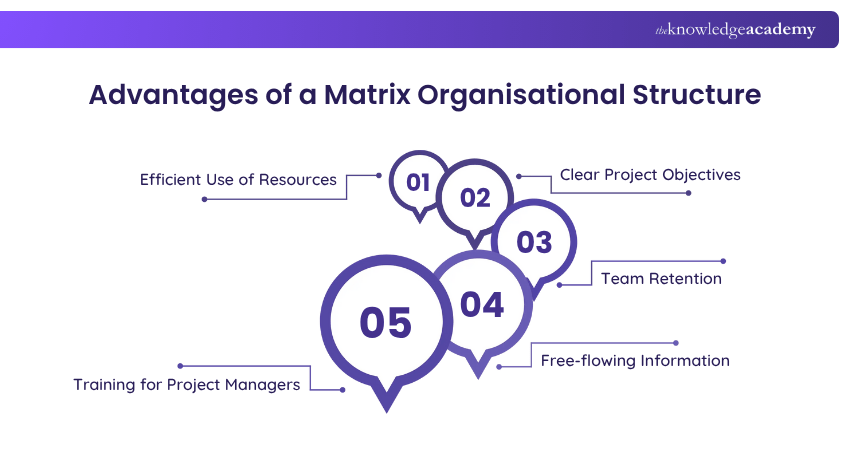
1) Efficient Use of Resources
A Matrix Structure enables efficient use of resources by allowing employees to contribute to multiple projects simultaneously. It ensures that their skills and availability are maximised. Teams can be reshuffled quickly anytime priorities shift, while shared tools and systems across departments streamline the processes. This reduces duplication of work and removes the need to hire new employees for every new project.
2) Clear Project Objectives
Within a Matrix Organisational Structure, every project begins with a clearly defined goal that aligns with the broader business strategy. These objectives are communicated to all the teams, making it easier to measure outcomes. Project Managers play a big role in keeping teams focused and on track. Subsequently, the team members develop a strong sense of purpose, knowing their work directly contributes to organisational success.
3) Team Retention
A Matrix Organisational Structure supports stronger team retention by involving employees in diverse projects. Working across departments cultivates familiarity and collaboration. This reduces stress during projects and encourages loyalty to both the team and the company. This structure creates an environment where employees feel supported and valued, resulting in low turnover rates.
4) Free-flowing Information
In a Matrix Organisational Structure, information flows more freely as teams from different areas share regular updates. This approach encourages open feedback and continuous learning, while increasing transparency across departments. With clearer communication, decisions are made faster and teamwork is strengthened.
5) Training for Project Managers
A Matrix Organisational Structure provides valuable training for Project Managers as they lead cross-functional teams and gain diverse skills. It improves their communication and conflict-resolution abilities while strengthening their planning and scheduling expertise. By managing multiple projects, Managers can increase their overall value within the organisation.
Effectively practice People Management and development with the CIPD Level 3 Foundation Certificate in People Practice – Begin your journey!
Disadvantages of Matrix Organisational Structure
Despite its advantages, the Matrix Organisation Structure has its own challenges that organisations need to manage carefully. Here are its disadvantages:
1) Potential Conflicts
When both the Functional Manager and the Project Manager share authority, their goals may not always match. One manager may push departmental targets while another focuses on project deadlines. This can leave teams stuck between completing priorities and slow progress. To reduce friction and keep direction aligned, it requires regular communication, defined decision rights, and manager training.
2) Slower Decision-making
In Matrix Organisational Structure, multiple managers are involved. This means there will be more opinions, approvals, and decisions. This complex flow of information across the department can make it harder to reach an agreement. So, to speed up execution and prevent bottlenecks, it is important to set clear decision frameworks and name a final decision owner.
3) Decreased Team Performance
Unclear responsibilities can erode morale and focus, making it more challenging for teams to remain productive. Without proper coordination, employees may duplicate work or waste time switching between tasks from different Managers. The performance slows further when expectations are unclear.
4) Confusion Over Hierarchy
In a Matrix Organisational Structure, employees may struggle to understand who holds final authority, leading to uncertainty in decision-making. Unclear roles can delay important actions and reduce confidence in leadership. This lack of clarity also leaves employees unsure about reporting lines, creating further confusion.
Boost employee engagement by incorporating development strategies with the CIPD Level 5 Associate Diploma in People Management – Join now!
Can Small Companies Use a Matrix Structure?
Yes, small companies can use Matrix Organisational Structure, but it is not always mandatory. In small teams where communication is direct and roles are clearer; a formal matrix setup may add more complexity. However, growing businesses can benefit from a light structure because it supports collaboration and flexible resource sharing. The key is to keep reporting lines simple, decision authority clear, and coordination practical to improve productivity across teams.
What is the Most Difficult Thing About Working in a Matrix Organisation?
The biggest challenge is the complexity and ambiguity that the structure inherently introduces. Since people often have multiple reporting lines and overlapping priorities, they receive conflicting directions. This leads to slow, low-quality decision-making, delays in execution, difficulty aligning incentives across teams, and frequent tension or frustration.
Conclusion
A Matrix Organisational Structure can be a powerful way to bring flexibility, collaboration, and better resource use into modern organisations. Although it comes with certain challenges, the right approach can turn it into a strong advantage. When it is designed thoughtfully, it is useful for teams to work smarter across functions and projects. This makes organisations more adaptable and better prepared for complex, fast-changing business needs.
Enhance recruitment, performance, and employee relations with our CIPD Qualifications – Register today!
Frequently Asked Questions
What is Matrix Management?

Matrix Management is a way of organising work where employees report to two or more Managers, usually a Functional and a Project Manager. It supports collaboration across departments and helps manage complex projects effectively.
Who Would Use a Matrix Structure?
A Matrix Organisation Structure is typically used by large and complex organisations, especially those managing cross-functional projects or operating across multiple regions. It is common in industries that require collaboration across departments. Companies seeking flexibility and dynamic project teams also benefit from this structure.
What are the Other Resources and Offers Provided by The Knowledge Academy?
The Knowledge Academy takes global learning to new heights, offering over 3,000+ online courses across 490+ locations in 190+ countries. This expansive reach ensures accessibility and convenience for learners worldwide.
Alongside our diverse Online Course Catalogue, encompassing 17 major categories, we go the extra mile by providing a plethora of free educational Online Resources like Blogs, eBooks, Interview Questions and Videos. Tailoring learning experiences further, professionals can unlock greater value through a wide range of special discounts, seasonal deals, and Exclusive Offers.
What is The Knowledge Pass, and How Does it Work?
The Knowledge Academy’s Knowledge Pass, a prepaid voucher, adds another layer of flexibility, allowing course bookings over a 12-month period. Join us on a journey where education knows no bounds.
What are the Related Courses and Blogs Provided by The Knowledge Academy?
The Knowledge Academy offers various CIPD Qualifications, including CIPD Level 5 Associate Diploma in Organisational Learning and Development, CIPD Level 3 Foundation Certificate in People Practice and CIPD Level 5 Associate Diploma in People Management. These courses cater to different skill levels, providing comprehensive insights into Organisational Culture.
Our Human Resource Blogs cover a range of topics related to Matrix Organisational Structure, offering valuable resources, best practices, and industry insights. Whether you are a beginner or looking to advance your Organisational skills, The Knowledge Academy's diverse courses and informative blogs have got you covered.

The Knowledge Academy


Global Training Provider
The Knowledge Academy is a world-leading provider of professional training courses, offering globally recognised qualifications across a wide range of subjects. With expert trainers, up-to-date course material, and flexible learning options, we aim to empower professionals and organisations to achieve their goals through continuous learning.

Upcoming HR Resources – Learn about Human Resources Batches & Dates
Date
 CIPD Level 5 Associate Diploma in Organisational Learning and Development Course

 If you wish to make any changes to your course, please


