


 Top Rated Course

We may not have the course you’re looking for. If you enquire or give us a call on 800969236 and speak to our training experts, we may still be able to help with your training requirements.
Binomial Distribution: Definition, Properties, and Applications
Lily Turner 04 February 2026Binomial Distribution is a discrete probability distribution that measures the number of successes in fixed independent trials with two possible outcomes. It is a core concept in data analysis and statistics to predict the likelihood of outcomes. It outlines the conditions required for a situation to recognise when and how to apply it.

Training Outcomes Within Your Budget!
We ensure quality, budget-alignment, and timely delivery by our expert instructors.
Table of Contents

Probability is essential to understand when analysing outcomes that involve chance. This is where the Binomial Distribution plays a key role in making the process simple and structured. It explains how likely an event is to happen when there are only two possible outcomes. This is widely used to turn uncertain situations into predictable results.
This concept is widely used in areas such as quality testing, healthcare research, business decision-making, and data analysis. In this blog, you will learn about the Binomial Distribution, its formulas, its importance, its real-world applications, and more. Keep reading to learn more!
Table of Contents
1) What is the Binomial Distribution?
2) Formula for Binomial Distribution
3) Importance of Binomial Distribution
4) Key Properties of Binomial Distribution
5) Real-world Applications of Binomial Distribution Across Industries
6) Common Misconceptions of Binomial Distribution
7) Conclusion
What is Binomial Distribution?
Binomial Distribution shows how likely it is for a specific outcome to occur when there are two possible outcomes in each trial. It is used to calculate the probability of achieving a specific number of successes across a fixed number of trials. This works under a few important assumptions, such as each trial must have one possible outcome and the probability of success remains the same for every trial.

Formula for Binomial Distribution
Like any other Distributions, Binomial Distribution comprises the formula to find the probability of Binary results. These can be calculated using:

Where,
1) n = the number of experiments
2) X = 0,1,2, 3, or 4
3) P = Probability of a single experiment success
4) Q = Probability of a single experiment failure (1-p)
For instance, the coin is tossed 5 times. We need to find the probability of exactly 2 heads (success), using Binomial Distribution.
To find out, we have the,
1) Exactly two heads= x=2
2) Number of trials: n=5
3) Probability of head (success): p=½
4) Probability of tail (failure), q= 1-½ = ½
Putting these values in the above formula, we have

P(x=2) = 5/16, as the final answer.
Importance of Binomial Distribution
Binomial Distribution is important since it helps to calculate the probability of success or failure in a situation. Since each trial has only two possible outcomes, it provides a clear and reliable way to measure how often a particular result is likely to occur.
Also, Binomial Distribution plays an integral role in data analysis by estimating every possible outcome and how frequently it can repeat. It supports forecasting by helping organisations understand outcomes before action, essential for planning and growth.
Perform seamless Predictive Analytics with our Predictive Analytics Course - Sign up today!
Key Properties of Binomial Distribution
Binomial Distribution carries certain levels of key properties. Here are the properties of Binomial Distribution described below:
1) The number of independent trials is fixed and has a discrete value: 1, 2, 3, or 4.
2) Each trial has two possible outcomes in the form of 0 (negative) and 1 (positive). These outcomes include true or false, success or failure, and yes or no.
3) The success or failure probability remains the same in each trial. For example, in the case of a coin toss, a 50% chance of head (success) and a 50% chance of tails (failure) are there.
4) Each trial is mutually exclusive from the others. This means that one trial does not affect the outcome of another trial.
Become a top-level Data Scientist - sign up for our Advanced Data Science Certification today!
Real-world Applications of Binomial Distribution Across Industries
Let’s look at some real-world applications of Binomial Distribution:
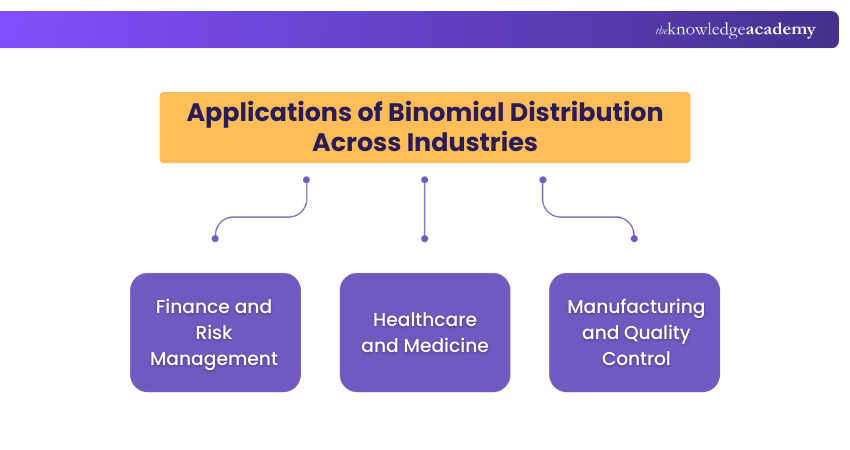
1) Finance and Risk Management: Binomial Distribution helps model investment outcomes by measuring the probability of gains and losses. It is widely used in options pricing and supports risk assessment for portfolio performance.
2) Healthcare and Medicine: Binomial Distribution is used to analyse treatment success or failure. It plays an important role in clinical trials and helps researchers study patterns in disease transmission.
3) Manufacturing and Quality Control: Manufacturers utilise Binomial Distribution to estimate defect rates and monitor production quality. It supports acceptance sampling plans to decide if a product batch meets quality standards.
Common Misconceptions of Binomial Distribution
Let’s explore some of the common misconceptions of Binomial Distribution:
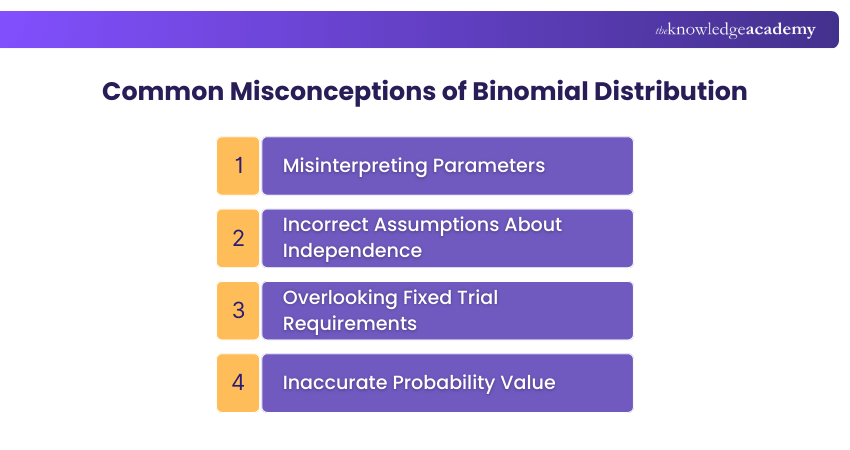
1) Misinterpreting Parameters: In Binomial Distribution, confusing the number of trials with the number of successes can lead to incorrect probability calculations.
2) Incorrect Assumptions About Independence: Treating dependent events as independent can produce inaccurate results, leading to misleading analytical results.
3) Overlooking Fixed Trial Requirements: Using the Binomial model when the number of trials is not fixed results in an unreliable analysis.
4) Inaccurate Probability Value: Incorrect or biased probability of success can significantly distort outcomes and predictions.
Conclusion
Binomial Distribution makes it easier to analyse situations where outcomes are uncertain but structured. It is a practical tool for turning scenarios with two possible outcomes into meaningful insights. It is used across sectors, from business forecasting to healthcare, for clear thinking, confident decision-making, accurate data interpretation, and predicting real-world outcomes.
Learn to turn data into powerful insights and shape smarter decisions with Data Science Courses today!
Frequently Asked Questions
What is the Difference Between Binomial and Bernoulli Distribution?

A Bernoulli Distribution models a single trial with two outcomes, described by one parameter. Binomial Distribution counts the number of successes across independent Bernoulli trials and needs both trials and the success probability.
Can Binomial Distribution be Applied to Machine Learning?
Yes, Binomial Distribution can be applied to machine learning. It is useful in binary classification problems where outcomes are two-sided and helps to model the number of correct predictions.
What are the Other Resources and Offers Provided by The Knowledge Academy?
The Knowledge Academy takes global learning to new heights, offering over 3,000+ online courses across 490+ locations in 190+ countries. This expansive reach ensures accessibility and convenience for learners worldwide.
Alongside our diverse Online Course Catalogue, encompassing 19 major categories, we go the extra mile by providing a plethora of free educational Online Resources like Blogs, eBooks, Interview Questions and Videos. Tailoring learning experiences further, professionals can unlock greater value through a wide range of special discounts, seasonal deals, and Exclusive Offers.
What is The Knowledge Pass, and How Does it Work?
The Knowledge Academy’s Knowledge Pass, a prepaid voucher, adds another layer of flexibility, allowing course bookings over a 12-month period. Join us on a journey where education knows no bounds.
What are the Related Courses and Blogs Provided by The Knowledge Academy?
The Knowledge Academy offers various Data Science Courses, including Probability and Statistics for Data Science Training, Predictive Analytics Course, and Data Mining Course. These courses cater to different skill levels, providing comprehensive insights into Conditional Probability.
Our Data, Analytics & AI Blogs cover a range of topics related to Data Science and Data Analytics, offering valuable resources, best practices, and industry insights. Whether you are a beginner or looking to advance your data-driven decision-making skills, The Knowledge Academy's diverse courses and informative blogs have got you covered.

Lily Turner


Senior AI/ML Engineer and Data Science Author
Lily Turner is a data science professional with over 10 years of experience in artificial intelligence, machine learning, and big data analytics. Her work bridges academic research and industry innovation, with a focus on solving real-world problems using data-driven approaches. Lily’s content empowers aspiring data scientists to build practical, scalable models using the latest tools and techniques.
View Detail
Upcoming Data, Analytics & AI Resources Batches & Dates
Date
 Probability and Statistics for Data Science Training
Probability and Statistics for Data Science Training
Thu 27th Aug 2026
Probability and Statistics for Data Science Training
Thu 26th Nov 2026

 If you wish to make any changes to your course, please


