


 Top Rated Course

We may not have the course you’re looking for. If you enquire or give us a call on +44 1344 203 999 and speak to our training experts, we may still be able to help with your training requirements.
PyTorch or TensorFlow: Key Differences Explained
Lily Turner 15 July 2026PyTorch vs TensorFlow compares two leading deep learning frameworks widely used for AI and machine learning development. Understanding their features, performance, flexibility, and use cases helps developers and organisations choose the right framework for building scalable, efficient, and high-performing AI applications.

Training Outcomes Within Your Budget!
We ensure quality, budget-alignment, and timely delivery by our expert instructors.
Table of Contents
PyTorch and TensorFlow are two of the most widely used deep learning frameworks in Artificial Intelligence and Machine Learning development. Both frameworks offer powerful tools for building, training, and deploying AI models, making them popular choices among researchers, developers, and organisations worldwide.
In this blog, you will explore PyTorch vs TensorFlow through a detailed comparison of their features, flexibility, performance, and use cases. It also highlights their strengths, limitations, and practical applications to help you choose the right framework for your AI and Machine Learning projects.
Table of Contents
1) What is PyTorch?
2) What is TensorFlow?
3) PyTorch vs TensorFlow: Key Differences
a) Dynamic vs Static Computational Graphs
b) Ease of Use
c) Community and Ecosystem
d) Visualisation Tools
e) Deployment
f) Mobile and Embedded
g) Popularity
4) Conclusion
What is PyTorch?
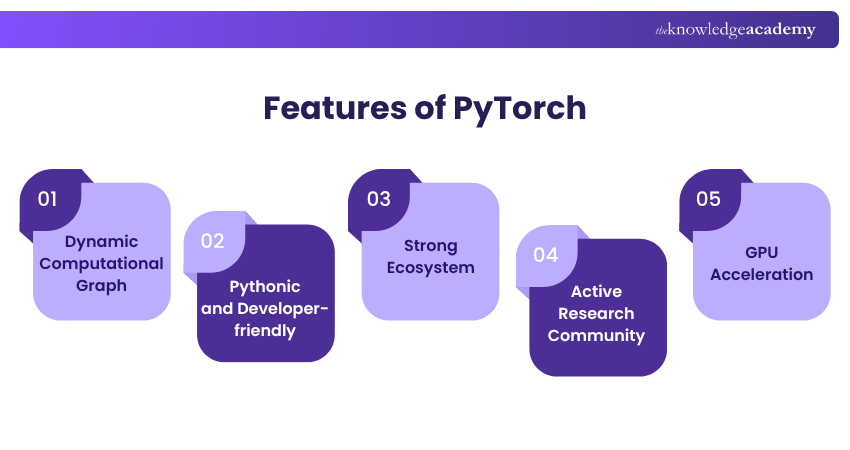
PyTorch is an open-source Machine Learning framework that has gained widespread popularity among researchers, developers, and data scientists for its flexibility, dynamic computation graph, and extensive library of tools and libraries. Developed by Facebook's AI Research Lab (FAIR), PyTorch is designed to provide a seamless and efficient platform for building, training, and deploying Deep Learning models.
One of PyTorch's standout features is its dynamic computation graph, allowing developers to change neural network architecture on the fly, making it an excellent choice for research and experimentation. This dynamic nature is in contrast to static computation graphs used by other frameworks like TensorFlow.

PyTorch offers a comprehensive ecosystem of libraries and tools for various Machine Learning tasks, including computer vision, natural language processing, and reinforcement learning. Its user-friendly interface and extensive documentation make it accessible to newcomers while providing advanced features for experienced researchers. Moreover, PyTorch's strong community support and frequent updates ensure it remains at the forefront of the rapidly evolving field of Machine Learning.
Develop advanced AI skills to build neural networks and solve complex real-world problems effectively with our Deep Learning Training- Sign in now!
What Is TensorFlow?
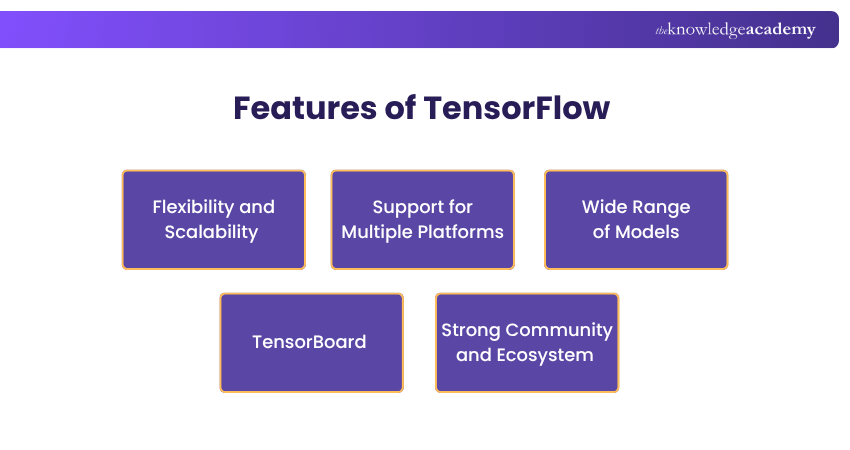
TensorFlow is an open-source Machine Learning framework developed by the Google Brain team. It has become one of the most widely used tools in the field of Artificial Intelligence and Machine Learning. At its core, TensorFlow is designed to facilitate the creation, training, and deployment of Machine Learning models, especially Deep Learning models.
One of TensorFlow's defining characteristics is its use of static computation graphs. Users define the graph structure, including the mathematical operations, before they execute the computation. This design makes TensorFlow efficient, particularly for large-scale production applications.
TensorFlow is versatile, offering multiple APIs for various levels of user expertise. This includes high-level APIs like Keras for those who prefer a more user-friendly approach, as well as the traditional TensorFlow API for more advanced users who require greater control over their models.
The framework supports a wide range of applications, from computer vision and natural language processing to reinforcement learning and more. TensorFlow is especially favored by developers and researchers who need powerful tools for building and deploying Machine Learning models at scale. Its active community, thorough documentation, and consistent updates ensure it remains a pivotal tool in the world of Machine Learning and AI.
Gain practical machine learning skills to build predictive models and make data-driven decisions confidently with our Machine Learning Course- Join now!
PyTorch vs TensorFlow: Key differences
1) Dynamic vs Static Computational Graphs
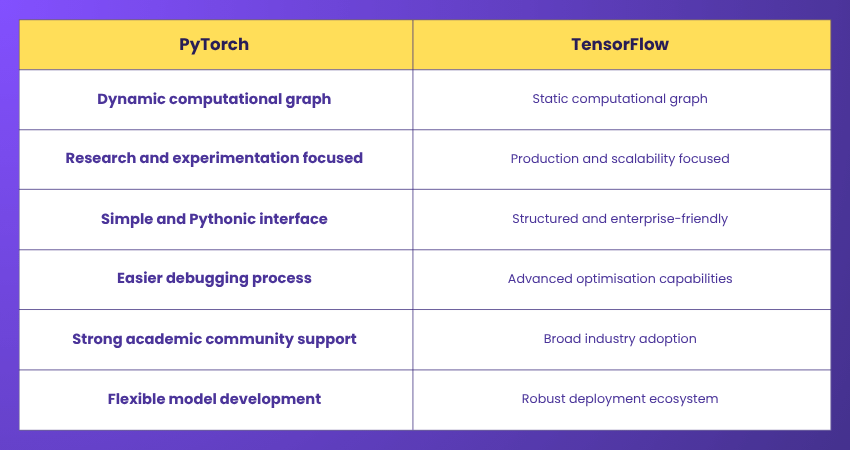
Dynamic and static computational graphs are key concepts in Deep Learning frameworks such as PyTorch and TensorFlow. They determine how neural networks are built and executed, influencing flexibility, debugging, and performance. Understanding these approaches helps developers choose the right framework for Machine Learning projects.
PyTorch uses dynamic computational graphs, where the graph is created during model execution. This provides flexibility for research, experimentation, and debugging, allowing developers to modify models and make real-time adjustments easily. It is particularly useful for building complex and non-standard neural network architectures.
TensorFlow traditionally uses static computational graphs, where the entire graph is defined before execution. This approach enables optimisation techniques that improve performance and scalability for production environments. With TensorFlow 2.0 and Keras integration, it now also supports more dynamic and user-friendly model development.
2) Ease of Use
Ease of use plays a major role when comparing PyTorch and TensorFlow, as it directly affects the development experience for Machine Learning and Deep Learning projects. Both frameworks have improved their interfaces, but they differ in flexibility, learning curve, and usability.
PyTorch is widely recognised for its intuitive and Python-friendly approach. Its dynamic computational graphs allow developers to modify models, debug easily, and make real-time adjustments, making it highly suitable for research and experimentation. Clear error messages and extensive documentation also improve the development process.
TensorFlow traditionally had a steeper learning curve due to its static computational graphs. However, TensorFlow 2.0 introduced eager execution and integrated Keras as a high-level API, making the framework more user-friendly and accessible. These improvements have simplified model development while maintaining strong scalability and production capabilities.
3) Community and Ecosystem
The community and ecosystem surrounding a Deep Learning framework play a pivotal role in its development, adoption, and success. When comparing PyTorch and TensorFlow, it's essential to consider the differences in their respective communities and ecosystems.
PyTorch boasts a vibrant and rapidly growing community, particularly in the academic and research domains. Researchers and individual developers widely embrace it, and its popularity continues to rise. The following factors contribute to its thriving ecosystem:
a) Academic Adoption: Many researchers and educational institutions prefer PyTorch for its flexibility and dynamic computation graph, which aligns well with the exploratory nature of academic research.
b) Libraries and Resources: PyTorch offers a rich collection of libraries and resources for tasks like natural language processing, computer vision, and reinforcement learning. Notable libraries such as Transformers and fastai have contributed to its popularity.
c) Active Development: The PyTorch development team, in collaboration with Facebook AI, consistently releases updates, new features, and improvements, ensuring that the framework remains competitive and up to date.
TensorFlow, developed by Google, boasts a robust presence in both the academic and industrial sectors. The following features distinguish its ecosystem:
a) Industry Adoption: TensorFlow has been widely adopted in various industries, including tech giants like Google, Uber, and Airbnb. It is known for its production readiness and scalability.
b) TensorFlow Extended (TFX): For large-scale Machine Learning pipelines and production deployments, TFX provides end-to-end Machine Learning infrastructure.
c) TensorBoard: TensorFlow's integration with TensorBoard offers advanced visualisation tools for model training, evaluation, and debugging, enhancing its usability in research and development.
d) High-level APIs: TensorFlow's integration with Keras simplifies model building and training, attracting both beginners and experienced developers.
4) Visualisation Tools
Visualisation tools are essential in Deep Learning as they help developers analyse model performance, understand data behaviour, and improve training processes. Both PyTorch and TensorFlow provide visualisation capabilities, but they differ in how they implement and support these features.
PyTorch is known for its flexibility and integrates with TensorBoardX, which allows users to visualise dynamic computational graphs, histograms, images, and other model metrics. Its dynamic graph structure supports experimentation and helps developers understand how models process data during execution.
TensorFlow provides a comprehensive visualisation platform through TensorBoard. It supports graph visualisation, embeddings, scalars, and model tracking, making it highly suitable for production-ready applications. Features like the TensorBoard projector also help visualise high-dimensional data and analyse model behaviour more effectively.
5) Deployment
Deployment is a critical phase in any Machine Learning project, as it's the stage where your trained models move from the development and testing environment to actual production systems. Both PyTorch and TensorFlow offer various tools and options for deployment, each with its strengths and considerations.
Deployment in PyTorch has traditionally been seen as more researcher-centric, with a focus on flexibility and rapid prototyping. However, recent developments have expanded its deployment capabilities. Here are key points to consider:
a) TorchScript: PyTorch introduced TorchScript, a way to create serialisable and optimisable representations of models. This feature allows you to save your PyTorch model in a format that can be loaded and executed outside of the PyTorch environment. TorchScript enables smoother model deployment in production.
b) LibTorch: LibTorch is a PyTorch library that enables C++ deployment of PyTorch models. It's beneficial when you want to integrate PyTorch models with existing C++ applications.
c) Production Libraries: While PyTorch is known for research and prototyping, libraries like PyTorch Mobile are emerging to facilitate the deployment of PyTorch models on mobile.
TensorFlow has traditionally been favoured in industry applications, and it offers several robust deployment options:
a) TensorFlow Serving: This is a dedicated service for serving TensorFlow models in production. It provides a flexible and efficient way to deploy Machine Learning models as REST APIs.
b) TensorFlow Lite: For mobile and embedded devices, TensorFlow Lite is the go-to solution. It optimises models for these platforms while ensuring low latency and efficient use of resources.
c) TensorFlow.js: This framework allows you to run TensorFlow models in web browsers and Node.js, enabling in-browser Machine Learning Applications.
Enhance your AI skills with the Deep Learning PDF—download it today!
6) Mobile and Embedded
Mobile and embedded deployment is an important factor when comparing PyTorch and TensorFlow for real-world AI applications. Both frameworks support deployment on resource-constrained devices, but they differ in maturity, optimisation, and platform support.
TensorFlow has a strong advantage in this area through TensorFlow Lite, which is designed for mobile, IoT, and edge devices. It optimises model size, improves inference speed, and supports hardware acceleration, making it highly suitable for production-ready mobile applications and web-based deployments.
PyTorch has traditionally focused more on research and prototyping, with limited mobile deployment support. However, PyTorch Mobile has improved its ability to run models efficiently on mobile and embedded platforms. Although still evolving, it continues to expand its capabilities for edge computing and mobile AI solutions.
7) Popularity
The popularity of PyTorch and TensorFlow plays an important role in selecting the right Deep Learning framework for AI and Machine Learning projects. Both frameworks are widely used, but they differ in their primary user base and areas of adoption.
PyTorch is highly popular within the research and academic community due to its dynamic computational graphs, flexibility, and Python-friendly interface. Its extensive libraries and ease of experimentation make it a preferred choice for researchers and developers working on innovative AI models.
TensorFlow enjoys strong popularity in industry and enterprise environments, particularly for production-ready applications. Its robust ecosystem, scalability, deployment tools, and support for distributed computing make it widely adopted by organisations building large-scale AI and Machine Learning solutions.
Explore advanced deep learning skills to build neural networks and create intelligent AI-driven solutions with our Neural Networks with Deep Learning Training- Join today!
Conclusion
In Deep Learning, PyTorch and TensorFlow continue to lead the way and shape the landscape. The difference between PyTorch vs TensorFlow may sometimes seem subtle, yet these nuances can significantly impact your AI journey. Whether you opt for the dynamic elegance of PyTorch or the production-ready might of TensorFlow, your choice should align with your specific goals and preferences.
Learn to build and deploy deep learning models using TensorFlow for advanced AI applications and intelligent solutions with our Deep Learning with TensorFlow Training- Sign in today!
Frequently Asked Questions
What are PyTorch and TensorFlow Used For?

PyTorch and TensorFlow are Deep Learning frameworks used to build, train, and deploy Artificial Intelligence and Machine Learning models. They support tasks such as computer vision, natural language processing, predictive analytics, and neural network development across research and production environments.
What is the Difference Between Dynamic and Static Computational Graphs?
Dynamic computational graphs are created during model execution, offering flexibility and easier debugging, as seen in PyTorch. Static computational graphs are defined before execution, enabling performance optimisation and scalability, which is a traditional strength of TensorFlow.

Lily Turner


Senior AI/ML Engineer and Data Science Author
Lily Turner is a data science professional with over 10 years of experience in artificial intelligence, machine learning, and big data analytics. Her work bridges academic research and industry innovation, with a focus on solving real-world problems using data-driven approaches. Lily’s content empowers aspiring data scientists to build practical, scalable models using the latest tools and techniques.
View Detail

 If you wish to make any changes to your course, please


