


We may not have the course you’re looking for. If you enquire or give us a call on 01344203999 and speak to our training experts, we may still be able to help with your training requirements.
Essential Reading Skills and How to Improve Them
ByNaveena VenkatesanLast updated on: 24 October 2026
Reading skills help individuals understand, interpret and evaluate written information effectively. This blog explores the essential reading skills, their importance and practical strategies to overcome common reading challenges.
The Gist
1. Phonics, fluency, vocabulary and comprehension form important foundations for effective reading.2. Skimming, scanning, intensive reading and analytical reading serve different purposes.3. Strong reading skills help you interpret information, recognise key ideas and think critically.4. Regular practice, note-taking, vocabulary building and varied reading materials support progress.5. Limited vocabulary, poor concentration and decoding difficulties may affect reading performance.
Ever finished reading a page only to realise you barely remember what it said? Or found yourself re-reading the same paragraph to understand its meaning? You're not alone. Reading isn't just about recognising words. It also involves understanding ideas, making connections and remembering important information. That's where strong reading skills make a difference.
Whether you're studying for an exam, reviewing a report or enjoying a novel, the way you approach reading can influence how much you understand. By developing effective habits and choosing the right techniques, you can make reading a more productive and rewarding experience.
Seven Essential Reading Skills
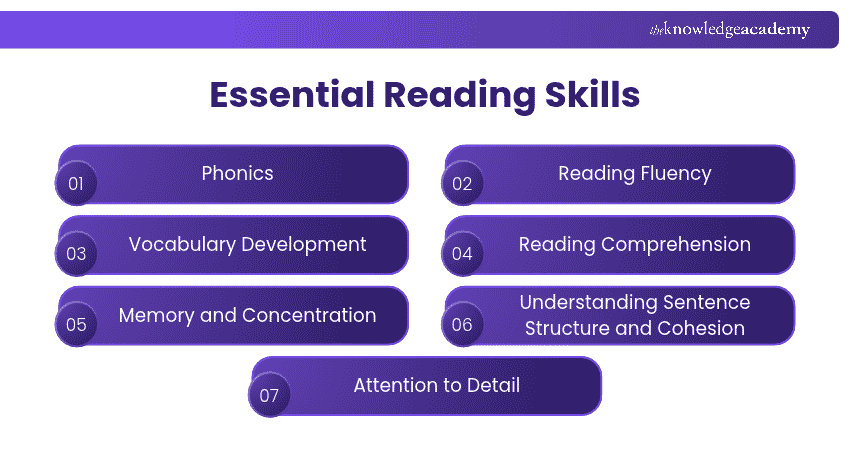
Effective reading involves several interconnected abilities that help you recognise words, understand meaning and process information. While some skills are particularly important for developing readers, others support comprehension and critical thinking at different levels. Here are seven essential reading skills worth developing:
1) Phonics
Phonics involves learning the relationships between letters or groups of letters and the sounds they represent. It is especially important for beginning readers because it helps them decode unfamiliar words and develop accurate word-reading skills.
How to Develop This Skill:
a) Practise identifying individual letter sounds and common blends.
b) Practise blending individual sounds to read words and identifying common letter-sound patterns.
c) Read simple, appropriately levelled texts that allow you to practise familiar letter-sound patterns.

2) Reading Fluency
Reading fluency is the ability to read text accurately, at an appropriate pace and with suitable expression. It helps readers focus on understanding the meaning rather than concentrating solely on recognising individual words.
How to Develop This Skill:
a) Read suitable passages aloud to practise accuracy, phrasing and expression.
b) Re-read familiar texts to build confidence and fluency.
c) Read with a partner or teacher who can provide feedback and support.
3) Vocabulary Development
A strong vocabulary enhances comprehension and helps readers engage with increasingly complex texts. Vocabulary development involves learning unfamiliar words, understanding their meanings and recognising how they are used in different contexts. It also helps readers interpret subject-specific terminology and expressions.
How to Develop This Skill:
a) Expose yourself to a variety of genres and subjects.
b) Keep a list of new words and their meanings.
c) Play games like Scrabble or complete crossword puzzles to make learning new words fun.
4) Reading Comprehension
Reading comprehension is understanding, interpreting and analysing what you read. It involves identifying main ideas, making inferences, recognising supporting details and connecting new information with existing knowledge. Strong comprehension helps readers understand both the explicit meaning and deeper implications of a text.
How to Develop This Skill:
a) Pose questions about the text to deepen understanding.
b) Write summaries of what you read to reinforce comprehension.
c) Talk about the text with others to gain different perspectives.
5) Memory and Concentration
Good reading requires remembering what you've read and staying focused on the text. Concentration helps you maintain attention while reading, while memory supports the retention and recall of important information. Together, these abilities make it easier to follow complex arguments and connect ideas across sections.
How to Develop These Skills:
a) Practise focused reading in a distraction-free environment, gradually increasing the length of your reading sessions.
b) Jot down key points while reading to aid memory.
c) Go over what you've read to reinforce retention.
Quick Exercise: The Read, Recall and Review Method
This simple activity helps readers practise remembering important information.
1. Read: Choose a short passage and read it carefully.2. Recall: Close the text and write down three important points from memory.3. Review: Reopen the passage and compare your notes with the original information.4. Correct: Identify anything you missed or misunderstood.5. Repeat: Revisit the key ideas later to reinforce your learning.
6) Understanding Sentence Structure and Cohesion
Sentence structure and cohesion involve recognising how sentences are constructed and how they connect to form a coherent narrative. Understanding grammar, punctuation and linking words helps readers follow relationships between ideas. It is particularly useful when interpreting complex sentences, academic texts and detailed reports.
How to Develop This Skill:
a) Break down sentences to understand their components.
b) Identify connecting words such as "however", "therefore" and "although" to understand relationships between ideas.
c) Look at well-written texts to see how sentences are effectively constructed.
7) Attention to Detail
Attention to detail involves noticing and understanding the finer points of a text. This skill helps readers identify important facts, instructions and subtle differences in meaning. It is especially valuable when proofreading documents, interpreting technical information or reviewing detailed instructions.
How to Develop This Skill:
a) Take your time to read carefully.
b) Use a highlighter to mark important information.
c) Focus on small text sections to understand them thoroughly.
Understand the language better and bring clarity to every sentence by joining the English Grammar Course now!
Types of Reading Techniques
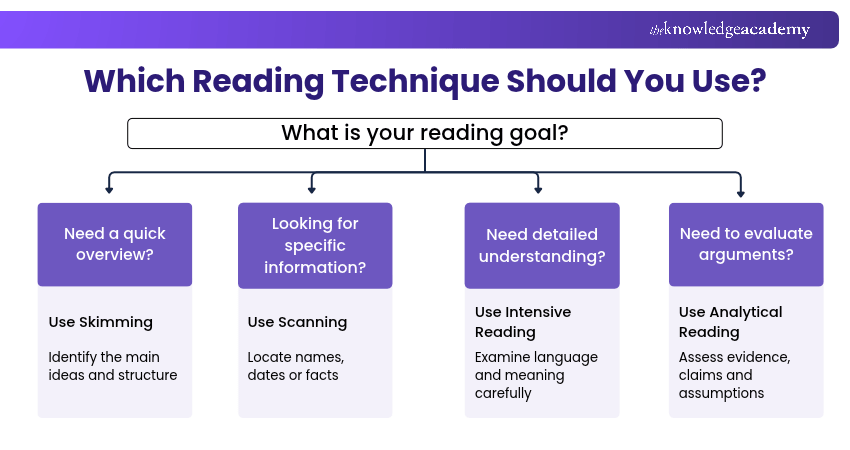
Depending on your goals, several reading techniques can help you read more effectively. Here are some of the most common ones:
1) Skimming
Skimming involves moving quickly through a text to understand its overall purpose, structure and main ideas without reading every word.
When to Use It:
a) Previewing Material: Skim through a text before a detailed reading session to understand the main ideas and structure.
b) Determining Relevance: Identify which information is important and where to focus your attention.
c) Refreshing: Quickly review material before an exam to recall main points.
Remember
Skimming is useful for gaining an overview, but it may miss important details. It should not replace careful reading when a thorough understanding is required.
2) Scanning
Scanning involves searching through a text to locate specific information, such as names, dates, figures or keywords, without reading every sentence.
When to Use It:
a) Finding Information: Locate pieces of information in indexes, tables of contents or glossaries.
b) Specific Data: Quickly find specific data in long articles or reports.
c) Locating Answers: Efficiently find answers during exams or assignments.
Remember
Scanning helps locate information quickly, but the surrounding text may need closer reading to understand its full meaning.
3) Active and Intensive Reading
Active reading involves engaging with a text by asking questions, making connections and taking notes. Intensive reading focuses on examining shorter or more complex passages carefully to understand their meaning, language and details.
When to Use These Techniques:
a) Studying Academic Material: Ideal for in-depth study of complex subjects.
b) Enhancing Comprehension: Supports deeper understanding through focused reading and review.
c) Examining Complex Information: Helps readers understand detailed explanations, unfamiliar concepts and relationships between ideas.
d) Applying Strategies: Annotate the text, highlight key points, write questions and summarise important information in your own words.
Remember
These techniques require more time and attention than skimming or scanning, but they are useful when detailed understanding is necessary.
4) Analytical Reading
Analytical reading involves examining a text critically to understand its arguments, evaluate evidence and assess the reliability of its conclusions.
When to Use It:
a) Identification: Identify the author's arguments, claims and supporting evidence.
b) Assessment: Evaluate the credibility and reliability of the information.
c) Recognition: Recognise underlying assumptions and potential biases.
d) Comparison: Compare the text with other relevant sources to develop a comprehensive perspective.
Remember
Analytical reading goes beyond understanding what a text says. It involves evaluating how well its ideas and conclusions are supported.
Turn complex information into clear, connected and memorable ideas with the Mind Mapping Training now!
Importance of Reading Skills
Strong reading skills support learning, communication and informed decision-making. They help individuals access information, understand different perspectives and engage with increasingly complex material. Here are some important benefits:
a) Better Academic Learning: Effective reading helps learners understand instructions, interpret subject-specific information and engage with educational materials across different subjects.
b) Stronger Critical Thinking: Reading and evaluating different ideas can help individuals examine arguments, question assumptions and form reasoned opinions.
c) Improved Vocabulary and Communication: Exposure to varied texts introduces new words, expressions and writing styles that can support clearer communication.
d) Greater Access to Information: Good reading abilities make it easier to understand reports, instructions, articles and other information used in everyday life and professional settings.
e) Broader Perspectives: Reading different viewpoints, experiences and stories can encourage reflection, empathy and greater cultural awareness.
How to Improve Your Reading Skills?
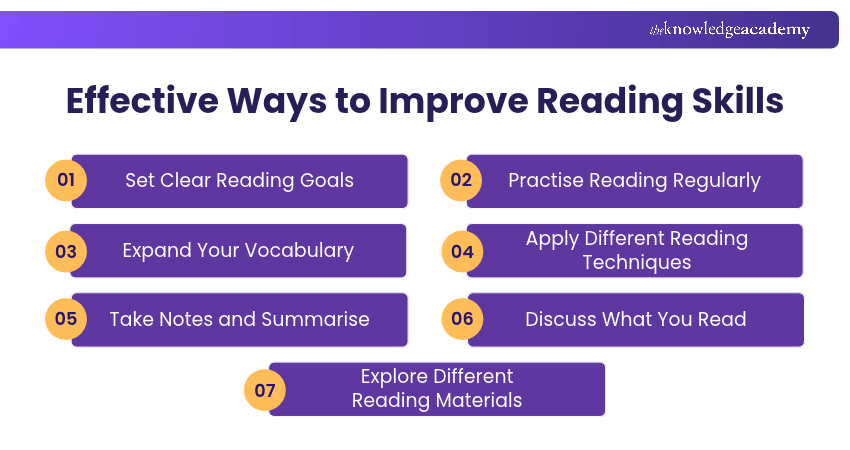
Improving your reading skills involves practice and the use of effective strategies. The following methods can help you develop stronger reading habits and improve your understanding over time:
1) Set Clear Reading Goals
Know what you want to accomplish by reading and establish specific, achievable objectives. Clear goals help you stay focused, monitor progress and maintain motivation. For example, you might aim to read for 20 minutes daily or complete one chapter and summarise its main ideas.
2) Practise Reading Regularly
Reading should become part of your routine so that you can gradually develop and sustain your skills. With regular practice, you can strengthen fluency, comprehension and confidence over time. Choose materials that match your current ability while gradually introducing more challenging texts.
Pro Tip
Choose materials that you can understand with reasonable effort while still encountering some unfamiliar words or ideas. If a text feels overwhelming, try a more accessible version before returning to the original. Gradually increasing difficulty can help build confidence and comprehension.
3) Expand Your Vocabulary
Learn unfamiliar words by examining their meanings and how they are used in different contexts. Keeping a vocabulary journal and reviewing new words regularly can help reinforce learning. Try using newly learned words in your own sentences to develop a stronger understanding of their meaning.
4) Apply Different Reading Techniques
Choose reading techniques according to your purpose. Use skimming to gain an overview, scanning to find specific information and intensive reading to understand complex material. Selecting the appropriate technique can help you read more efficiently without sacrificing necessary detail or comprehension.
5) Take Notes and Summarise
Make notes of important facts, ideas and conclusions while reading. Summarising information in your own words helps you identify the main message and gives you material to review later. Focus on essential points instead of copying large sections of text.
6) Discuss What You Read
Discuss books, articles or study materials with others to explore different interpretations and clarify unfamiliar ideas. Explaining what you have read can also reveal gaps in your understanding and encourage deeper engagement with the material.
7) Explore Different Reading Materials
Read across various formats, genres and topics to develop familiarity with different vocabulary, writing styles and text structures. For example, combining fiction, news articles, reports and educational materials can help you adapt your reading approach to different purposes.
Sharpen your attention to detail by signing up for the Proofreading Course now!
Common Reading Challenges
Reading difficulties can affect accuracy, comprehension, confidence and motivation. Understanding the nature of these challenges can help readers identify suitable strategies and seek additional support when needed. Let's look at them below:
1) Limited Vocabulary
An unfamiliar word can make it difficult to understand the meaning of a sentence or follow an argument. When several unfamiliar words appear together, comprehension may become particularly challenging.
How to Address It: Build vocabulary gradually through varied reading, contextual examples and regular review of unfamiliar words.
2) Lack of Motivation
When the material is not interesting or applicable to the reader, maintaining interest and practising regularly can become difficult.
How to Address It: Choose engaging reading materials, set achievable goals and gradually introduce texts that support your learning or personal interests.
3) Attention and Concentration Difficulties
Difficulty maintaining attention can make it harder to follow ideas, remember details or complete lengthy reading tasks. Distractions, fatigue and other factors may contribute to these challenges.
How to Address It: Read in a suitable environment, divide longer texts into manageable sections and take breaks when needed. Persistent difficulties may require additional support.
Trainer's Insight
When reading becomes difficult, identify what is causing the problem before changing your routine. Difficulty decoding words, understanding vocabulary and maintaining attention may require different strategies. Persistent difficulties may benefit from support from an appropriately qualified educator or specialist.
4) Phonemic Awareness Difficulties
Phonemic awareness is the ability to identify and manipulate individual sounds in spoken words. Difficulties with this skill can affect the development of decoding and word-reading abilities, particularly among beginning readers.
How to Address It: Practise identifying, blending and segmenting spoken sounds through structured activities. Explicit phonics instruction can help learners connect those sounds with written letters.
5) Limited Reading Exposure
Limited opportunities to engage with books and other written materials can reduce familiarity with vocabulary, sentence structures and different types of texts. However, reading development also depends on instruction, individual learning needs and other factors.
How to Address It: Encourage regular access to suitable reading materials, provide opportunities for supported reading and gradually increase text complexity as skills develop.
Reading Skills Self-assessment Checklist
Use this checklist to identify your strengths and areas for improvement:
□ Can I recognise and read unfamiliar words accurately?□ Can I read suitable texts fluently without rushing?□ Can I understand unfamiliar vocabulary using context?□ Can I identify the main ideas and supporting details?□ Can I summarise important information in my own words?□ Can I choose a reading technique based on my purpose?□ Can I distinguish factual claims from opinions or assumptions?□ Can I maintain concentration and review what I have learned?
Read critically and research effectively with the Academic Writing Course now!

Naveena Venkatesan is a Content Editor with 2+ years of experience in content writing, editing and linguistic quality assurance. Her research, fact-checking and editorial experience enable her to develop accurate, accessible resources across Business Skills, Human Resources, and Accounting and Finance.
View Detail

 If you wish to make any changes to your course, please


