


 Top Rated Course

We may not have the course you’re looking for. If you enquire or give us a call on 01344203999 and speak to our training experts, we may still be able to help with your training requirements.
Top Life Coach Skills Every Successful Coach Must Have
Charlotte Wilson 27 August 2026This blog explores the core Life Coach Skills that set effective coaches apart, from active listening and powerful questioning to trust-building, accountability, and ethical awareness.

Training Outcomes Within Your Budget!
We ensure quality, budget-alignment, and timely delivery by our expert instructors.
Table of Contents
Key Takeaways
1. Effective Life Coach Skills combine active listening, powerful questioning, communication, trust-building, and mindful presence.2. Coaches help clients explore their own perspectives and solutions rather than simply telling them what to do.3. Goal setting and accountability help turn coaching insights into practical and meaningful action.4. Effective coaching balances encouragement with constructive challenge to support deeper reflection and progress.5. Ethical awareness and professional boundaries help coaches recognise what belongs within coaching and when specialist support may be needed.
The room goes quiet. A client leans forward and finally says the thing they've been circling for the last ten minutes:
“I know something needs to change. I just don't know what.”
The easiest response might be to start offering solutions. But effective coaching begins somewhere else: listening, questioning, and helping the client discover what comes next.
That is where strong Life Coach Skills make the difference. From building trust and asking powerful questions to encouraging accountability, these skills help turn an ordinary conversation into an opportunity for clarity, reflection, and meaningful action.
Who is a Life Coach?
A Life Coach is a professional who guides individuals towards achieving their personal and professional goals. They collaborate with clients to establish clear targets and work through the steps needed to reach them. The coach offers guidance and encouragement to help clients stay on track and follow through.
This typically involves embracing new perspectives and formulating a detailed plan of action. Life Coaches maintain ongoing sessions with clients until the desired outcomes are achieved. Some coaches provide services to a broad demographic, while others focus on assisting those with mental or physical challenges.

Top Life Coach Skills
Becoming an effective coach requires developing a specific set of skills that support clients through reflection, growth, and meaningful action. Here are some key skills that set the foundation for a Life Coach.
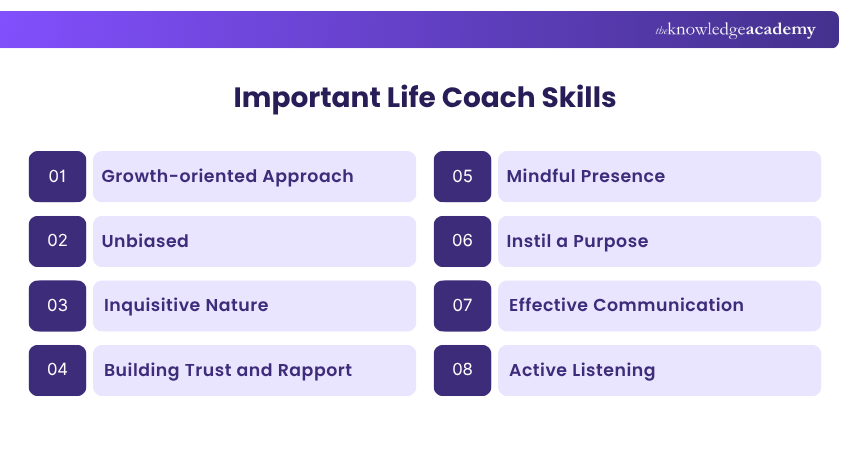
1) Growth-oriented Approach
Effective Life Coaches bring a growth-oriented mindset to their work, both with clients and in their own development. With clients, this means prioritising learning and growth, encouraging clients to adopt the same mindset and become more capable, personally and professionally. It also builds enough trust for clients to make brave, well-informed decisions.
For coaches themselves, growth is an ongoing process, not something that stops once training ends. Reflecting on experience and continuing to build capability through practice, feedback, and self-reflection helps coaches keep improving their own approach.
2) Unbiased
Unbiasedness is one of the essential Life Coach Skills for you to excel in your career. It helps your clients work through challenges better. You can practise this skill by asking open-ended questions to your clients. This will prevent you from judging your clients by their actions.
When you do not judge, you can listen and cater better to your client's needs. Moreover, offering relevant, solution-oriented advice can help you become a caring and compassionate professional who handles situations politely and professionally.
3) Inquisitive Nature
As a Life Coach, you should have an inquisitive nature and be open to accepting situations or suggestions. Asking questions can help you discover additional factors about your client's personality. You will know more about your client's life stories and experiences that shape them into the person they are.
This skill also lets you ask your clients deeper questions and support and guide them better on their journey. When you are curious about them, you make more space and opportunities for the clients to share their experiences safely and authentically.
4) Building Trust and Rapport
Clients are more likely to explore difficult questions when they feel respected and able to speak openly. Coaches can build trust by being consistent, maintaining confidentiality, respecting the client's perspective, and demonstrating genuine interest in their goals.
Trust does not mean agreeing with everything a client says. It means establishing a professional relationship in which exploration, reflection, and respectful challenges can take place.
Before responding to a client, ask:
Am I...Exploring their perspective?asking rather than assuming?helping them generate options?allowing them to choose their next action?Or simply telling them what I would do?Quick Rule
If the coach is doing most of the problem-solving, the client may be doing too little of the thinking.
5) Mindful Presence
Maintaining a positive attitude is key for you to excel and effectively assist your clients. Your positivity can instil confidence and optimism in your clients, helping them tackle challenges more positively.
This optimistic approach not only boosts your effectiveness but also encourages clients to open up about their deepest fears and emotions. Noticing small details in a client's behaviour or responses can avoid misunderstandings and ensure the guidance given is truly aligned with the client's individual needs.
6) Instil a Purpose
You need to guide your clients towards a sense of purpose in their life. For example, if a client wants to lose weight, helping them understand why that goal matters, whether it's long-term health, confidence, or energy, gives the goal staying power beyond the techniques used to achieve it.
Encouraging clients to connect with a sense of purpose is important for their constant development and improvement. This will also help them to have positive energy and an outlook towards their life.
7) Effective Communication
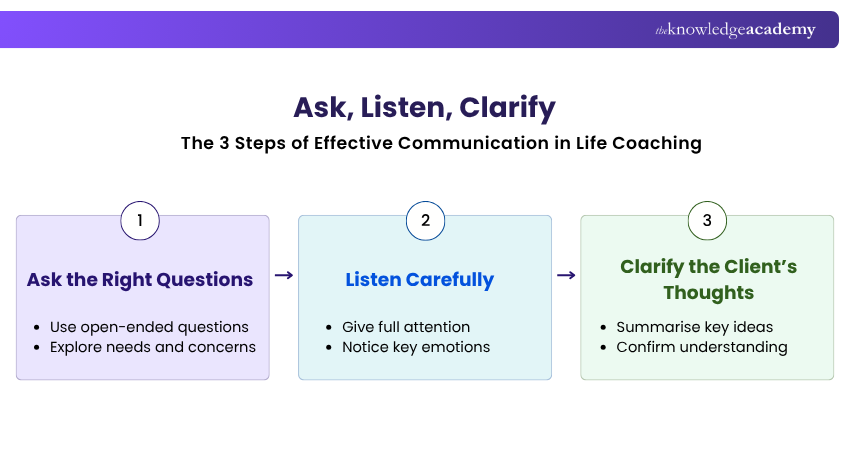
Effective Communication is important to maintain your relationship with clients. They look forward to you communicating efficiently. You can communicate directly during sessions with clear language to help make a positive impact on them.
You should also help them understand issues from another perspective and help them find clarity when they feel insecure. This involves using questions in effective ways to help them gain clarity on their problems and how they can best work toward their goals. Also, always use respectful and proper language with your clients.
8) Active Listening
Active listening is being fully present with your client, paying attention to more than just words; body language is also key. For example, if a client says they've had a great week but shows signs of frustration through their body language, it suggests hidden feelings.
Active listening extends to noticing the client's tone, pitch, and choice of words. This can reveal deeper emotions, like sadness instead of anger. Coaches must be attuned to these cues to address any contradictions between what clients say and how they communicate otherwise.
9) Encouragement
Support is something every human expects from others when they face different situations. It is no different here. You might see the progress of your clients over time, but they may not have as much awareness of how they are doing. A little encouragement from you can make a big difference for them.
Encourage them for every action they take to move forward, every milestone they reach. You can tell them, “I know that discussing this out loud may not be easy for you, and I’d like to applaud you for your courage. You have been doing such excellent work in our sessions!” You wish you heard that more often, don’t you?
Enhance your leadership skills with our Mentoring Course - Sign up now!
10) Confident Assertion
Every coach has a different coaching style, but at some point, you have to challenge your clients to help them grow. You won't achieve that by always being gentle with them. Transformation demands the courage to face oneself, and being too cautious about pushing your clients can hold their progress back rather than protect it.
The benefits of coaching become most apparent when clients are pushed out of their comfort zones and encouraged to confront their limitations. Being assertive lets you challenge and encourage them at the same time and put the responsibility of their future into their own hands. There is nothing more empowering than that.
11) Ethical Awareness and Professional Boundaries
Professional boundaries help protect both the coach and the client. Coaches should understand issues such as confidentiality, conflicts of interest, competence, appropriate conduct, and the limits of the coaching relationship.
Life coaching should also not be presented as a substitute for therapy, medical treatment, or other specialist professional services. When a client's needs extend beyond the coach's competence or scope, an appropriate referral may be necessary.
Is this within my coaching competence?
YES → Continue coachingUNSURE → Pause and clarify the needNO → Discuss appropriate specialist supportTrainer’s Insight:Knowing when not to coach is also a professional skill. Good boundaries protect the client and the integrity of the coaching relationship.
Conclusion
Strong Life Coach Skills can turn meaningful conversations into opportunities for growth, clarity, and action. By developing skills such as active listening, thoughtful questioning, trust-building, and constructive challenges, coaches can better support clients in discovering their own path forward. Ultimately, effective life coaching is about empowering people to recognise their potential and create meaningful progress in their lives.
Learn how to choose the right coaching method with our Train the Trainer Course - Join now!
Frequently Asked Questions
What are the Five Cs of Coaching?

The five Cs of coaching are widely recognised as Clarity, Compassion, Curiosity, Confirmation, and Commitment. It's a framework that guides effective coaching conversations and leadership development. They help coaches build trust, encourage growth, and support meaningful progress.
What Type of Life Coach is Most in Demand?
Health and wellness coaching, career coaching, and executive or business coaching are among the most in-demand coaching specialisations today. Growing emphasis on personal wellbeing, evolving workplace dynamics, and increasing demand for professional development continue to drive the need for coaches in these areas.
What Makes a Life Coach Successful?
A good Life Coach works as a supportive partner, helping you define clear goals, overcome challenges, and make meaningful progress towards personal growth. Rather than giving direct advice, they encourage self-discovery by asking insightful questions that help you find your own solutions.

Charlotte Wilson


Soft Skills and Business Training Manager
Charlotte Wilson is an expert in soft skills development, with over 14 years of experience helping individuals and teams improve communication, productivity and emotional intelligence in the workplace. Her training content is focused on enhancing interpersonal effectiveness and fostering positive, collaborative environments across all levels of an organisation.
View Detail

 If you wish to make any changes to your course, please


