


 Top Rated Course

We may not have the course you’re looking for. If you enquire or give us a call on 01344203999 and speak to our training experts, we may still be able to help with your training requirements.
Leadership and Management Skills Every Professional Needs
Benjamin Walker 02 September 2026Get familiar with the essential Leadership and Management Skills that help professionals lead teams, make effective decisions, and achieve better workplace outcomes.
Home
 Resources
ILM Leadership & Management
Leadership and Management Skills Every Professional Needs
Resources
ILM Leadership & Management
Leadership and Management Skills Every Professional Needs
Resources
ILM Leadership & Management
Leadership and Management Skills Every Professional Needs

Training Outcomes Within Your Budget!
We ensure quality, budget-alignment, and timely delivery by our expert instructors.
Table of Contents
Key Takeaways
1. Leadership and Management Skills combine people-focused abilities with planning and organisational capabilities.2. Leadership focuses on direction and influence, while Management helps organise people, processes, and resources.3. Communication, decision-making, delegation, emotional intelligence, and strategic thinking are essential skills.4. Strong Leadership and Management Skills can improve teamwork, accountability, adaptability, and workplace performance.5. These skills can be strengthened through practice, feedback, self-reflection, mentoring, and continuous learning.
You can see a completed project.
You can see whether a deadline was met.
You can track a target.
But behind those results are things that are harder to see: a difficult decision made well, a responsibility delegated at the right time, a conflict handled calmly, or a team encouraged when progress stalls.
These moments are where Leadership and Management Skills come to life. Often unnoticed, they can shape everything from team morale and collaboration to the outcome of an important project. But what skills make these everyday moments successful? Let’s explore them!
What are Leadership and Management Skills?
Leadership and Management Skills are the abilities professionals use to guide people, organise work, make decisions, solve problems, and achieve shared objectives. They bring together interpersonal skills such as communication, motivation, and influence with practical abilities such as planning, delegation, decision-making, and problem-solving.
While Leadership Skills help create direction, inspire people, and build commitment towards shared goals, Management Skills help turn that direction into action by organising responsibilities, allocating resources, setting priorities, and monitoring performance.
The two often work best together. You do not need a management title to demonstrate Leadership Skills, and being a Manager alone does not automatically make someone an effective Leader. Strong professionals learn when to lead people and when to manage the work.

Essential Leadership and Management Skills
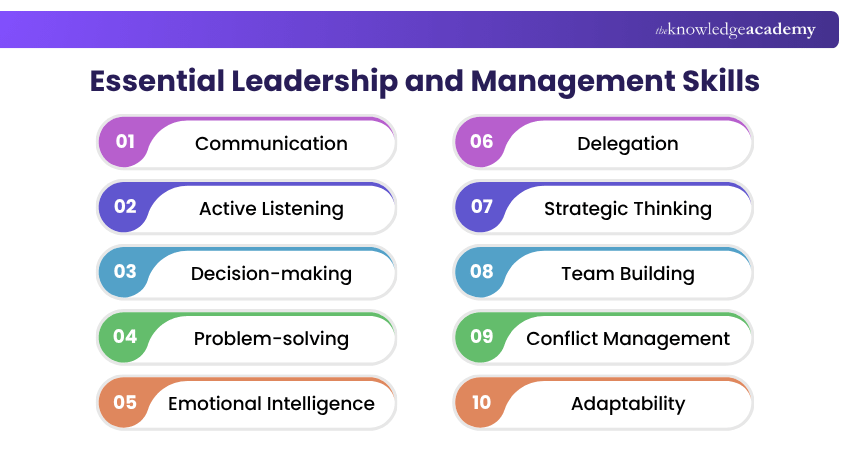
Leadership and Management involve a range of skills for guiding people, coordinating responsibilities and making decisions. Some skills are particularly important because they influence how well professionals communicate, solve problems, lead teams, and manage day-to-day responsibilities.
Here are 10 essential Leadership and Management Skills to develop:
1) Communication
Clear communication keeps everyone working from the same understanding. Leaders and managers need to explain goals, responsibilities, expectations, decisions, and feedback in ways that are easy to understand and act upon.
It also creates alignment within a team. When people understand what is expected, why it matters, and what happens next, they can coordinate their efforts more effectively and avoid unnecessary confusion.
2) Active Listening
Strong leaders not only communicate clearly; they also pay attention to what others are saying. Active Listening helps leaders and managers understand concerns, ideas, feedback, and different perspectives before responding or making decisions.
This means giving people time to speak, asking relevant questions, and clarifying anything that is unclear. Listening carefully can reveal useful information, reduce misunderstandings, and help people feel that their views are being considered.
3) Decision-making
Everyday leadership involves choices about priorities, people, resources, risks, and deadlines. Decision-making helps leaders and managers evaluate these situations and determine the most appropriate course of action.
Good decisions are based on relevant information rather than assumptions alone. Considering available options, possible consequences, and wider objectives helps professionals make choices they can explain and act on with confidence.
4) Problem-solving
Workplace problems are not always as straightforward as they appear. A missed deadline, for example, could result from an unrealistic workload, unclear responsibilities, limited resources, or a breakdown in communication.
Problem-solving helps leaders and managers identify the root cause of an issue, explore possible solutions, and select an appropriate response. Understanding the underlying cause can help professionals develop solutions that address the problem rather than only its symptoms.
5) Emotional Intelligence
How a leader responds under pressure can influence the entire team. Emotional Intelligence helps leaders and managers recognise their own emotions, understand how others may be feeling, and respond appropriately to different situations.
It is particularly valuable when giving feedback, managing disagreements, supporting team members, or dealing with stressful situations. Greater emotional awareness can help professionals remain composed, show empathy, and handle sensitive conversations constructively.
6) Delegation
Delegation helps leaders and managers distribute responsibilities effectively across a team. It involves matching tasks with people who have the appropriate skills, experience, or development opportunities.
Good delegation includes explaining the expected outcome, providing the necessary authority and resources, and remaining available for support. This encourages ownership while helping responsibilities move forward efficiently.
Trainer’s Insight: The best time to develop Leadership Skills is during everyday work, not only during major challenges. Meetings, feedback conversations, project decisions, and changing priorities all provide opportunities to practise them.
7) Strategic Thinking
Day-to-day decisions can have consequences far beyond the immediate task. Strategic thinking helps leaders and managers consider the bigger picture, including longer-term objectives, risks, opportunities, and organisational priorities.
This perspective helps them connect current actions with future outcomes. Instead of only asking “What solves the problem today?”, they can also consider “How will this decision affect where we want to be tomorrow?”
8) Team Building
A group of capable individuals does not automatically become a strong team. Team building involves creating the trust, clarity, and collaboration needed for people to work effectively towards shared goals.
Leaders and managers can strengthen teams by recognising individual strengths, defining responsibilities, encouraging cooperation, and acknowledging contributions. They also help team members understand how their individual work contributes to the team's wider success.
9) Conflict Management
Differences in priorities, opinions, and working styles are inevitable when people work together. Conflict management helps leaders and managers address these disagreements before they begin to damage relationships or disrupt progress.
Leaders and managers can listen to different perspectives, identify the source of disagreement, and keep discussions focused on the issue. This creates opportunities to find practical solutions while maintaining productive working relationships.
Build the confidence to guide and inspire others with our Leadership Skills Training - Join today!
10) Adaptability
Plans change, priorities shift, and unexpected challenges arise. Adaptability helps leaders and managers respond to these changes without losing sight of the overall objective.
This could mean revising a plan, reallocating resources, changing priorities, or adopting a different approach when the original one is no longer suitable. Adaptable leaders also communicate changes clearly so that their teams understand what has changed and what they need to do next.
The Leadership Compass
When facing a workplace challenge, ask:
People → Who needs to be heard, supported, or guided?Purpose → What are we trying to achieve?Action → What decision or next step is needed?Change → What might require us to adjust?
Good leadership is not about using every skill at once. It is about recognising which skill the situation requires.
Why are Leadership and Management Skills Important?
Leadership and Management Skills shape how teams are guided, how challenges are handled, and how effectively plans are turned into results. They are important because they help create the clarity, coordination, trust, and accountability needed for people to work towards shared objectives.
1) Provide Clear Direction
Teams perform better when they understand what their responsibilities are and what is expected of them. Strong Leadership and Management Skills help establish clear goals, priorities, responsibilities, and expectations.
This gives people a stronger sense of purpose and helps ensure that individual efforts remain aligned with wider team and organisational objectives.
2) Improve Team Performance
Strong teams need more than individual talent. They also need coordination, appropriate support, clear responsibilities, and a shared understanding of what they are working towards.
Leadership and Management Skills help bring these elements together, enabling people to use their strengths effectively, collaborate with others, and maintain progress towards common goals.
3) Support Better Decision-making
Strong Leadership and Management Skills enable professionals to make well-informed and balanced decisions that support team and organisational objectives.
By considering relevant information, different perspectives, available options, and potential outcomes, leaders and managers can choose appropriate courses of action with greater clarity and confidence.
4) Build Stronger Workplace Relationships
The way people are managed can significantly influence trust and cooperation within a workplace. Fair treatment, open communication, appropriate support, and respect for different perspectives can strengthen relationships between leaders, managers, and their teams.
Stronger relationships can also make it easier to exchange feedback, discuss concerns, resolve disagreements, and work collaboratively.
5) Support Teams Through Change
Leadership and Management Skills help teams adapt when priorities, processes, technologies, or organisational directions evolve. Leaders and managers can provide the clarity and support people need throughout the transition.
By explaining the purpose of the change, clarifying expectations, listening to concerns, and communicating next steps, they can help teams adjust and maintain progress.
6) Strengthen Accountability
Accountability is easier to establish when people clearly understand what they are responsible for and what outcomes are expected. Leaders and managers create this clarity by defining responsibilities, setting expectations, and reviewing progress.
At the same time, accountability should be supported with appropriate resources, authority, and guidance. This helps people take ownership of their work rather than simply being held responsible for results.
Step confidently into management with our Management Courses – Join today!
Leadership vs Management: What is the Difference?
Leadership and Management work towards organisational success, but their primary focus differs. Leadership is more concerned with direction, influence, and people, while Management focuses on planning, coordination, and execution.
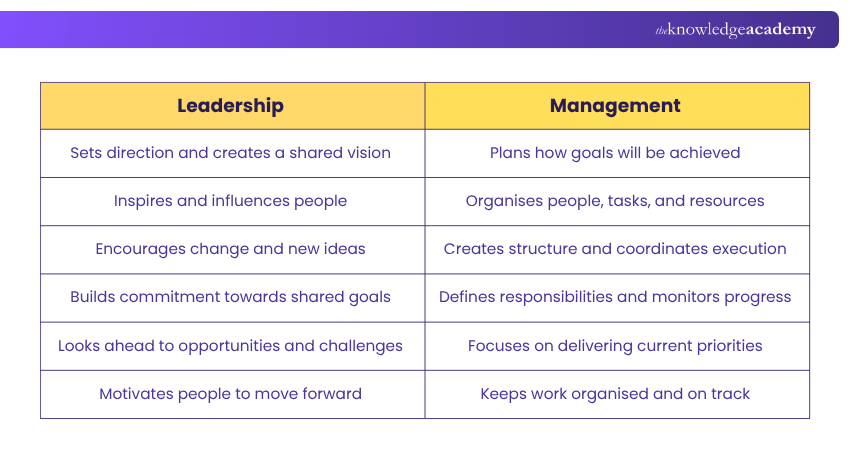
The distinction becomes clearer in practice. A leader might inspire a team around a new direction, while a manager determines the responsibilities, resources, and timelines needed to deliver it.
Leadership and Management are therefore complementary rather than competing approaches. Leadership provides direction; Management helps turn that direction into coordinated action.
How to Develop Leadership and Management Skills?
Leadership and Management Skills grow through practice, experience, feedback, and continuous learning. Everyday workplace situations, from leading a meeting to resolving a disagreement, can provide opportunities to strengthen how you guide people and manage responsibilities.
Here are practical ways to develop these skills:
1) Identify Your Strengths and Development Areas
Start by understanding where your Leadership and Management Skills currently stand. Consider how confidently you communicate, delegate responsibilities, make decisions, manage pressure, and support others.
Identifying both strengths and areas for improvement gives you a clearer starting point and helps focus your development on where it can make the greatest difference.
2) Seek Constructive Feedback
Feedback can provide valuable insight into how your leadership style is experienced by others. Ask colleagues, managers, mentors, or team members for specific observations about areas such as communication, decision-making, delegation, and teamwork.
Use this feedback to identify practical changes you can make and revisit it over time to understand how you are progressing.
3) Practise Clear Communication
Use everyday conversations as opportunities to strengthen how you communicate. Set clear expectations, ask purposeful questions, listen attentively, and provide feedback that people can understand and use.
Regular practice can help you communicate with greater clarity across meetings, one-to-one discussions, project updates, and challenging conversations.
4) Take on New Responsibilities
Taking on new responsibilities gives you opportunities to develop Leadership and Management Skills through practical experience. This could involve leading a meeting, coordinating a project, mentoring a colleague, or managing a team initiative.
Each responsibility presents different challenges and helps you build confidence in areas such as planning, decision-making, communication, and problem-solving.
5) Learn From Experienced Leaders
Learning from experienced leaders can offer valuable insight into how leadership works in real situations. Pay attention to how they set priorities, communicate decisions, delegate responsibilities, support their teams, and respond to challenges.
You can also seek guidance from a mentor who can share practical experiences, provide feedback, and help you consider different ways of approaching Leadership and Management situations.
6) Practise Effective Delegation
Delegation develops through practice. Start by identifying suitable responsibilities, matching them with the right people, clarifying the expected outcome, and providing the authority and resources required.
Giving team members appropriate independence can strengthen their confidence and ownership while allowing you to focus on wider priorities.
7) Turn Experience into Learning
Every project, decision, and challenging conversation can teach you something about your Leadership and Management approach. Take time afterwards to consider what worked well and what you could approach differently in the future.
Ask yourself: What worked well? What could I improve? What will I do differently next time? Regular reflection helps turn everyday workplace experiences into practical lessons for future situations.
Pro Tip
Do not wait for a management title to practise Leadership Skills. Taking ownership, supporting colleagues, communicating clearly, and helping solve problems are all opportunities to demonstrate leadership.
Conclusion
Leadership and Management Skills shape more than how work gets completed. They influence how clearly people are guided, how confidently decisions are made, how effectively challenges are handled, and how well teams work together.
These skills develop through experience, reflection, feedback, and consistent practice. You do not need to strengthen everything at once. Start with one skill, put it into practice, learn from the result, and build from there.
Learn how to balance leadership vision with management execution with Leadership and Management Foundation and Practitioner Training – Sign up today!
Frequently Asked Questions
Which Leadership and Management Skills Should I Develop First?

Start with skills that match your current responsibilities and development goals. Communication and active listening provide a strong foundation for working with others, while delegation, decision-making, and strategic thinking become increasingly valuable as you take on greater responsibility.
Can Leadership and Management Skills Be Learned?
Yes. Leadership and Management Skills can be developed through training, practical experience, feedback, mentoring, self-reflection, and consistent practice. Applying these skills in real workplace situations can help build confidence and strengthen your approach over time.
Can Someone Be a Leader Without Being a Manager?
Yes. Leadership is not limited to a job title or formal authority. Professionals at any level can demonstrate Leadership Skills by taking initiative, influencing positively, supporting colleagues, solving problems, and helping others work towards shared goals.

Benjamin Walker


Leadership Development Coach and Management Consultant
Benjamin Walker is a leadership coach and business consultant with over 18 years of experience in guiding organisations through strategic growth and transformation. He specialises in developing leadership capabilities at all levels, from emerging managers to executive teams. Benjamin’s work focuses on practical leadership, team dynamics, and performance management.
View Detail

 If you wish to make any changes to your course, please


