


 Top Rated Course

We may not have the course you’re looking for. If you enquire or give us a call on 01344203999 and speak to our training experts, we may still be able to help with your training requirements.
Importance of Negotiation Skills and How to Develop Them
Charlotte Wilson 31 August 2026Negotiation Skills help you communicate clearly, manage disagreements, build trust, and reach mutually beneficial outcomes. These skills are valuable in workplace discussions, business decisions, conflict resolution, and everyday situations where different interests need to be balanced.

Training Outcomes Within Your Budget!
We ensure quality, budget-alignment, and timely delivery by our expert instructors.
Table of Contents
Key Takeaways
1. Negotiation Skills help people navigate different interests and work towards acceptable outcomes.2. Effective negotiation combines clear communication with careful listening and understanding.3. Strong Negotiation Skills can support conflict resolution, trust, collaboration, and decision-making.4. Preparation and emotional control can help you approach negotiations more effectively.5. Negotiation improves through regular practice, reflection, and learning from different situations.
Salary discussions.
Project deadlines.
Supplier contracts.
Even deciding who takes on which task.
Negotiation happens more often than we realise, and it is not always across a boardroom table.
Whenever people have different priorities but need to reach an agreement, Negotiation Skills come into play. The ability to listen, communicate, explore options, and find common ground can influence both the outcome and the relationship afterwards.
So, why are Negotiation Skills important? This blog explores their role in communication, conflict resolution, decision-making, collaboration, and achieving mutually beneficial outcomes.
What are Negotiation Skills?
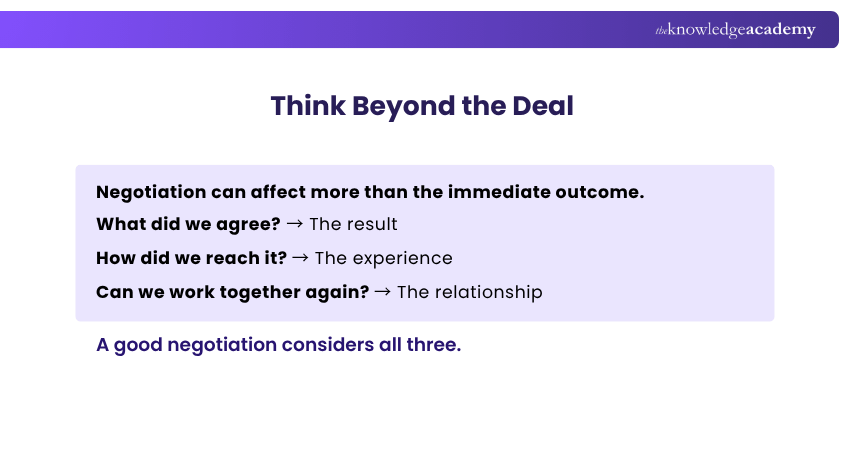
Negotiation Skills are the abilities used to communicate, discuss different interests, and work towards an agreement between two or more parties. They combine skills such as active listening, communication, problem-solving, decision-making, empathy, and emotional control.
Effective negotiation is not simply about persuading someone to accept your position. It involves understanding what matters to each side, identifying areas of common ground, and exploring solutions that can address different interests.
Why are Negotiation Skills Important?
Negotiation Skills are valuable in professional and everyday situations where people need to manage different expectations, priorities, or interests. Here are some key reasons why they matter:
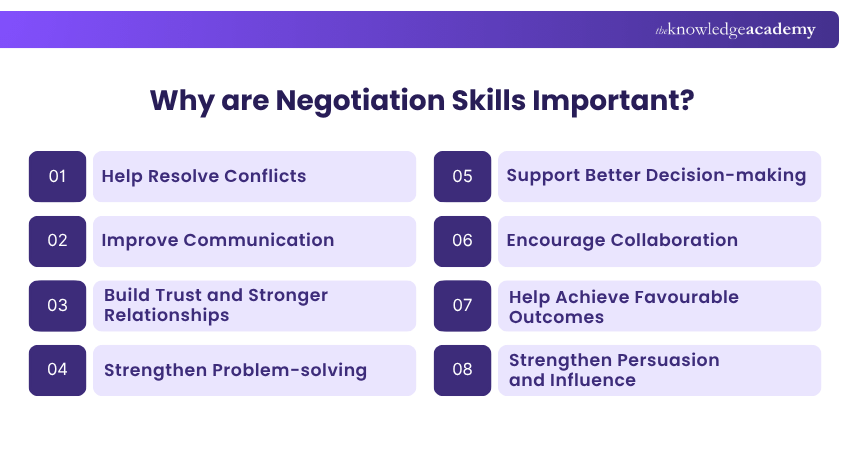
1) Help Resolve Conflicts
Disagreements are inevitable when people have different goals or perspectives. Negotiation provides a structured way to discuss these differences rather than avoiding them or allowing them to escalate.
By identifying common ground and exploring acceptable solutions, people can resolve conflicts while preserving working relationships.
Example: Two colleagues disagree over task ownership and negotiate a clearer division of responsibilities.
2) Improve Communication
Negotiation requires you to express your ideas, needs, and concerns clearly while listening to the other person's perspective.
This two-way communication can reduce misunderstandings and help everyone involved develop a clearer understanding of the issue being discussed.
Example: A manager and employee discuss workload expectations and agree on which tasks should take priority.
3) Build Trust and Stronger Relationships
When people feel heard and treated respectfully during a negotiation, it can strengthen trust between the parties.
Open communication and consideration of different needs can support stronger professional relationships and make future discussions more constructive.
Example: A supplier openly explains a delivery delay and works with the client to agree on a revised schedule.
4) Strengthen Problem-solving
Negotiations often involve obstacles that cannot be solved by simply choosing one person's preferred option.
Strong Negotiation Skills encourage you to analyse the problem, consider alternatives, and explore solutions that address the interests of those involved.
Example: When a project exceeds its budget, the team negotiates which features can be adjusted without affecting essential requirements.
5) Support Better Decision-making
Negotiation can help people examine different perspectives before reaching a decision. This involves evaluating available options and considering how each choice affects the parties involved.
Looking at a problem from several angles can support more informed and balanced decisions.
Example: Two departments discuss their competing requirements before agreeing on which project should receive priority.
6) Encourage Collaboration
Negotiation encourages people to exchange ideas, listen actively, and work towards shared solutions.
In workplace settings, this approach can support teamwork by helping colleagues address differences constructively rather than allowing competing priorities to become barriers.
Example: The marketing and sales teams negotiate campaign priorities and agree on shared targets that support both teams.
7) Help Achieve Favourable Outcomes
Negotiation plays an important role in discussions involving contracts, partnerships, salaries, clients, suppliers, and other business arrangements.
Strong Negotiation Skills can help you understand what is negotiable, identify common interests, and work towards an outcome that delivers value without unnecessarily damaging the relationship.
Example: A candidate negotiates a job offer by discussing salary, flexible working, and other employment terms.
8) Strengthen Persuasion and Influence
Negotiation helps you present ideas and proposals in a way that considers what matters to the other party. This makes it easier to explain the value of your position and gain support without relying on pressure.
Strong influencing skills are particularly valuable when discussing proposals, securing stakeholder support, or navigating competing priorities.
Example: A Project Manager explains the business value of additional resources to gain stakeholder support.
Develop the skills to inspire action and achieve better outcomes in every interaction with Persuasion Training – Sign up soon!
9) Help Manage Resources Effectively
Time, budgets, people, and other resources are often limited, making negotiation important when deciding how they should be allocated.
Effective Negotiation Skills help people discuss competing requirements, establish priorities, and agree on resource arrangements that support broader objectives.
Example: Two project teams negotiate access to a limited group of specialists based on deadlines and priorities.
10) Support Adaptability in Changing Situations
Circumstances can change during a negotiation, from new requirements and deadlines to unexpected constraints. Strong negotiators can reassess their approach without losing sight of their key priorities.
This flexibility helps them respond to new information, explore alternative options, and keep discussions moving towards a workable agreement.
Example: When a deadline unexpectedly changes, a team renegotiates deliverables to keep the most important work on schedule.
Essential Negotiation Skills You Should Develop
Effective negotiation depends on more than knowing what you want. It requires a combination of communication, analytical, and interpersonal skills that help you understand different interests, respond to challenges, and work towards suitable agreements.
1) Active Listening
Active listening helps you understand the other party’s priorities, concerns, and expectations. Paying attention and asking relevant questions can also uncover information that shapes the negotiation.
2) Communication
Clear communication helps you explain your needs, expectations, and proposals without creating unnecessary confusion. It also involves choosing the right tone and adapting your message to the situation.
Communicate with greater confidence and effectiveness through Communication Skills Courses – Register today!
3) Emotional Intelligence
Emotional Intelligence helps you recognise and manage your emotions while responding appropriately to those of others. This can be particularly useful when negotiations become tense or sensitive.
4) Problem-solving
Problem-solving allows you to look beyond disagreements and identify workable alternatives. It helps turn conflicting interests into opportunities for finding practical solutions.
5) Persuasion
Persuasion helps you present the value and reasoning behind your proposal. Rather than applying pressure, effective persuasion connects your position with the other party’s priorities.
6) Decision-making
Negotiators often need to compare options, assess trade-offs, and decide when to accept, reject, or modify an offer. Strong decision-making helps ensure these choices remain aligned with key objectives.
7) Preparation and Planning
Preparation involves researching relevant information and defining your priorities, limits, and possible alternatives before negotiations begin. It gives you a clearer basis for responding as the discussion develops.
8) Adaptability
Negotiations do not always follow the expected path. Adaptability helps you respond to new information, changing demands, and unexpected proposals while keeping your main objectives in focus.
Know What Can Move
Not every part of a negotiation carries the same weight.
Must-have: What can you not compromise on?Tradeable: What could you adjust?Flexible: What are you open to changing?Knowing these boundaries beforehand helps you negotiate with clarity without becoming inflexible.
Conclusion
The Importance of Negotiation Skills is ultimately seen in the quality of the decisions, agreements, and relationships they help shape. Developing these skills can make challenging discussions more constructive and outcomes more sustainable. A negotiation ends with an agreement, but its impact often continues long after.
Turn conflict into constructive change with our Conflict Resolution and Negotiation for Change Training - Join today!
Frequently Asked Questions
Can Negotiation Skills be Learned?

Yes. Negotiation Skills can be developed through learning, preparation, practice, feedback, and reflection. Regular exposure to different negotiation situations can also help you become more comfortable applying them.
What Should You not Say When Negotiating?
Avoid absolute or confrontational statements such as “That’s my final offer” too early or “You’re wrong.” Such language can restrict discussion or create defensiveness. Instead, explain your concerns clearly, ask questions, and keep the conversation open to workable alternatives.
What are Common Negotiation Mistakes to Avoid?
Common mistakes include entering negotiations without preparation, focusing only on your own position, interrupting the other party, making assumptions, reacting emotionally, and accepting terms without considering their wider impact.

Charlotte Wilson


Soft Skills and Business Training Manager
Charlotte Wilson is an expert in soft skills development, with over 14 years of experience helping individuals and teams improve communication, productivity and emotional intelligence in the workplace. Her training content is focused on enhancing interpersonal effectiveness and fostering positive, collaborative environments across all levels of an organisation.
View Detail

 If you wish to make any changes to your course, please


