


We may not have the course you’re looking for. If you enquire or give us a call on +1 6474932992 and speak to our training experts, we may still be able to help with your training requirements.
15 High-Income Skills to Build a Successful Career
ByThe Knowledge AcademyLast updated on: 28 October 2026
High-income skills are valuable professional abilities that may support better earning opportunities across technology, business and creative industries. Explore 15 high-income skills to learn, their practical applications and ways to develop expertise that aligns with your career goals.

The Gist
1. High-income skills can support specialist employment, consulting or freelance opportunities, depending on the profession.2. Earning potential depends on experience, location, industry demand and demonstrable results.3. AI, software development and cybersecurity are among the technical capabilities relevant to evolving career requirements.4. Business and creative expertise can also be valuable through project delivery, client relationships and communication.5. The market value of a skill can change as technology and business requirements evolve.
Your next career opportunity might not need a new degree!
Imagine discovering an interesting career path, only to assume you need to start your education all over again. But depending on the role, building on your existing experience and learning a relevant new skill may be another way forward.
A writer might explore copywriting, a business professional could strengthen their project management abilities and someone comfortable with numbers might develop data analysis skills.
These are just a few examples of how high-income skills can support different career directions. Let's explore 15 valuable skills to consider in the current job market, their practical applications and how you can start developing them.
15 High-Income Skills Worth Developing
High-income skills are specialised technical, creative or professional capabilities that organisations may value because they help solve problems, improve processes or deliver business results. These abilities can be developed through education, experience and practical training.
The following 15 skills cover different career paths and potential earning opportunities. They are not ranked by salary, as earnings vary across roles, industries and locations.
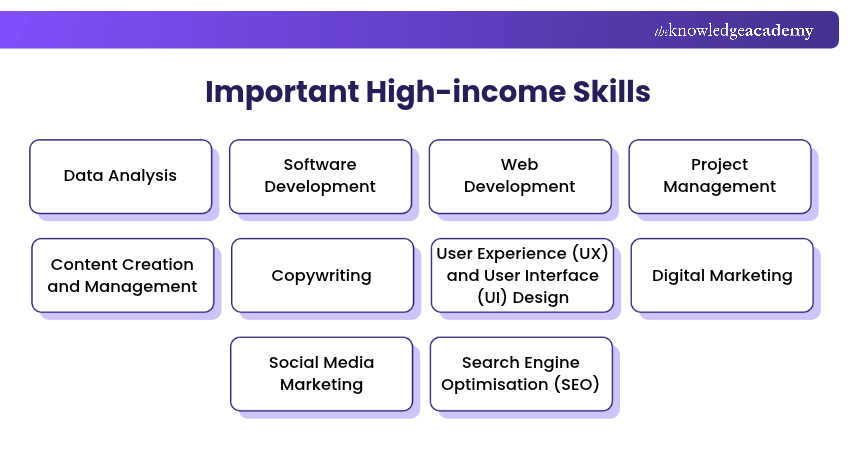
1) Data Analysis
Data analysis involves collecting, examining and interpreting information to answer questions and support decisions. Organisations use it to understand customer behaviour, review performance and identify patterns that may not be immediately visible.
Useful technical skills include data cleaning, spreadsheet analysis, SQL, basic statistics and data visualisation. Tools such as Microsoft Excel, Power BI and Tableau help analysts organise information and communicate findings clearly.
Example: A Retail Analyst examines monthly sales records and discovers that certain products perform better during particular periods. The findings help the business review its stock planning.

2) Software Development
Software development involves designing, building, testing and maintaining applications or computer systems. Developers use programming languages and structured development practices to create software that meets user and business requirements.
Relevant languages include Python, Java and C++, depending on the application. Developers also work with version control, debugging, software testing and development frameworks. For Android development, Kotlin is a recommended starting language, although Java remains supported.
Example: A Software Developer creates an inventory application that allows employees to record stock movements and check available quantities.
3) Web Development
Web development focuses on building and maintaining websites and web applications. It includes front-end development, which concerns the interface users interact with, and back-end development, which handles server-side processing and application functionality.
Common technologies include HTML for page structure, CSS for styling and JavaScript for interactive features. Back-end work may involve Node.js, Django or other suitable technologies. Web Developers also consider accessibility, security, performance and responsive design.
Example: A Web Developer builds an appointment-booking website that checks available slots and submits booking information to a server.
4) Project Management
Project management involves planning, coordinating and controlling work to achieve agreed objectives within defined constraints. Project Managers oversee areas such as scope, schedules, budgets, resources, risks and stakeholder expectations.
Useful skills include planning, prioritisation, risk assessment, communication and change control. Professionals may use tools such as Microsoft Project, Jira or other planning applications to organise and monitor work.
Example: A Project Manager coordinates the launch of a new internal system, tracks dependencies and responds to changes that could affect the delivery schedule.
Learn essential tools and techniques for effective project planning with our Introduction to Project Management Course – Join now!
5) Content Creation and Management
Content creation and management involves planning, producing, publishing and maintaining material for particular audiences. This may include articles, videos, graphics, podcasts and other digital formats.
Relevant skills include audience research, content planning, editing, production coordination and performance evaluation. Professionals also need to understand how content fits different channels and contributes to wider communication objectives.
Example: A Content Specialist develops an editorial calendar and coordinates articles and videos that answer common customer questions.
6) Copywriting
Copywriting focuses on writing clear, persuasive messages that encourage a particular response. It is used in advertising, product descriptions, landing pages, email campaigns and other marketing communications.
Effective copywriting requires audience understanding, concise language, appropriate tone and the ability to explain benefits accurately. Copywriters may also test different messages to understand which can communicate more effectively.
Example: A Copywriter prepares two versions of a landing page headline and compares the resulting enquiry rates before recommending a final version.
Pro Tip: Persuasion Should Not Come at the Expense of AccuracyA strong message should communicate a genuine benefit rather than promise an outcome a product cannot reliably deliver. Review marketing claims for clarity, supporting evidence and suitability for the intended audience.
7) User Experience (UX) and User Interface (UI) Design
User Experience (UX) design focuses on how people interact with a product and how effectively it meets their needs. User Interface (UI) design focuses more specifically on the visual and interactive elements people use.
Relevant capabilities include user research, wireframing, prototyping, usability testing and interface design. Tools such as Figma can support the creation and review of digital prototypes.
Example: A UX Designer tests an online registration process and discovers that users struggle with unclear instructions. A UI Designer then helps improve the form layout and visual feedback.
8) Digital Marketing
Digital marketing involves planning and managing promotional activities across online channels. It may include paid advertising, email marketing, content distribution, website performance and campaign measurement.
Professionals use advertising platforms, analytics tools and customer relationship management systems to plan activities and assess results. Strong digital marketing also requires understanding campaign objectives, audience needs and relevant privacy requirements.
Example: A Digital Marketing Executive reviews the cost and conversion performance of two advertising campaigns and adjusts spending based on their results.
Trainer’s Insight: Activity is Not the Same as ImpactA campaign can generate many clicks or impressions without delivering useful enquiries or sales. Consider the quality of the outcomes alongside traffic, engagement and campaign costs before deciding whether an activity is effective.
9) Social Media Marketing
Social media marketing involves developing and managing content, conversations and campaigns on social platforms. Organisations use these channels to communicate with audiences, support brand awareness and encourage relevant engagement.
Skills include platform-specific content planning, community management, social listening and performance analysis. Professionals may work with platforms such as LinkedIn, Instagram, Facebook and TikTok, depending on their audience and objectives.
Example: A Social Media Manager studies audience questions and creates a series of explanatory posts, then reviews engagement and relevant website activity.
Learn advanced strategies to enhance your online presence effectively with our Social Media Marketing Course – Register now!
10) Search Engine Optimisation (SEO)
Search Engine Optimisation (SEO) involves improving a website's content, structure and technical accessibility to help search engines understand its pages and make them easier for relevant users to discover.
Important skills include keyword research, content optimisation, technical checks, internal linking and performance analysis. Tools such as Google Search Console can help professionals investigate search visibility and website issues.
SEO can improve a site's ability to appear in relevant searches, but no technique guarantees a particular ranking.
Example: An SEO Specialist improves a product guide's headings, internal links and content clarity so that it better answers common customer questions.
11) Investment Management
Investment management involves assessing and managing investment portfolios according to defined objectives, risk considerations and client or organisational requirements.
Relevant skills include financial analysis, asset allocation, portfolio evaluation, market research and risk management. Professionals may use spreadsheets and specialist financial platforms to examine performance and compare investment scenarios. However, certain investment management roles also require relevant professional qualifications and compliance with financial regulations.
Example: An Investment Analyst examines a portfolio's exposure to different asset classes and prepares a report explaining potential risks under changing market conditions.
12) Account Management
Account management includes developing and maintaining relationships with existing clients. Account Managers work to understand customer requirements, coordinate services and identify opportunities to support long-term business relationships.
Useful capabilities include negotiation, relationship management, commercial awareness, problem-solving and Customer Relationship Management (CRM) software proficiency.
Real-world Scenario: When a Client Considers Leaving
Imagine an important client considering another provider after several missed service deadlines. Rather than offering an immediate discount, the Account Manager investigates the issues, coordinates corrective action and establishes clear expectations for future delivery.
13) Artificial Intelligence
Artificial Intelligence (AI) involves developing or applying systems that perform tasks such as identifying patterns, processing language and making predictions. AI skills range from using existing applications responsibly to designing and evaluating machine learning systems.
Technical AI roles may require programming, statistics, data preparation and model evaluation. Other professionals may need to understand prompting, output verification, privacy risks and where human judgement remains necessary.
Example: A Business Analyst uses an AI-assisted application to organise customer feedback into themes, then checks the classifications against the original responses before preparing a report.
Learn how Artificial Intelligence (AI) can complement business analysis with our Artificial Intelligence (AI) for Business Analysts Training – Join now!
14) Graphic Design
Graphic design involves creating visual communication that presents information or ideas clearly. It is applied in branding, advertising, publishing, digital content and other creative work.
Relevant skills include typography, layout, colour, composition and image preparation. Applications such as Adobe Photoshop, Illustrator and InDesign support different design tasks, but understanding design principles is as important as knowing software features.
Example: A Graphic Designer develops a set of campaign visuals that maintain consistent branding while adapting layouts for different publishing formats.
15) Cybersecurity
Cybersecurity involves protecting digital information, systems and networks against threats, unauthorised access and disruption. Professionals use technical controls, monitoring and established processes to identify vulnerabilities and respond to security incidents.
Relevant skills include network security, identity and access management, vulnerability assessment, log analysis and incident response. Cybersecurity work also requires understanding organisational risk and applicable security requirements.
Example: A Security Analyst investigates an unusual authentication alert, reviews the available records and follows an authorised incident response procedure to assess the activity.
How to Develop High-income Skills?
Developing high-income skills requires more than learning new terminology or completing a course. Focus on abilities that fit your professional goals, then build experience through practical tasks and regular feedback.
Here are six ways to strengthen your skills:
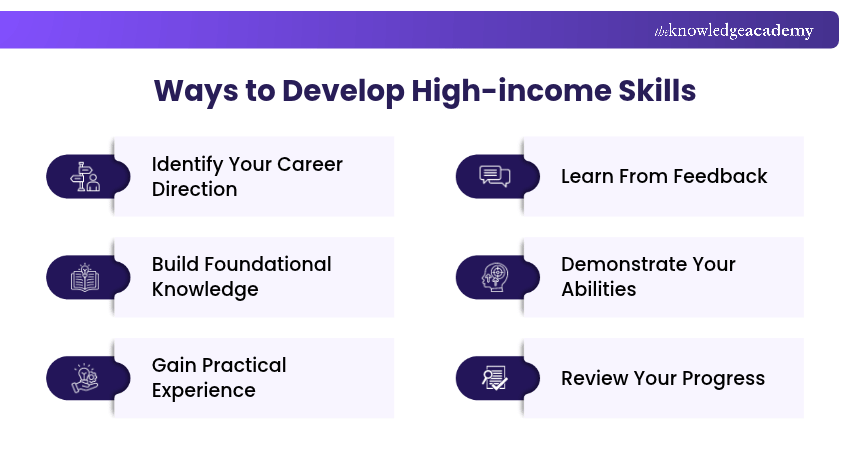
1) Identify Your Career Direction: Consider the type of role you want and review relevant job descriptions. This can help you identify which technical, creative or business skills deserve your attention.
2) Build Foundational Knowledge: Choose reliable courses, tutorials, documentation or professional training that cover the underlying concepts before progressing to complex tasks.
3) Gain Practical Experience: Apply what you learn through manageable projects. For example, build a website, analyse a dataset, create a design portfolio or prepare a project schedule.
4) Learn From Feedback: Ask experienced professionals, trainers or colleagues to review specific work. Use their observations to identify areas where your approach could improve.
5) Demonstrate Your Abilities: Prepare work samples, project summaries or portfolios that show what you can do. Respect confidentiality and use only material you are authorised to share.
6) Review Your Progress: Set a realistic goal and assess whether you can complete relevant tasks more independently and accurately. Update your learning priorities as your responsibilities and industry requirements change.
Which High-income Skill Should You Explore?
Different career interests may benefit from different capabilities. Use this guide to explore skills relevant to your goals.
| Your Area of Interest | Skills to Explore |
| Working with information and patterns | Data analysis, AI |
| Building digital products | Software development, web development, UX/UI design |
| Coordinating business work and relationships | Project management, account management |
| Marketing and online communication | Digital marketing, social media marketing, SEO |
| Writing and creative communication | Content creation, copywriting, graphic design |
| Financial markets and portfolios | Investment management |
| Protecting systems and information | Cybersecurity |
Choose a skill that matches your interests and the responsibilities of your intended role. Consider the time, training and practical experience needed before committing to a learning pathway.
Learn top industry tools and technologies used by professionals with our Engineering Skills Training – Sign up now!

The Knowledge Academy develops accessible learning content across Project Management, IT, Cybersecurity, Data Science, Business Analysis, HR, Accounting and Finance, Leadership and Health and Safety. Its resources combine subject research with clear explanations to help professionals build practical knowledge across a wide range of disciplines.
View Detail

 If you wish to make any changes to your course, please


