


 Top Rated Course

We may not have the course you’re looking for. If you enquire or give us a call on 01344203999 and speak to our training experts, we may still be able to help with your training requirements.
What are Counselling Skills and How to Develop Them?
The Knowledge Academy 31 August 2026Counselling Skills help create supportive conversations where people feel heard, understood and able to explore their thoughts and feelings.
Training Outcomes Within Your Budget!
We ensure quality, budget-alignment, and timely delivery by our expert instructors.
Table of Contents
Related Courses
Key Takeaways
Counselling skills help professionals listen, understand and respond effectively to others.Effective Counselling involves paying attention to both what a client communicates and how they express their thoughts and feelings.Active listening, empathy and questioning are central to meaningful counselling conversations.Rapport, clear communication and collaborative goals can help create a supportive environment for exploration and personal growth.Counselling Skills can be strengthened through practice, reflection and feedback.
A young professional in a counselling room says, "I don't even know where to begin. I just feel exhausted all the time."
Instead of immediately offering advice, the Counsellor pauses and responds, "It sounds like things have been overwhelming for quite some time." That simple response does not solve the problem. It opens the conversation.
Effective counselling is often built through moments like this. The ability to listen, understand another person's perspective and build trust can help clients feel comfortable exploring their thoughts and emotions. These abilities are known as Counselling Skills, and they form the foundation of meaningful counselling conversations. So, what are the key Counselling Skills and how to develop them? Let's explore in this blog!
What are Counselling Skills?
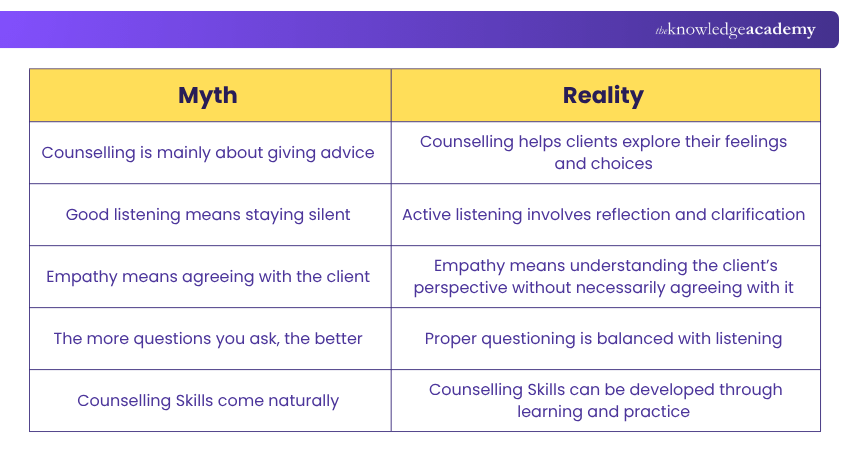
Counselling Skills are interpersonal and communication abilities used to create supportive conversations and help clients explore their thoughts, emotions and experiences. They include active listening, empathy, questioning, reflection, summarisation and rapport building.
Together, these skills can help establish trust, encourage openness and create an environment where clients can develop greater understanding and self-awareness. Rather than simply giving advice or providing immediate solutions, Counselling Skills help facilitate meaningful exploration and communication.
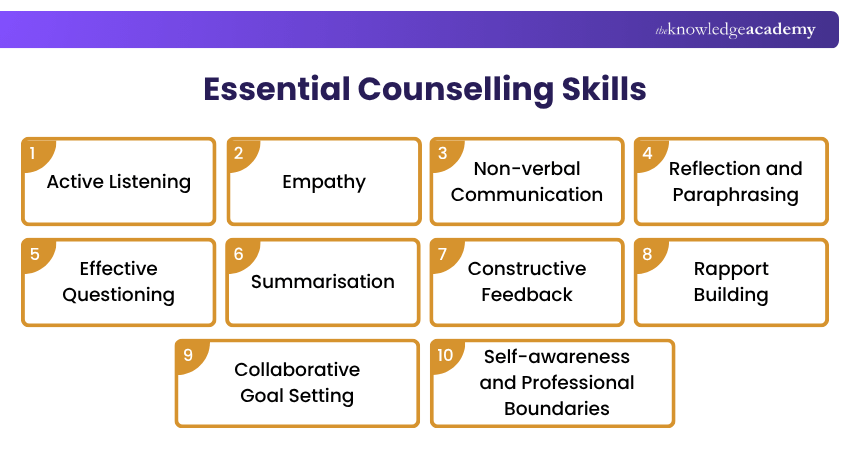
10 Essential Counselling Skills
Counselling involves more than simply listening to what a client says. Counsellors need a range of skills to understand emotions, encourage open communication, build trust and guide conversations effectively. Here are 10 essential Counselling Skills that support meaningful interactions with clients:
1) Active Listening
Active listening means giving focused attention to what a client communicates rather than simply hearing their words. It involves listening carefully to their experiences and emotions and giving them sufficient space to express themselves. Active listening is important for building trust and encouraging deeper exploration of feelings.
Effective active listening may involve:
Minimising unnecessary interruptions
Paying attention to the client's words
Allowing appropriate pauses
Checking your understanding
Responding to important themes
2) Empathy
Empathy involves trying to understand another person's emotions and experiences from their perspective without judgement. It helps clients feel recognised and understood, which can contribute to a stronger counselling relationship. Empathy does not mean assuming that you know exactly how another person feels. Instead, it involves listening carefully and remaining open to their individual experience.
Pro Tip
Avoid assuming and saying "I know exactly how you feel." Give the client space to describe their experience in their own words.
3) Non-verbal Communication
Communication involves more than spoken words. Tone of voice, facial expressions, posture, gestures and other non-verbal cues may provide additional context during a conversation. However, non-verbal behaviour should be considered alongside what the person says rather than treated as definitive proof of what they are thinking or feeling.
So, treat body language as contextual information rather than a certain indicator of emotion. Explore observations carefully instead of making assumptions.
4) Reflection and Paraphrasing
Reflection involves responding to important thoughts or feelings expressed by a client. Paraphrasing involves expressing the essence of what someone has communicated in your own words to check understanding and encourage further exploration.
For example:
Client: "I've been working constantly, but I still feel like I'm falling behind."
Reflective response: "It sounds like you're putting in a lot of effort but still feeling that you're not keeping up."
Used carefully, reflection can demonstrate attentive listening and help clients explore their experiences more deeply.
5) Effective Questioning
Questions can help clients explore experiences, clarify information and consider different aspects of a situation. Counsellors may use both open and closed questions depending on what they need to explore. Open questions encourage clients to explore their experiences in greater depth, while closed questions can help clarify specific information.
An open question such as "How did that situation affect you?" allows greater exploration than a question that can be answered simply with yes or no.
Counselling Insight
Use questions purposefully. Asking too many questions in quick succession can make a supportive conversation feel more like an interview.
6) Summarisation
Summarisation involves bringing together important points from a conversation in a concise way. It can help:
a) Check shared understanding
b) Identify recurring themes
c) Review what has been discussed
d) Refocus a conversation
e) Support progress towards agreed goals
7) Constructive Feedback
Feedback can help clients develop insight into their experiences, behaviours or progress. To make feedback useful, keep it relevant, respectful and thoughtful rather than judgemental. The goal is not to tell the client what they have done "right" or "wrong", but to provide observations that may support further reflection and self-awareness.
Looking for the key to well-being and personal growth? Our Positive Psychology Course will help you out. Sign up now!
8) Rapport Building
Rapport refers to developing a professional relationship in which the client feels comfortable enough to communicate openly. Trust, consistency, respect and attentive communication can all contribute to rapport building. Strong rapport can provide a supportive foundation for the other Counselling Skills to work effectively.
9) Collaborative Goal Setting
Goal Setting gives direction to the counselling process by helping the client identify what they would like to understand, address or change. Rather than imposing objectives, goals can be developed collaboratively between the Counsellor and client. Effective goals should be meaningful to the client and realistic enough to support progress.
10) Self-awareness and Professional Boundaries
Counselling conversations can involve sensitive and emotionally challenging experiences. Counsellors therefore benefit from recognising their own reactions, assumptions and limitations while maintaining appropriate professional boundaries. Self-awareness can help Counsellors reflect on how their personal experiences or responses may influence a conversation.
Test Your Counselling Skills
Which Response Uses Counselling Skills Most Effectively?
Scenario:
A client says: "Everyone keeps telling me I should change jobs, but I'm not sure that's what I want."
Which response is most appropriate for encouraging further exploration?
A. "You should probably stay until you find something better."B. "Why haven't you followed their advice?"C. "It sounds like other people have strong opinions, but you're still working out what feels right for you."D. "Have you started applying for other jobs?"
Correct Answer: CIt leaves space for the client to explore their own perspective.
How Counselling Skills Work Together?
Counselling Skills are rarely used one at a time. During a conversation, a Counsellor may move naturally between listening, reflecting, questioning and summarising. Consider this example:
Client: "I've been trying to keep everything together at work, but lately I feel like whatever I do isn't enough."Step 1: Active ListeningThe Counsellor gives the client space to explain the situation without unnecessary interruption.↓Step 2: Reflection"It sounds as though you're putting in a lot of effort but still feeling that you're falling short."↓Step 3: Effective Questioning"When do you notice that feeling most strongly?"↓Step 4: EmpathyThe Counsellor acknowledges the difficulty of the experience without judging it or assuming they fully understand how the client feels.↓Step 5: SummarisationThe Counsellor brings together the important themes that have emerged and checks their understanding with the client.↓Step 6: Collaborative Goal SettingThe Counsellor and client explore what the client would like to understand or work towards.
However, this sequence is not a rigid formula. Different conversations may require different skills at different times.
How to Develop Counselling Skills?
Counselling Skills can improve through learning, practice and reflection. Knowing the definition of active listening or empathy is useful, but applying these skills appropriately requires experience. Here are several ways to strengthen them:
1) Practise Focused Listening: During conversations, notice whether you are genuinely listening or preparing your response while the other person is still speaking.
2) Practise Open-ended Questions: Experiment with questions beginning with what, how or tell me about when you want to encourage greater exploration.
3) Develop Reflection Skills: Practise paraphrasing what another person has said without simply repeating their exact words.
4) Reflect on Your Conversations: After an important conversation, consider:
a) Did I listen without unnecessary interruption?
b) Did I make assumptions?
c) Were my questions useful?
d) Did I give the other person enough space?
e) What could I do differently next time?
5) Seek Feedback: Constructive feedback can help identify communication habits that may be difficult to recognise independently.
Conclusion
Effective counselling is not about finding the perfect response to every situation. It is about knowing how to listen, respond and adapt to the individual in front of you. Developing Counselling Skills takes continued practice, reflection and learning, but each improvement can contribute to more thoughtful and supportive conversations.
Master the craft of responding to mental health challenges with our Mental Health Courses. Sign up now!
Frequently Asked Questions
Can Counselling Skills be Useful Outside Professional Counselling?

Yes. Counselling Skills can improve everyday interactions in workplaces, education, leadership and personal relationships. They are particularly useful for handling sensitive conversations, resolving misunderstandings, supporting others and creating an environment where people feel comfortable expressing themselves.
What are the Main Types of Counselling?
The main types of counselling include:
a) Individual counselling
b) Group counselling
c) Family counselling
d) Couples or marriage counselling
e) School counselling
f) Career counselling
What are the Goals of Counselling?
Counselling aims to help clients explore thoughts, feelings and experiences in a supportive environment. Goals may include improving self-understanding, developing coping strategies, making informed decisions, managing challenges and supporting positive changes based on the client’s individual needs.
Why is Self-awareness Important in Counselling?
Self-awareness helps Counsellors recognise their own emotions, assumptions and reactions. This can help them maintain professional boundaries and keep the conversation focused on the client’s experiences and needs.

The Knowledge Academy


Global Training Provider
The Knowledge Academy is a world-leading provider of professional training courses, offering globally recognised qualifications across a wide range of subjects. With expert trainers, up-to-date course material, and flexible learning options, we aim to empower professionals and organisations to achieve their goals through continuous learning.


 If you wish to make any changes to your course, please


