


 Top Rated Course

We may not have the course you’re looking for. If you enquire or give us a call on 01344203999 and speak to our training experts, we may still be able to help with your training requirements.
Essential Conflict Management Skills for Handling Disagreements
William Brown 02 September 2026This blog explores the essential Conflict Management Skills that help you communicate effectively and work towards constructive solutions, along with why they matter and how to develop them.

Training Outcomes Within Your Budget!
We ensure quality, budget-alignment, and timely delivery by our expert instructors.
Table of Contents
Key Takeaways
1. Conflict Management Skills help address disagreements before they become more difficult to resolve.2. Active listening, empathy, communication, and problem-solving are essential for managing conflict.3. Emotional control helps you respond thoughtfully instead of reacting impulsively.4. Effective Conflict Management can strengthen teamwork, communication, and professional relationships.5. These skills can be improved through practice, reflection, feedback, and difficult conversations.
“That’s not what I meant.”
“But that’s not what you said.”
And just like that, normal conversation becomes uncomfortable.
Conflict does not always arrive as a heated argument. Sometimes, it starts with a misunderstood message, a missed deadline, competing priorities, or simply two people seeing things differently.
Conflict Management Skills help you handle these moments before friction takes over. Left unaddressed, even small misunderstandings can quietly erode trust and make future collaboration harder. Learning to recognise and manage these moments early is what keeps working relationships intact.
What are Conflict Management Skills?
Conflict Management Skills are the abilities used to recognise, address, and manage disagreements constructively. They help people understand different perspectives, communicate concerns, control emotional reactions, and work towards suitable solutions.
Conflict itself is a natural part of professional environments. When managed effectively, disagreements can encourage better communication, reveal different ideas, and provide opportunities to strengthen working relationships.
Essential Conflict Management Skills
Handling conflict effectively requires more than staying calm. Below are key skills that can help you understand disagreements, communicate constructively, and work towards solutions:
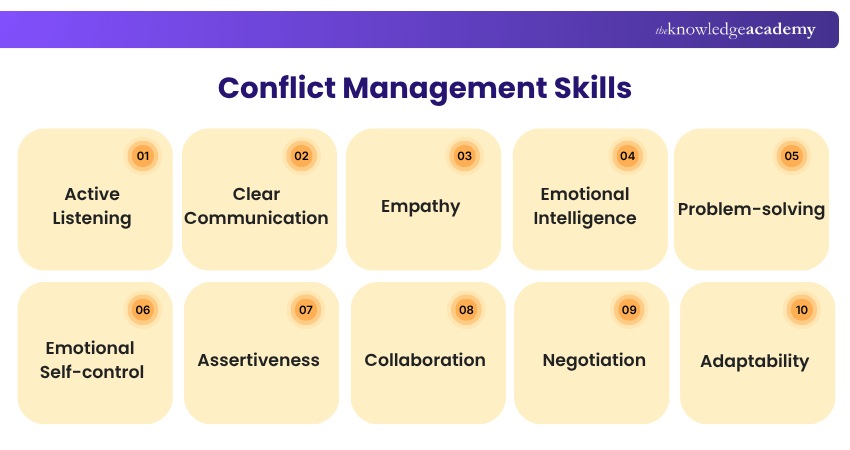
1) Active Listening
Active listening means giving the other person your full attention before responding. It helps you understand their concerns, identify important details, and reduce misunderstandings during difficult conversations. It also involves asking relevant questions and confirming what you have understood rather than making assumptions.
2) Clear Communication
Clear communication helps you explain your concerns, expectations, and perspective without creating additional confusion. The words you choose, your tone, and your non-verbal communication can all influence how your message is received. Being direct but respectful can keep the discussion focused on the issue rather than turning it into a personal confrontation.
3) Empathy
Empathy involves recognising another person's emotions and trying to understand the situation from their perspective. It does not mean that you must agree with their position. Instead, it allows you to acknowledge their concerns and respond with greater awareness, which can reduce tension and encourage more constructive discussion.
4) Emotional Intelligence
Emotional Intelligence helps you recognise your own emotions while understanding how others may be feeling. This awareness is particularly useful when disagreements become tense. It can help you notice emotional triggers, adjust your response, and communicate more thoughtfully instead of reacting impulsively.
Conflict Has Two Directions
A disagreement can move towards:Escalation: Reaction → Blame → Defensiveness → Greater tensionorResolution: Listening → Understanding → Discussion → SolutionConflict Management Skills can influence which direction the conversation takes.
5) Problem-solving
Problem-solving shifts attention from who caused the problem to how it can be addressed. It involves identifying the underlying issue, considering alternatives, and evaluating practical solutions. This skill can prevent discussions from becoming trapped in blame and help everyone involved concentrate on what needs to happen next.
6) Emotional Self-control
Conflict can trigger frustration, defensiveness, or anger. Emotional Self-control helps you manage these reactions so they do not take control of the conversation. Knowing when to pause, lower your tone, or temporarily step away can help prevent an already difficult discussion from escalating.
7) Assertiveness
Assertiveness helps you communicate your needs, boundaries, and concerns clearly while respecting the other person's position. It creates a balance between remaining silent and becoming aggressive, allowing you to address the issue directly without unnecessarily intensifying the disagreement.
8) Collaboration
Collaboration encourages the people involved to approach conflict as a shared problem rather than a competition. By exchanging ideas and considering different perspectives, both sides can explore solutions that address important concerns and support their wider objectives.
9) Negotiation
Negotiation becomes important when people have different priorities but still need to reach an agreement. It involves discussing expectations, identifying common ground, and determining where compromise may be possible. Strong negotiation can help turn competing positions into practical agreements that everyone involved can work with.
10) Adaptability
Not every conflict can be handled using the same approach. Some situations require direct discussion, while others benefit from compromise, collaboration, or additional time. Adaptability helps you assess the circumstances and adjust your communication and Conflict Management approach accordingly.
Pause Before You ReactHear → Think → RespondA short pause can prevent an emotional reaction from making the conflict harder to resolve.
Why are Conflict Management Skills Important?
Conflict Management Skills can influence how disagreements affect people, relationships, and workplace performance. Their value lies not simply in ending arguments but in helping people deal with differences constructively.
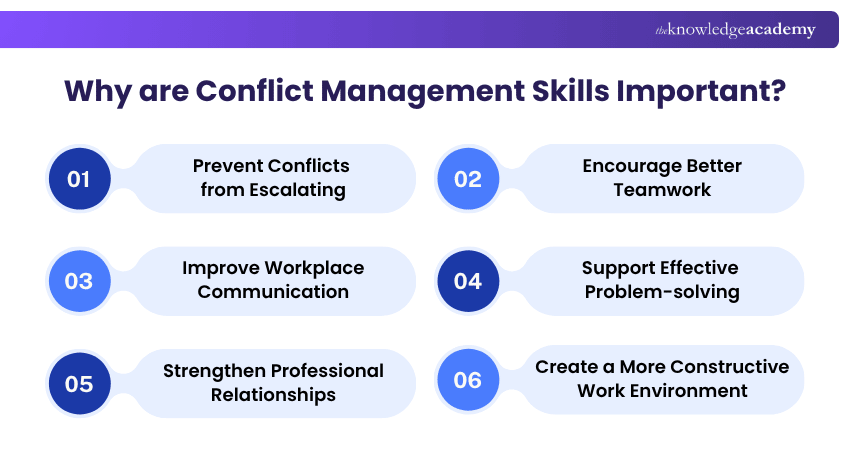
1) Prevent Conflicts from Escalating
Addressing disagreements early can prevent misunderstandings and frustration from developing into more serious disputes.
Example: A Manager discusses repeated deadline concerns with an employee before frustration begins affecting the wider team.
2) Improve Workplace Communication
Managing conflict encourages people to express concerns and listen to different viewpoints. This can make expectations clearer and reduce misunderstandings.
Example: Two colleagues discuss conflicting task priorities and clarify which deadline should take precedence.
3) Strengthen Professional Relationships
Handling disagreements respectfully can help preserve trust even when people do not initially agree. In fact, how a disagreement is handled often shapes a working relationship more than the disagreement itself.
Example: A Manager acknowledges an employee's concerns about a new process before explaining why the change is required.
4) Encourage Better Teamwork
Unresolved disagreements can make collaboration difficult. Conflict Management Skills help teams address differences and refocus on shared objectives.
Example: Two departments with competing priorities agree on responsibilities before beginning a joint project.
Learn to develop the right negotiation process with our Conflict Resolution and Negotiation for Change Training – Join now!
5) Support Effective Problem-solving
Conflict can reveal problems that might otherwise remain unnoticed. Managing it constructively allows teams to examine those issues and explore possible solutions.
Example: Repeated disagreements about project handovers reveal that responsibilities between two teams were never clearly defined.
6) Create a More Constructive Work Environment
When people know that concerns can be discussed respectfully, workplace disagreements can become easier to address. This kind of environment also makes people more willing to raise small issues early, before they have the chance to grow into bigger ones.
Example: A team regularly discusses challenges during meetings instead of allowing unresolved concerns to build over time.
Pro Tip
Address the issue, not the person. Focus on the specific behaviour, decision, or situation causing the disagreement rather than making personal judgements. This keeps the conversation constructive and reduces defensiveness.
How to Improve Your Conflict Management Skills?
Conflict Management Skills develop through deliberate practice and reflection. These can be expanded into the following practical approaches:
1) Identify Your Conflict Response
Consider how you naturally react when disagreements arise. You might become defensive, avoid the issue, give in quickly, or push strongly for your own position. Recognising these patterns can help you decide when your usual response needs to change.
2) Listen Before Responding
During disagreements, concentrate on understanding what the other person is saying before preparing your response. Allow them to finish, ask questions, and clarify uncertain points. This can prevent assumptions from shaping the conversation.
3) Separate the Person from the Problem
Focus on the specific behaviour, decision, or issue causing the disagreement rather than attacking someone's character. Keeping the conversation centred on the problem makes it easier to discuss possible solutions without creating unnecessary defensiveness.
4) Ask Questions Before Making Assumptions
If someone's behaviour or decision is unclear, ask for their reasoning rather than immediately assuming their intentions. Questions can reveal missing information and uncover the underlying cause of a disagreement.
5) Manage Emotional Reactions
Notice when frustration or stress begins affecting how you communicate. Pausing before responding can help you choose a more constructive reaction. If necessary, suggest returning to the conversation after everyone has had time to think.
6) Practise Difficult Conversations
Role-playing realistic workplace disagreements can help you practise responding under pressure without the consequences of an actual dispute. Experiment with different ways of questioning, listening, explaining concerns, and proposing solutions.
7) Seek Feedback and Reflect
After handling a conflict, consider what worked and what you could have approached differently. Feedback from trusted colleagues or Managers can provide another perspective on your communication style.
Change the Question
When conflict becomes stuck, the question being asked can sometimes be part of the problem.Instead of “Who is right?”, try:“What is causing the disagreement?”“What does each person need?”“What would help us move forward?”The goal shifts from proving a point to solving the problem.
Conclusion
Not every disagreement needs to become a lasting problem. The way you listen, respond, and work through differences can determine whether conflict creates further tension or leads to a useful resolution. Conflict Management Skills improve with every difficult conversation handled thoughtfully. The aim is not to eliminate disagreement, but to become better at what happens next.
Lead difficult conversations with confidence through our Senior Management Training - Join today!
Frequently Asked Questions
What are the Five C's of Conflict Management?

The Five C's are Clarity, Communication, Collaboration, Compromise, and Control. Together, these elements guide a disagreement from confusion to resolution: understand what's actually being disputed, keep the conversation respectful and collaborative, stay open to middle ground, and manage emotions so they don't derail things.
What is the Most Important Conflict Management Skill?
There is no single skill that works for every conflict, but active listening is particularly valuable because understanding the issue and the perspectives involved provides a stronger basis for communication, problem-solving, and negotiation.
What is the Difference Between Conflict Management and Conflict Resolution?
Conflict Management focuses on handling disagreements constructively and limiting their negative effects. Conflict Resolution focuses more specifically on addressing the underlying issue and reaching a solution. Not every conflict can be fully resolved, which makes effective management important.

William Brown


Senior Business Analyst and Strategic Advisor
William Brown is a senior business analyst with over 15 years of experience driving process improvement and strategic transformation in complex business environments. He specialises in analysing operations, gathering requirements and delivering insights that support effective decision making. William’s practical approach helps bridge the gap between business goals and technical solutions.
View Detail

 If you wish to make any changes to your course, please


