




We may not have the course you’re looking for. If you enquire or give us a call on +44 1344 203 999 and speak to our training experts, we may still be able to help with your training requirements.
Top Bookkeeping Skills for Success
ByThe Knowledge AcademyLast updated on: 24 November 2026
Discover essential bookkeeping skills, including financial data entry, bank reconciliation, accounting software and numerical accuracy. Learn how these technical and interpersonal abilities help Bookkeepers maintain reliable records and manage financial transactions.

Quick Snapshot
Strong bookkeeping skills go beyond recording financial transactions. They involve maintaining accurate records, reconciling accounts, using accounting software and handling financial information responsibly. Developing these abilities helps Bookkeepers manage daily financial tasks with greater accuracy and confidence.
What happens when a business loses track of its financial records?
A missing invoice, an unrecorded transaction or an incorrect entry might seem like a small mistake. But over time, these errors can create confusion, affect financial reporting and make it difficult to understand a business's financial position.
This is where bookkeeping skills become essential. From recording transactions accurately to maintaining financial records and identifying discrepancies, these skills support effective financial management. But what are the essential bookkeeping skills every professional should know? Let's explore in detail!
Essential Bookkeeping Skills
Bookkeepers need technical knowledge and interpersonal abilities to record transactions accurately, maintain financial information and support day-to-day accounting activities. Here are the important bookkeeping skills:
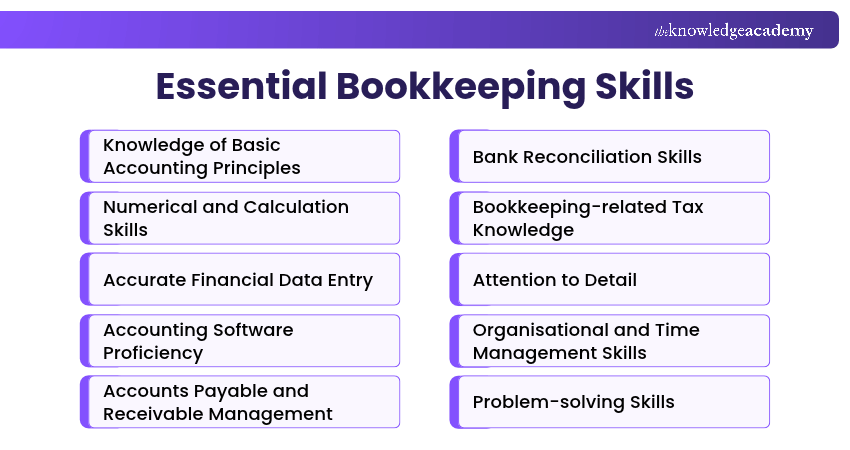
1) Knowledge of Basic Accounting Principles
A strong foundation in basic accounting principles is the first step toward proper bookkeeping. Bookkeepers should understand double-entry bookkeeping, debits and credits, account classifications and the purpose of ledgers.
Under double-entry bookkeeping, each transaction affects at least two accounts, with total debits equaling total credits. Understanding these principles helps Bookkeepers classify transactions correctly and maintain balanced accounting records.

2) Numerical and Calculation Skills
Strong numerical skills help Bookkeepers calculate transaction totals, verify balances and check financial information for mathematical accuracy. They use basic arithmetic to review invoices, discounts, payments, taxes and other amounts relevant to their work.
Understanding numerical relationships also helps them recognise calculations that appear inconsistent. For example, a Bookkeeper may verify whether an invoice total correctly reflects the listed quantities, prices and applicable tax.
3) Accurate Financial Data Entry
Financial data entry involves recording transactions such as sales, purchases, expenses and payments accurately in the appropriate accounting records.
Bookkeepers need to enter correct amounts, dates, account codes and transaction descriptions while checking information against supporting documents. Accurate entries reduce discrepancies and help maintain complete, reliable ledgers.
4) Accounting Software Proficiency
Being skilled in accounting software is essential for many modern bookkeeping roles. Widely used platforms like QuickBooks, Xero and Sage can help streamline tasks and improve the efficiency of financial recordkeeping.
Bookkeepers should understand how to enter transactions, process invoices, reconcile accounts and generate reports using the software required by their organisation. Familiarity with spreadsheets can also support financial calculations and record reviews.
5) Accounts Payable and Receivable Management
Accounts payable and receivable management involves maintaining records of amounts owed to suppliers and payments due from customers. Bookkeepers record invoices, monitor supplier payments and track outstanding customer balances.
Bookkeepers help maintain these records, match payments to invoices and identify overdue balances. Accurate payable and receivable records support cash flow monitoring and effective financial administration.
6) Bank Reconciliation Skills
Bank reconciliation involves comparing transactions recorded in the accounting system with those shown on a bank statement. Bookkeepers identify unmatched entries, investigate differences and record necessary adjustments when appropriate.
These differences may arise from timing, missing transactions, bank charges or recording errors. For example, a bank charge appearing on the statement but not in the ledger may require an appropriate accounting entry. Regular reconciliation supports accurate cash records and helps identify potential discrepancies.
Learn the skills that keep business finances in check by joining the Bookkeeper Course now!
7) Bookkeeping-related Tax Knowledge
Knowledge of relevant tax requirements helps Bookkeepers maintain appropriate records and support tax-related accounting activities. For example, Bookkeepers may need to understand VAT recordkeeping requirements, relevant transaction classifications and the documentation needed for VAT returns.
The specific responsibilities depend on the employer, jurisdiction and Bookkeeper's role. Keeping up with applicable requirements helps reduce recordkeeping errors and supports compliance with relevant obligations.
8) Attention to Detail
Attention to detail helps Bookkeepers identify errors, inconsistencies and missing information in financial records. A skilled Bookkeeper carefully reviews invoices, receipts, account balances and transaction details to maintain accurate records and reduce the risk of incorrect financial reporting.
9) Organisational and Time Management Skills
Organisation is the linchpin of effective bookkeeping. A Bookkeeper deals with invoices, receipts, financial records and supporting documents regularly.
Strong organisational skills help Bookkeepers maintain systematic records, retrieve documents efficiently and manage several financial tasks. Effective time management also helps them meet invoicing, reconciliation, payroll and reporting deadlines, depending on their responsibilities.
10) Problem-solving Skills
Bookkeepers often find themselves in situations where discrepancies or reconciliation issues arise. Problem-solving skills help them investigate incorrect entries, identify the causes of differences and determine appropriate corrective actions.
For example, when an invoice appears twice in the accounting system, a Bookkeeper must verify the records before correcting or escalating the issue.
11) Integrity and Confidentiality
Ethical conduct is non-negotiable in bookkeeping. Bookkeepers handle sensitive financial information and must maintain honesty, confidentiality and professional integrity.
This involves recording transactions truthfully, protecting confidential records, following workplace policies and reporting suspected irregularities through appropriate channels. Ethical practices help maintain trust and support reliable financial recordkeeping.
12) Effective Communication
Good communication is among the most basic and fundamental bookkeeping skills, but it goes beyond numbers. Bookkeepers communicate with clients, colleagues, suppliers and accountants to clarify financial transactions and resolve information gaps. Clear written and verbal communication helps them explain discrepancies, request missing documents and provide accurate updates.
Turn accounting tasks into organised financial records with the QuickBooks Training – Join today!
How to Improve Bookkeeping Skills?
Improving bookkeeping skills requires regular practice, a clear understanding of accounting principles and familiarity with practical financial tasks. Here are the effective ways to strengthen these abilities:
a) Strengthen Your Accounting Fundamentals: Learn double-entry bookkeeping, debits, credits and ledger management. Practise recording transactions to improve your understanding of accounting principles.
b) Practise with Sample Transactions: Use fictional invoices, receipts and payment records to practise financial data entry. Review your entries against the source documents to identify and correct errors.
c) Learn Accounting Software: Develop proficiency in tools such as QuickBooks, Xero or Sage. Focus on recording transactions, managing invoices, tracking payments and generating basic reports.
d) Develop Reconciliation Skills: Practise matching bank statements with accounting records. Investigate discrepancies and identify transactions that require correction or clarification.
e) Improve Spreadsheet and Numerical Skills: Use spreadsheets to organise financial data, calculate totals and verify balances. Learn basic formulas, sorting and filtering to improve accuracy and efficiency.
f) Stay Updated and Seek Feedback: Keep up with relevant accounting practices, tax requirements and software updates. Seek professional feedback and consider bookkeeping training to strengthen your skills.
Bonus Tip: Practise a Complete Bookkeeping Cycle
Use fictional invoices, receipts and bank transactions to create a small set of accounting records. Record the transactions, check account balances and complete a bank reconciliation. This practical exercise helps connect individual bookkeeping skills through one realistic workflow.

The Knowledge Academy develops accessible learning content across Project Management, IT, Cybersecurity, Data Science, Business Analysis, HR, Accounting and Finance, Leadership and Health and Safety. Its resources combine subject research with clear explanations to help professionals build practical knowledge across a wide range of disciplines.
View Detail

 If you wish to make any changes to your course, please


