


 Top Rated Course

We may not have the course you’re looking for. If you enquire or give us a call on +44 1344 203 999 and speak to our training experts, we may still be able to help with your training requirements.
What is Strategic Management, and Why is it Important?
William Brown 05 March 2026Strategic Management is the process of planning, implementing, and reviewing strategies to align resources, navigate competition, and achieve long-term goals. It helps companies understand where they are, where they are headed, and how to get there. This leads to smart decisions, improved performance, and drives innovation.

Training Outcomes Within Your Budget!
We ensure quality, budget-alignment, and timely delivery by our expert instructors.
Table of Contents
Every successful business requires clear direction and an effective strategy to turn ideas into action. By understanding What is Strategic Investment, organisations can align goals, resources, and market trends to foster growth and innovation. Whether it is a small or large company, this approach can make a big difference.
In this blog, you will learn about What is Strategic Investment, how it works, its benefits, its importance, and much more. So, if you are ready to adopt the right strategy to put your business ahead and sustain long-term success, keep reading ahead!
Table of Contents
1) What is Strategic Management?
2) Importance of Strategic Management
3) The Five Phases of Strategic Management
4) Key Characteristics of Strategic Management
5) Benefits of Effective Strategic Management
6) Examples of Strategic Management
7) Strategic Management: Career Opportunities
8) What are the Three Major Areas of Strategic Management?
9) What are the 3P’s of Strategic Management?
10) Conclusion
What is Strategic Management?
Strategic Management is an ongoing process where organisations plan, apply, and review strategies to meet their goals. It involves setting clear objectives, making well-informed choices, and arranging resources to ensure long-term success and maintain a competitive edge. This process helps organisations understand their Strengths, Weaknesses, Opportunities, and Threats (SWOT).
It begins with defining a clear vision and mission for the organisation. Following this, detailed strategic plans are developed to support decision-making and resource management. Strategic Leadership and Management play a crucial role in executing these plans through various projects and initiatives.
Importance of Strategic Management
In a dynamic setting, Strategic Management provides an organised method for accomplishing long-term corporate objectives. Organisations are empowered to make wise decisions, adjust to change, and keep a competitive edge when their vision and actions are in sync.
1) Provides long-term direction and clarity for organisational goals.
2) Aligns resources and departments toward shared objectives.
3) Enables proactive responses to market changes and challenges.
4) Supports innovation, agility, and resilience in dynamic environments.
5) Helps identify growth opportunities and areas for improvement.
6) Enhances competitiveness through continuous evaluation and refinement.
7) Encourages a unified approach to achieving business success.
8) Prepares organisations to adopt sustainable and future-ready strategies.
The Five Phases of Strategic Management
Strategic Management process unfolds five essential phases, each critical for the successful navigation and implementation of an organisation's Strategic plan, requiring both critical thinking and strategic thinking. These five stages are as follows.

1) Goal Setting: The first step involves clearly defining the organisation’s long-term goals and strategic direction. This sets the foundation for all future decisions by aligning the company’s mission and values with measurable outcomes.
2) Analysis: A thorough internal and external analysis follows, often using tools like SWOT to assess strengths, weaknesses, opportunities, and threats. This step helps organisations understand their current position and gather insights on market trends, resources, and competitors.
3) Strategy Formulation: Based on the analysis, a strategic plan is developed to bridge the gap between current capabilities and future goals. This plan outlines the approach, priorities, and resource allocation needed to achieve the desired outcomes.
4) Strategy Implementation: With a strategy in place, the focus shifts to execution; assigning roles, allocating resources, and initiating action plans. Effective implementation ensures that the strategy is translated into measurable results through coordinated efforts.
5) Evaluation and Control: The final step involves tracking performance against the original objectives to assess effectiveness. Continuous feedback and analysis allow for timely adjustments, ensuring the strategy remains relevant and impactful.
Want to learn how to communicate with remote teams using technology? Sign up with our Managing Remote Teams Course today!
Key Characteristics of Strategic Management
Strategic Management gives a roadmap to sustain long-term success. It includes key characteristics to help organisations stay focused and future-ready. Let’s look at them below.
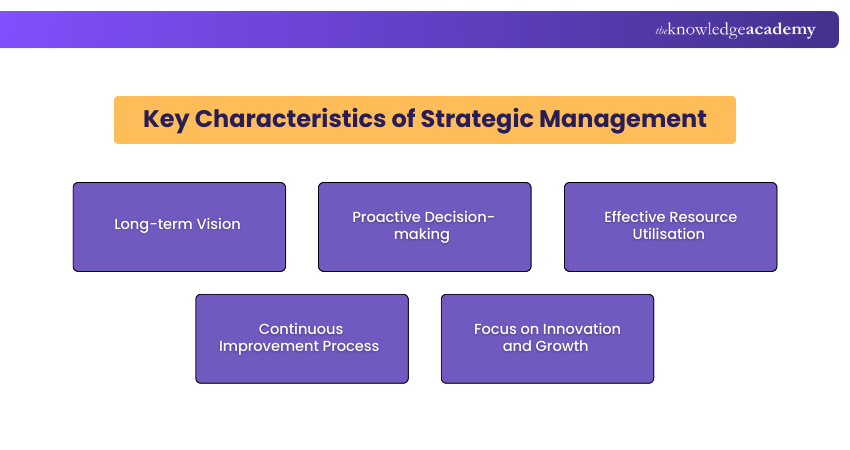
1) Long-term Vision
Strategic Management focuses on sustainable growth instead of relying on quick fixes. This aligns organisations with long-term goals to help teams work together towards a shared direction.
2) Proactive Decision-making
Strategic Management helps organisations to proactively anticipate future trends and challenges. This approach supports seamless adaptation in transitions in the business environment.
3) Effective Resource Utilisation
An integral aim of Strategic Management is to maximise the organisation’s resources. It makes sure time, money, and talent are being used effectively and carefully to achieve business objectives.
4) Continuous Improvement Process
Strategic Management is an ongoing process of improvement. It involves consistently identifying opportunities, implementing strategies, and evaluating results. This keeps priorities aligned and performance efficient.
5) Focus on Innovation and Growth
Strategic Management helps organisations to stay relevant and embrace change. It encourages innovation by suggesting that businesses adopt new technologies, explore fresh ideas, and leverage emerging marketing opportunities.
Plan impactful conferences with confidence - Start your journey in Conference Management Course today!
Benefits of Effective Strategic Management
Adopting an effective Business Strategy brings about many positive aspects to an organisation’s efficiency and competitiveness. Let's explore some of the key advantages:
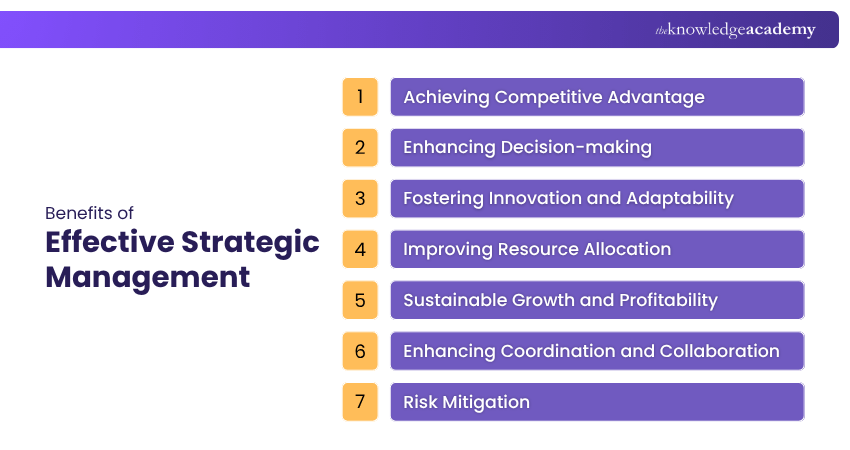
1) Achieving Competitive Advantage: Strategic Management helps businesses discover their strengths and employ them to achieve a leading position over their competitors. By matching resources and capabilities with market reality, companies can become market leaders, thus differentiating themselves from their rivals.
2) Enhancing Decision-making: A Strategic approach involves thorough analysis and data-driven decision-making. By considering both internal and external variables, leaders could make wiser choices that would lead to better outcomes with minimal risks. This guarantees that these are not impulsive decisions but are based on proven data with strategic alignment.
3) Fostering Innovation and Adaptability: A successful Strategic Management system endorses creativity across the organisation. By leading a culture of innovation and experimentation , businesses can adjust swiftly to changes in the market, advances in technology, and customer trends.
4) Improving Resource Allocation: Strategic Management helps in assigning capital and labour efficiently. By linking resources with key initiatives, organisations omit the wastage of funds and concentrate only on projects that add value to the organisation in the long run.
5) Sustainable Growth and Profitability: Firms that possess effective Strategic Management are way more suitable for long-term durability and profitability. By means of constantly reviewing and amending strategies, businesses are able to react to changes, capture opportunities, and minimise the risks that may affect the future of their business.
6) Enhancing Coordination and Collaboration: Strategic Management stimulates the natural flow of information and collaboration across different groups and functions. It thus encourages functional integration, catalysing the overcoming of complex challenges and generating joint knowledge and skills.
7) Risk Mitigation: Strategic Management involves risk assessment and contingency planning. By assessing possible risks and formulating risk mitigation strategies, businesses will be better equipped to face uncertainties, thus protecting their operations and limiting the adverse impacts of negative events.
Lead remote teams effectively with Managing Projects Remotely Training - Join today!
Examples of Strategic Management
Let’s look at some real-world examples for an insightful understanding of What is Strategic Management.
Example 1
Netflix utilises an effective Strategic Management that helped to evolve from a DVD rental business to a global streaming leader. For bringing this into reality, it involved:
1) Strategy Development
Netflix anticipated the shift from DVDs to online streaming and created a long-term plan to transition its business model.
2) Strategy Execution
The company executed its strategy by:
a) Investing in strong streaming technology
b) Building a wide content library through licensing
c) Improving user experience with personalisation
3) Performance Evaluation
Netflix utilises data analytics to track its viewers behaviour and identified patterns of what content keeps subscribers engaged.
4) Strategic Adaptation
Gathering data-driven insights led towards production of original content. For example, “House of Cards” marked the start of Netflix Originals to boost brand value and subscriber growth.
5) Ongoing Evaluation
Netflix continues to strengthen its competitive edge by:
a) Enhancing algorithm recommendation
b) Expanding globally with more local content
c) Experimenting with emerging storytelling techniques
Example 2
Another leading example of Strategic Management is Apple. The company created long-term success by focusing on innovation, branding, and customer needs. It involved:
1) Strategy Development
Apple identified rising demand for smart and user-friendly technology. This encouraged them to develop a strategy focused on premium products, seamless integration across devices, and a powerful brand experience.
2) Strategy Execution
Apple brought this strategy to reality by:
a) Launching innovative products, such as the iPhone, Apple Watch, and MacBook
b) Developing an interconnected ecosystem, such as iOS, App Store, and iCloud
c) Delivering a simple, high-quality user experience
3) Performance Evaluation:
The company tracks customer satisfaction, product sales, and ecosystem management. The data supports driving quality and innovation.
4) Strategy Adaptation:
Utilising data-driven insights, Apple expanded into digital services, such as Apple Music, Apple Pay, iCloud+, and Apple TV+. These revenue streams strengthened long-term growth.
5) Ongoing Evaluation:
Apple continues to polish its strategies by:
a) Investing in new technologies, such as chip innovation
b) Expanding features focused on health and wearables
c) Improving privacy and security features
Build essential skills every great leader needs with Management Training for New Managers Course – Join now!
Strategic Management: Career Opportunities
Strategic Management has become important across various industries. It has created strong career opportunities in the field of consulting, healthcare, finance, and more. Most often, professionals work as Business Analysts, Management Consultants, or Business Development Managers. These professionals apply strategic thinking to drive growth.
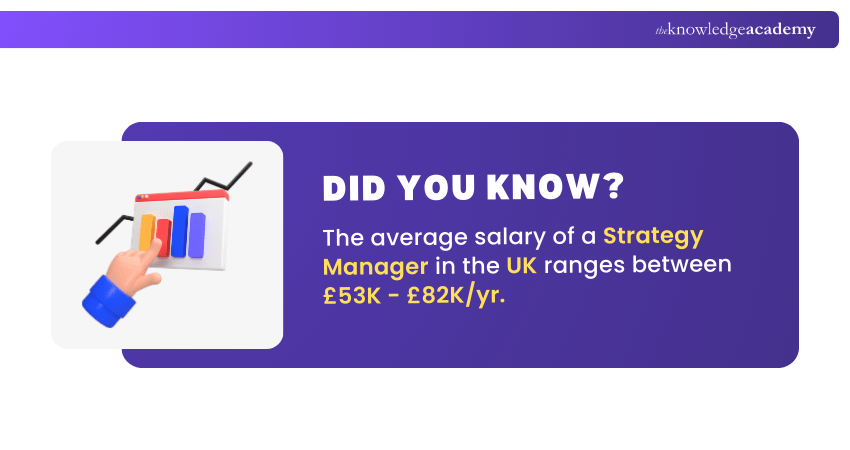
Professionals in Strategic Management develop valuable skills, such as organisational analysis, financial planning, and decision-making. This supports career advancement and opens new business opportunities. As companies are reliant on data-driven strategies, the demand for Strategic Management professionals continues to grow.
What are the Three Major Areas of Strategic Management?
The three main pillars of Strategic Management serve as a roadmap for an organisation's planning, execution, and ongoing development.
1) Strategy Formulation: This involves defining the organisation’s mission, setting long-term goals, and identifying the best course of action to achieve them. It includes analysing internal and external environments to develop a competitive strategy.
2) Strategy Implementation: Once a strategy is formulated, it must be put into action. This stage focuses on allocating resources, aligning operations, and ensuring that teams and departments are working toward the strategic objectives.
3) Strategy Evaluation: The final area involves monitoring performance and assessing whether the strategy is delivering the expected results. It includes reviewing key metrics, identifying gaps, and making necessary adjustments to stay on track.
What are the 3 P's of Strategic Management?
The three Ps - People, Process, and Product- are the cornerstones of successful Strategic Management, guaranteeing that all facets of an organisation function in unison to promote sustained success.
1) People: People are the foundation of any successful strategy. Engaged, skilled, and aligned teams drive innovation, execute plans effectively, and contribute to a strong organisational culture.
2) Process: Processes ensure consistency, efficiency, and scalability. Well-defined workflows and systems help translate strategic goals into actionable steps, enabling smooth execution and measurable outcomes.
3) Product: The product or service is the value delivered to customers. Strategic Management focuses on refining offerings to meet market demands, enhance customer satisfaction, and maintain a competitive edge.
Conclusion
Strategic Management is the foundation of long-term and sustainable success for businesses. Understanding What is Strategic Investment enables organisations to set clear goals, align actions, and regularly evaluate outcomes. This helps to make informed decisions to foster growth, innovation, and success. Wanting a career in this field, or launching a venture, developing these skills is a step towards achieving big goals with confidence.
Elevate your management career with expert-led Management Courses. Register today to become a dynamic leader!
Frequently Asked Questions
Is Strategic Management a Good Career?

Strategic Management is an excellent career for those passionate about shaping the direction of businesses and organisations. It offers the opportunity to make significant impacts on an organisation's success, provides exposure to various industries and functions, and leads to high satisfaction and competitive compensation.
What Industries Use Strategic Management?
Strategic Management is used across many industries. Some of the well-known industries or sectors include:
1) Finance
2) Insurance
3) Technology
4) Manufacturing
5) Healthcare
6) Public Administration
7) Government
What are the Other Resources and Offers Provided by The Knowledge Academy?
The Knowledge Academy takes global learning to new heights, offering over 3,000+ online courses across 490+ locations in 190+ countries. This expansive reach ensures accessibility and convenience for learners worldwide.
Alongside our diverse Online Course Catalogue, encompassing 17 major categories, we go the extra mile by providing a plethora of free educational Online Resources like Blogs, eBooks, Interview Questions and Videos. Tailoring learning experiences further, professionals can unlock greater value through a wide range of special discounts, seasonal deals, and Exclusive Offers.
What is The Knowledge Pass, and How Does it Work?
The Knowledge Academy’s Knowledge Pass, a prepaid voucher, adds another layer of flexibility, allowing course bookings over a 12-month period. Join us on a journey where education knows no bounds.
What are the Related Courses and Blogs Provided by The Knowledge Academy?
The Knowledge Academy offers various Management Courses, including the Management Training For New Managers Course, Managing Remote Teams Course, and the Introduction To Managing People Course. These courses cater to different skill levels, providing comprehensive insights into Business Strategy.
Our Business Skills Blogs cover a range of topics related to Strategic Management, offering valuable resources, best practices, and industry insights. Whether you are a beginner or looking to advance your Business skills, The Knowledge Academy's diverse courses and informative blogs have got you covered.

William Brown


Senior Business Analyst and Strategic Advisor
William Brown is a senior business analyst with over 15 years of experience driving process improvement and strategic transformation in complex business environments. He specialises in analysing operations, gathering requirements and delivering insights that support effective decision making. William’s practical approach helps bridge the gap between business goals and technical solutions.
View Detail
Upcoming Business Skills Resources Batches & Dates
Date
 Introduction to Management
Introduction to Management
Fri 27th Mar 2026
Introduction to Management
Fri 15th May 2026
Introduction to Management
Fri 14th Aug 2026
Introduction to Management
Fri 6th Nov 2026

 If you wish to make any changes to your course, please


