


 Top Rated Course

We may not have the course you’re looking for. If you enquire or give us a call on +46 850282424 and speak to our training experts, we may still be able to help with your training requirements.
Top 30 IBM AIX Interview Questions and Answers You Must Prepare
Richard Harris 22 April 2026Preparing for an IBM AIX interview requires brushing up on the top IBM AIX Interview Questions on System Administration, networking, troubleshooting, etc. AIX was initially released in 1986 and supports various hardware platforms, including IBM RS/6000 series and Power systems. It is a Unix-based Operating System.
Training Outcomes Within Your Budget!
We ensure quality, budget-alignment, and timely delivery by our expert instructors.
Table of Contents

IBM AIX is one of those Operating Systems that quietly powers some of the world’s most demanding enterprise environments. Born from the UNIX family, AIX is the backbone of mission-critical environments, trusted for its rock-solid stability and scalability. If you are professionally stepping into the world of IBM AIX, the following IBM AIX Interview Questions will lead the way.
The IBM AIX Interview Questions and answers outlined in this blog cover everything from System Administration essentials to advanced storage, networking, and security topics. So read on, amplify your IBM AIX expertise and dominate the world of Enterprise Computing!
Table of Contents
1) Top IBM AIX Interview Questions With Answer
a) What is AIX (Advanced Interactive eXecutive), and what are its key features?
b) What are the steps to install AIX on IBM Power Systems hardware?
c) What are the best practices for managing AIX in a high-security environment?
d) How to enable and disable quorum?
e) What are the error levels severity?
f) How can I clone the rootvg?
g) How do I mirror a logical volume?
h) What is AIX record framework?
i) How Do I Display Routing Table, Interface and Protocol Information?
j) What is the login procedure to the AIX framework?
2) Conclusion
Top IBM AIX Interview Questions with Answers
Here are the most frequently asked IBM AIX Interview Questions paired with clear, concise answers. This section will help you strengthen your technical understanding and prepare effectively for real-world AIX Administrator interviews. Let's dive in:
What is AIX (Advanced Interactive eXecutive), and what are its key features?

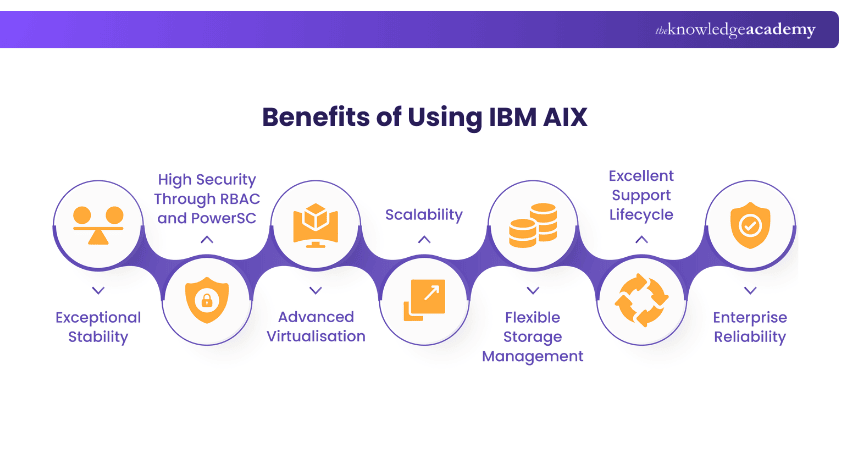
AIX is IBM’s UNIX Operating System built for Power Systems. It’s known for its stability, scalability and strong security. Its main features include:
1) Logical Partitions (LPARs)
2) Workload Partitions (WPARs)
3) System Management Interface Tool (SMIT)
4) Journaled File System 2 (JFS2)
5) Advanced performance tuning
These features make it ideal for enterprise workloads. It’s designed for high availability and efficient Resource Management.

What are the steps to install AIX on IBM Power Systems hardware?
Here are the installation steps:
1) Booting usually begins from DVD, NIM or VIOS as the installation source.
2) The installation menus guide the process step by step.
3) Disks are configured, and the required filesystems are selected.
4) Network settings are defined during setup.
5) System updates are applied once installation completes.
6) User accounts are configured as needed.
7) Final verification ensures the system is ready for use.
What are the best practices for managing AIX in a high-security environment?
I’d focus on the following:
1) Hardening Secure Shell (SSH)
2) Enforcing strong passwords
3) Enabling Role-eased Access Control (RBAC)
4) Patching regularly
5) Using PowerSC
6) Monitoring logs
7) Restricting root access
Additionally, auditing should always be enabled, network services should be minimised and firewalls must be configured properly. Basically, it's about reducing exposure and following IBM’s security guidelines closely.
How to enable and disable quorum?
Quorum can be enabled or disabled using smitty quorum or the chvg -Q command. Quorum controls how a volume group behaves when disks fail. Enabling quorum helps prevent corruption, while disabling it is handy for mirrored setups where surviving disks can still run safely.
What are the error levels severity?
AIX error logs classify events as:
1) Informational
2) Warning
3) Error
4) Fatal
Each level helps you understand system health and prioritise issues. errpt makes it easy to check what’s going on. Fatal errors are the most serious and usually indicate hardware or system-level problems.
How can I clone the rootvg?
Cloning rootvg is usually done with alt_disk_copy to another disk. It creates a bootable backup of your root volume group. It’s a neat way to test upgrades, patching or migration without touching the live system. The alternate disk can be rebooted whenever needed.
How do I mirror a logical volume?
A logical volume can be mirrored using the mklvcopy command, followed by syncvg to synchronise the copies. After selecting the target disk, AIX handles the duplication automatically. This method improves redundancy and protects against disk failures. You can also use SMIT for a simplified, menu-based approach to mirroring logical volumes.
Learn UNIX Administration and power enterprise performance. Sign up for our Administrating UNIX Systems Course now!
What is AIX record framework?
The AIX record framework refers to how the system logs and manages structured operational data. Tools such as errpt, alog and syslog form part of this framework. It allows administrators to track errors, monitor performance, review boot logs and observe user activity in a consistent and organised manner.
How do I display routing table, interface and protocol information?
Commands like netstat -rn, netstat -i, and netstat -p are the go-tos. We can also use lsattr, ifconfig and entstat for detailed interface stats. SMIT menus make this even easier if you prefer a guided approach rather than command-line options.
What is the login procedure to the AIX framework?
When we log in, AIX checks authentication, loads the environment, applies security rules and starts the shell. It reads files like /etc/profile and .profile. Once everything loads, we get the prompt. It’s similar to other UNIX systems but with stronger RBAC support.
Write the order design in AIX group
'savebase' is used after making Object Data Manager (ODM) changes to make sure the system configuration gets written to the boot logical volume. It’s handy after hardware updates, device changes or network modifications. Running it ensures those settings survive a reboot and keep everything consistent.
When is the savebase order utilised?
'savebase' is used after making Object Data Manager (ODM) changes to make sure the system configuration gets written to the boot logical volume. It’s handy after hardware updates, device changes or network modifications. Running it ensures those settings survive a reboot and keep everything consistent.
How do I replace a disk?
We can identify the failing disk with errpt or lspv. The steps include:
1) Unmirror or migrate data if needed
2) Remove it using reducevg or rmdev
3) Physically swap the hardware
4) Re-add the disk into the volume group
After that, we restore mirrors and run syncvg.
What is the Mirroring concept?
Mirroring simply means keeping multiple copies of your data on different disks, so that you’re protected against failures. AIX handles this at the logical volume level. If one disk fails, the system keeps running from the mirror. It’s a core high-availability feature.
Can examples of real-world AIX troubleshooting scenarios be provided?
There are plenty of examples including:
1) rootvg disk failures
2) Network interface drops
3) Filesystem full issues
4) LPAR performance slowdowns
5) NFS hangs
6) ODM corruption
Troubleshooting usually involves logs, errpt, lslv, topas, and sometimes rebooting into maintenance mode to fix deeper system problems.
Write smarter scripts, solve bigger problems. Register for our AIX Korn Shell Programming Training now!
What is the IBM PowerSC suite, and how does it enhance AIX security?
PowerSC is IBM’s security suite for Power Systems. It adds the following:
1) Compliance checks
2) Real-time monitoring
3) Encryption
4) Patch automation
5) Virtualisation-aware protection
It basically gives AIX a strong security layer tailored for regulated environments like banking or healthcare.
How does AIX support IPv6 networking?
AIX supports IPv6 through commands like ifconfig, SMIT and configuration files. We can assign IPv6 addresses, enable forwarding and configure routes just like IPv4. Applications and services on AIX are fully compatible, making migration pretty smooth for dual-stack environments.
Elaborate on the benefits of Bourne Again Shell or slam?
Here are the key benefits of bash:
1) It provides command history for quick recall and reuse of previous commands
2) It offers powerful autocomplete that speeds up command entry
3) It supports functions and aliases to simplify repetitive tasks
4) It features cleaner, more readable scripting syntax
5) It's user-friendly compared to traditional shells like sh
6) It's highly portable across Linux and UNIX systems, including AIX
7) It's Widely used for automation, making it ideal for System Administration
How do I activate a network interface?
We can bring up an interface using ifconfig en0 up, modify attributes with chdev or use smitty tcpip. After configuration, we have to verify using netstat or entstat. It’s pretty simple once the IP and gateway details are ready.
What is VGDA, VGSA?
The Volume Group Descriptor Area (VGDA) stores the volume group’s metadata. The Volume Group Status Area (VGSA) tracks which data block copies are stale or in sync. Together, they help maintain the health and consistency of a volume group, especially when mirroring is used or when recovering from disk failures.
What is the default dump device?
The default dump device in AIX is usually the primary paging space. You can check or change it using sysdumpdev -l. Many Admins configure a dedicated dump logical volume for reliability during crashes.
What is a Physical Partition (PP) in AIX?
A Physical Partition (PP) in AIX is the smallest unit of storage allocation within a volume group. Logical volumes are constructed from multiple PPs that may be spread across different disks. PPs support efficient storage management, allow balanced data placement and enable redundancy. They also provide flexibility when resizing or reorganising logical volumes.
Master AIX Shell scripting and automate your world - Sign up for our AIX Shell Programming Course now!
What is T–factor?
T-Factor refers to how efficiently workloads run on IBM Power hardware compared to other platforms. It helps us estimate the consolidation capacity and performance gains when migrating applications to Power Systems.
What is the clear, echo, print and banner order?
1) Clear wipes the terminal screen
2) Echo prints text
3) Print is used in shell scripts
4) Banner displays large stylised text
They are simple but handy commands for scripting, messaging or making terminal output more readable.
Describe the role of Kerberos in AIX authentication and encryption
Kerberos plays the following role in AIX authentication:
1) Kerberos adds secure, ticket-based authentication to AIX.
2) It avoids sending passwords over the network and supports strong encryption.
3) It’s especially useful in enterprise environments where centralised and secure identity management is essential.
Explain the process of setting up and managing SSH in AIX
Here are the key steps:
1) Install OpenSSH from the AIX Toolbox or use the bundled package.
2) Configure sshd settings according to security and access requirements.
3) Generate SSH keys and ensure correct file and directory permissions.
4) Restart the SSH service to apply changes.
5) Test connectivity to confirm the setup is working correctly and securely.
How would I be able to change the characteristics of a volume group?
We can adjust VG attributes using chvg, like quorum settings, PP size or auto-varyon. SMIT is also great for this if you prefer menus. Most changes apply instantly and help fine-tune storage behaviour.
How will you find LTG sise?
We can run lsattr -El hdiskX or lsvg vgname to check the Logical Track Group (LTG) size. It helps understand disk geometry and performance. It’s a small detail but important for tuning the storage. LTG values are especially useful when planning disk replacements or migrations.
Explain the role of IBM Tivoli Monitoring (ITM) in AIX monitoring and management
ITM monitors AIX performance, resources, logs and applications. It helps track CPU, memory, storage, and network behaviour in real time. It’s great for troubleshooting and capacity planning, especially in big enterprise setups.
What is System Mirror for Rootvg (SMIT) in AIX, and why is it used?
System Mirror helps create mirrored copies of rootvg to protect against disk failure. It’s easy through SMIT menus and keeps the system bootable even if one disk dies. It’s a must for high-availability environments.

Richard Harris


Senior Full Stack Developer and Technology Educator
Richard Harris is a highly experienced full-stack developer with deep expertise in both frontend and backend technologies. Over his 12-year career, he has built scalable web applications for startups, enterprises and government organisations. Richard’s writing combines technical depth with clear explanations, ideal for developers looking to grow in modern frameworks and tools.


 If you wish to make any changes to your course, please


