


 Top Rated Course

We may not have the course you’re looking for. If you enquire or give us a call on +46 850282424 and speak to our training experts, we may still be able to help with your training requirements.
8 Workforce Planning Tools Every Business Needs
James Smith 25 February 2026Workforce Planning Tools support strategy, HR analytics, and cost decisions, helping organisations align staffing with future business needs. These tools analyse workforce data to forecast demand, identify skills gaps, and optimise hiring strategies. They improve decision-making, control costs, and enhance productivity.

Training Outcomes Within Your Budget!
We ensure quality, budget-alignment, and timely delivery by our expert instructors.
Table of Contents

Every successful business runs on people. Having the right people in the right roles at the right time is easier said than done. Hiring fewer people than needed hurts performance. Having more employees than needed drives up expenses. This is where Workforce Planning Tools come in, helping organisations predict needs, close skill gaps, and stay agile.
In this blog, we’ll explain what Workforce Planning Tools are, introduce the top 8 tools, cover their benefits, highlight key features, and share steps to make planning smarter and easier. Let’s get started!
Table of contents
1) What are Workforce Planning Tools?
2) Top 8 Workforce Planning Tools
3) Benefits of Workforce Planning Tools
4) Key Features to Look for in Workforce Planning Tools
5) Implementing Workforce Planning Tools: A Step-by-step Guide
6) Conclusion
What are Workforce Planning Tools?
Workforce Planning Tools are methods or systems that help organisations understand their current workforce and prepare for future needs. They focus on checking the skills, roles, and number of employees required to meet business goals in the short and long term.
These tools work by collecting and studying information about employees, such as skills, performance, and future needs. For example, if a company knows it will launch a new product next year, Workforce Planning Tools can show if extra staff or new skills will be needed.
Anticipating staffing needs
Workforce planning is not limited to filling vacant positions; it's about predicting future requirements using a Workforce Planning Model. Organisations can accurately forecast staffing needs by analysing historical data, market trends, and projected growth. This predictive insight safeguards against both under-staffing, which could hamper operations, and over-staffing, which could inflate costs.
Alignment with business objectives
The workforce planning process necessitates thoroughly understanding an organisation's strategic goals. This alignment ensures that every hiring decision contributes directly to achieving these objectives. Whether it's expansion into new markets, diversification of services, or technological innovation, workforce planning ensures the availability of the right talent at the right time.
Top 8 Workforce Planning Tools
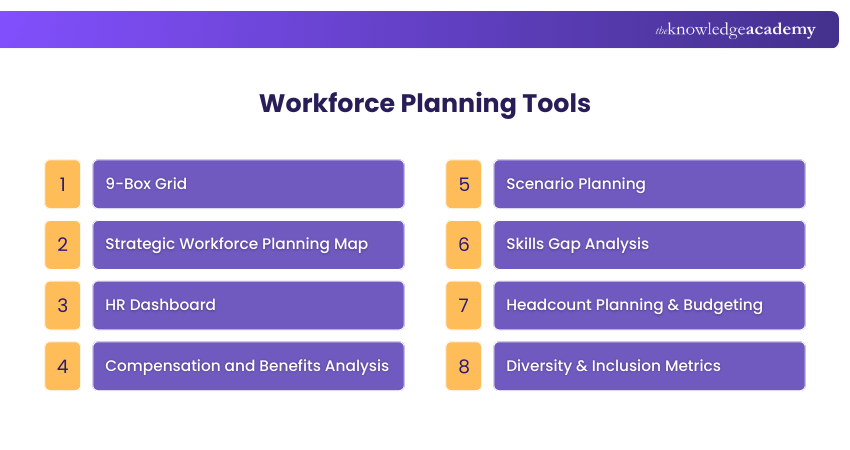
When you look for Workforce Planning Tools, you will find many choices. Here, we share the top eight tools with a short explanation of what they do and why they are useful:
1) 9-Box Grid
This tool helps you check how employees are performing now and their future growth potential. It shows who is ready for leadership roles and who needs more support. It looks at:
a) Past and current performance
b) Future growth and leadership potential
Value: Helps find employees with high potential and plan for future leaders.
2) Strategic Workforce Planning Map
This tool helps plan your workforce based on business goals and future needs. It focuses on:
a) Checking current workforce skills and performance
b) Predicting future staffing needs
c) Finding skill gaps
d) Making an action plan
Value: Keeps your workforce aligned with business plans and prepares for future changes.
3) HR Dashboard
This tool shows important workforce data in a visual format. It helps Human Resources (HR) and leaders understand employee performance quickly. It looks at:
a) Absenteeism
b) Employee engagement
c) Performance and productivity
d) Recruitment and turnover
e) Workforce overview
Value: Gives leaders a clear and quick view of HR data to make better decisions.
4) Compensation and Benefits Analysis
This tool studies everything about employee salaries and benefits. It checks if pay and benefits are fair, competitive, and cost-effective. It looks at:
a) Salary structures
b) Bonuses and incentives
c) Benefits and perks
d) Pay fairness
e) Total compensation
Value: Helps set fair salaries to attract, keep, and motivate top talent.
5) Scenario Planning
This tool prepares for different future situations by creating plans for each one. It helps manage unexpected changes better. It looks at:
a) Best-case situations
b) Worst-case situations
c) Expected or normal situations
Value: Helps businesses stay ready, flexible, and confident in times of change.
6) Skills Gap Analysis
This tool compares the skills employees have now with the skills needed in the future. It helps plan training and hiring better. It looks at:
a) Current skills
b) Required skills
c) Missing skills that need training or hiring
Value: Ensures employees get the right training and helps plan smarter hiring.
7) Headcount Planning & Budgeting
This tool helps manage the number of employees a company needs now and in the future. It also plans the hiring budget. It looks at:
a) Current workforce size
b) Future hiring needs
c) Budget planning
d) Resource use
Value: Ensures the company has the right people in the right jobs without overspending.
8) Diversity & Inclusion Metrics
This tool tracks data to make the workplace fair and inclusive. It measures:
a) Diverse hiring
b) Pay fairness
c) Leadership promotions
d) Employee satisfaction
e) Retention of diverse employees
Value: Builds an inclusive workplace that attracts, supports, and keeps top talent.
Equipped with the modern tools and techniques for effective hiring. Join our Talent Acquisition Training now!
Benefits of Workforce Planning Tools
Amid the intricate dance of managing a workforce, technology becomes indispensable. Workforce Planning Tools orchestrate data-driven insights, predictive analytics, and strategic foresight, providing organisations with benefits that elevate their staffing strategies. Here are the benefits of Workforce Planning Tools:
1) Data-informed Decision Making
Workforce Planning Tools are a treasure trove of Data, enabling organisations to make informed decisions based on concrete insights rather than intuition. From historical performance metrics to future projections, these tools allow HR professionals and management to identify trends, anticipate needs, and make precise decisions.
2) Anticipating Skill Requirements
The evolving business landscape demands agility in skill acquisition. Workforce Planning Tools analyse market trends and technological advancements to identify the skills in demand. This foresight empowers organisations to proactively train their existing workforce or attract new talent, ensuring a continuous alignment with industry needs.
3) Resource Optimisation
Practical Workforce Planning Tools help organisations optimise their resource allocation. Companies can streamline staffing levels by understanding peak periods, identifying surplus capacities, and addressing skill gaps. This enhances operational efficiency and curtails unnecessary expenses associated with overstaffing.
4) Talent Retention and Engagement
Employee turnover can be a costly affair. Workforce Planning Tools analyse factors contributing to turnover, enabling organisations to design targeted retention strategies. By identifying engagement trends, organisations can create a work environment that caters to employee satisfaction and loyalty.
5) Cost Savings
Financial implications are never far behind in the intricate web of staffing decisions. Workforce Planning Tools assist in calculating the cost of staffing decisions, aiding organisations in making choices that align with their Budget constraints. This strategic financial approach prevents overspending and promotes a lean staffing strategy.
6) Scenario Modelling
Workforce Planning Tools empower organisations to simulate different scenarios, such as expansion, downsizing, or changes in project volume. This capability allows for strategic evaluation of the outcomes of various decisions before they are implemented, reducing the risk of missteps.
7) Aligning HR with Business Strategy
Gone are the days when Human Resources (HR) was confined to administrative tasks. Workforce Planning Tools elevate HR to a strategic partner, aligning its efforts with overarching business goals. HR becomes an integral driver of success by contributing to organisational growth strategies.
Learn fair methods to conduct accurate performance reviews. Join our Performance Appraisal Training now!
Key Features to Look for in Workforce Planning Tools
The right features in Workforce Planning Tools can greatly improve staffing strategies. These tools bring together Data Analysis, predictive modelling, and strategic insights. Here are the key features organisations should consider when choosing tools used in Workforce Planning:
1) Forecasting Capabilities
Accurate predictions lie at the heart of effective Workforce Planning. Advanced tools harness historical data and trends to forecast future staffing needs. These forecasts act as a compass, guiding organisations toward staffing decisions aligned with projected demand.
2) Data Visualisation
Numbers alone may not convey the complete picture. Workforce Planning Tools with robust data visualisation capabilities transform complex data sets into understandable visuals. This empowers decision-makers to quickly grasp trends, patterns, and anomalies, enabling faster and more informed choices.
3) Scenario Modelling and Simulations
The ability to simulate various scenarios is invaluable. Tools that allow users to model different staffing scenarios, such as expansion, market shifts, or seasonal fluctuations, help organisations assess potential outcomes before making decisions. This minimises risks associated with uninformed choices.
4) Skill Gap Analysis
Identifying skill gaps is crucial for targeted training and recruitment. Workforce Planning Tools that analyse existing skills within the workforce and compare them against anticipated skill requirements can guide Professional Development initiatives and hiring strategies.
5) Integration with HR and Management Systems
Seamless integration with existing HR and management systems is a game-changer. This feature enables a unified view of workforce data, ensuring that staffing decisions are informed by real-time information from various organisational departments.
6) Predictive Analytics
Predictive analytics take Workforce Planning to the next level. These tools leverage historical data and algorithms to anticipate future trends, enabling organisations to make proactive decisions rather than reactive adjustments.
7) Scalability and Flexibility
As organisations grow, their staffing needs change. Workforce Planning Tools should be scalable and capable of accommodating the expanding demands of an evolving organisation. Flexibility to adapt to changing industry dynamics and strategies is also essential.
8) Collaboration and Reporting
Efficient collaboration and reporting functionalities ensure that relevant stakeholders are on the same page. Workforce Planning Tools that facilitate easy sharing of insights, reports, and recommendations enhance communication and decision-making.
Learn how to support employee growth and career development effectively. Join our Talent Management Training now!
Implementing Workforce Planning Tools: A Step-by-step Guide
Integrating the Workforce Planning Tool is more than adding software; it’s a strategic shift. Here’s a simple step-by-step guide to implement them effectively and maximise their benefits
Step 1: Identifying Staffing Needs
Begin by defining the organisation's short-term and long-term staffing needs. Consider projected growth, market trends, and evolving skill requirements. This clarity lays the foundation for effective Workforce Planning.
Step 2: Data Collection and Analysis
Gather relevant data, including historical staffing patterns, turnover rates, and performance metrics. Clean, accurate data forms the bedrock of informed decision-making,utilise Workforce Planning Tools to analyse this data for insights.
Step 3: Selecting the Right Tool
Choose a Workforce Planning Tool that aligns with your organisation's size, industry, and objectives. Consider factors such as scalability, integration capabilities, and the specific features that meet your needs.
Step 4: Training and Onboarding
A tool is only as effective as its users. The tool provides comprehensive training to the HR team, managers, and Stakeholders. Ensure they understand how to input data, interpret insights, and make informed decisions.
Step 5: Integration with HR and Management Systems
Seamlessly integrate the new tool with existing HR and management systems to ensure a unified view of workforce data. This integration facilitates efficient data sharing and informed decision-making across departments.
Step 6: Piloting and Testing
Before full implementation, conduct a pilot phase with a smaller team or project. This allows you to identify glitches, fine-tune processes, and ensure the tool aligns with your organisation's needs.
Step 7: Feedback and Iteration
Gather feedback from users during the pilot phase and initial implementation. Use this input to make necessary adjustments and improvements. Continuous iteration ensures that the tool remains aligned with evolving needs.
Step 8: Communication and Change Management
Communication is vital. Communicate the new tool's purpose, benefits, and expectations to all stakeholders. Address any concerns and emphasise its positive impact on staffing strategies.
Step 9: Monitoring and Continuous Improvement
Regularly monitor the tool's performance and its impact on staffing decisions. Analyse whether it's meeting its intended goals and identify areas for improvement. Stay open to updates and enhancements.
Step 10: Integration with Organisational Strategy
Integrate the insights derived from the Workforce Planning Tool into broader organisational strategies. Use the data to inform growth initiatives, resource allocation, and skill development efforts.
Conclusion
Workforce Planning Tools help businesses manage their people better by using data to plan for hiring, training, and growth. By using these tools, companies can identify skill gaps, improve productivity, and prepare for future needs. Choosing the right tools ensures the organisation has the right people, in the right roles, at the right time to achieve business goals successfully.
Learn effective leadership skills to manage and motivate diverse teams. Join our People Management Courses now!
Frequently Asked Questions
What are the 7 R's of Workforce Planning?

These are the 7 R’s:
1) Right People: Hire those who fit the company
2) Right Skills: Ensure they have the abilities needed
3) Right Shape: Keep the right mix of roles
4) Right Size: Maintain the correct workforce
5) Right Time: Have staff when required
6) Right Place: Position employees strategically
7) Right Cost: Budget-friendly pay
What are the two Types of Workforce Planning?
The two main types are:
1) Strategic Workforce Planning: Plans for the future, focusing on long-term goals, skills, and talent growth.
2) Operational Workforce Planning: Handles current needs, like filling vacancies and meeting short-term staffing demands.
What are the Other Resources and Offers Provided by The Knowledge Academy?
The Knowledge Academy takes global learning to new heights, offering over 3,000+ online courses across 490+ locations in 190+ countries. This expansive reach ensures accessibility and convenience for learners worldwide.
Alongside our diverse Online Course Catalogue, encompassing 17 major categories, we go the extra mile by providing a plethora of free educational Online Resources like Blogs, eBooks, Interview Questions and Videos. Tailoring learning experiences further, professionals can unlock greater value through a wide range of special discounts, seasonal deals, and Exclusive Offers.
What is The Knowledge Pass, and How Does it Work?
The Knowledge Academy’s Knowledge Pass, a prepaid voucher, adds another layer of flexibility, allowing course bookings over a 12-month period. Join us on a journey where education knows no bounds.
What are the Related Courses and Blogs Provided by The Knowledge Academy?
The Knowledge Academy offers various People Management Courses, including the Workforce Resource Planning Training, Talent Acquisition Training, and the Talent Management Training. These courses cater to different skill levels, providing comprehensive insights into HR Courses After 12.
Our HR Blogs cover a range of topics related to Workforce Planning Tools, offering valuable resources, best practices, and industry insights. Whether you are a beginner or looking to advance your HR skills, The Knowledge Academy's diverse courses and informative blogs have got you covered.

James Smith


Digital Marketing Manager and Trainer
James Smith is a digital marketing professional with over a decade of experience in SEO, content strategy, paid media and analytics. He has supported both SMEs and global brands in transforming their digital presence. James’s writing and training are rooted in results-driven tactics and the latest marketing trends.
View Detail
Upcoming Business Skills Resources Batches & Dates
Date
 Workforce Resource Planning Training
Workforce Resource Planning Training
Fri 14th Aug 2026
Workforce Resource Planning Training
Fri 13th Nov 2026

 If you wish to make any changes to your course, please


