


 Top Rated Course

We may not have the course you’re looking for. If you enquire or give us a call on +46 850282424 and speak to our training experts, we may still be able to help with your training requirements.
25 Toxic Traits You Might Be Ignoring (in Yourself and Others)
The Knowledge Academy 23 April 2026Toxic Traits are negative behaviours or attitudes, such as dishonesty, hostility, or selfishness, that harm relationships, workplaces, and personal growth. Some Toxic Traits are obvious, while others hide beneath the surface. If ignored, these behaviours can spark conflict and quietly hold back growth in any relationship.

Training Outcomes Within Your Budget!
We ensure quality, budget-alignment, and timely delivery by our expert instructors.
Table of Contents
Toxic Traits aren’t always loud or obvious. Sometimes they hide behind habits we’ve normalised or excuses we make. Beneath the surface, Toxic Traits can quietly sabotage relationships, careers and self-growth. From subtle manipulation to toxic negativity, these behaviours often go unnoticed until it’s too late.
This blog peels back the layers of human nature and spotlights 24 of the most common Toxic Traits that can drain our energy both in personal and professional settings. So read on, dive into this reality check and head for the destination of self-awareness and personal growth!
Table of Contents
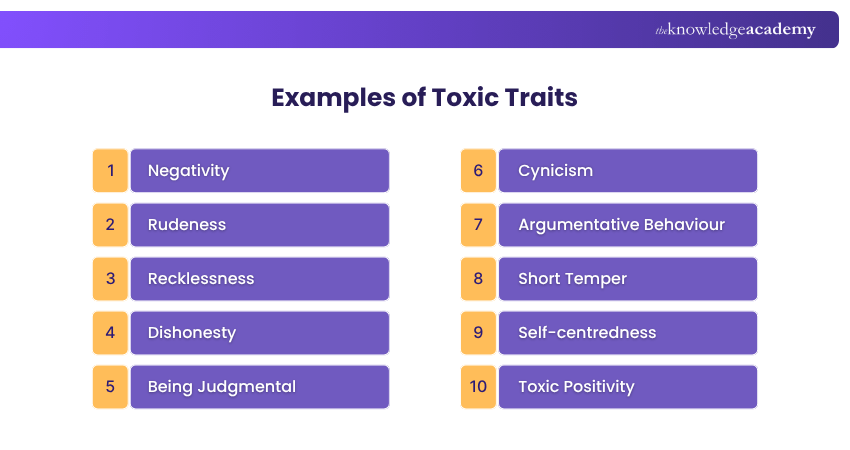
1) 24 Examples of Toxic Traits
a) Negativity
b) Rudeness
c) Recklessness
d) Dishonesty
e) Being Judgmental
f) Cynicism
g) Argumentative Behaviour
h) Short Temper
i) Self-centredness
j) Toxic Positivity
2) How to Handle Toxic Personality Traits in Relationships and at Work?
3) Conclusion
24 Examples of Toxic Traits
This section lists all the major Toxic Traits that can silently undermine relationships, disrupt teams and stunt personal growth. Awareness is the gateway to change. So, let’s understand these traits to effectively handle them:
1) Negativity
Negative people always see the worst in situations. They complain constantly, focus too much on the flaws and rarely acknowledge any positives. This behaviour drags down the team spirit and creates an environment where progress feels impossible. Therefore, Managing Negative People becomes essential to maintain a positive and productive workplace culture. For example, they may dismiss a new idea by saying, “It will never work.” For example, they may dismiss a new idea by saying, “It will never work.”

2) Rudeness
Rudeness shows up through dismissive words or actions that ignore basic respect. This could mean cutting people off mid-sentence, being impolite to service staff, refusing to say “please” and “thank you” etc. Over time, such behaviour creates resentment and damages relationships.
3) Recklessness
People exhibiting reckless behaviour frequently ignores risks and consequences. This leads them to endangering their lives as well as others'. Such people may act impulsively, like driving carelessly or suggesting unsafe activities. Their disregard for caution can lead to serious harm, conflict and broken trust within teams and relationships.
4) Dishonesty
Dishonest people lie and mislead. While occasional lying may seem like a small thing, repeated dishonesty can destroy trust and relationships. For example, someone may consistently exaggerate their achievements to impress others, only to eventually be exposed.
5) Being Judgmental
Judgmental people prematurely form opinions without full knowledge and context. They criticise others’ choices, often based on stereotypes or shallow assumptions. For instance, they might say a movie will be bad without ever learning much about it. This discourages others from giving it a chance.
6) Cynicism
Cynical individuals assume that people’s motives are selfish and insincere. They believe that kindness is a facade and that it's done solely for personal gain. For instance, they might think a colleague is offering help only to win favour with the boss, not out of goodwill.
7) Argumentative Behaviour
Argumentative people thrive on creating conflict. They don't care for constructive debate. They pick apart ideas simply to provoke or prove themselves right (sometimes even when they are wrong). For example, a family member may challenge relatively harmless opinions just to spark a quarrel. Over time, this constant friction wears down relationships.
8) Short Temper
People with short tempers react with intense anger over the minutest triggers. They may lash out when criticised, even if the feedback is delivered in a calm manner. For example, a colleague might explode over a minor mistake being pointed out. This can leave others hesitant to communicate openly.
Your journey to self-mastery starts here with our Personal Development Courses - Sign up now!
9) Self-centredness
Self-centred people put their own needs above everyone else’s. They frequently ignore the feelings of others. They rarely show empathy and focus only on their own gain. For example, they may ignore a friend in distress simply because they’d rather continue with their own plans.
10) Toxic Positivity
While positivity is an uplifting force, toxic positivity does the opposite. It dismisses real struggles by insisting people “just stay positive.” Such behaviour can silence genuine concerns and make others feel unheard. For example, if an employee shares stress about deadlines, a toxic response would be, “Don’t worry, just think happy thoughts.”
11) Avoiding Conflict
While avoiding conflict may sometimes be harmless, consistently ignoring problems can go on to create long-term issues. Such individuals suppress their feelings to be at peace and can even tolerate unfair treatment. For example, they may stay silent when disrespected, which only encourages continued mistreatment.
12) Passive-aggressive Behaviour
Passive-aggressive individuals express anger indirectly through sarcasm, sulking or subtle digs. For example, instead of admitting frustration about workload, they may mutter sarcastic remarks like, “Wow, I guess I’m the only one who works here.” Such behaviour breeds confusion and tension.
13) Overly Defensive
Defensive individuals have a hard time accepting feedback. They often view it as a personal attack. Instead of listening, they respond with excuses or even anger. For example, when told their report had errors, they might say, “It’s not my fault. You didn’t give me enough time.”
14) Avoiding Responsibility
People who avoid responsibility shift blame and never own their actions. This prevents growth and damages trust. For instance, if they break a dish, they might blame someone else for placing it “in the wrong spot,” thus avoiding accountability for their own carelessness.
15) Jealousy
Jealous people feel bitter about others’ success and happiness. Even when they pretend to be supportive, they may secretly resent the achievement. For instance, a colleague may congratulate someone on a promotion but feel upset that they weren’t chosen instead.
16) Acting Superior or Entitled
Those who act superior believe that they deserve more than others and that they are always right. This creates resentment and damages teamwork. For example, a Manager might dismiss every idea except their own, thus silencing the creativity of the entire team.
17) Laziness
Lazy individuals love to avoid responsibilities and procrastinate on important tasks. Their lack of motivation reduces productivity for both themselves and their teams. For example, a student might repeatedly delay assignments. That can cause group projects to stall and frustrate teammates.
Active listening is the silent skill that speaks volumes in leadership and life. Learn to master it in our Active Listening Training - Register now!
18) Harsh or Destructive Criticism
Destructive criticism refers to negative comments that are made with the aim of hurting someone. This can be either through personal attacks or belittling their work. It often masquerades as constructive feedback, but the intent is to tear down rather than build up. An example of this would be: “Your presentation was awful. You clearly don’t know what you’re talking about. I don’t even know how you still have this job.”
19) Rarely Apologising
Those who rarely apologise do it because they refuse to accept responsibility for their mistakes. Instead, they shift the blame or divert attention to others. For example, after hurting someone with mean words, they may respond with, “You’re too sensitive,” instead of offering a genuine apology.
20) Guilt Tripping and Control
Toxic individuals often use guilt as a tool for control. They twist situations to make the other person feel bad for asserting themself or setting boundaries. By doing this, they maintain power and discourage the other person from questioning their behaviour. This is among the sneakiest Toxic Traits.
21) Stinginess
Stingy people are unwilling to share their time, money or resources, even if fairness demands it. This creates imbalance and frustration in relationships. For example, a stingy friend may avoid paying their fair share at a restaurant, leaving others to cover the cost.
22) Being Disruptive
Disruptive people interrupt conversations, disturb group settings and create chaos for attention. Their actions can lower productivity and harmony. For example, a team member may play loud music at work, making it hard for everyone else to focus on their tasks.
23) Thoughtlessness
Thoughtless individuals act without considering how their words and actions could affect others. For instance, they will reveal a friend’s personal secret to others, completely disregarding the trust that was placed in them. This lack of care damages bonds and creates emotional distance.
24) Hostility
Hostile individuals carry resentment and aggression into every interaction. They are quick to insult or provoke others, which makes communication severely unpleasant. For example, they may respond to simple feedback with anger or sarcasm, escalating minor issues into major conflicts. This is one of the most unpleasant Toxic Traits.
Train your emotional muscles for real-world impact. Sign up for our Emotional Intelligence Training now!
How to Handle Toxic Personality Traits in Relationships and at Work?
You may not always be able to remove toxic people from your life, but you can control how you respond to them. Here are five practical strategies that have been proven to work:
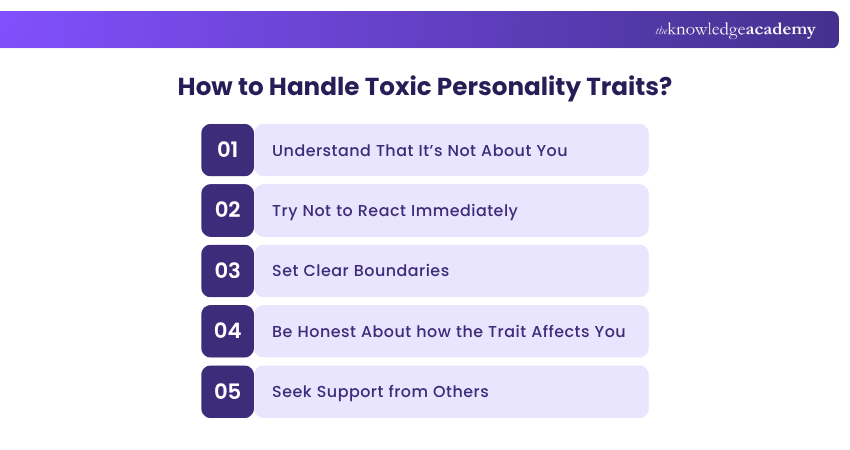
1) Understand That It’s Not About You
1) Don’t internalise others’ Toxic Traits.
2) It reflects their struggles, not your worth.
3) Shift your focus to what you can control like your actions, your boundaries and your mental well-being.
4) Protect your peace by recognising that their negativity doesn’t define you.
2) Try Not to React Immediately
1) Avoid responding to Toxic Traits with anger or frustration, as it can escalate the situation.
2) Pause, take a deep breath, and step away to regain calm.
3) Practise self-care to restore your balance after the encounter.
4) For ongoing negativity, respond in a dull, neutral way so the toxic person loses energy to feed on.
3) Set Clear Boundaries
1) Boundaries exist to protect your well-being.
2) Be clear and consistent when setting them.
3) Always attach consequences to boundaries you set.
4) For example: “If a colleague makes a passive-aggressive remark, I’ll step away and address it privately later.”
5) Boundaries communicate what behaviour you will and won’t accept.
4) Be Honest About how the Trait Affects You
Some people are unaware of how damaging their behaviour can be.
1) Be honest and explain the impact of their actions on you.
2) Use this simple template: “When you do (action), I feel (emotion). I know you may not intend this, but I’d like you to stop (action).”
3) Honest conversations can shift dynamics in a positive way.
5) Seek Support from Others
1) You don’t need to handle toxic behaviour by yourself.
2) Seek support from friends, family, or colleagues for perspective and encouragement.
3) In the workplace, raise the issue with HR or management if it persists.
4) Having support makes addressing toxic behaviour easier and more effective.
Conclusion
Toxic Traits can sneak into our lives and end up shaping how we connect with others and even how we treat ourselves. Recognising them is the first step toward change. By addressing these patterns, setting boundaries, choosing healthier behaviours, and learning to Stop Procrastinate, we can create stronger relationships and space for personal growth.
Say what needs to be said without burning bridges. Learn about it in our Managing Difficult Conversations Training - Register now!
Frequently Asked Questions
Is Jealousy a Toxic Trait?

Yes, jealousy is one of the most common Toxic Traits. This is especially true when it becomes persistent and uncontrolled. It can fill a person with resentment, damage trust, and create unhealthy competition. While occasional envy is natural, constant jealousy undermines relationships and personal well-being if not recognised.
How Do I Identify Negative Traits?
You can spot negative or Toxic Traits by observing patterns of behaviour that harm relationships, lower morale or block growth. Look for actions that leave others feeling drained or disrespected. Honest feedback from trusted people can also help reveal traits you may overlook.
What are the Other Resources and Offers Provided by The Knowledge Academy?
The Knowledge Academy takes global learning to new heights, offering over 3,000+ online courses across 490+ locations in 190+ countries. This expansive reach ensures accessibility and convenience for learners worldwide.
Alongside our diverse Online Course Catalogue, encompassing 17 major categories, we go the extra mile by providing a plethora of free educational Online Resources like Blogs, eBooks, Interview Questions and Videos. Tailoring learning experiences further, professionals can unlock greater value through a wide range of special discounts, seasonal deals, and Exclusive Offers.
What is The Knowledge Pass, and How Does it Work?
The Knowledge Academy’s Knowledge Pass, a prepaid voucher, adds another layer of flexibility, allowing course bookings over a 12-month period. Join us on a journey where education knows no bounds.
What are the Related Courses and Blogs Provided by The Knowledge Academy?
The Knowledge Academy offers various Personal Development Courses, including the Dealing with Difficult People Training, Managing Difficult Conversations Training and the Emotional Intelligence Training. These courses cater to different skill levels, providing comprehensive insights into the various Types of Listening.
Our Business Skills Blogs cover a range of topics related to personality traits, offering valuable resources, best practices, and industry insights. Whether you are a beginner or looking to advance your Personal Development skills, The Knowledge Academy's diverse courses and informative blogs have got you covered.

The Knowledge Academy


Global Training Provider
The Knowledge Academy is a world-leading provider of professional training courses, offering globally recognised qualifications across a wide range of subjects. With expert trainers, up-to-date course material, and flexible learning options, we aim to empower professionals and organisations to achieve their goals through continuous learning.

Upcoming Business Skills Resources Batches & Dates
Date
 Effective Communication Skills
Effective Communication Skills
Fri 14th Aug 2026
Effective Communication Skills
Fri 16th Oct 2026
Effective Communication Skills
Fri 18th Dec 2026

 If you wish to make any changes to your course, please


