


 Top Rated Course

We may not have the course you’re looking for. If you enquire or give us a call on +0800 780004 and speak to our training experts, we may still be able to help with your training requirements.
What is Market Capitalisation: Explained in Detail
Olivia Taylor 02 December 2025Market Capitalisation or market cap is the total value of a company’s shares, calculated by multiplying the share price by the total number of shares. By Understanding What is Market Capitalisation, it helps to compare companies of different sizes, understand their risk levels and make smart business decisions.

Training Outcomes Within Your Budget!
We ensure quality, budget-alignment, and timely delivery by our expert instructors.
Table of Contents

Big or small, every company has a price tag and that tag is known as Market Capitalisation. It represents the total value of a company’s shares, size, strength and how market perceives its stability. This helps to understand where a company stands in the larger landscape of business.
In this blog, you will learn about What is Market Capitalisation, its importance, how it is calculated, types and more. Keep reading ahead to learn more about it!
Table of Contents
1) What is Market Capitalisation?
2) Calculating Market Capitalisation
3) Importance of Market Capitalisation
4) Types of Market Capitalisation
5) Drawbacks of Market Cap
6) How to Consider Market Cap When Investing?
7) Does Market Cap Affect Stock Price?
8) Conclusion
What is Market Capitalisation?
Market Capitalisation refers the total market value of a company’s shares, calculated by multiplying the share price by the number of outstanding shares. It is one of the most important metrics for investors because it shows how big a company is and how the market values it.
Market capitalisation also helps investors compare companies across industries, giving a clearer picture of their overall size, stability, and growth potential. It’s often used to classify businesses into large-cap, mid-cap, and small-cap categories, each carrying its own level of risk and opportunity. By understanding a company’s market cap, investors can make more informed decisions about portfolio diversification and long-term investment strategy.

How to Calculate Market Cap (Formula and Example)
Market Capitalisation involves a straightforward formula: current Market price of a company's stock is multiplied by the total number of its outstanding shares.
The Market Capitalisation formula is:
Market Capitalisation = Current stock price × Total number of outstanding shares
For instance, if a company has 1 million shares and each share is priced £39.87, its market cap becomes £39.87 million. This shows the total market value of a company and how much it would take to buy all shares at today’s price. Market Capitalisation changes as share prices change, an indicator for investors to see the company’s size and its market position.
Importance of Market Capitalisation
Here are some points that will show you the importance of Market Capitalisation:
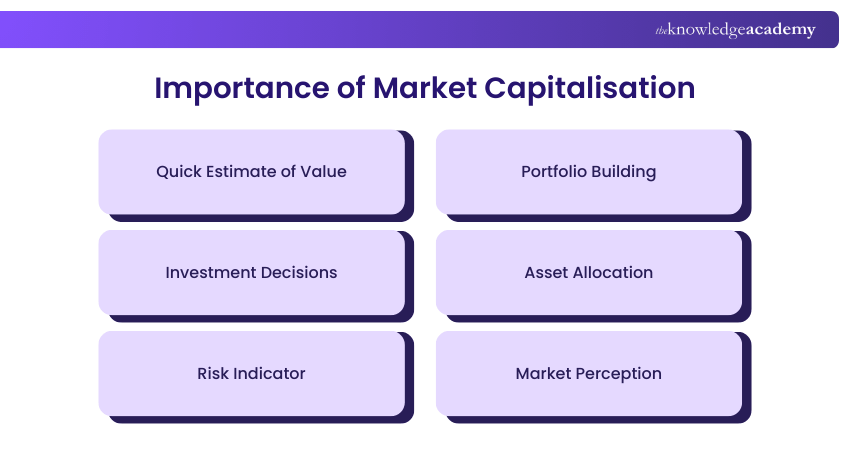
1) Quick Estimate of Value:
Market Capitalisation provides a fast and simple way to understand the overall value of a company in monetary terms.
2) Investment Decisions:
Helps companies of different sizes react differently to economic conditions. It is done using strategies based on market cap, such as ETFs Exchange Traded Funds)
3) Risk Indicator:
Market Cap signals the level of risk tied to a stock. Large-cap companies offer higher liquidity and stable price movements, while small-cap companies experience greater volatility and lower liquidity.
4) Portfolio Building:
Market cap helps determine how a stock fits into your asset allocation based on your risk tolerance. It supports building a diversified mix of companies across different sizes.
5) Asset Allocation:
It can assist in making decisions on how much to invest in different-sized companies within your portfolio for balanced risk. This helps to spread exposure and avoid concentrating in one category only.
6) Market Perception:
It reflects investor confidence and shows how the market views a company’s strength, position, and prospects. A rising market cap signal growing trust and positive investor expectations.
Obtain the knowledge of the Cash Flow system for business growth with our Cash Flow Training – Register today!
Types of Market Capitalisation
So far, you would have an idea of What is Market Capitalisation. Now, let’s check the types of Market Capitalisation:

1) Mega-cap Stocks
Mega-Cap companies are the world’s largest and most powerful corporations, such as Apple, Microsoft, and Amazon. They dominate global markets, have strong financial stability, and are considered the safest investments. Their growth is usually slower but steady, backed by global demand.
2) Large-cap Stocks
Large-Cap companies are the giants of the market, usually well-established and trusted brands you see every day. They're like large, sturdy ships that can weather market storms better than smaller companies. Their growth is steady, and they often pay dividends, making them a popular choice for safer investing.
3) Mid-Cap Stocks
Mid-cap companies are the rising stars of the market, positioned between the giants and the small players. They often grow faster than large-cap firms, though they may carry more risk. A good example is Reddit, which went public in March 2024, valued at £9.84B and quickly grew into the large-cap category by the year’s end. Think of this as teenagers, still developing, but with more balance and stability.
4) Small-Cap Stocks
Think of these as promising startups that have already shown some success. While they're riskier investments than larger companies, they might grow significantly if things go well. However, their stock prices tend to bounce up and down more dramatically. Many are young companies with fresh ideas, though some are older businesses that have shrunk over time.
5) Micro-Cap Stocks
Micro-Cap companies are the smallest players in the stock market, often trading as penny stocks. Many are young firms experimenting with innovative ideas, such as new medicines or Artificial Intelligence (AI) technologies. They carry the highest level of risk, but potential rewards can be big if they succeed.
6) Nano-Cap Stocks
Nano-Cap companies are even smaller than Micro-Caps and carry extreme risk. Many are newly listed, experimental, or struggling firms. Their shares trade at very low prices, often below £1, and their market presence is limited. Investors should approach with high caution.
Explore our Investment and Trading Training to enhance your financial knowledge today!
Drawbacks of Market Cap
While Market Capitalisation is a useful tool, it is crucial to know about its drawbacks. Here, are some drawbacks to be aware of.
1) Debt
Market Cap does not consider a company’s debt, which can greatly affect financial stability. A high market cap means heavy debt that may be riskier than a smaller company with low debt.
2) Earnings
Market Cap does not reflect earnings, cash flow or profitability. These are important measures of assessing financial performance and growth potential for the future.
3) Short-term visibility
Market cap can fluctuate with short-term market sentiments. This results in temporary price movements rather than long-term performance value.
4) Ignores Non-publicly Traded Assets
It does not account for valuable private assets or intellectual property. These exclusions can understate the true worth of a company.
5) Contextual Factors
Overlooks key elements, such as industry trends or management quality. These are important since they influence a company’s long-term prospects.
6) Affected by Stock Splits and Buybacks
Market cap can change due to stock splits and buybacks, even though these do not alter a company’s value.
7) May Not Reflect Growth Potential
It focuses on current valuation and overlooks growth opportunities. It is done in young companies with strong expansion prospects.
How to Consider Market Cap When Investing?
With a solid understanding of What is Market Capitalisation, here are some ways to use it in your investment research and portfolio construction.
1) Choose an Appropriate Asset Allocation
Successful investing begins with a well-considered plan. Whether you conduct your own research, use an online tool, or work with a financial advisor, for developing a suitable strategy . Key factors such as risk tolerance, risk capacity, and time horizon should guide your decision-making process to create a portfolio that aligns with your goals.
2) Evaluate Diversification Strategies
In your portfolio's stock component, consider diversifying across large-cap, mid-cap, and small-cap companies. The performance of these categories can vary, and diversification helps to balance risk. At times, one Market Cap segment may outperform others, so spreading your investments across different sizes can help reduce risk.
3) Consider Simplicity with ETFs and Mutual Funds
If you're building a portfolio yourself, selecting individual companies and ensuring a diversified mix of stocks can be time-consuming. Exchange-traded Funds (ETFs) and mutual funds can simplify this process. They allow you to achieve your target asset allocation, including the desired balance among market-cap segments. This approach eliminates the need to research hundreds of companies individually.
Enhance your financial understanding with our Accounting and Finance Policies Course – Sign up now!
Does Market Cap Affect Stock Price?
No, Market Cap does not affect stock price. A company’s stock price directly influences its Market Cap. This is because Market Cap is determined by multiplying a company’s share price by its total number of outstanding shares.
Conclusion
Market Capitalisation provides investors with a powerful tool to understand a company’s size, stability, and growth potential. When combined with a broad understanding of market workings, this knowledge helps to make informed investment decisions. So, What is Market Capitalisation? It is a financial compass for smarter and rewarding opportunities.
Advance your financial skills with our professional Accounting Courses – Join today!
Frequently Asked Questions
What is the Difference Between Market Value and Market Capitalisation?

Market value is the term that refers to the current price at which a company or asset can be bought or sold. On the other hand, Market Capitalisation represents total value of a company, worked out by share price multiplied by the number of outstanding shares.
What Factors Alter a Company's Market Cap?
A company’s Market Cap changes with its share price. Strong earnings, new products, or positive news can push it higher, while losses, scandals, or economic downturns can bring it down. Market trends and investor sentiment also strongly influence these shifts.
What are the Other Resources and Offers Provided by The Knowledge Academy?
The Knowledge Academy takes global learning to new heights, offering over 3,000+ online courses across 490+ locations in 190+ countries. This expansive reach ensures accessibility and convenience for learners worldwide.
Alongside our diverse Online Course Catalogue, encompassing 19 major categories, we go the extra mile by providing a plethora of free educational Online Resources like Blogs, eBooks, Interview Questions and Videos. Tailoring learning experiences further, professionals can unlock greater value through a wide range of special discounts, seasonal deals, and Exclusive Offers.
What is The Knowledge Pass, and How Does it Work?
The Knowledge Academy’s Knowledge Pass, a prepaid voucher, adds another layer of flexibility, allowing course bookings over a 12-month period. Join us on a journey where education knows no bounds.
What are the Related Courses and Blogs Provided by The Knowledge Academy?
The Knowledge Academy offers various Accounting Courses, including Capital Market Course, Accounting and Finance Policies Course and Inventory Accounting and Costing Course. These courses cater to different skill levels, providing comprehensive insights into Equity Market.
Our Accounting and Finance Blogs cover a range of topics related to Market Capitalisation, offering valuable resources, best practices, and industry insights. Whether you are a beginner or looking to advance your Accounting and Finance skills, The Knowledge Academy's diverse courses and informative blogs have got you covered.

Olivia Taylor


Chartered Accountant and Financial Training Specialist
Olivia Taylor is a qualified chartered accountant with over a decade of experience in financial management, auditing and corporate reporting. Having worked with leading firms in both the public and private sectors, Olivia brings clarity to complex financial topics. Her writing focuses on helping professionals build confidence in key areas of accounting, compliance and financial planning.
View Detail
Upcoming Accounting and Finance Resources Batches & Dates
Date
 Capital Market Training
Capital Market Training
Fri 11th Sep 2026
Capital Market Training
Fri 11th Dec 2026

 If you wish to make any changes to your course, please


