


 Top Rated Course

We may not have the course you’re looking for. If you enquire or give us a call on +0800 780004 and speak to our training experts, we may still be able to help with your training requirements.
What is Sales Management: Everything You Need to Know
Charlotte Wilson 26 March 2026Sales Management drives revenue growth by setting goals, managing performance, and optimising processes to build a successful & high-performing sales team. It helps businesses meet sales targets, build strong customer relationships, and stay competitive through strategy, performance tracking, and smart resource allocation.

Training Outcomes Within Your Budget!
We ensure quality, budget-alignment, and timely delivery by our expert instructors.
Table of Contents

You walk into your favourite store and quickly find what you need, thanks to a helpful salesperson. Or you order on Amazon, and it arrives right on time. These smooth experiences aren’t just a coincidence, they’re the result of great Sales Management working behind the scenes to plan, guide, and deliver. In this blog, we’ll explore What is Sales Management, why it matters, and how it helps businesses grow by turning one-time buyers into loyal customers. This knowledge can improve sales performance and drive long-term business success. Let’s get started!
Table of Contents
1) What is Sales Management?
2) What are the Objectives of Sales Management?
3) What are the Sales Management Responsibilities
4) Types of Sales Management
5) What is the Sales Management Process
6) What are the Effective Sales Management Techniques
7) What is a Sales Management System?
8) Benefits of Using a Sales Management System
9) Sales Management Tools and Techniques
10) What are the Challenges Faced by a Sales Manager?
11) Careers in Sales Management
12) Conclusion
What is Sales Management?
Sales Management is the process of planning, guiding, and controlling a company’s sales activities. It includes setting sales goals, leading the sales team, and making sure the business earns money through product or service sales.
For example, think of a company that sells mobile phones. The Sales Manager decides how many phones they should aim to sell this month, helps the team understand the best ways to talk to customers, and checks how many phones are actually sold. This helps the team stay on track and the business grow.

What are the Objectives of Sales Management?
Sales Management is an integral part of every organisation, whether small or large. Understanding the objectives of Sales Management helps you to determine the goals or targets for the organisation. Sales Performance Management supports this by focusing on measuring, monitoring and improving those objectives. Here are the main objectives for good Sales Management:
a) Growing market share
b) Increasing revenue generation
c) Achieving targets
d) Developing better professional relationships
e) Increasing sales volume
f) Increasing profits
g) Increasing brand awareness
Determining the objectives not only helps the organisation to increase its revenue, but also clarifies strategic goals, targets, and values for the long term.
Learn to close high-value deals with confidence and strategic selling techniques. Join our Corporate Selling Training now!
What are the Sales Management Responsibilities
Sales Manager responsibilities cover a wide range of important tasks essential for effectively managing sales. Here are several key responsibilities:

a) Coaching: Sales Managers play the role of heads for their salesforce which involves Coaching and doing development work. They offer coaching, error corrections, and sales abilities/product awareness assistance. They function as the compass for the salespersons to direct their paths, set goals, and attain all their aspirations.
b) Recruiting: Quality Sales Managers play a huge role in the process of bringing in stellar Sales talent. They stipulate the skills and qualities necessary to achieve high performance Sales teams then they conduct interviews and assess candidates to ascertain the strength of the team to provide what the organisation desires.
c) Shadowing: Sales Managers often shadow their Sales team members to observe their Sales calls, presentations, and customer interactions. By observing firsthand, they can identify areas for improvement, provide real-time feedback, and offer coaching to enhance Sales performance.
d) Meeting and Alignment: Sales Managers facilitate regular team meetings to ensure alignment and clarity. These meetings provide an opportunity to discuss Sales strategies, goals, and challenges. They also align Sales objectives with broader organisational goals, ensuring the sales team's efforts align with company objectives.
e) Reporting: Sales Managers are responsible for tracking and reporting Sales performance metrics. They monitor KPIs, such as sales revenue, conversion rates, and average deal size. They prepare reports to provide insights into sales performance and make informed decisions to drive sales growth.
f) Managing Time: Sales Managers must effectively manage their own time and that of their team members. They allocate time for coaching, training, meetings, and other activities to ensure a productive and efficient sales operation. They also help sales representatives manage their time effectively, prioritising tasks and focusing on high-value activities.
Types of Sales Management
There are many ways in which you can increase your sales and revenue. These Types of Sales Management have different methods to approach a Sales target. Let us look at some of these types:
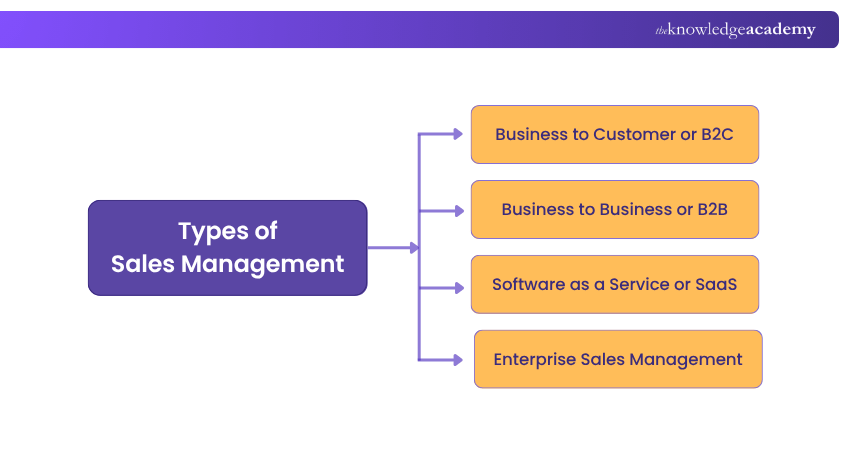
a) Business to Customer or B2C: In this type of Sales Management, the business operations directly cater to consumers. This method is often applied when the organisation asks the sales team to conduct aggressive marketing.
b) Business-to-Business or B2B: This type of Sales Management involves conducting business directly with another business. B2B Sales typically focus on major goods or services and often require a longer sales cycle due to larger deal sizes and multiple decision-makers.
c) Software as a Service or SaaS: This method of Sales Management is used when a company plans to sell software services to businesses or customers. It generally comes with a subscription plan, when the software is purchased. SaaS is conducted by contacting potential customers by phone, email or face-to-face- conversation.
d) Enterprise Sales Management: In this type of Sales Management, the enterprise team advises the sales team on the types of enterprises or services that they need to sell to other businesses to generate revenue. There are Sales Engineers who are directly involved in making Communication with large businesses regarding the opportunities in their firms.
Learn proven sales techniques to engage customers and close deals more effectively. Join our Online Sales Training now!
What is the Sales Management Process
A good Sales Management process helps a business grow by hiring and training a strong team, setting goals, planning, talking to leads, forecasting, and tracking results. These are the processes of Sales Management:
1) People
The sales team is the most important part of the business. To build a good team, a manager should know what each person is good at and what keeps them happy and motivated. They should give the team the right training and make sure everyone works well together. If the job needs someone to find new customers, the manager should hire someone who has that skill, not someone who only works with old customers.
2) Performance
A good manager checks how the team is doing. They set clear and simple goals. They use easy numbers to track progress. They help the team improve and say "well done" when the team does a good job. It’s also important to tell the team what is expected and help them take care of their work. Tools like Salesforce Trailhead and Salesblazer can help the team learn and grow.
3) Process
The sales process is a list of steps that help turn a person who is interested into a real customer. These steps include finding new customers, talking to them, and closing the sale. Each step should be clear and done properly before moving to the next one. Managers can use data to make the process better. A good process also helps guess how much money the team might make in the future.
4) Planning
Planning is what brings everything together. A Sales Manager should set clear goals and make simple plans to reach them. They should use time, tools, and money in a smart way. They must also be ready to face problems or new challenges. The plan should match the company’s main goals. It should also be easy to change if things change in the business.
What are the Effective Sales Management Techniques
There are several effective Sales Management techniques which are applied in Sales Management to achieve maximum profit. Some of these techniques are:
1) Recruit Top-tier Candidates
The first step to good sales is hiring the best people. A sales manager should take time to find people who are good at selling and work well with the team. The right person will match the team’s goals and attitude. Hiring well at the start helps the whole team do better later.
2) Lead Ongoing Training, Coaching and Development
Training shouldn't end after hiring. Salespeople need to learn new skills often, but few get regular help. A good manager gives ongoing coaching, teaches useful selling tips, and offers support based on each person’s needs. This helps the team grow and sell better.
3) Forecast Future Sales and Track Key Metrics
Good Sales Managers look at current deals and the future leads to guessing future sales. This is called forecasting. It helps set better targets and shows where things are stuck, like finding new customers or closing deals. Managers should check the same numbers each quarter and share them with the team so everyone knows how they’re doing and can adjust if needed.
4) Implement a Sales Management System
A sales system or CRM is a tool that helps track everything. It stores customer details, shows what deals are in progress, and helps the team stay organised. New tools also use smart technology (AI) to suggest the best leads or predict sales. With less paperwork and more helpful info, salespeople can focus more on talking to customers and making sales.
What is a Sales Management System?
Due to the constant change in the Sales system, there has to be a uniform platform where the entire Sales team can work together, manage contacts and most importantly, track important deals. This is achieved by the Sales Management system which is a software that helps to make the entire Sales Process simple.
Nowadays, the Sales teams have started incorporating the latest technologies for their Sales Management. All the organisation’s social media platforms, Stakeholders, employees and the customers of the organisation can now be connected with this Sales Management system. This helps in extracting the relevant data which can be later used by the sales staff to draw patterns and predict future trends.
Gain practical tools to align sales goals with overall business strategy. Join our Sales Management Training now!
Benefits of Using a Sales Management System
Here you are going to learn some of the benefits of using the Sales Management system. They are as follows:

a) Understands What Customers Want:
Sales Management helps the team know what customers like. It looks at past sales and customer habits. This helps the business guess what people may want to buy next.
b) Keeps Customer Information Safe:
It saves names, phone numbers, emails, and more in one place. This helps salespeople talk to customers easily and tell them about new offers or products.
c) Helps Build Good Customer Relationships:
Salespeople can talk to customers before, during, and after the sale. This helps customers feel happy and heard. They can give feedback, and the business can improve.
d) Makes Reports and Plans:
The system can create reports that show how the sales team is doing. Managers use these reports to make smart plans and set new goals for the team.
e) Tracks Work and Tasks:
Salespeople can see what jobs they have done and what’s left. They can also focus on the most important work first. Managers can check this anytime and help if needed.
Sales Management Tools and Techniques
Nowadays, Sales Managers are provided with a wide range of assistive tools, through which they can easily implement the most efficient Sales Management practices. Here are several Types of Sales Tools commonly used by Sales Managers:
a) Customer Relationship Management (CRM) Systems: CRM systems are tools that give us information about customers' behaviours, supply us with leads, and provide a way for tracking Sales opportunities and managing the pipeline. Sales Managers can leverage an immeasurable number of benefits with the integration of CRM systems. They can ensure customer data is properly managed by keeping track of contacts, communication history and customer purchases.
b) Sales Performance Analytics Tools: This tool helps the Sales Manager to analyse Sales data, track KPIs, and generate comprehensive reports. This analytics tool provides in-depth data on the Sales performance and provides an explanation of why a customer does not choose a particular product. With the help of this Sales performance analytics tool, Managers can get the latest Sales trends description. For example: Tableau, Power BI, and Salesforce Analytics.
c) Sales Enablement Platforms: Through Sales enablement platforms, Sales teams are provided with multiple tools that are helpful in providing information and assets that the teams require in making sales. These platforms act as a basis of a centralised location for Sales collateral, product information, training materials and playbook. Some of these platforms are: Highspot, Showpad, and Seismic.
d) Sales Forecasting Tools: Forecasting instruments can help Sales Managers to anticipate the future Sales income using historical data, market trends and etc. These tools fine-tune the accurate revenue forecasting, resource apportioning and most importantly, the decision-making process.
e) Communication and Collaboration Tools: Sales Managers these days, use communication and collaboration tools to not only organise but also foster collaboration between team members. The use of collaboration tools allows for quick messaging, document exchange and video conferencing. Some of these are: Slack, Microsoft Teams, and Google Workspace.
f) Lead Generation and Prospecting Tools: Lead generation and prospecting instruments can show the Sales Managers the available leads and help them choose the best ones. These tools automate lead generation, scoring, and nurturing processes which allow Sales Managers to concentrate on high-quality leads. Automation of these processes leaves ample time for Sales Managers to focus on high-value leads. Some of these tools are LinkedIn Sales Navigator, HubSpot and ZoomInfo.
g) Sales Training and Learning Management Systems (LMS): Sales Managers can leverage the application of training and Learning Systems Management to create and deliver efficient sales related training sessions. Not only that, but these platforms also facilitate e-learning that is based on interactivity, while at the same time offering quizzes for evaluation, and progress tracking for continuous learning and development. Examples of such LMS include MindTickle, Lessonly, and SAP Litmos.
h) Proposal and Contract Management Tools: Proposal and contract management tools help Sales Managers keep their ideas, plans and terms of the contract under control. These tools of automation take care of document drafting, flows of approval, and tracking of contracts helping to reduce data overload. Some of these are PandaDoc, DocuSign, and Conga.
i) Territory Management Software: The goal of territory management software is to effectively organise Sales territory, such as a uniform load of targeted leads to each salesperson and appropriately allocate resources. These tools present visualisations of sealed territories, information on the customers that the business currently has, and the opportunity to assign territories to each employee. Some of the examples of this tool are: MapAnything, Badger Maps and Salesforce Territory Management among others.
j) Mobile Sales Apps: Mobile Sales apps make it possible for Sales Managers and Salespeople to get the Sales data, customer essentials, etc., in real time with the help of these apps. These apps help employees in remote work and let them update in no time which makes things more productive. Here are some examples of Mobile Sales app – Salesforce Mobile, Hubspot Mobile and Zoho CRM Mobile.
Become familiar with sales analysis techniques for businesses efficiently. Join our Sales Analytics Training now!
What are the Challenges Faced by a Sales Manager?
No, let’s discuss some of the challenges that are faced in Sales Management:
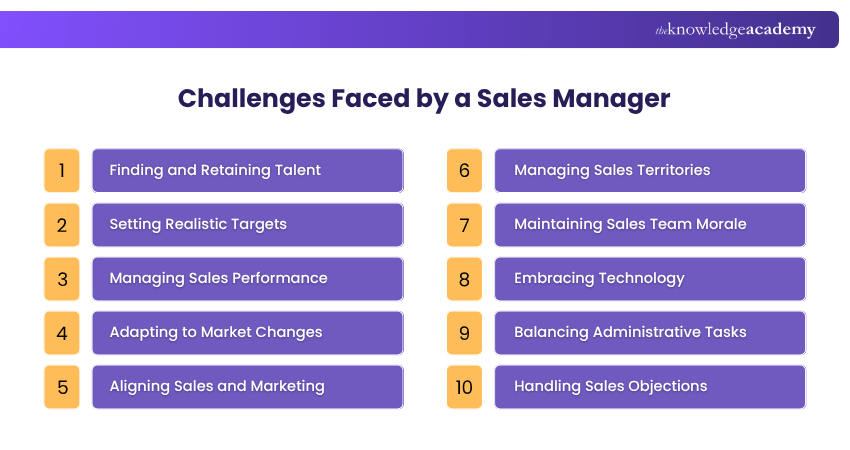
a) Finding and Retaining Talent: Attracting skilled sales professionals that are fit for the culture and values requires Sales Managers to be on the lookout for and maintain the best talent. The appropriate hiring decisions contribute towards staff retention and engagement.
b) Setting Realistic Targets: Setting the Sales targets is a complex task for Sales Managers as it should be realistic but at the same time encourage the team avoiding unachievable goals.
c) Managing Sales Performance: Steady Sales performance at the team level might be difficult to guarantee. Sales Managers must identify and fix performance gaps, offer coaching and training, and implement performance plans for the maintenance of productivity and at least the target achievement.
d) Adapting to Market Changes: The Sales environment is under continuous transformation, and the Sales Managers must be dynamic enough to keep themselves updated with the market trends, customer bases, and participation with other competitors. Moreover, Sales Managers should closely monitor the industry changes, new technologies arising on the market, and what customers expect from products to bring those factors into the Sales strategy planning.
e) Aligning Sales and Marketing: Sales Managers need to develop efficient communication, align joint goals with the Marketing Department, and bridge gaps between them. Sales and marketing are most effective when both teams work together to deliver a coherent message and drive growth.
f) Managing Sales Territories: Maintaining optimal Sales territories can be difficult, even more so in the case of geographically divided markets in which there is a lot of rivalry. Sales Managers are required to distribute the available resources based on priorities and provide equal leads to all sales representatives so that all territories are serviced adequately and receive full support from the Sales Manager.
g) Maintaining Sales Team Morale: Sales can be a demanding and high-pressure profession. Sales Managers need to foster a positive and motivating work environment to keep the team engaged and motivated, particularly during periods of intense competition or when facing Sales setbacks.
h) Embracing Technology: The rapid advancements in Sales technology can pose challenges for Sales Managers. They must stay updated with the latest tools and platforms, integrate technology into Sales processes effectively, and provide training and support to ensure the team maximises the benefits of technological advancements.
i) Balancing Administrative Tasks: Sales Managers often juggle multiple responsibilities, including administrative tasks, reporting, and Strategic Planning. Balancing these demands while staying focused on coaching the team and driving sales can be a challenge.
j) Handling Sales Objections: Overcoming customer objections is a common challenge faced by Sales teams. Sales Managers must equip their team with objection-handling techniques, train them to address common objections effectively and provide ongoing support to navigate challenging sales situations.
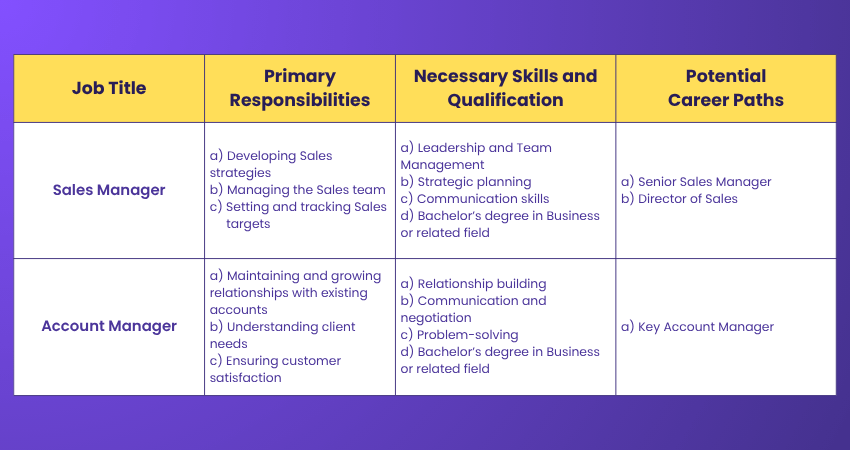
Careers in Sales Management
To understand the careers in Sales Management, let’s have a look at this table:
Conclusion
In essence, understanding What is Sales Management is the key to building strong teams, reaching sales goals, and growing a successful business. By hiring the right people, offering training, tracking progress, and planning smartly, businesses can boost results and keep customers happy. With the right tools and leadership, Sales Management turns effort into real, lasting success.
Acquire skills to handle customers via telephone with our Telephone Sales Training – Join now!
Frequently Asked Questions
What Skills do you Need to be a Sales Manager?

You need to talk clearly, listen well, and help your team. You should solve problems, plan your time, and stay calm. You must keep your team happy and working well. Knowing how to use a computer, send emails, and use sales tools is also helpful. A good Sales Manager leads the team and helps them sell more.
What Qualifications do I Need to be a Sales Manager?
Most Sales Managers finish school or college, often in business or marketing. But even without a degree, you can be a manager if you have sales experience. Some people do short courses or get certificates to learn more. The most important thing is knowing how to sell and lead a team well.
What are the Other Resources and Offers Provided by The Knowledge Academy?
The Knowledge Academy takes global learning to new heights, offering over 3,000+ online courses across 490+ locations in 190+ countries. This expansive reach ensures accessibility and convenience for learners worldwide.
Alongside our diverse Online Course Catalogue, encompassing 17 major categories, we go the extra mile by providing a plethora of free educational Online Resources like Blogs, eBooks, Interview Questions and Videos. Tailoring learning experiences further, professionals can unlock greater value through a wide range of special discounts, seasonal deals, and Exclusive Offers.
What is The Knowledge Pass, and How Does it Work?
The Knowledge Academy’s Knowledge Pass, a prepaid voucher, adds another layer of flexibility, allowing course bookings over a 12-month period. Join us on a journey where education knows no bounds.
What are Related Courses and Blogs Provided by the Knowledge Academy?
The Knowledge Academy offers various Sales Training, including Sales Bootcamp Course, Meeting Skills Training Course, and Online Sales Training. These courses cater to different skill levels, providing comprehensive insights into Sales methodologies.
Our Business Skills blogs covers a range of topics related to Sales, offering valuable resources, best practices, and industry insights. Whether you are a beginner or looking to advance your Sales skills, The Knowledge Academy's diverse courses and informative blogs have you covered.

Charlotte Wilson


Soft Skills and Business Training Manager
Charlotte Wilson is an expert in soft skills development, with over 14 years of experience helping individuals and teams improve communication, productivity and emotional intelligence in the workplace. Her training content is focused on enhancing interpersonal effectiveness and fostering positive, collaborative environments across all levels of an organisation.
View Detail
Upcoming Digital Marketing Resources Batches & Dates
Date
 Online Sales Training
Online Sales Training
Fri 10th Jul 2026
Online Sales Training
Fri 2nd Oct 2026

 If you wish to make any changes to your course, please


