


 Top Rated Course

We may not have the course you’re looking for. If you enquire or give us a call on +0800 780004 and speak to our training experts, we may still be able to help with your training requirements.
Business Intelligence Developer: Roles and Responsibilities
The Knowledge Academy 09 February 2026A BI developer transforms raw data into insightful reports and dashboards, helping organisations make informed decisions using analytics and visualisation tools. They identify trends, improve efficiency, and support business strategy through accurate, actionable insights derived from complex datasets.

Training Outcomes Within Your Budget!
We ensure quality, budget-alignment, and timely delivery by our expert instructors.
Table of Contents

Business Intelligence Developers play a vital role in transforming raw data into meaningful insights that support informed business decisions. They design and manage reporting systems that help organisations analyse performance and trends.
In this blog, we explore the role of a Business Intelligence Developer, outlining their key responsibilities, required skills, and the value they bring to data-driven organisations.
Table of Contents
1) What Does Business Intelligence (BI) Developers do?
2) Business Intelligence Developer Roles and Responsibilities
3) Business Intelligence Developer Skills
4) Business Intelligence Developer Salary
5) How to Become a Business Intelligence Developer?
6) What are the Four Types of Business Intelligence?
7) What is the Most Popular Business Intelligence Software?
8) Conclusion
What Does Business Intelligence (BI) Developers do?
A Business Intelligence Developer is a software engineer specialising in developing, deploying, and maintaining BI interfaces, including Data Analytics, Data Visualisation tools, and reporting software. Their work involves transforming data into insights that drive business decisions. These developers are critical in increasing business efficiency and productivity by providing the most current and relevant data for decision-making processes.

Business Intelligence Developer Roles and Responsibilities
Business Intelligence Developers will design, develop, and maintain the systems that will convert unstructured business data into useful insights that organisations can act upon. Their presence ensures that information is used to work out strategic decisions through the provision of precise reports, visualisations, and sound streams of data.
The roles of Business Intelligence Developers are:
1) Design and Deploy BI Solutions: Precise systems that are connected to databases and data warehouses to assist in reporting and analysis.
2) Create Dashboards and Visualisations: Showcase information issues in a concise but comprehensible way to stakeholders.
3) Create and Sustain Data Structure: Make quality, accurate, and meaningful data to analyse.
4) Deal with ETL Processes: Gather, transform, and format data across various sources.
5) Work with Stakeholders: Differentiate business requirements and map them to technical BI solutions.
Business Intelligence Developer responsibilities are:
1) Giving User Support and Training: Assistance to stakeholders when utilising BI tools and insights.
2) Maintain and Upgrade BI Systems: Modify the business requirements in accordance with the changing needs and add novel data sources.
3) Ensure Data Quality and Governance: Standards are put in place to ensure reliability and compliance.
4) Stay Updated with BI Trends: Continuous improvement of BI in the organisation.
Sign up for our Business Intelligence Reporting and master the art of interpreting and presenting complex data effectively!
Business Intelligence Developer Skills
Business Intelligence Developers need a strong mix of technical, analytical, and business-focused skills to transform data into meaningful insights. As outlined in industry guidance from BCS, these skills ensure BI solutions are accurate, scalable, and aligned with organisational goals. The key skills include:
1) Communication
A great Business Intelligence Developer can explain complicated concepts to those outside the field. The information you present drives essential decisions that affect the company.
2) Public Speaking
After collecting data, a BI Developer must present it to the company's decision-makers. They must be prepared to speak to audiences and respond to their queries to explain the data effectively.
3) Problem-solving
A Business Intelligence Developer must be able to troubleshoot technology and find solutions for the problems they identified. For example, if they detect any failure in data recording, they must be able to develop a new tool or query to expedite the process.
4) Attention to Detail
When analysing data, a Business Intelligence Developer must identify telling information about the business. Such information can include noticing trends in the data that influence customer retention and sales revenue. A BI Developer's analysis is vital since they use mathematical evidence to explain their findings.
5) Collaboration
A BI Developer often has to work with other specialists. They must be able to collaborate with others to deliver comprehensive results from vast data sets.
Learn how to generate interactive reports and dashboards with our Microsoft Power BI Course – Join now!
Business Intelligence Developer Salary
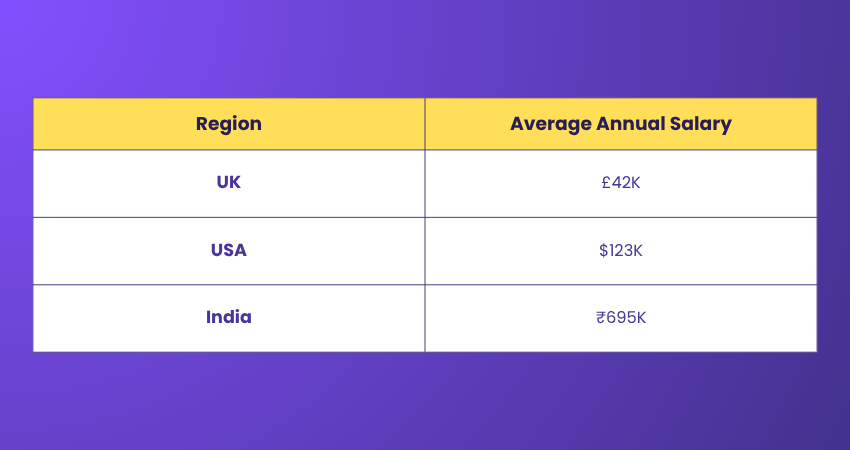
The salary of a Business Intelligence Developer can vary based on location, experience, industry, and the tools they use. Here's a breakdown of the average annual salary hike of a BI Developer across three major regions:
How to Become a Business Intelligence Developer?
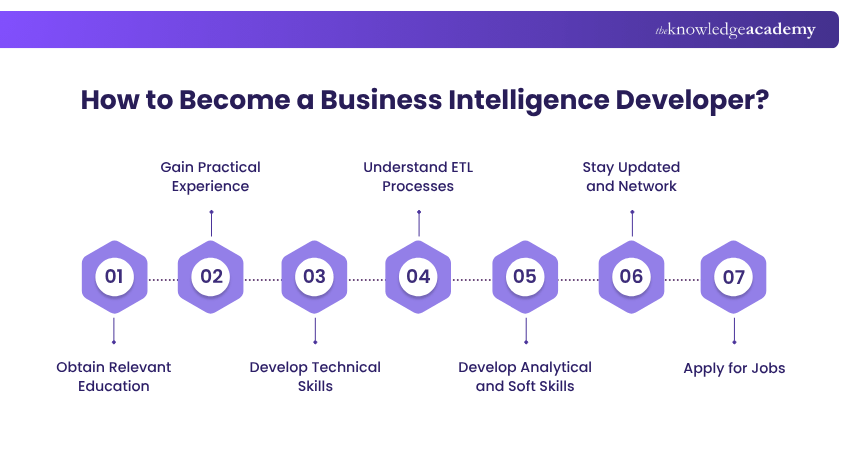
Pursuing a career path of a Business Intelligence Developer entails a balanced combination of academic learning, skill development, and hands-on experience. Here's a step-by-step look into entering this dynamic field
1) Obtain Relevant Education
Begin with a bachelor's degree in a relevant field such as IT, Data Science, Computer Science, or Business Information Systems to build a solid foundation of the key concepts and technologies used in BI development for the Business Intelligence Developer role. Also, consider taking courses specific to Data Analytics, BI, Data Modelling, and Database Management. Certifications can also increase your skills and make you more desirable to employers.
2) Gain Practical Experience
Apply for internships in Database Management, Data Analysis, or related areas. You can work on projects that allow you to practice BI development skills, such as database design or Data Visualisation.
Based on this, you can create a work portfolio, including any personal projects that demonstrate your ability to translate data into actionable insights. This could include reports, dashboards, or data models you have developed.
3) Develop Technical Skills
You must learn BI and Data Visualisation tools like Tableau, Microsoft Power BI, or Qlik Sense to excel in Business Intelligence Developer roles. Understanding how to use these tools to create dashboards and reports is crucial. Additionally, you must master SQL and Database Management, which will develop your database querying skills and strengthen your knowledge of Database Design and management principles.
4) Understand ETL Processes
Learn about Extract, Transform and Load (ETL) tools and processes, which are key to preparing data for analysis. Additionally, get comfortable with Data Modelling principles, including building and maintaining data marts and warehouses.
5) Develop Analytical and Soft Skills
Business Intelligence (BI) Developers must have strong analytical, problem-solving and communication skills. These skills enable you to:
a) Analyse data trends and provide insights.
b) Identify issues and find practical solutions under tight deadlines.
c) Communicate complex data insights clearly and understandably to non-technical stakeholders.
6) Stay Updated and Network
Since the field of BI is constantly evolving with new tools and technologies, staying updated is essential. You can follow industry news, attend workshops, and participate in relevant forums and groups.
Additionally, you should connect with professionals in the field through industry conferences and sites such as LinkedIn. Networking can provide valuable insights into the BI field and open better job opportunities.
7) Apply for Jobs
Craft your resume to highlight relevant experience and skills and start applying for BI Developer positions. Don’t forget to include your portfolio and examples of projects you have worked on.

What are the Four Types of Business Intelligence?
There are four primary types of business intelligence that help organisations interpret information, comprehend trends, predict results, and make strategic choices. These are the types that exists:
1) Descriptive Analytics: A summary of past data points to display what has occurred based on dashboards and reports to point out trends and patterns.
2) Diagnostic Analytics: Investigative data with the purpose of revealing the reasons why certain results were achieved, revealing the underlying factors that hold the end outcomes or changes in trends.
3) Predictive Analytics: Predictive analytics involves modelling past data to predict the most probable future condition or behaviour and is helpful in proactive planning.
4) Prescriptive Analytics: This is a combination of predictions and optimisation methods used to suggest the most ideal actions to achieve the desired effects.
What is the Most Popular Business Intelligence Software?
Some of the most popular Business Intelligence software tools that Business Intelligence Developers can utilise today include Microsoft Power BI, Tableau, Qlik Sense, and SAP BusinessObjects. These platforms help organisations visualise data, generate reports, and uncover actionable insights with ease.
Among them, Microsoft Power BI stands out for its user-friendly interface, affordability, and seamless integration with Microsoft tools, making it a top choice for professionals and organisations of all sizes.
Conclusion
Business Intelligence Developers have become significant in the current data-driven world, whereby they assist organisations to convert complicated data into insights used to act upon. With the help of their technical experience and analytical skills, they enable informed decision-making, optimisation of business processes, and strategy development.
Want to understand how to connect, blend and clean diverse data sources? Our up-to-date Tableau Desktop Training will help you – Sign up now!
Frequently Asked Questions
What are the Four Major Components of Business Intelligence?

The four main components of Business Intelligence are:
a) Data Collection and Integration
b) Data Analysis
c) Data Visualisation
d) Reporting and Dashboards
What is the Main Technique of Business Intelligence?
The main technique of Business Intelligence is Data Analysis, which involves Data Mining and Data Warehousing.
What are the Other Resources and Offers Provided by The Knowledge Academy?
The Knowledge Academy takes global learning to new heights, offering over 3,000+ online courses across 490+ locations in 190+ countries. This expansive reach ensures accessibility and convenience for learners worldwide.
Alongside our diverse Online Course Catalogue, encompassing 19 major categories, we go the extra mile by providing a plethora of free educational Online Resources like Blogs, eBooks, Interview Questions and Videos. Tailoring learning experiences further, professionals can unlock greater value through a wide range of special discounts, seasonal deals, and Exclusive Offers.
What is The Knowledge Pass, and How Does it Work?
The Knowledge Academy’s Knowledge Pass, a prepaid voucher, adds another layer of flexibility, allowing course bookings over a 12-month period. Join us on a journey where education knows no bounds.
What are the Related Courses and Blogs Provided by The Knowledge Academy?
The Knowledge Academy offers various Business Intelligence Reporting Courses, including the Business Intelligence Analyst Course and the Microsoft Power BI Course. These courses cater to different skill levels, providing comprehensive insights into What is Business Intelligence (BI).
Our Office Applications Blogs cover a range of topics related to Business Intelligence, offering valuable resources, best practices, and industry insights. Whether you are a beginner or looking to advance your Business Intelligence Developer skills, The Knowledge Academy's diverse courses and informative blogs have got you covered.

The Knowledge Academy


Global Training Provider
The Knowledge Academy is a world-leading provider of professional training courses, offering globally recognised qualifications across a wide range of subjects. With expert trainers, up-to-date course material, and flexible learning options, we aim to empower professionals and organisations to achieve their goals through continuous learning.

Upcoming Office Applications Resources Batches & Dates
Date
 Business Intelligence Analyst Course
Business Intelligence Analyst Course
Fri 7th Aug 2026
Business Intelligence Analyst Course
Fri 6th Nov 2026

 If you wish to make any changes to your course, please


