


 Top Rated Course

We may not have the course you’re looking for. If you enquire or give us a call on +0800 780004 and speak to our training experts, we may still be able to help with your training requirements.
What is the ArchiMate® Modelling Language: A Comprehensive Guide
James Smith 15 July 2026The ArchiMate® Modelling Language is a powerful modelling language designed for Enterprise Architecture which provides a standardised and visual way to represent complex systems. This blog acts as your guide to understanding the ArchiMate® Modelling Language with comprehensive explanations and practical examples. Keep reading to learn more!
Home
 Resources
Business Improvement
What is the ArchiMate® Modelling Language: A Comprehensive Guide
Resources
Business Improvement
What is the ArchiMate® Modelling Language: A Comprehensive Guide
Resources
Business Improvement
What is the ArchiMate® Modelling Language: A Comprehensive Guide

Training Outcomes Within Your Budget!
We ensure quality, budget-alignment, and timely delivery by our expert instructors.
Table of Contents

The ArchiMate® Modelling Language serves as a blueprint for Enterprise Architecture (EA), offering a standardised approach to describe, analyse, and visualise relationships within business domains. The ArchiMate® Modelling Language was originally developed between 2002 and 2004, revolutionising the way architects and stakeholders understand and implement changes in enterprise structures.
This blog will delve into the ArchiMate® Modelling Language and its significance in aligning business strategies with Information Technology. Join us as we explore the intricacies of this powerful modelling language that has become integral to modern Enterprise Architecture.
Table of Contents
1) What is the ArchiMate® Modelling Language?
2) Benefits of Using the ArchiMate® Modelling Language
3) Layers of the ArchiMate® Modelling Language with Examples
4) Steps to Create Architecture Models Using the ArchiMate® Modelling Language
5) Conclusion
What is the ArchiMate® Modelling Language?
The ArchiMate® Modelling Language is a standardised modelling language designed to help organisations describe, analyse, and visualise their Enterprise Architecture in a clear and structured way.
The ArchiMate® Modelling Language was developed by The Open Group®. It provides a common set of concepts, symbols, and relationships that allow different stakeholders, such as Business Managers, IT teams, and Architects, to understand how various parts of an organisation work together.
Instead of dealing with complex technical diagrams, the ArchiMate® standard simplifies communication by presenting architecture in layered views, typically covering business, application, and technology layers which form the core structure with some additional layers. In essence, the ArchiMate® Modelling Language acts as a bridge between technical complexity and business clarity, helping teams see the bigger picture without losing important details.

Benefits of Using the ArchiMate® Modelling Language
As organisations grow, so does the complexity of their systems, processes, and technologies. The ArchiMate® Modelling Language provides a standardised approach to bring all these elements together in a meaningful way. Let's check some of the benefits it brings to every business:
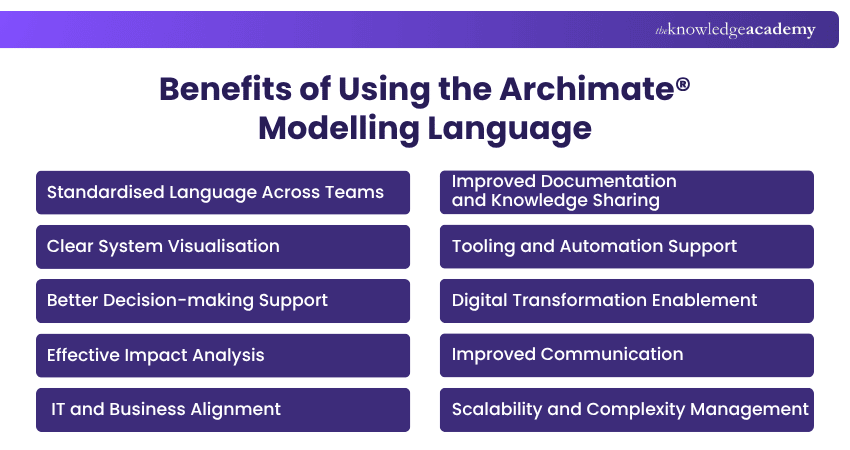
1) Standardised Language Across Teams
The ArchiMate® Modelling Language uses a common visual vocabulary that goes beyond the limitation of a text to model the different aspects of the enterprise. In simple terms, this shared language allows stakeholders with different backgrounds such as Business Analysts, Software Developers, and IT Managers to communicate more effectively while exchanging information.
It provides clear and consistent representations of complex concepts, relationships, and dependencies, reducing the risk of misinterpretation. This clarity encourages more meaningful discussions and helps ensure everyone is aligned.
2) Clear System Visualisation
The ArchiMate® Modelling Language excels in illustrating architectural transformations, making it an ideal tool for change management and modernisation initiatives. Architects can map the current state, design the desired future state, and visually depict the transition steps, helping stakeholders grasp the transformation journey.
3) Better Decision-making Support
The visual representations of the ArchiMate® Modelling Language empower stakeholders to make well-informed decisions by offering a tangible preview of potential changes or implementations. Architects can model different scenarios and assess the implications before committing resources, resulting in optimised choices and reduced risks.
4) Effective Impact Analysis
The ArchiMate® Modelling Language enables organisations to carry out effective impact analysis by clearly mapping relationships between business processes, applications, and technology components. When a change is proposed such as introducing a new system or modifying an existing one, Architects can quickly identify which areas of the enterprise will be affected.
5) IT and Business Alignment
One of the key benefits of the ArchiMate® Modelling Language is that it spans the gap between business goals and IT implementation. It enables stakeholders to align strategic objectives with the technology solutions that are being delivered, ensuring that both business and IT move in the same direction.
Such an alignment brings about improved collaboration, ensures the ability to define changeable architectures easily, and ensures the technology decisions comply with business objectives.
6) Improved Documentation and Knowledge Sharing
This model serves as comprehensive documentation that encapsulates the intricacies of a system or enterprise. These models capture the structural elements and the dynamic behaviours, relationships, and dependencies. As a result, they become invaluable assets for future reference, knowledge transfer, and maintaining a clear record of architectural evolution.
7) Tooling and Automation Support
The ArchiMate® Modelling Language is widely supported by various EA tools, enabling organisations to create, manage, and analyse models efficiently. These tools allow Architects to build interactive diagrams, maintain centralised repositories, and automate repetitive modelling tasks.
This level of tooling support improves productivity, ensures consistency across architectural artefacts, and makes it easier to update models as systems evolve over time.
8) Digital Transformation Enablement
The ArchiMate® Modelling Language plays a key role in supporting digital transformation initiatives by providing a structured way to model both the current and future status of an organisation. It helps Architects visualise transformation roadmaps and identify the steps needed to move from existing systems to modern solutions.
This clarity allows organisations to plan changes more effectively, align transformation efforts with business goals, and track progress throughout the journey.
9) Improved Communication
This modelling language helps in enhancing communication by offering clear and standardised visual representations of EA. These visuals make it easier for stakeholders to understand complex systems without needing deep technical expertise. By simplifying how information is presented, the ArchiMate® Modelling Language encourages more productive discussions and reduces ambiguity.
10) Scalability and Complexity Management
The ArchiMate® Modelling Language standardised framework and hierarchical structure enable Architects to model and manage complex systems easily. It allows breaking down large architectures into manageable components, making it simpler to analyse, optimise, and adapt as the system evolves.
Elevate your career with the ArchiMate® 3 Training Course – Sign up today!
Layers of the ArchiMate® Modelling Language with Examples
Concrete examples display the real-world application of the ArchiMate® Modelling Language, illustrating how it captures the essence of complex architectures and fosters stakeholder understanding.
1) Business Layer Example
Assume that there is a retail business organisation that wants to adapt its supply chain management. A business layer model must exist, explaining different constituents like the business actors (customers, suppliers), the business processes (order processing, inventory management), and the relationship between them.
A model would enable the visualisation of how a customer's order would finally result in the updating of corresponding procurement decisions. This would help stakeholders to visualise the bottlenecks, streamline the process, and, in so doing, improve customer satisfaction.
2) Application Layer Example
This model for an e-commerce platform's application layer represents Application Components, Application Interfaces, and Data Objects. It illustrates how users interact with applications, how data is processed and stored, and how different systems communicate through defined interfaces.
Architects and Developers can use this model to optimise the User Experience (UX), identify potential performance bottlenecks, and ensure smooth integration between various software components.
3) Technology Layer Example
Consider a financial institution upgrading its IT infrastructure. The technology layer would display hardware components (servers, routers), software platforms (operating systems, databases), and communication paths which are the connections between them.
This model could visualise data flow and transactions across the network, identifying potential security vulnerabilities and ensuring compliance with industry standards.
Steps to Create Architecture Models Using the ArchiMate® Modelling Language
Creating architecture models using the ArchiMate® Modelling Language involves structuring complex organisational elements into clear, meaningful visuals that support decision-making. We will show how to create models that accurately depict complex architectures:
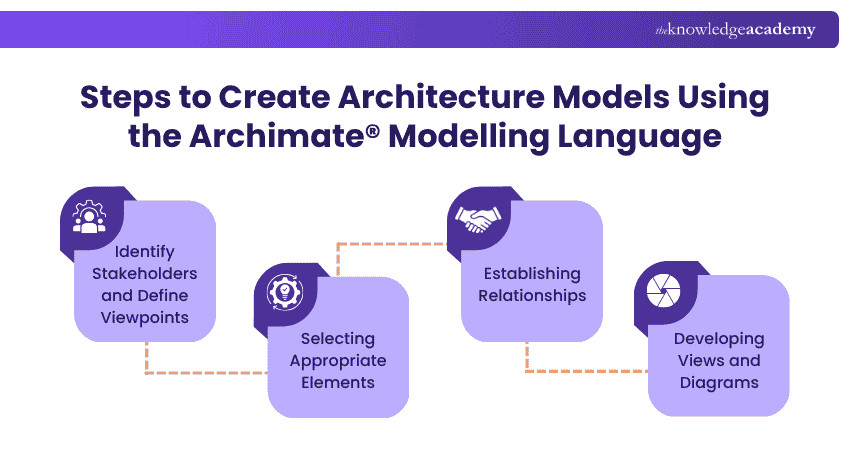
1) Identify Stakeholders and Define Viewpoints
The first step is to identify the scope of who will use the model and what they need to understand. Different stakeholders such as Business Managers, Architects, Developers or operations teams have different concerns and expectations. The ArchiMate® Modelling Language supports this through viewpoints, which allow you to present the same architecture in different ways depending on the audience.
2) Selecting Appropriate Elements
Once the viewpoints and scope are defined, the next step is to select the ArchiMate® Modelling Language elements that are appropriate to your business. Identify the key aspects you want to represent, such as business processes, application components, or technology infrastructure. Then, choose the ArchiMate® Modelling Language elements that best capture these aspects. For instance, in a business process model, you might select elements like "Business Process," "Actor," and "Role."
Begin your journey into Enterprise Architecture with the ArchiMate® 3 Training Course: Level 1 - Sign up now!
3) Establishing Relationships
The heart of this model lies in the relationships between elements. Define how different parts interact, depend on, or influence one another. Establish relationships that accurately depict the flow of activities, information, and behaviours within the architecture.
By using the ArchiMate® Language Modelling defined by The Open Group®, you can leverage its structural, dynamic, and dependency relationships to display these connections. For instance, you might create a structural relationship between a "Business Process" and an "Application Component" to depict how the process interacts with the software.
4) Developing Views and Diagrams
The ArchiMate® Modelling Language offers various viewpoints to capture different facets of EA. Choose the appropriate viewpoints based on your audience and objectives. Develop views which are the diagrams that focus on specific layers (business, application, technology) or aspects (process flow, data flow). Use these diagrams to provide clear visualisations that highlight relevant elements and relationships. Label elements and relationships with concise descriptions to ensure clarity.
Utilise colours, shapes, and annotations to enhance the readability of your diagrams. Group related elements and emphasise critical paths to guide the viewer's attention. Consider creating multiple views and diagrams to represent different perspectives and levels of detail, ensuring that each diagram contributes to the overall understanding of the architecture.
Conclusion
In conclusion, the ArchiMate® Modelling Language empowers architects and stakeholders to effectively communicate, design, and align complex systems. Its standardised visual representations bridge gaps, inform decisions, and drive successful implementations, making the ArchiMate® an indispensable tool in modern architecture and enterprise management.
Elevate your architecture skills with the ArchiMate® Training and unlock new opportunities in Enterprise Architecture.
Frequently Asked Questions
What Industries and Sectors Actively Seek Professionals With Expertise in the ArchiMate® Modelling Language?

Industries such as banking, insurance, telecommunications, healthcare, and government sectors actively seek professionals proficient in the ArchiMate® Modelling Language. These professionals streamline operations, enhance IT systems, facilitate digital transformation, and align business strategies with technology initiatives.
How can Mastering the ArchiMate® Modelling Language Contribute to Career Advancement?
Mastering the ArchiMate® Modelling Language can contribute to career advancement by enabling professionals to effectively design, communicate, and implement EA solutions. This expertise enhances job performance, increases opportunities for leadership roles, and opens doors to higher-paying positions in diverse industries and sectors.

James Smith


Digital Marketing Manager and Trainer
James Smith is a digital marketing professional with over a decade of experience in SEO, content strategy, paid media and analytics. He has supported both SMEs and global brands in transforming their digital presence. James’s writing and training are rooted in results-driven tactics and the latest marketing trends.
View Detail

 If you wish to make any changes to your course, please


