


 Top Rated Course

We may not have the course you’re looking for. If you enquire or give us a call on +44 20 4538 6376 and speak to our training experts, we may still be able to help with your training requirements.
What is Financial Accounting and Why is it Important?
Olivia Taylor 26 February 2026Financial Accounting involves recording, summarising, and reporting a company’s financial transactions through statements for investors and stakeholders. Its focus lies in preparing key statements including cash flow statements, income statement, balance sheets etc. This helps stakeholders, investors and creditors make informed decisions.

Training Outcomes Within Your Budget!
We ensure quality, budget-alignment, and timely delivery by our expert instructors.
Table of Contents

Ever wondered where all the money goes at the end of the month? Or felt lost when someone mentioned “balance sheets” at work? You’re not alone. Whether you run a business or work in a team, understanding Financial Accounting helps you read reports, track money, and make better decisions with confidence.
In this blog, we’ll explain What is Financial Accounting, how it works, its main parts, why it matters, who uses it, real examples and common challenges. It is perfect for anyone wanting to understand business money matters.
Table of Contents
1) What is Financial Accounting?
2) How Financial Accounting Works?
3) Core Principles Guiding Financial Accounting
4) Importance of Financial Accounting
5) Key Parts of Financial Accounting
6) Challenges in Financial Accounting
7) What is an Example of Financial Accounting?
8) Who Uses Financial Accounting?
9) Conclusion
What is Financial Accounting?
Financial Accounting is one of the most crucial branches of Accounting. It works with recording, summarising, and reporting a company’s financial transactions. Its duty is to track monetary activities, such as sales, purchases and expenses. Then, it proceeds to organise them into systematic financial documents, like income statement, and balance sheet
The core purpose of financial accounting is to present an accurate overview of a company’s financial posture. To ensure accuracy and reliability of information, it utilises established accounting standards, such as GAAP or IFRS. This aids stakeholders to make smart-informed decisions.

How Financial Accounting Works?
Financial Accounting follows a set of fixed rules. The rules a company uses depend on what reports it needs to give and what laws it must follow. Many companies have their own guidebook that explains which rules to use.
In the UK, big companies follow different Types of Accounting standards, like GAAP and IFRS. This is to ensure companies maintain reliability, accuracy and uniformity in financial reporting.
Financial Accounting looks at five main things:
1) Revenues: Money the company earns
2) Expenses: Money the company spends
3) Assets: Things the company owns
4) Liabilities: Money the company owes
5) Equity: What the company is really worth
Gain expertise in project Financial Analysis and techniques. Join our Project Accounting Course now!
Core Principles Guiding Financial Accounting
For a company to ensure their financial reports are consistent and reliable, financial accounting principles must be followed. These principles are fundamental to the development of the foundation of accounting practices, Below, we have mentioned the give core principles for your insight:
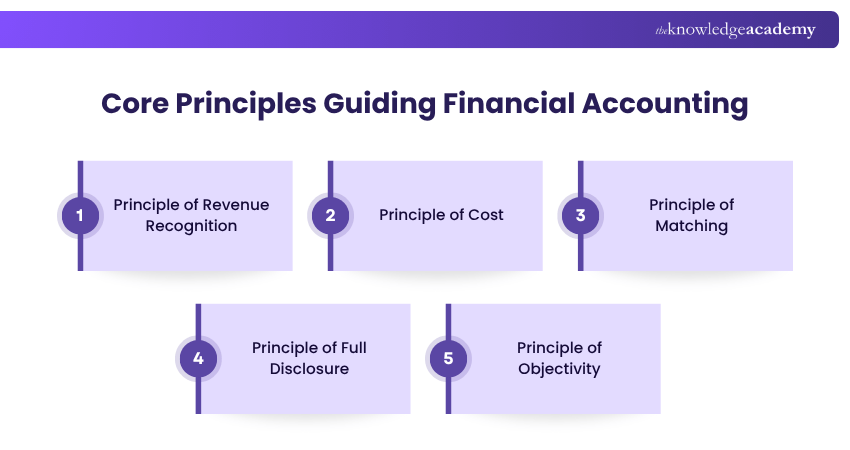
1) Principle of Revenue Recognition
This principle means that revenue must be recognised when it is earned instead of when the cash is received. For instance, if a company delivers good in January, but receives the payment in February, the record of the revenue will be recorded in January itself. This helps to provide an accurate view of finance performance.
2) Principle of Cost
The cost principle states that companies should record assets and expenses at their purchase price. It helps businesses to prevent assets value from inflating based on the present market conditions. For example, if an equipment is bought for £1,000, it will appear at those costs even if its market value increases later.
3) Principle of Matching
Matching principle makes sure that every expense related to generating revenue are being recorded in the same accounting period. For example, if a company spends on advertising in September to earn sales in October, those set of expenses must match with April’s revenue out of sales.
4) Principle of Full Disclosure
The full disclosure principle needs companies to provide all relevant information that has the potential to affect stakeholder's understanding of financial statements. This includes, schedules, accounting policies, legal issues and more. Through conducting it, businesses build trustful relationships with investors and regulators.
5) Principle of Objectivity
This principle states that financial data must be based on objective, reliable, and verifiable evidence. Documents, such as receipts, invoices, or bank statements must serve as valid proof of recorded transactions. This ensures decisions are based on factual, verifiable data to main accuracy standards.
Importance of Financial Accounting
Financial Accounting serves as a system that enables businesses to make their business operations transparent and informed, playing a pivotal role in facilitating communication, decision-making, compliance, and confidence among various stakeholders. Some of the main importance of accounting are as follows:
1) Decision-making for Stakeholders
One of the primary reasons Financial Accounting holds immense importance is its role in aiding decision-making for stakeholders. Business owners and management teams rely on accurate and up-to-date financial information to make strategic choices. Financial statements provide insights into revenue streams, cost structures, profitability, and operational efficiency.
These insights guide resource allocation, investment decisions, and long-term planning. Investors also use financial statements to assess the health and potential of a company, determining whether it aligns with their objectives and risk tolerance.
2) Regulatory Compliance
Financial Accounting operates within a framework of standards and regulations allocated authoritative bodies like the International Financial Reporting Standards (IFRS). Adhering to these standards guarantees that financial statements are accurate, consistent, and comparable. Compliance with these standards is ethically essential and often legally mandated.
Businesses must provide transparent and accurate financial information to regulatory agencies, shareholders, and the public. Proper Financial Accounting practices safeguard against fraud, misrepresentation, and unethical reporting.
3) Investor Confidence
Investor confidence is a cornerstone of healthy financial markets and successful businesses. Accurate Financial Accounting fosters investor confidence by providing transparency and insights into a company's financial health.
When investors have access to authentic financial information, they can make informed decisions about buying or selling securities. A company that consistently reports accurate and transparent financial data is more likely to attract investment and retain shareholder trust over the long term.
4) Business Performance Evaluation
Financial Accounting allows businesses to evaluate their performance objectively. By analysing financial statements over different periods, businesses can identify trends, strengths, and weaknesses.
This analysis aids in refining strategies, adapting to market changes, and seizing opportunities for improvement. Accurate Financial Accounting also supports effective budgeting and forecasting, enabling management to allocate resources efficiently and set achievable financial goals.
5) Transparency and Accountability
Transparency in financial reporting is integral to building and maintaining relationships with stakeholders. Accurate financial statements demonstrate a company's commitment to transparency and accountability, fostering positive relationships with customers, employees, suppliers, and investors. Open communication about a company's financial health builds trust and helps stakeholders make informed decisions that align with their interests.
Learn everything about financial recording and bookkeeping; register for our Book Keeping Training!
Key Parts of Financial Accounting
It’s crucial to understand the key parts constituting financial accounting. It helps to grasp how systems and reports turn raw business transaction into smart financial information.
1) Double-entry Accounting
Every financial transaction affects a minimum of two accounts, one that is debited and the other is credited. This is to ensure the accounting equation remains balanced. Also, the built-in systems identify errors. For instance, a company buys office supplies for 500 in cash. You would debit the Supplies account and credit the Cash account by the same amount.
2) Debits and Credits
A debit appears on the left side of an account and credit on the right side. Here, different types of accounts have normal balances. For example, assets and expense accounts increase with debits whereas liability, equity and revenue accounts increase with credits. While transactions are being recorded, totals must match. This is a pillar of accurate financial accounting.
3) Journal Entries and Ledgers
This is known as the “flow” of how transactions are recorded and summarised. a journal is a systematic record of all financial transactions of a business. When something happens, such as sales made, it gets recorded with date, account names and debit or credit.
Ledger account refers to the posting of entries to the relevant accounts. for instance, cash ledger, supplies ledger. At the end, these ledger balances are utilised to prepare trial balance and finally, the financial statements.
4) Understanding the Financial Statements
This refers to the outputs of financial accounting process. It standardises reports that summarise a company’s financial overview. Some key financial statements to be familiar with include:
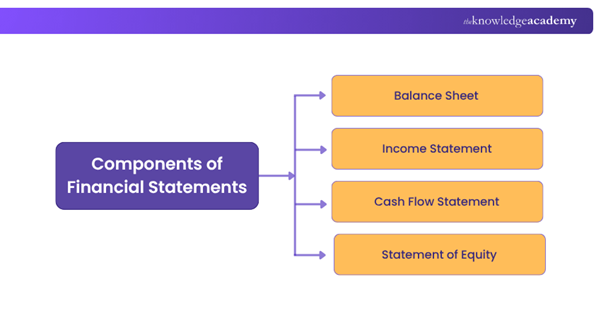
1) Balance Sheet:
This shows what assets a company owns, and what it owes during a period. Stakeholders utilise it to assess liquidity, capital structure, and financial posture.
2) Income Statement:
It’s also known as statement of profit and loss. it summarises the performances of businesses over a period, such as recording the revenue earned, expenses incurred and more.
3) Cash Flow Statement:
Here, the reports provide information on actual cash inflows and outflows over a period. This is divided into: operating, investing and financing activities. It is important since companies may show profits gain on income statement but struggle with cash.
4) Statement of Equity:
The Statement of Equity shows how shareholder’s equity changes over a time. It includes, share capital, retained earnings, and reserves. This is to reflect profits, dividends, or share issues. It explains changes in ownership value and complements the balance sheet by showing how equity tends to evolve over a period.
Challenges in Financial Accounting
If you are to understand what Financial Accounting is and what its importance, you must know the challenges of the accounting process. Navigating the challenges is essential to ensure accurate, transparent, and reliable financial reporting. Some of the common challenges in Financial Accounting are as follows:
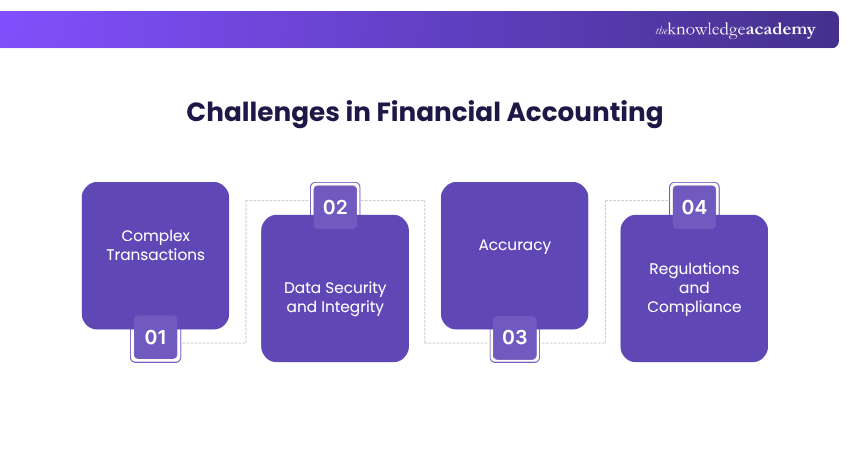
1) Complex Transactions
Modern business operations often involve intricate transactions that pose challenges to accurate financial reporting. Mergers, acquisitions, complex financial instruments, and revenue recognition are examples of transactions that can be convoluted in the Market in Financial Instruments Directive context.
2) Data Security and Integrity
In times when cybercrimes and data breaches are common, maintaining the security and integrity of financial data is paramount. Financial records are vulnerable to hacking, unauthorised access, or corruption, which can have serious impact for both businesses and stakeholders.
3) Accuracy
Accuracy is the foundation of Financial Accounting. Minor errors in accounting can have significant implications on financial statements and, subsequently, on business decisions. Ensuring that each transaction is recorded correctly, entries are categorised accurately, and financial statements are free from errors is a constant challenge.
4) Regulations and Compliance
The concept of accounting operates within a framework of rules and regulations set by authoritative bodies. However, these regulations are not static; they evolve in response to changing economic environments and emerging business practices.
Understand Risk Management strategies to safeguard financial integrity. Join our Accounting and Financial Statement Analysis Course now!
What is an Example of Financial Accounting?
A local bakery prepares its year-end accounts for the year ended 31 March. It records all sales of bread and cakes, the cost of flour and wages, and other expenses. From these records it produces:
1) Income Statement: Shows revenue of £420,000, expenses of £380,000, and profit of £40,000.
2) Balance Sheet: Lists ovens, delivery van, cash, stock of ingredients, as well as loans and amounts owed to suppliers.
3) Cash Flow Statement: Shows how much cash came in from customers and how much went out for rent, wages, and equipment.
These statements are prepared under recognised standards such as IFRS or local GAAP so that investors, banks, and the tax authority can trust the figures and compare them with other businesses
Who Uses Financial Accounting?
Financial Accounting is mainly used by people who need a clear picture of a company’s finances but are not involved in its daily operations. Investors rely on it to judge whether to buy or sell shares. Banks and lenders use it to decide if a company is a safe choice for loans. Regulators and government agencies review financial accounts to ensure laws and standards are followed. Auditors also depend on financial reports to check accuracy and reliability.
Conclusion
Understanding What is Financial Accounting is key to keeping a business honest, organised, and successful. It helps record money matters, create clear reports, and share important information with others. By following proper rules and using the right tools, Financial Accounting builds trust, supports smart decisions, and keeps the business on the right track.
Gain proficiency in budgeting and Financial Analysis with our Accounting Courses – Join now!
Frequently Asked Questions
What Is the Main Purpose of Financial Accounting?

The main objective of Financial AccountingFinancial Accounting's key objective is to show a company’s financial performance. It gives clear reports on what the company earns, spends, owns, and owes. These reports are mostly for people outside the company, like investors, banks, and the government, while managers may use other tools for planning.
What Is the Difference Between Accounting and Financial Accounting?
Accounting is about keeping track of all the money a company gets and spends. It includes everything like bills, records, and reports. Financial Accounting is one part of this. It only looks at making money reports that follow special rules, so people outside the company can understand how the business is doing.
What are the Other Resources and Offers Provided by The Knowledge Academy?
The Knowledge Academy takes global learning to new heights, offering over 3,000 online courses across 490+ locations in 190+ countries. This expansive reach ensures accessibility and convenience for learners worldwide.;
Alongside our diverse Online Course Catalogue, encompassing 17 major categories, we go the extra mile by providing a plethora of free educational Online Resources like Blogs, eBooks, Interview Questions and Videos. Tailoring learning experiences further, professionals can unlock greater value through a wide range of special discounts, seasonal deals, and;Exclusive Offers.
What is The Knowledge Pass, and How Does it Work?
The Knowledge Academy’s Knowledge Pass, a prepaid voucher, adds another layer of flexibility, allowing course bookings over a 12-month period. Join us on a journey where education knows no bounds.
What are the Related Courses and Blogs Provided by The Knowledge Academy?
The Knowledge Academy offers various Accounting Courses, including the Accounting Course, Accounting and Financial Statement Analysis Training, and the Accounting and Finance Policies Course. These courses cater to different skill levels, providing comprehensive insights into Trail Balance .
Our Accounting and Finance Blogs cover a range of topics related to Financial Accounting, offering valuable resources, best practices, and industry insights. Whether you are a beginner or looking to advance your accounting skills, The Knowledge Academy's diverse courses and informative blogs have got you covered.

Olivia Taylor


Chartered Accountant and Financial Training Specialist
Olivia Taylor is a qualified chartered accountant with over a decade of experience in financial management, auditing and corporate reporting. Having worked with leading firms in both the public and private sectors, Olivia brings clarity to complex financial topics. Her writing focuses on helping professionals build confidence in key areas of accounting, compliance and financial planning.
View Detail
Upcoming Accounting and Finance Resources Batches & Dates
Date
 Accounting Course
Accounting Course
Fri 20th Mar 2026
Accounting Course
Fri 15th May 2026
Accounting Course
Fri 14th Aug 2026
Accounting Course
Fri 13th Nov 2026

 If you wish to make any changes to your course, please


