


 Top Rated Course

We may not have the course you’re looking for. If you enquire or give us a call on +44 20 4538 6376 and speak to our training experts, we may still be able to help with your training requirements.
What is Blockchain ETF: Functions & Top ETFs List
Richard Harris 04 December 2025A Blockchain ETF is an exchange-traded fund that invests in the shares of companies that develop, utilise, or gain value from Blockchain technology. It allows investors to access Blockchain without directly buying cryptocurrencies. It includes firms involved in digital payments, mining, software development, and Blockchain infrastructure.

Training Outcomes Within Your Budget!
We ensure quality, budget-alignment, and timely delivery by our expert instructors.
Table of Contents
Wondering how to tap into the fast-growing Blockchain Technology sector without purchasing cryptocurrencies directly? Knowing What is a Blockchain ETFs could be your subsequent one-stop solution! These innovative investment funds offer a diversified and professional way to gain exposure to companies involved in Blockchain Technology. Taking the Market and Market research into consideration, the global Blockchain market is set to witness a CAGR of 66.2% from 2026 to 2027.
Yet the question that arises is, What is a Blockchain ETF exactly, and how do they work so efficiently for investors seeking exposure to Blockchain technology? This blog will answer all of your questions. Let's dive in to explore the best available Blockchain ETFs!
Table of Contents
1) What is a Blockchain ETF?
2) How Does a Blockchain ETF Work?
3) Top Blockchain ETFs in the Market
4) Why Invest in Blockchain ETFs?
5) How to Invest in Blockchain ETFs?
6) What are the Risks of Investing in Blockchain?
7) What are the Top Three Bitcoin ETFs?
8) Conclusion
What is a Blockchain ETF?
Blockchain Exchange-Traded Funds (ETFs) are investment funds that focus on companies leveraging or benefiting from Blockchain technology. Rather than investing directly in cryptocurrencies, these funds focus on businesses involved in areas such as Blockchain infrastructure, digital payments, mining equipment, cloud computing, and enterprise software.
By investing in a basket of Blockchain-related companies, Blockchain ETFs offer broader diversification compared to buying individual stocks. This helps reduce risk, as the fund’s performance isn’t tied to a single company. Investors also benefit from the convenience and liquidity of ETFs, which can be bought and sold on major stock exchanges just like regular shares.

How Does a Blockchain ETF Work?
Blockchain ETFs allow investors to own a Blockchain-related stock group through a single instrument that trades like a regular exchange stock. Here is how the entire system works:
1) Passive Management: Indexes like the Nasdaq Blockchain Economy Index (through which most Blockchain ETFs are managed passively) select companies based on a "Blockchain Score," which measures their involvement and potential in Blockchain technology.
2) Index Holdings: The top companies are included in the index, and their holdings are updated every six months. This ensures that the ETF reflects the most relevant and promising Blockchain companies.
3) Active Management: However, some Blockchain ETFs, like the Amplify Transformational Data Sharing ETF (BLOK), utilise the applications of active management. These funds rely on managers to pick stocks they believe will perform best in the Blockchain space.
4) Revenue Focus: BLOK then targets companies generating substantial revenue from Blockchain-related technologies and adjusts its portfolio as new opportunities emerge. This flexible strategy seeks to capitalise on the evolving Blockchain sector.
5) Industry Range: Blockchain ETFs often invest in a range of industries, including finance, technology, Information Technology (IT) services, and biotechnology. This diversification helps spread risk across different sectors.
6) Well-known Companies: They typically hold shares in well-known companies like Coinbase, MicroStrategy, and Accenture. These companies are leaders in their fields and have significant involvement in Blockchain technology. If you're preparing for a career with companies like these, reviewing Microstrategy Interview Questions can provide valuable insights into the skills and knowledge required.
7) Global Exposure: While most investments are concentrated in North American companies, Blockchain ETFs also include businesses from Asia and Europe. This approach offers investors global exposure to innovative companies utilising Blockchain technology.
Top Blockchain ETFs in the Market
There are numerous Blockchain ETFs that are available for investment. Below, we have listed those ETFs in detail:
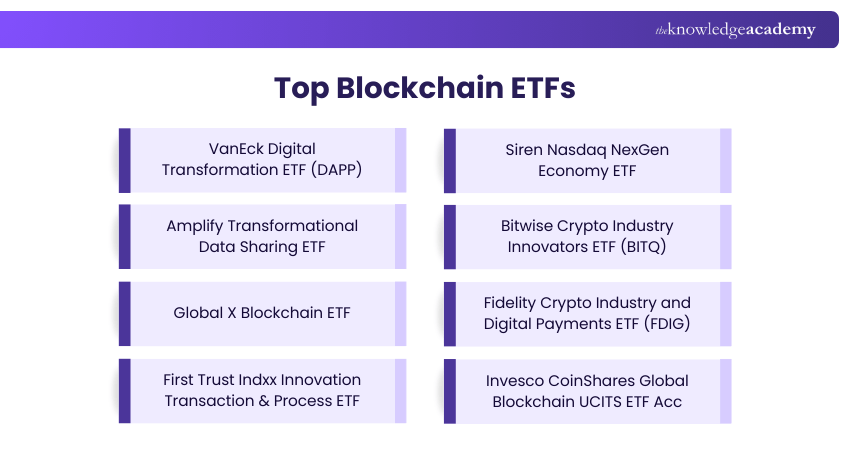
1) VanEck Digital Transformation ETF (DAPP)
The VanEck Digital Transformation ETF (DAPP) was launched in April 2021. It manages and tracks the MVIS Global Digital Assets Equity Index in a passive way by keeping a strong focus on companies that are involved in cryptocurrency and Blockchain technology.The fund comprises a total asset of £162 million under management and a 0.51% expense ratio, making it a budget-friendly investor’s choice. Moreover, DAPP also offers exposure at the global level, with 34.53% of its holdings based outside the U.S. This diversification adds an international dimension to its portfolio.
2) Amplify Transformational Data Sharing ETF
The Amplify Transformational Data Sharing ETF is among the most prominent funds focused on the cryptocurrency and digital asset market. It manages £743 million in assets under management as of 2026.
Even though it doesn't invest in cryptocurrencies directly, it's an excellent platform to begin your quest for the top crypto sector ETFs. The product has an annual cost ratio of 0.76%. This means that for every investment of £1,000 annually, there is a deduction of £7.60 in fees from the annual fund's performance.
The Amplify Transformational Data Sharing ETF holds 51 stocks in companies. It was introduced in January 2018, making it one of the most renowned ETFs on this list. However, it is still a relatively new financial product in the broader scheme.
3) Global X Blockchain ETF
The Global X Blockchain ETF goes beyond cryptocurrencies by focusing on Blockchain technology. It invests in 25 IT and Bitcoin mining companies that drive crypto innovation and support the underlying Blockchain infrastructure.
However, this is a new ETF product launch, which started in July 2021. The fund's annual cost ratio is approximately 0.5%. This new fund is worth exploring if you are looking for centric investing exposure to crypto miners and Blockchain-related tech businesses like Coinbase.
4) First Trust Indxx Innovation Transaction & Process ETF
Another large crypto bet is the First Trust Indxx Innovative Transaction & Process ETF. The portfolio contains 103 stocks (excluding cash, as of Jan 2026). This makes it the most diverse crypto ETF on this list.
First Trust is also a well-established organisation known for its extensive range of investment products. This reputation assures investors concerned about the Fund Manager's track record and credibility. The annual cost ratio of the First Trust Indxx Innovative Transaction & Process ETF is 0.65%, making it one of the cheaper alternatives in the market.
Master Bitcoin’s working and security with our Bitcoin and Cryptocurrency Course – Join today!
5) Siren Nasdaq NexGen Economy ETF
Another fund that targets companies' development and utilisation of Blockchain technology is the Siren Nasdaq NexGen Economy ETF. Even though its assets under management are significantly less than those of Amplify's similar ETF product, it still offers a slightly different perspective on this market.
The ETF consists of 64 stocks, with an expanding focus on general crypto or Blockchain segment technology, such as IBM (NYSE: IBM). It serves as a top holding known for its Blockchain-based solutions and enterprise technologies.
It also includes traditional lender shares and digital payment networks like American Express (NYSE: AXP) and Visa (NYSE: V), which have begun exploring cryptocurrency. This approach provides a more diverse way to invest in cryptocurrency industrial growth.
6) Bitwise Crypto Industry Innovators ETF (BITQ)
The Bitwise Crypto Innovators 30 Index’s performance is tracked by the Bitwise Crypto Industry Innovators ETF (BITQ), a passively managed investment fund. This index consists of 30 stocks from cryptocurrency-sector invested businesses. These include crypto mining operations, mining equipment suppliers, and companies that provide financial services.
To be listed in the Bitwise Crypto Innovators 30 Index, a business must generate at least 75% of its income from cryptocurrencies alone. Alternatively, the company must hold 75% of its net assets in Bitcoin or another crypto holding.
7) Fidelity Crypto Industry and Digital Payments ETF (FDIG)
The Fidelity Crypto Industry and Digital Payments ETF (FDIG) was launched in April 2022. FDIG is typically compared with the Digital Payments Index and the Fidelity Crypto Industry. This index tracks the performance of companies that are involved in Blockchain, cryptocurrency, and digital payments.
Currently, FDIG has about 35 stocks, of which the tech industry holds 63% of these stocks, and the other 33% of these stocks are in financial services.
8) Invesco CoinShares Global Blockchain UCITS ETF Acc
The Invesco CoinShares Global Blockchain UCITS ETF Acc, launched on March 11, 2019, tracks the Blockchain Global Equity Index for Coinshares, including global Blockchain technology companies.The ETF replicates the index's performance using a sampling technique. It has a Total Expense Ratio (TER) of 0.65% per year, and any dividends are reinvested into the fund. With £162 million in assets under management (as of January 2026), it is a sizable fund.
Be at the forefront of Blockchain Innovation with our Ethereum Developer Training – book your spot now!
Why Invest in Blockchain ETFs?
If you're unsure whether investing in Blockchain ETFs is right for you, it helps to understand what makes them appealing. Blockchain ETFs provide exposure to a fast-growing technology sector while avoiding many of the complexities and risks associated with buying cryptocurrencies directly. You will get a single, easy-to-manage investment, offering diversification, lower risk, and an accessible entry point for investors.
1) All-in-one-solution
A Blockchain ETF bundles many Blockchain-related companies into one investment, giving instant diversification across sectors and regions. For example, one leading ETF spreads holdings across IT, financials, communications, and markets such as the US, Japan, and South Korea, helping reduce overall risk.
1) You invest in many Blockchain companies at once
2) Your money isn’t tied to just one company
3) You get exposure to different countries and industries
2) Simple Approach
These ETFs remove the complexity of crypto wallets and exchanges. They can be traded through normal brokerage accounts, making Blockchain exposure straightforward for beginners and experienced investors alike.
1) You can buy them through a normal investment account
2) Get to invest in trusted, established companies
3) Can be held in an ISA for tax-free growth
3) Low Fees
Most Blockchain ETFs track an index, allowing them to keep fees low. This cost-efficiency helps investors retain more of their returns over time.
1) You pay less compared to many actively managed funds
2) More of your money stays invested for growth
3) A cost-effective way to invest in Blockchain
How to Invest in Blockchain ETFs?
Investing in Blockchain ETFs can be a strategic way to seek exposure to the Blockchain Technology sector without buying cryptocurrencies directly. Here are detailed steps to help you get started:
1) Understand Blockchain ETFs
Before starting, it’s important to understand what exactly Blockchain ETFs are and the key details that make them distinct. These investment funds focus on companies involved in Blockchain technology. They offer a diversified and simplified way to invest in the growing Blockchain ecosystem without directly purchasing cryptocurrencies.
2) Research Available ETFs
When researching available Blockchain ETFs, research their historical performance to assess returns over time. Review the companies included in each ETF to ensure they align with your investment goals. Additionally, consider the expense ratio, as lower costs can contribute to higher net returns.
3) Evaluate Your Investment Goals
Evaluate your investment goals by first assessing your tolerance for risk to understand the volatility level you can comfortably manage in your portfolio. Additionally, define the timeline of your investment, as Blockchain ETFs can be tailored for both short-term and long-term financial objectives.
4) Choose a Brokerage Account
Open a Brokerage account with a platform that offers your interest in Blockchain ETFs. Additionally, define the timeline of your investment, as Blockchain ETFs can be tailored for both short-term as well as long-term financial objectives.
5) Place Your Order
Choose between placing a market order, which is executed at the current price, or a limit order. After that, determine the amount of money you want to invest in the Blockchain ETF to align with your financial goals.
Monitor your investment through regular performance tracking and make adjustments as needed to align with market conditions and your financial goals. Also, rebalance your portfolio on a periodic basis to maintain your asset allocation and ensure it stays on track.
7) Stay Informed
Stay up to date with Blockchain industry trends and evaluate their potential impact on your investments. Additionally, remain aware of regulatory changes that could shape the future of Blockchain technology and related assets.
What are the Risks of Investing in Blockchain?
Before investing in Blockchain, it is important to recognise that this sector is still young and growing. Here are the risks that can come with the advantages of Blockchain:
1) Uncertain Future Growth: Blockchain is still developing, and its long-term success isn’t guaranteed.
2) Market Volatility: Blockchain-related companies can experience sharp price swings, even if less extreme than cryptocurrencies.
3) Slow Adoption Risk: If businesses don’t adopt Blockchain quickly, Blockchain ETFs may not perform well.
4) Regulatory Changes: New laws or restrictions on digital assets can affect Blockchain companies and ETFs.
5) Technology Challenges: Problems like slow networks, security issues, or limited real-world use can affect growth.
6) Overstated Exposure: Some ETFs include big companies with only small involvement in Blockchain, which may limit returns.
7) Portfolio Concentration: Investing too heavily in one theme increases risk, so diversification remains important.
What are the Top Three Bitcoin ETFs?
The top three Bitcoin ETFs are the iShares Bitcoin Trust (IBIT), Fidelity Wise Origin Bitcoin Fund (FBTC), and the Grayscale Bitcoin Trust (GBTC). IBIT and FBTC both offer direct exposure to Bitcoin’s market price with lower fees and strong backing from major financial institutions.
GBTC, one of the oldest and most widely recognised Bitcoin investment products, also provides exposure to Bitcoin but typically carries higher fees. Together, these three options are among the most popular choices for investors seeking regulated, convenient access to Bitcoin without holding the cryptocurrency directly.
Conclusion
Blockchain ETFs offer a practical and accessible way to invest in one of today’s most exciting and fast-evolving technologies. Having a clear knowledge of What is a Blockchain ETF let you get into a smart way to gain exposure to an industry with strong long-term potential. As Blockchain continues to shape everything from finance and supply chains to digital identity, these ETFs give everyday investors a simple route to be part of its future.
Discover the power of Blockchain with our comprehensive Blockchain Course – Explore today!
Frequently Asked Questions
Is There an ETF That Holds Bitcoin?

Yes, there are ETFs that hold Bitcoin. These ETFs provide exposure to Bitcoin by tracking its price, allowing investors to gain Bitcoin exposure without directly purchasing it. Examples include the ProShares Bitcoin Strategy ETF and the VanEck Bitcoin Strategy ETF.
Is There a 3x Bitcoin ETF?
Yes, there are 3x Bitcoin ETFs, which are leveraged ETFs designed to provide triple the daily return of Bitcoin. These ETFs utilise financial derivatives and debt to maximise returns. An example is the Direxion Daily Bitcoin 3x ETF, which offers the potential for significant gains but comes with higher risk.
What are the Other Resources and Offers Provided by The Knowledge Academy?
The Knowledge Academy takes global learning to new heights, offering over 3,000 online courses across 490+ locations in 190+ countries. This expansive reach ensures accessibility and convenience for learners worldwide.
Alongside our diverse Online Course Catalogue, encompassing 19 major categories, we go the extra mile by providing a plethora of free educational Online Resources like Blogs, eBooks, Interview Questions and Videos. Tailoring learning experiences further, professionals can unlock greater value through a wide range of special discounts, seasonal deals, and Exclusive Offers.
What is The Knowledge Pass, and How Does it Work?
The Knowledge Academy’s Knowledge Pass, a prepaid voucher, adds another layer of flexibility, allowing course bookings over a 12-month period. Join us on a journey where education knows no bounds.
What are the Related Courses and Blogs Provided by The Knowledge Academy?
The Knowledge Academy offers various Blockchain Training, including Blockchain Course, Ethereum Developer Training, and Bitcoin and Cryptocurrency Course. These courses cater to different skill levels, providing comprehensive insights into Dogecoin vs Bitcoin.
Our Advanced Technology Blogs cover a range of topics related to Blockchain ETF, offering valuable resources, best practices, and industry insights. Whether you are a beginner or looking to advance your Blockchain skills, The Knowledge Academy's diverse courses and informative blogs have got you covered.

Richard Harris


Senior Full Stack Developer and Technology Educator
Richard Harris is a highly experienced full-stack developer with deep expertise in both frontend and backend technologies. Over his 12-year career, he has built scalable web applications for startups, enterprises and government organisations. Richard’s writing combines technical depth with clear explanations, ideal for developers looking to grow in modern frameworks and tools.

Upcoming Programming & DevOps Resources Batches & Dates
Date
 Blockchain Course
Blockchain Course
Thu 16th Apr 2026
Blockchain Course
Thu 9th Jul 2026
Blockchain Course
Thu 17th Dec 2026

 If you wish to make any changes to your course, please


