


 Top Rated Course

We may not have the course you’re looking for. If you enquire or give us a call on +44 1344 203 999 and speak to our training experts, we may still be able to help with your training requirements.
HIPAA: Health Insurance Portability and Accountability Act 1996
Scarlett Adams 23 June 2026HIPAA is a U.S. law that protects patient health information by setting data privacy and security standards for healthcare providers and related entities. It improves healthcare efficiency with secure digital records and insurance portability. Understanding What is HIPPA helps build trust, prevents data misuse and meets legal standards.
Home
 Resources
IT Security & Data Protection
HIPAA: Health Insurance Portability and Accountability Act 1996
Resources
IT Security & Data Protection
HIPAA: Health Insurance Portability and Accountability Act 1996
Resources
IT Security & Data Protection
HIPAA: Health Insurance Portability and Accountability Act 1996

Training Outcomes Within Your Budget!
We ensure quality, budget-alignment, and timely delivery by our expert instructors.
Table of Contents
Nowadays, data is as valuable as care itself, which makes protecting health information is more critical than ever. The Health Insurance Portability and Accountability Act (HIPAA) of 1996 laid the foundation for this. It protects sensitive patient data while ensuring accessibility and trust in healthcare systems.
Designed to improve insurance portability and curb fraud, HIPAA remains a cornerstone of modern healthcare compliance. This blog explores What is HIPAA, its key rules, components and benefits. So read on and learn how HIPAA empowers patients and providers alike!
Table of Contents
1) What is HIPAA?
2) Why is HIPAA Important?
3) The Five Key Components of HIPAA
4) Who Needs to be HIPAA-compliant?
5) What are the Essential HIPAA Rules?
6) Key Benefits of HIPAA Compliance for Patients
7) Evaluating HIPAA Compliance
8) The Seven Core Elements of an Effective Compliance
9) Key Requirements for HIPAA Compliance
10) HIPAA Compliance Violations
11) Recent HIPAA Updates
12) How Multi-factor Authentication (MFA) Supports HIPAA Compliance?
13) Conclusion
What is HIPAA?
HIPAA (Health Insurance Portability and Accountability Act) of 1996 is a U.S. law designed to protect the privacy of a person’s medical information. It lays down the rules on how medical information can be used, shared and store by hospitals, doctors and insurance companies. Simultaneously, it supports smooth health insurance transfers and improves healthcare efficiency through secure digital practices.

Why is HIPAA Important?
HIPAA plays a key role in protecting sensitive health information of patients. It makes sure hospitals, doctors, insurance companies and other health related organisations managing PHI (Protected Health Information) uphold strong privacy practices. The purpose is to safeguard personal medical details and prevent any misuse of it.
It is essential to understand the basics of HIPAA for healthcare workers, business associates, and patients to understand their rights and duties. Patients also benefit as the law equips them with rights over their medical information, allowing them access and control on how their data is shared. This ensures healthcare systems remains secure and only authorised entities can access private information.
The Five Key Components of HIPAA
HIPAA is built on five key components, each serving a different purpose in the safeguarding of health information and secure access. They are mentioned below:
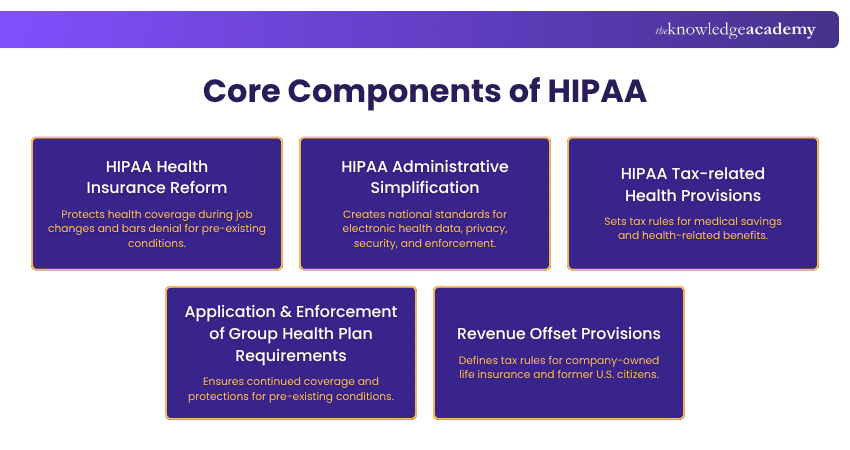
1) HIPAA Health Insurance Reform
This helps to protect health insurance coverage for individuals who have lost their job or during transitioning between jobs. Also, it prevents group health plans from denying coverage due to pre-existing conditions.
2) HIPAA Administrative Simplification
This is a core part of the HIPAA compliance. It directs HHS (U.S. Department of Health and Human Services) to establish national standards for digital healthcare transactions and PHI handling. Under this, there are crucial components designed for protecting health data, such as:
a) NPI (National Provider Identifier): Unique 10-digit number assigned to healthcare providers.
b) Transactions and Code Standards: Maintains consistency in digital data exchange for claims and billing purposes.
c) HIPAA Privacy Rule: In charge of how patients' information is used and shared.
d) HIPAA Security Rule: Meant for protecting electronic PHI.
e) HIPAA Enforcement Rule: Lays down procedures for investigating compliance violations and enforcing penalties.
3) HIPAA Tax-related Health Provisions
This provision provides guidelines regarding taxes. It lays down guide for handling medical care, including setting of rules for medical savings accounts and tax-based health benefits.
4) Applications and Enforcements of Group Health Plan Requirements
Under this component, it is meant for strengthening insurance protection for continuing coverage and pre-existing conditions. It establishes reforms for maintaining health insurance during changes in circumstances.
5) Revenue Offset Provisions
This includes rules on company-owned life insurance. Also, it offers guidance for individuals who are no longer U.S. citizens for tax reasons. It helps to ensure financial compliance is maintained.
Lead the next evolution of safety with cutting‑edge AI skills. Sign up for our Certified Artificial Intelligence (AI) for Health and Safety Professional Course now!
Who Needs to be HIPAA-compliant?
HIPAA is not designed only for doctors or hospitals. It applies to any organisation or individual who is managing PHI. In general, HIPAA compliance is necessary for two groups:
1) Covered Entities
These are directly involved in delivering, managing and processing of healthcare services. Their responsibility is handling the patient information. Under covered entities, it includes:
a) Healthcare Providers: Doctors, Nurses, Dentists, clinics, hospitals etc.
b) Health Plans: Insurance companies, Medicare programs, government health programmes etc.
c) Healthcare Clearinghouses: Refers to organisations that convert non-standard healthcare data into standard electronic formats.
2) Business Associates
These are third-party partners who handle PHI on behalf of covered entities. Under business associates, it includes:
a) IT and cloud storage providers
b) Consultants, auditors and legal firms.
c) Billing and claims processing companies.
d) Cybersecurity companies
What are the Essential HIPAA Rules?
HIPAA constitutes important rules for effectively protecting health information. Some of the key rules include:
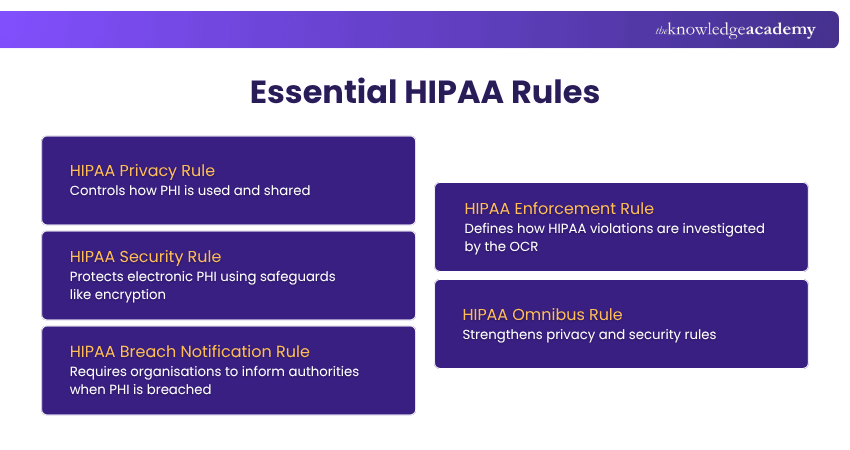
1) HIPAA Privacy Rule
This rule sets standards for how healthcare providers, insurers and business associates use, protect and share PHI. It makes sure information regarding patients remains confidential and gives individuals the right to access and manage their information. Under the privacy rule, organisations set limits to who can view PHI and follow strict procedures.
2) HIPAA Security Rule
Under this rule, electronic PHI is protected. Here, proper cybersecurity measures are utilised to safeguard the availability and integrity of digital health data. This involves using encryption, secure access systems, multi-factor authentication, risk assessments and more to prevent data breaches.
3) HIPAA Breach Notification Rule
In this rule, organisations need to notify patients, HHS and sometimes the media in situations when PHI is exposed due to a breach. The aim is to uphold transparency in reporting the breaches to prevent financial penalties, criminal charges and legal action.
4) HIPAA Enforcement Rule
This rule outlines how HIPAA violations are investigated, and penalties are charged. The OCR (Office for Civil Rights) at HHS oversees compliance, audits, complaints and issues penalties for non-compliance. It is crucial for organisations to prove they are following HIPAA compliance regulations through their documentation, policies and practices.
5) HIPAA Omnibus Rule
This HIPAA rule aims to strengthen HIPAA’s privacy and security protections. It expanded responsibilities of business associates, increased patient rights over their data, and established strict penalties for non-compliance. Also, it reinforced notification requirements for system breaches for efficient safeguarding of PHI handling.
Raise the bar on workplace safety with our Best Practice in Occupational Health and Safety Regulation Training - Sign up now!
Key Benefits of HIPAA Compliance for Patients
HIPAA provides various benefits and protection to patients. Some key benefits of HIPAA include:
1) Strong Privacy Protection
HIPAA gives patients the trust on keeping their medical information confidential. It limits who can access and use PHI. It is only the authorised healthcare staff who has access for providing treatment or managing billing tasks also, patients can choose family members for accessing health information when necessary.
2) Health Data Security
Healthcare organisations need to protect patient’s data using strong security measures and protocols. This involves protection of paper records, encryption for digital files, firewalls and training employees on cybersecurity. This is useful for the purpose of safeguarding sensitive information, preventing cyberattacks and unauthorised access.
3) Notification in Case of Data Breach
HIPAA needs healthcare organisations and their business associates to notify patients in case their information is compromised. It must be issued within 60 days of the discovery. This helps individuals to act rapidly, such as monitor financial data for preventing fraud.
4) Access to Medical Records
HIPAA provides the patients with the right to request and receive their medical record copies. This makes individuals take an active role, review past treatment, share information with doctors and spot errors in their history. This mitigates complications in treatment-based decisions and prevents potentially fraudulent activities.
Evaluating HIPAA Compliance
Due to the emergence of digital platforms handling data, evaluation of HIPAA has become integral than ever. HIPAA compliance involves both physical and technical safeguards set by the HHS. These measures are designed to protect PHI and electronic PHI (ePHI).
1) Physical Safeguarding
Healthcare organisations need to control access facilities and equipment where information of patients is stored. Under this, the key requirements include:
a) Limit facility access to authorised personnel
b) Create clear device-use policies
c) Manage how electronic devices transfer, re-use or dispose data
d) Protect physical environments, such as computer stations or server rooms
2) Technical Safeguarding
Under HIPAA, healthcare organisations require strong digital protection for safeguarding ePHI. This includes:
a) Unique user IDs and secure login systems
b) Emergency access procedures during failure of systems
c) Data encryption and decryption
d) Audit logs that track system activity
e) Disaster recovery and offsite backup systems for restoring data
f) Secure protection of networks for data transmissions
It is also essential to keep in mind that most data breaches occur due to negligence, errors or threats. This is why it is crucial to train staff members, adhere to strict policies and monitor user behaviour.
Every detail matters in safety. Learn how to investigate, analyse and prevent in our Safety Investigation Training - Sign up now!
The Seven Core Elements of an Effective Compliance
These HIPAA elements ensure rules are followed and sensitive information is protected. The seven key elements of an effective HIPAA compliance include
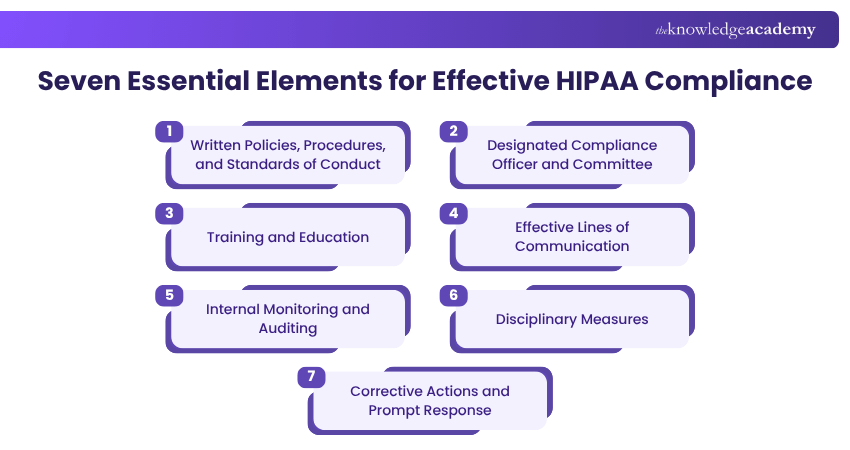
1) Written Policies, Procedures, and Standards of Conduct
Organisations must document privacy and security policies clearly. Also, it is required to explain responsibilities to the staff and define standards of ethical conduct. These act as a rulebook for protecting sensitive patient information.
2) Designated Compliance Officer and Committee
A HIPAA Compliance Officer oversees the privacy and security programs of an organisation. They ensure policies are followed, risks are identified and corrections are implemented.
3) Training and Education
HIPAA training is important for staff members for insightfully understanding their responsibilities with PHI. This involves enhancing awareness on cybersecurity, privacy practices and reporting procedures for suspicious activities.
4) Effective Lines of Communication
For reporting violations confidentially, clear communication channels must be in place for employees to ask questions or raise concerns. It helps to foster a transparent environment and maintain accountability.
5) Internal Monitoring and Auditing
Routinely conducted audits and system check-ups help organisations to identify gaps in compliance. This proactively mitigates compliance violations consequences. Also, it upholds HIPAA compliance standards for keeping systems secured and updated.
6) Disciplinary Measures
Organisations must establish fair rules. Here, clear disciplinary procedures help to minimise negligence, update policies and prevent potential violations in managing PHI.
7) Corrective Actions and Prompt Response
During issues with compliance, organisations must be rapid in their responses. This involves investigating incidents, taking corrective measures for preventing violations.
From recognising risks to responding the right way, our Safeguarding Officer Training shows the way - Sign up now!
HIPAA Compliance Violations
In cases of failing to comply with HIPAA rules and regulations, it results in financial, legal and reputational consequences. Some of its types are discussed below:
1) Types of HIPAA Violations
Some common types of violations include:
a) Unauthorised Access: Viewing, sharing or using PHI without permission.
b) Failure to Issue Breach Notification: Not informing affected individuals or authorities after PHI breach.
c) Insufficient Safeguards: Lack of physical, technical or administrative safeguarding procedures.
d) Poor Employee Training: Negligence or errors from the staff due to inadequate training.
2) HIPAA Penalties
The OCR (Office for Civil Rights) under HHS enforced HIPAA penalties. These violations fall under four tiers:
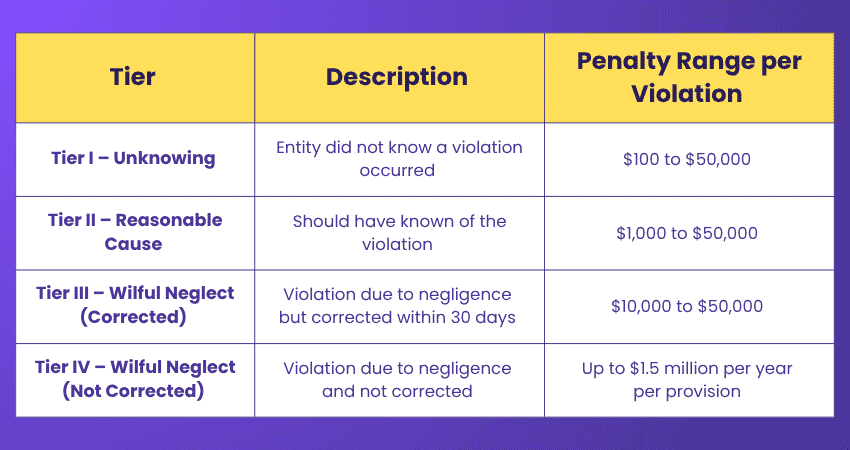
3) Real-world Examples of HIPAA Violations
Some real-world examples of HIPAA violation include:
a) Anthem, Inc. (2005):
Cybercriminals accessed PHI of nearly 79 million individuals due to lack of security controls. Anthem agreed to a $16 million settlement, that went on to be one of the largest HIPAA fines.
b) Memorial Healthcare System (2012):
Employees accessed patient information without authorisation for more than a year. This compromised a total of 115,000 patient records. The organisation went on to the pay $5.3 million for settlement.
c) New York Presbyterian Hospital & Columbia University Medical Centre (2014):
Due to a disabled server, PHI was exposed online. This made patients records searchable over the internet. This affected 6,800 patients and $4.8 million in settlement.
Recent HIPAA Updates
In the recent updates for HIPAA, it emphasised strongly on patient access, cybersecurity and digital communication in the domain of healthcare. It includes:
1) Information Blocking Rule (2021):
Came in April 5, 2021, for the purpose of improving interoperability between electronic health systems and seamless record access.
2) OCR’s Right of Access Initiative (2019-present):
OCR launched this initiative to enforce patient’s rights to receive medical records quickly and at a reasonable cost. It acts against organisations that delay record or charge excessive fees.
3) Ransomware & Cybersecurity Guidance (2021):
In June 2021, OCR updated guidance stressing for the need of strong cybersecurity programmes. It includes regular risk assessments, employee cybersecurity training, data backups and incident response plans.
4) Telehealth HIPAA Flexibilities (Response for Covid-19):
For supporting remote care during the pandemic era, HHS relaxed certain HIPAA enforcement rules for telehealth. This meant providers could use non-public facing communication tools without penalties.
How Multi-factor Authentication (MFA) Supports HIPAA Compliance
As cyberthreats have been on the rise, protecting access to patient information has become essential. For safeguarding PHI, one of the strongest security practices is multi-factor authentication.
MFA requires the users to verify their identity using two or more authentication factors. These includes a combination of your password or PIN (something you know), one-time passcode or security token (something you have) and biometrics, such as fingerprints (something you are).
Conclusion
HIPAA helps to protect trust of patients, strengthen data security, and ensure sensitive data is managed responsibly. It sets the foundation for a safer, transparent healthcare environment. By understanding What is HIPAA, providers and patients can safeguard their data, avoid penalties and maintain high quality care.
Ensure safe hands and strong teams to build a workplace where everyone thrive. Sign up for our Health & Safety in the Workplace Training now!
Frequently Asked Questions
Is HIPAA in the UK?

No, HIPAA is only applied to the United States. In the UK, patient data is protected under the Data Protection Act of 2018 and UK-GDPR. Only time the UK must follow HIPAA is when they handle U.S patient data on behalf of U.S healthcare.
What is a HIPAA Example?
A hospital staff member accesses a patient’s medical records without work reasons. This is an example of unauthorised access that violates HIPAA rules and regulations.
What are the Other Resources and Offers Provided by The Knowledge Academy?
The Knowledge Academy takes global learning to new heights, offering over 3,000+ online courses across 490+ locations in 190+ countries. This expansive reach ensures accessibility and convenience for learners worldwide.
Alongside our diverse Online Course Catalogue, encompassing 17 major categories, we go the extra mile by providing a plethora of free educational Online Resources like Blogs, eBooks, Interview Questions and Videos. Tailoring learning experiences further, professionals can unlock greater value through a wide range of special discounts, seasonal deals, and Exclusive Offers.
What is The Knowledge Pass, and How Does it Work?
The Knowledge Academy’s Knowledge Pass, a prepaid voucher, adds another layer of flexibility, allowing course bookings over a 12-month period. Join us on a journey where education knows no bounds.
What are the Related Courses and Blogs Provided by The Knowledge Academy?
The Knowledge Academy offers various Health & Safety in the Workplace Training, including the Health and Safety in the Workplace Course, HIPAA Training and the Safety Investigation Training. These courses cater to different skill levels, providing comprehensive insights into Medical Coding.
Our Health & Safety Blogs cover a range of topics related to HIPAA, offering valuable resources, best practices, and industry insights. Whether you are a beginner or looking to advance your health & Safety expertise, The Knowledge Academy's diverse courses and informative blogs have got you covered.
Upcoming IT Security & Data Protection Resources Batches & Dates
Date
 HIPAA Training Course
HIPAA Training Course
Fri 10th Jul 2026
HIPAA Training Course
Fri 9th Oct 2026

 If you wish to make any changes to your course, please


