


 Top Rated Course

We may not have the course you’re looking for. If you enquire or give us a call on +40 316317743 and speak to our training experts, we may still be able to help with your training requirements.
Management Consulting: A Complete Guide
William Brown 25 November 2025Management Consultant helps organisations solve problems, improve performance, and reach goals by offering expert advice and implementing solutions. Out here, in this blog, you will get to know the various types of Management Consultants. You will also gain insights into the path to becoming one. Read this blog to know more.

Training Outcomes Within Your Budget!
We ensure quality, budget-alignment, and timely delivery by our expert instructors.
Table of Contents
Knowing What Does a Management Consultant Do is Important. This is because they play a crucial role in today's corporate world. They also give the best advice and solutions to existing firms. Due to their strong experience, businesses confidently improve their performance, efficiency, and overall success. This alone means that they are skilled professionals who work with organisations. These consultants help in identifying challenges, opportunities, and areas for growth.
If you wish to explore the world of management consulting and What Does a Management Consultant Do, then this blog is for you..This type of consultant offers strategic guidance to organisations to address problems. Check out this blog to learn more. Let's Delve in!
Table of Contents
1) Management Consultant- An overview
2) What Do Management Consultants Do?
3) Roles and Responsibilities of a Management Consultant
4) The Salary of a Management Consultant
5) Qualifications for Management Consultant
6) Essential Skills for a Management Consultant
7) How to Become a Management Consultant?
8) Professional Development for Management Consultants
9) What is the 80 20 Rule in Management Consulting?
10) What Type of Management Consultant Makes the Most Money?
11) Conclusion
Management Consultant- An overview
A Management Consultant is a skilled professional. He is the one who provides specialised guidance to firms. They play an important role in managing specific business challenges. These consultants thoroughly check the company's existing operations. This helps them to understand its merits and demerits. Based on their analysis, they propose good solutions. This enhances the overall performance and efficiency of the organisation.

What Do Management Consultants Do?
Management Consultants help organisations tackle complex problems. It also helps in improving efficiency and achieve their goals. They participate in-depth research and analyse company data. They also assess the existing processes. This helps to identify gaps or inefficiencies. By understanding the client's operations, strategic solutions are crafted. Consultants often merge with internal teams to ensure their recommendations are sustainable.
They also play a key role in managing change. This can be anything starting from restructuring to adopting new technologies. If one is working closely with senior executives, they will offer objective insights. These, on a large scale, support critical decisions. Their expertise comes up in various domains. This can include strategy, finance, operations, and human resources.
Roles and Responsibilities of a Management Consultant
Management Consultants play an important part in businesses. Their responsibilities are the topmost and believe it or not! It is very different based on the project. Plus, they have to give preference to the client's needs too. This indicates that they have a lot to follow. Some of the key roles are as follows:
a) Conducting Research and Analysis: At the core of a Management Consultant's role is conducting thorough research and analysis. They dive into the client's business model, and gain valuable insights.
b) Developing Strategies and Solutions: Management Consultants develop innovative strategies and practical solutions based on the research findings. These solutions are created to meet the specific needs and goals of the client.
Gain a new set of Managerial skills with our courses in Management Courses! Join today!
c) Bringing in Changes: A crucial aspect of a Management Consultant's responsibility is assisting in the implementation of the proposed solutions. This involves working closely with the client's team to ensure seamless execution of the recommended changes. Consultants give insights throughout the implementation process. They monitor progress as needed to achieve the desired outcomes.
d) Providing Expert Advice: As subject matter experts, Management Consultants offer valuable advice and insights to top-level management and key stakeholders. They communicate their findings, recommendations, and strategic plans in a clear and compelling manner. Bring the best out of people with our Introduction to Managing People Course. Join today!
The Salary of a Management Consultant
We have prepared a table where we have listed the average salary of a Management Consultant in different countries:
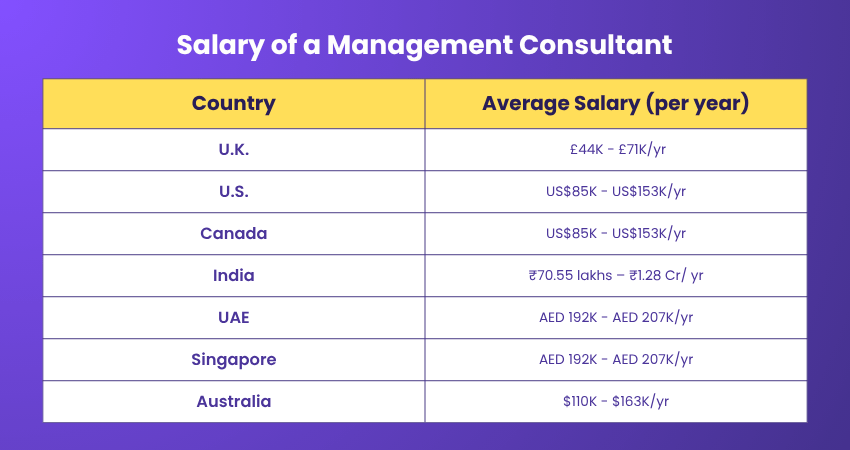
Source: Glassdoor
Qualifications for Management Consultant
Becoming a management consultant typically requires a strong academic background. In this, employers often seek candidates with problem-solving abilities, communication skills, and industry awareness. While entry-level roles exist, experience in consulting can offer a competitive edge. Below are some of the key qualifications:
a) Bachelor’s Degree in Business, Economics, Management, or a Related Field
b) MBA or Relevant Master’s Degree (Preferred for Higher-Level Roles)
c) Strong Analytical and Problem-Solving Skills
d) Excellent Communication and Interpersonal Abilities
e) Industry Knowledge and Commercial Awareness
f) Project Management Skills and Attention to Detail
g) Experience Through Internships or Entry-Level Business Roles
Essential Skills for a Management Consultant
Management Consultants require a diverse set of skills to be effective in their role, including:
a) Analytical Skills: This falls under the category of analysing data and understanding business processes. It also helps to identify problems and opportunities. This involves quantitative analysis, financial modelling, and critical thinking.
b) Problem-solving skills: Consultants must develop innovative solutions to complex business challenges. This requires creativity, logical reasoning, and the ability to approach problems from various angles.
c) Communication skills: Effective verbal and written communication skills are crucial for presenting findings, persuading stakeholders, and facilitating workshops or meetings. Consultants need to articulate complex ideas clearly and concisely.
d) Interpersonal skills: Consultants need to build active professional relationships with clients and team members. This includes empathy, listening skills, and the ability to work collaboratively in diverse teams.
e) Project Management skills: Consultants often manage multiple projects simultaneously, requiring strong organisational skills, time management, and the ability to prioritise tasks efficiently.
Become an expert in spoken and written communication with our Senior Management Training. Register today.
How to Become a Management Consultant?
Breaking into management consulting requires the right education. It's a career that values strategic thinking and adaptability. It also attracts ambitious individuals who thrive in fast client-facing roles. While paths vary, most successful consultants blend academic success with real-world exposure. Therefore, look at the points given below. This will help you in your journey of becoming a Management Consultant:
Common Employment Scenarios
Management consultants are often hired by top-tier consulting firms seeking external expertise. Some start as analysts after graduation, while others move into consulting after gaining industry experience. Internships or graduate schemes with well-known firms like McKinsey, BCG, or Deloitte can provide a valuable foot in the door. Many consultants also join through lateral moves. This is done from roles in finance, operations, or project management.
Educational Path
Most management consultants begin with a bachelor's degree in business, or economics. This goes onto build a strong foundation in analytical thinking and organisational behaviour. To boost their profile and access higher-level opportunities, many pursue an MBA or a master’s in management or finance. These programmes often include case study work, internships, and networking that are highly relevant to consulting. Professional certifications like PMP or Lean Six Sigma are also favoured.
Professional Development for Management Consultants
Professional development is essential for management consultants. This is because it helps to deliver high-value solutions to clients. Along with it, a constant urge of learning through certifications, workshops, and short courses helps consultants refine their skills. Along with it, attending industry conferences or networking events also keeps them updated about market shifts and best practices. Many firms encourage ongoing education. This helps teams to maintain a high standard of insight and professionalism.
In addition to formal learning, gaining diverse project experience is a key part of professional growth. Consultants often rotate across industries or specialisations to broaden their expertise and build versatility. Mentorship, peer collaboration, and performance feedback further enhance their problem-solving and leadership capabilities. This commitment to development allows consultants to take on more strategic roles and drive greater impact in client engagements.
What is the 80 20 Rule in Management Consulting?
The 80/20 Rule is also defined as the Pareto Principle. It is an important concept in management consulting. This principle suggests that 80% of outcomes come from 20% of efforts. Consultants use this principle to focus on those tasks or issues. This helps clients to achieve results more efficiently.
By identifying the key drivers of performance or problems, they can streamline analysis and avoid wasting time on low areas. This principle encourages a strategic focus rather than extended detail. In practice, the 80/20 Rule helps consultants prioritise client recommendations.
What Type of Management Consultant Makes the Most Money?
Earnings in Management Consulting vary by role, experience, and firm. Specialisations like strategy, digital transformation, or healthcare tend to pay more due to higher demand and impact. See the table below for a quick overview.
Conclusion
So, this is what you need to know on What Does a Management Consultant Do. These consultants offer intellectually stimulating work, diverse industry exposure, and attractive remuneration. To succeed, aspiring consultants should focus on building a strong network, continuous learning, and gaining industry expertise. They can thrive in this ever-changing and rewarding profession by cultivating problem-solving skills and effective communication.
Transform chaos into unforgettable experiences. Join our Event Management Course and master the art of seamless events!
Frequently Asked Questions
How Can a Management Consultant Help a Business?

A Management Consultant can help businesses by providing expert advice to solve complex problems, improve performance, and enhance efficiency. They can offer fresh perspectives, and analyse data for operational improvements
What are the Disadvantages of Management Consulting?
Management consulting can be costly, especially for small businesses. It may also lead to over-reliance on external advice, creating dependency. Consultants may lack deep knowledge of company culture, and short-term focus on deliverables can overshadow long-term growth or employee morale.
What is Knowledge Pass and How Does it Work?
The Knowledge Academy’s Knowledge Pass, a prepaid voucher, adds another layer of flexibility, allowing course bookings over a 12-month period. Join us on a journey where education knows no bounds.
What are the Other Resources Provided by The Knowledge Academy?
The Knowledge Academy takes global learning to new heights, offering over 3,000 online courses across 490+ locations in 190+ countries. This expansive reach ensures accessibility and convenience for learners worldwide.
Alongside our diverse Online Course Catalogue, encompassing 19 major categories, we go the extra mile by providing a plethora of free educational Online Resources like Blogs, eBooks, Interview Questions and Videos. Tailoring learning experiences further, professionals can unlock greater value through a wide range of special discounts, seasonal deals, and Exclusive Offers.
What are the Related Courses and Blogs Provided by The Knowledge Academy?
The Knowledge Academy offers various Management Courses, including Problem-Solving, Personal & Organisational Development and Business Process Improvement Training. These courses cater to different skill levels, providing comprehensive insights into Change Management Consultants.
Our Business Skills blogs covers a range of topics related to Communication Skills, offering valuable resources, best practices, and industry insights. Whether you are a beginner or looking to advance your Communication skills, The Knowledge Academy's diverse courses and informative blogs have you covered.

William Brown


Senior Business Analyst and Strategic Advisor
William Brown is a senior business analyst with over 15 years of experience driving process improvement and strategic transformation in complex business environments. He specialises in analysing operations, gathering requirements and delivering insights that support effective decision making. William’s practical approach helps bridge the gap between business goals and technical solutions.
View Detail
Upcoming Business Skills Resources Batches & Dates
Date
 Management Training for New Managers
Management Training for New Managers
Fri 15th May 2026
Management Training for New Managers
Fri 17th Jul 2026
Management Training for New Managers
Fri 18th Sep 2026
Management Training for New Managers
Fri 13th Nov 2026

 If you wish to make any changes to your course, please


