


 Top Rated Course

We may not have the course you’re looking for. If you enquire or give us a call on +40 316317743 and speak to our training experts, we may still be able to help with your training requirements.
Cryptography Techniques: Everything You Need to Know
John Davies 20 April 2026Cryptography Techniques are methods used to secure data by converting it into unreadable formats, ensuring confidentiality, integrity, and authenticity. Common techniques include encryption, hashing, and digital signatures. These tools protect sensitive information in cybersecurity by preventing unauthorised access and data breaches.

Training Outcomes Within Your Budget!
We ensure quality, budget-alignment, and timely delivery by our expert instructors.
Table of Contents

Have you ever stopped to think about what really keeps your messages private or your bank details safe when you’re online? It’s not luck, it’s the clever world of Cryptography Techniques working behind the scenes. These smart methods scramble your data into secret codes, making sure only the right eyes can see it. Sounds like spy movie stuff, right?
But it’s happening every time you shop online, send an email, or log into an app. In this blog, we’re diving into Cryptography Techniques - what they are, how they work, and why they matter more than ever. So, if you’re curious about the digital locks guarding your info, you’re in the right place!
Table of Contents
1) Overview of Cryptography Techniques
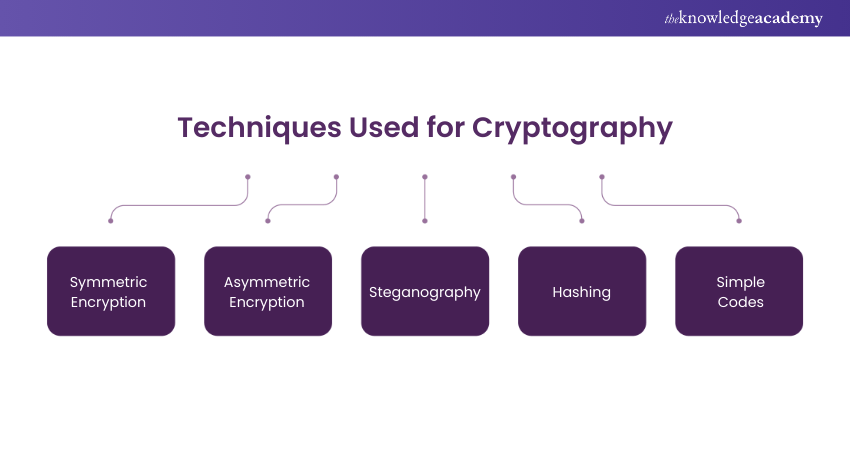
2) Techniques Used for Cryptography
a) Symmetric Encryption
b) Asymmetric Encryption
c) Steganography
d) Hashing
e) Simple Codes
3) Advantages and Disadvantages of Cryptography
4) Conclusion
Overview of Cryptography Techniques
Cryptography is all about communication. More specifically, secure communication. It’s the science of transforming information so that only the intended recipient can understand it. Whether it’s a simple substitution cipher or a complex algorithm protecting your medical records, Cryptography ensures that data stays confidential, authentic, and intact.
Cryptography Techniques have evolved significantly over time. What started as handwritten codes and secret messages has now become a sophisticated field involving mathematical formulas, computer algorithms, and high-powered encryption keys. These techniques not only secure emails and texts but also form the backbone of cybersecurity across industries.
In the digital age, Cryptography serves three main purposes:
1) Confidentiality: Ensuring that only authorised people can access the data.
2) Integrity: Making sure the information hasn’t been altered.
3) Authentication: Verifying the identity of users or systems.
Techniques Used for Cryptography
Cryptography Techniques are the building blocks of secure digital communication. Each method serves a specific purpose, whether it’s encrypting data, hiding messages, or verifying authenticity. Let’s take a closer look at the most used Cryptographic Techniques and how they help protect information in today’s digital world.
1) Symmetric Encryption
Imagine you write a note to a friend and lock it in a box. You give your friend the same key you used to lock it so they can unlock and read the message. That’s symmetric encryption in a nutshell.
Symmetric encryption uses one key for both encryption and decryption. It’s fast and efficient, making it perfect for large volumes of data. The most well-known symmetric encryption algorithm is the Advanced Encryption Standard (AES), widely used across the globe.
However, there's a catch. The challenge lies in sharing the key securely. If someone intercepts the key during transmission, the entire encryption falls apart. That’s where asymmetric encryption steps in.
2) Asymmetric Encryption
Unlike symmetric encryption, asymmetric encryption uses two keys - a public key for encryption and a private key for decryption. These keys are mathematically linked, but you can't easily figure one out from the other.
Let’s say you want to send someone a secret file. You use their public key to encrypt the file. Once encrypted, only their private key can unlock it. This technique is widely used in email encryption, secure web browsing (HTTPS), and digital signatures.
One of the most famous asymmetric encryption systems is RSA, named after its inventors Rivest, Shamir, and Adleman. Although slower than symmetric encryption, its added security makes it essential for tasks like verifying identities and securing sensitive communications.
3) Steganography
While encryption hides the content of a message, steganography hides the existence of the message itself.
This technique involves concealing data within other seemingly innocent files. For example, a text message can be hidden within an image or audio file in such a way that it’s invisible to the naked eye. Only someone with the right method or key can extract the hidden message.
Steganography might sound a bit James Bond, but it has practical uses in watermarking, digital rights management, and covert communication. Of course, it’s also a favourite tool among hackers, which is why it must be used carefully and responsibly.
Protect your data like a pro. Register in our Cyber Security Risk Management Coursetoday!
4) Hashing
Hashing is a bit different from encryption. Instead of transforming data with the intent of recovering it later, hashing converts information into a fixed-length string of characters, which acts like a fingerprint of the original data.
The idea is that even a tiny change in the input will produce a completely different hash output. This makes hashing extremely useful for verifying the integrity of data. For instance, when you download software, you might see a “checksum” or “hash value” next to the download link. That’s there so you can confirm the file hasn’t been tampered with.
Popular hashing algorithms include MD5, SHA-1, and SHA-256. While some older algorithms have known vulnerabilities, modern hashing methods are still a trusted part of cybersecurity.
5) Simple Codes
Before the digital age, people relied on basic techniques like substitution ciphers, Caesar ciphers, and transposition codes to hide their secrets. These methods involve rearranging letters or substituting them with others based on a set rule.
For example, the Caesar cipher shifts every letter in a message by a fixed number of places in the alphabet. A becomes D, B becomes E, and so on. It’s not very secure by today’s standards, but it’s a great way to introduce Cryptographic thinking.
These simple codes laid the foundation for more advanced Cryptographic methods. And they’re still used in puzzles, games, and basic educational tools to teach the principles of secure communication.
Step into the world of cybersecurity with expert Certified Cyber Security Professional Training. Register now and become a certified professional!
Advantages and Disadvantages of Cryptography
Like any tool, Cryptography has its strengths and limitations. Understanding both helps us appreciate its power and avoid over-reliance on it.

Advantages
1) Data Protection: Cryptography ensures that sensitive information stays private, whether it’s a bank transaction, email, or personal photo.
2) Authentication: It helps verify identities, making sure you’re communicating with the right person or server.
3) Integrity Checks: Hashing ensures that files, messages, or software haven’t been altered or corrupted.
4) Compliance: Cryptography helps organisations meet legal and regulatory requirements regarding data security.
Disadvantages
1) Key Management: Especially in symmetric encryption, securely sharing and storing keys can be complex and risky.
2) Performance Issues: Encryption and decryption processes can slow down systems, particularly with large files or high volumes of data.
3) Overconfidence: Just because something is encrypted doesn't mean it’s invincible. Weak algorithms, poor implementation, or human error can still leave data vulnerable.
4) Legal Barriers: In some countries, the use of strong encryption is restricted or regulated, raising questions about privacy and government surveillance.
Cryptography isn’t a silver bullet. It’s a powerful part of a broader security strategy that also includes firewalls, antivirus software, and good digital habits.
Conclusion
Cryptography has evolved from simple ciphers to advanced Cryptography Techniques that secure billions of digital interactions every day. From encryption and hashing to steganography and classic codes, each technique plays a vital role in protecting information. By understanding these techniques, you’re better equipped to navigate the digital world with confidence.
Get registered with us for Cyber Security Awareness Courses to learn more about the significance of Cyber Security.
Frequently Asked Questions
How Many Cryptographic Techniques Are There?

There are five main Cryptographic Techniques: symmetric encryption, asymmetric encryption, hashing, steganography, and simple codes. Each serves a different purpose in securing data, from hiding information to verifying integrity and protecting communications.
Is Cryptography the Study of Secure Communication Techniques?
Yes, Cryptography is the study and practice of secure communication techniques. It involves transforming information so that only authorised users can access it, ensuring confidentiality, authenticity, and data integrity in both digital and physical communications.
What are the Other Resources and Offers Provided by The Knowledge Academy?
The Knowledge Academy takes global learning to new heights, offering over 3,000+ online courses across 490+ locations in 190+ countries. This expansive reach ensures accessibility and convenience for learners worldwide.
Alongside our diverse Online Course Catalogue, encompassing 17 major categories, we go the extra mile by providing a plethora of free educational Online Resources like Blogs, eBooks, Interview Questions and Videos. Tailoring learning experiences further, professionals can unlock greater value through a wide range of special discounts, seasonal deals, and Exclusive Offers.
What is The Knowledge Pass, and How Does it Work?
The Knowledge Academy’s Knowledge Pass, a prepaid voucher, adds another layer of flexibility, allowing course bookings over a 12-month period. Join us on a journey where education knows no bounds.
What are the Related Courses and Blogs Provided by The Knowledge Academy?
The Knowledge Academy offers various Cyber Security Trainings, including the Cyber Security Incident Report Training and Incident Response Training, and the Cyber Security Awareness Course. These courses cater to different skill levels, providing comprehensive insights into Cyber Security Risk Management.
Our Cyber Security Blogs cover a range of topics related to Cyber Security, offering valuable resources, best practices, and industry insights. Whether you are a beginner or looking to advance your Security Risk Management skills, The Knowledge Academy's diverse courses and informative blogs have got you covered.

John Davies


Cyber Security Governance & Assurance Specialist
John Davies is a cybersecurity expert specialising in governance, risk management, and compliance. With over 15 years in the field, he has led enterprise-wide security programmes across finance, healthcare and public sector organisations. His content provides practical guidance on building secure environments, managing risk and aligning with regulatory frameworks.

Upcoming IT Security & Data Protection Resources Batches & Dates
Date
 Certified Cyber Security Professional (CCS-PRO)
Certified Cyber Security Professional (CCS-PRO)
Fri 24th Jul 2026
Certified Cyber Security Professional (CCS-PRO)
Fri 9th Oct 2026

 If you wish to make any changes to your course, please


