


 Top Rated Course

We may not have the course you’re looking for. If you enquire or give us a call on +40 316317743 and speak to our training experts, we may still be able to help with your training requirements.
Compliance and Risk Management: A Comprehensive Guide
Hailey Davis 09 March 2026Compliance and Risk Management work together to ensure legal adherence while identifying and reducing threats to business operations. Compliance focuses on adhering to laws, regulations, and industry standards. Risk Management is broader and proactive, assessing and mitigating potential threats that could impact organisational objectives.

Training Outcomes Within Your Budget!
We ensure quality, budget-alignment, and timely delivery by our expert instructors.
Table of Contents
Nowadays, regulations evolve overnight and risks hide in plain sight. In such a world, mastering Compliance and Risk Management becomes a strategic superpower. After all, they are the guardians shaping every resilient organisation. In an era of cyber threats and global competition, businesses must do more than simply follow rules; they must anticipate risks before they arise.
This comprehensive blog explores how businesses can stay ahead by embracing the power of Compliance and Risk Management. These disciplines can help build a culture where responsibility fuels innovation. So, whether you’re refining existing frameworks or starting fresh, read on!
Table of Contents
1) What is Compliance?
2) What is Risk Management?
3) Difference Between Compliance vs Risk Management
4) Integrating Compliance and Risk Management
5) What are the Three Needs of Compliance and Risk Management?
6) What are the Five Stages of Risk Management?
7) What are the Three C's of Compliance?
8) Conclusion
What is Compliance?
Compliance refers to the adherence to regulations, laws and industry standards applicable to an organisation's operations. It involves aligning business practices with legal and regulatory obligations to maintain ethical standards, ensure transparency and prevent violations. Understanding Compliance Objectives helps organisations implement effective policies that mitigate risks and enhance corporate integrity. Some of the benefits of Compliance include the following:
Compliance encompasses various areas, such as financial reporting, data privacy, environmental regulations, employment laws, and more. Organisations implement Compliance programs to establish the following:
1) Guidelines
2) Policies
3) Procedures
Compliance guidelines are established to meet certain obligations and demonstrate their commitment to legal and ethical conduct.
What is Risk Management?
Risk Management, on the other hand, focuses on identifying, assessing, and mitigating risks that could impact an organisation's objectives. Risks can come from numerous sources like operational, financial, strategic or external factors. Risk Management involves taking the following steps:
1) Risk Identification
2) Risk Analysis
3) Risk Evaluation
4) Risk Treatment/Mitigation
5) Risk Monitoring
These steps help align with the organisation's risk appetite, making it a critical skill to highlight on your Risk Management Resume.
Difference Between Compliance vs Risk Management
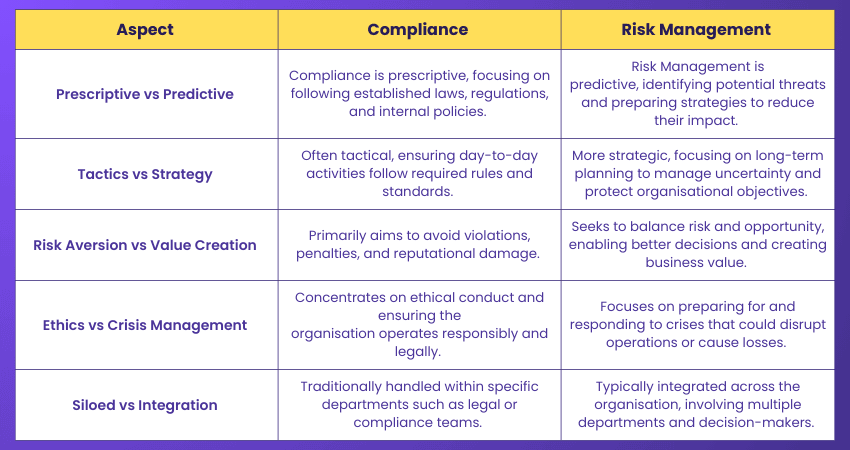
While Compliance and Risk Management are distinct concepts, they intersect in several ways. Thus, understanding their differences is crucial for leadership teams and Risk Managers to effectively navigate these areas and strike a balance. Let's take a detailed look at these differences between Compliance and Risk Management:
1) Prescriptive vs Predictive
Compliance tends to be prescriptive, often leading to a tactical, checkbox-oriented approach. In contrast, Risk Management endeavours to be predictive, anticipating potential risks, demanding a strategic approach.
Organisations are mandated to conform to prevailing laws and regulations for Compliance. Conversely, Risk Management necessitates a more proactive stance, aiming to foresee and address potential issues before they materialise.
Ensure your team meets regulations – Register in Effective Compliance Training and stay prepared.
2) Tactics vs Strategy
Overestimating non-compliance is unwise, it can result in expensive fines and penalties, along with damage to reputation. Compliance, however, demands a testing-oriented strategy to ensure organisational adherence to rules. On the other hand, Risk Management should lean towards a comprehensive, long-term analysis to evaluate the viability of taking specific risks.
3) Risk Aversion vs Value Creation
Adhering to rules and regulations typically doesn't yield value-generating business opportunities unless coupled with a forward-looking Risk Management strategy. Compliance often ends at verification to mitigate risk.
However, a precise Risk Management approach can convert a Compliant organisation into a compelling value proposition. This, in turn, can enhance a company's capacity to navigate complex regulatory landscapes. This transformation can make the company a more appealing business partner for others concerned about navigating stringent regulatory environments.
4) Ethics vs Crisis Management
Compliance focuses on maintaining ethical business practices and ensuring the organisation follows required laws, regulations, and standards. On the other hand, Risk Management concentrates on identifying potential threats and reducing the impact of unexpected crises.
While compliance aims to prevent misconduct and maintain accountability, Risk Management prepares the organisation to respond effectively when challenges arise. Together, they help create a responsible and resilient business environment.
5) Siloed vs Integration
Often, Compliance is driven by a segmented Compliance department or separate initiatives within different departments. In contrast, successful Risk Management programs cannot operate independently. It is essential to integrate processes, departments, and IT systems to assess all risks across a business comprehensively and manage them to either avert their consequences or create value.
Every guideline followed can mean a life protected. Learn how in our comprehensive Medical Compliance Training - Sign up now!
Integrating Compliance and Risk Management
Integrating Compliance and Risk Management helps organisations manage regulatory obligations while proactively identifying potential threats. Instead of treating these functions separately, businesses combine them within a unified framework so the risks that may lead to compliance breaches can be identified and managed early. This approach improves efficiency and reduces duplication of efforts across departments. Here are some points to consider:
1) Embed compliance risk within the broader Enterprise Risk Management (ERM) framework to ensure it's managed alongside other organisational risks.
2) Recognise that many compliance risks are also operational risks that may result in financial loss or reputational damage.
3) Use consistent risk assessment processes to evaluate compliance issues together with other business risks.
4) Connect the compliance obligations with related risks, controls, incidents and monitoring systems for better coordination.
5) Centralise compliance and risk information to improve visibility across the organisation.
6) Allow the teams to track regulatory requirements, detect potential breaches early, and respond quickly when risks arise.
What are the Three Needs of Compliance and Risk Management?
To build a strong compliance and risk framework, every organisation should focus on these three essential areas:
1) Defined Approach
A defined approach gives structure to compliance and Risk Management. It helps the organisation set clear goals, understand potential risks, and align strategies across departments. This ensures everyone knows what to do and how to manage responsibilities effectively.
2) Established Processes
Established processes create consistency in how compliance and risk activities are handled. From regular audits to employee training and reporting systems, these processes reduce errors, ensure legal requirements are met, and allow the business to operate smoothly and confidently.
3) Clear Accountability
Clear accountability ensures that every team member knows their role in Risk Management and Compliance. When people are responsible for specific actions, issues are addressed faster, mistakes are avoided, and the organisation builds a culture of ownership and trust.
Enhance your organisation's security governance and compliance practices with our Security Governance and Compliance Training- Sign up today!
What are the Five Stages of Risk Management?
From risk identification to risk monitoring, these are the five major steps involved in Risk Management:
1) Risk Identification
Start off by identifying potential risks that could affect your organisation’s goals or operations. This includes anything from financial and operational issues to cybersecurity threats and regulatory changes.
2) Risk Assessment
Once risks are identified, assess how likely each one is to occur and how much impact it could have. This step helps you prioritise and focus on the most significant risks.
3) Risk Control
Decide how to respond to each risk. You might avoid it, reduce its likelihood or impact, transfer it (through insurance), or accept it if the risk is manageable.
4) Risk Implementation
Put your chosen risk controls into action. This might involve updating policies, improving processes, training staff, or investing in new systems or tools.
5) Risk Monitoring and Review
Regularly monitor risks and review your Risk Management strategies. Circumstances change, so ongoing review ensures your organisation stays prepared and compliant.
What are the Three C's of Compliance?
The three C’s of compliance refer to key practices that help organisations maintain effective compliance programs:
1) Communication: It ensures that an organisation clearly expresses its commitment to doing the right thing. It involves establishing systems to document and show compliance, while encouraging behaviours that follow policies.
2) Confirmation: Confirmation is about verifying that compliance activities are actually happening. This includes maintaining records of events and transactions, reviewing reports, and implementing processes to investigate and resolve issues.
3) Correction: Correction involves responding effectively when problems or violations occur. Organisations must handle incidents properly and adapt to changes in business objectives, technology, regulations and the wider business environment.
Conclusion
Compliance and Risk Management are strategic tools for long-term success. When organisations manage risks and uphold regulatory standards in a proactive manner, they build trust and resilience. By embedding these practices into everyday operations, businesses can safeguard their reputation and create a culture of accountability for sustainable growth.
Empower your team to make ethical choices for a better tomorrow. Sign up for our Environmental, Social, And Governance (ESG) Training today!
Frequently Asked Questions
How Do Compliance and Risk Management Impact Business Success?

Compliance and Risk Management are linchpins in ensuring business success. A robust Compliance framework ensures adherence to laws and regulations, fostering ethical conduct and safeguarding reputation. Moreover, compliance and risk alignment optimise resource allocation, reducing financial exposure.
Are There Industry-specific Benefits to Focusing on Compliance and Risk Management?
Yes, focusing on Compliance and Risk Management offers industry-specific benefits such as reducing legal penalties in healthcare, protecting customer data in finance, and ensuring workplace safety in manufacturing. Tailored approaches help organisations meet sector regulations, avoid disruptions, and build long-term trust.
What Are the Other Resources and Offers Provided by the Knowledge Academy?
The Knowledge Academy takes global learning to new heights, offering over 3,000 online courses across 490+ locations in 190+ countries. This expansive reach ensures accessibility and convenience for learners worldwide.
Alongside our diverse Online Course Catalogue, encompassing 17 major categories, we go the extra mile by providing a plethora of free educational Online Resources like Blogs, eBooks, Interview Questions and Videos. Tailoring learning experiences further, professionals can unlock greater value through a wide range of special discounts, seasonal deals, and Exclusive Offers.
What Is Knowledge Pass, And How Does It Work?
The Knowledge Academy’s Knowledge Pass, a prepaid voucher, adds another layer of flexibility, allowing course bookings over a 12-month period. Join us on a journey where education knows no bounds.
What Are Related Courses and Blogs Provided by the Knowledge Academy?
The Knowledge Academy offers various Compliance Courses, including PCI DSS Implementer Course, Consumer Protection Training and the Effective Compliance Training. These courses cater to different skill levels, providing comprehensive insights into Compliance and Risk Management.
Our blogs on Compliance covers a range of topics related to Consumer Protection and Security Governance, offering valuable resources, best practices, and industry insights. Whether you are a beginner or looking to advance your knowledge base on Compliance and Risk Management, The Knowledge Academy's diverse courses and informative blogs have you covered.

Hailey Davis


Compliance Officer
Hailey Davis is an ISO compliance expert with over 10 years of experience in audit, quality management systems (QMS), and regulatory compliance. She has worked with various industries, including manufacturing, healthcare, and technology, ensuring organisations achieve and maintain ISO certifications. Hailey’s content provides practical, actionable insights on navigating compliance challenges and improving business processes.
View Detail
Upcoming ISO & Compliance Resources Batches & Dates
Date
 PCI DSS Implementer
PCI DSS Implementer
Thu 16th Apr 2026
PCI DSS Implementer
Thu 6th Aug 2026
PCI DSS Implementer
Thu 26th Nov 2026

 If you wish to make any changes to your course, please


