


 Top Rated Course

We may not have the course you’re looking for. If you enquire or give us a call on +40 316317743 and speak to our training experts, we may still be able to help with your training requirements.
What Is Cognitive Psychology? Definition, History, and Importance
The Knowledge Academy 14 February 2026Cognitive Psychology is the scientific study of mental processes such as perception, attention, memory, language, problem-solving, creativity, and reasoning. It explores how people acquire, process, and store information, offering insights into learning, decision-making, and human behaviour in everyday life.

Training Outcomes Within Your Budget!
We ensure quality, budget-alignment, and timely delivery by our expert instructors.
Table of Contents
Ever felt that rush of triumph when you crack a puzzle, solve a tricky math problem, or master a new language? Have you ever wondered what powers these achievements? This question leads us to the ultimate enigma—the human mind. It’s one of the most intricate puzzles we can explore, and the answers lie in the fascinating field of Cognitive Psychology.
Cognitive Psychology, which took off in the 1950s, explores how we perceive, pay attention, recognise patterns, represent knowledge, and more. This blog dives into the most thrilling aspects of this field, from Cognitive Behavioural Therapy to career opportunities and the vital role of Cognitive Psychologists. Ready to dive in? Let’s go!
Table of Contents
1) Cognitive Psychology Definition
2) Important Areas of Cognitive Psychology
3) History of Cognitive Psychology
4) The Cognitive Psychology Approach in Practice
5) Reasons to Consult a Cognitive Psychologist
6) Conflicts and Debates
7) Conclusion
Cognitive Psychology Definition
Cognitive Psychology refers to the branch of psychology that focuses on understanding internal mental processes. It studies how people perceive information, think, remember, pay attention, and learn. These processes explain how individuals interpret the world around them and respond to different situations.
Cognitive Psychology is valuable for helping researchers and Psychologists gain deeper insights into the human brain functioning. This is widely utilised to support people facing psychological difficulties, improve learning methods, improve decision-making, and develop effective psychological treatments.

Important Areas of Cognitive Psychology
Cognitive Psychology focuses on how the mind perceives information and influences behaviour. Researchers examine key mental functions such as memory, perception, language, and problem-solving to understand how people think, learn, and interact with the world around them.
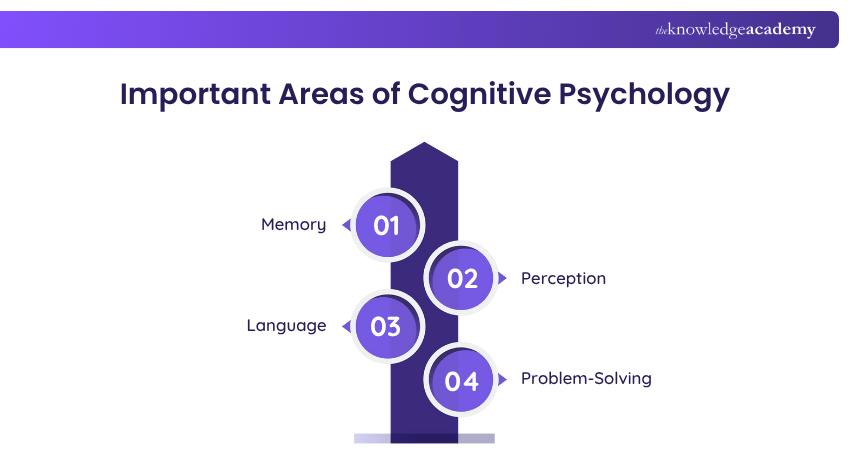
Memory
Memory is the process of encoding, storing, and retrieving information. Cognitive psychologists explore how the brain retains and recalls knowledge through various forms of memory.
1) Short-term and Long-term Memory: Researchers study how repetition and association transfer information from short-term storage to long-term memory.
2) Episodic Memory: This focuses on memories of personal experiences and how they are influenced or disrupted by external factors.
Perception
Perception is how the brain interprets sensory information to understand the environment. It shapes how individuals respond to what they see and hear.
1) Visual Perception: Examines how the brain processes and recognises images, faces, and objects.
2) Auditory Perception: Studies how sounds are identified, processed, and interpreted, such as understanding speech or recognising music.
Language
In Cognitive Psychology, language focuses on how people acquire, understand, and use language in daily life. It examines how humans comprehend spoken words, produce speech, interpret text, and express ideas clearly.
1) Language Acquisition: Examines how humans develop language skills, from early learning to advanced comprehension stages.
2) Speech Recognition: Studies how the brain perceives, processes, and interprets spoken words to create meaningful understanding.
Problem-Solving
Problem-solving studies how the brain identifies, analyses, and resolves challenges. It highlights the strategies and patterns people use to reach solutions.
1) Heuristics and Biases: Examines mental shortcuts the brain uses to solve problems and how these can lead to errors or biases.
2) Problem-solving Strategies: Looks at how individuals apply logical rules, algorithms, or creative thinking to find effective solutions.
Learn to manage stress mindfully and build resilience with our Handle Stress And Develop Your Resilience Training - Register now!
History of Cognitive Psychology
Cognitive Psychology foundation can be traced back to ancient philosophers. Thinkers, such as Aristotle, explored ideas related to memory, perception, and reasoning, believing that they can be studied through observation and logic.
This early focus on mental processes laid the foundation for what we now recognise as Cognitive Psychology. Let’s look at the history with insight:
1) The Rise of Scientific Psychology
In the late 19th century, Psychology began to develop as a scientific discipline. Wilhelm Wundt, the father of Experimental Psychology, used controlled experiments to study mental processes. During this time, Psychologists were actively exploring the mind, but the methods were limited, and they mainly focused on introspection.
2) Dominance of Behaviourism
In the early 20th century, Behaviourism became a dominant approach in Psychology. It meant that Psychology should study observable behaviour, as thoughts and memories cannot be directly measured. As a result, a study of cognition was pushed aside for several decades.
3) The Cognitive Revolution
By the mid-20th century, researchers began to challenge Behaviourism. With the advancement in linguistics, neuroscience, and computer science, mental processes could be studied scientifically. This brought a cognitive revolution by bringing the attention back to mental areas, such as memory, language, problem-solving, and decision-making.
4) Birth of Cognitive Psychology
Cognitive Psychology became a recognised field in the 1950s-60s. Ulric Neisser is one of the important figures who defined its scope. His work established how this branch became a study of how people perceive, think, remember, and learn. Since then, this field has continued to grow and presently plays a major role in education, mental health, artificial intelligence, and neuroscience.
The Cognitive Psychology Approach in Practice
Beyond enhancing our understanding of how the human mind functions, Cognitive Psychology has significantly influenced modern approaches to mental health. The cognitive revolution shifted this focus towards understanding how thought patterns and information processing affect emotions and behaviour. This research led to the development of new therapies designed to address psychological issues.
Cognitive Behavioural Therapy (CBT) and Rational Emotive Behaviour Therapy (REBT) are two key methods that emerged from Cognitive Psychology. Both approaches help individuals identify and challenge negative thought patterns, empowering them to manage distress and build healthier coping mechanisms.
Cognitive Behavioural Therapy
Cognitive Behavioural Therapy (CBT) is a leading therapeutic method that integrates principles of Cognitive Psychology with behavioural strategies. It focuses on understanding how thoughts influence emotions and actions, aiming to identify and challenge harmful thinking patterns.
CBT works by replacing negative or distorted thoughts with healthier, more constructive ones. This evidence-based approach has shown significant success in treating mental health conditions such as post-traumatic stress disorder (PTSD), and obsessive-compulsive disorder (OCD), making it a foundational element of modern psychotherapy.
Transform CBT techniques into bringing real change with Cognitive Behavioural Therapy Training – Register today!
Careers in Cognitive Psychology
Cognitive Psychology offers diverse career opportunities across various sectors. Professionals in this field may work in academia, research, healthcare, or industry, applying their expertise to solve real-world problems.
1) Academic and Research Positions
Many Cognitive Psychologists work as University Professors or Researchers, conducting studies to advance our understanding of mental processes. They may teach courses, mentor students, and publish their findings in academic journals.
2) Clinical and Counselling Roles
Cognitive Psychologists can also work as clinical or counselling Psychologists. They use their knowledge to diagnose and treat mental health issues. They often employ CBT and other evidence-based therapies to help clients improve their mental health.
3) Industry and Technology
In the tech industry, Cognitive Psychologists contribute to the development of user-friendly interfaces, Artificial Intelligence (AI), and human-computer interaction. Their insights make sure that technology is designed in ways that align with human cognitive capabilities.
4) Educational Consulting
Cognitive Psychologists collaborate with educational institutions to design curricula and teaching strategies that optimise learning and memory retention. By applying principles from Cognitive Psychology, they create impactful educational programs and assessments.
Reasons to Consult a Cognitive Psychologist
Consulting a Cognitive Psychologist can be helpful when thoughts, emotions, or behaviours begin to affect daily life. These Cognitive Psychology professionals focus on how thinking patterns influence feelings and actions. They help to support individuals with mental health challenges and improve well-being. Some key reasons to consult them include:
1) Managing anxiety, depression, stress, and trauma
2 Addressing substance abuse, including alcohol or gambling
3) Coping with loss, grief, and major life changes
4) Improving sleep problems and stress management
5) Dealing with anger issues, phobias, or unhealthy habits
6) Supporting recovery from eating disorders and body image concerns
7) Handling difficulties in work, school, family, or relationships
8) Managing chronic illness, pain, or post-partum mental health challenges
9) Building self-confidence and healthier thought patterns
Build focus and reduce stress with Mindfulness Training – Join today!
Conflicts and Debates
Since the beginning of psychological inquiry, scholars have debated how and why people think and behave the way they do. In Cognitive Psychology, several key debates shape how researchers interpret human thought and action. thought and action.
1) Free Will vs Determinism
This Cognitive Psychology debate examines whether human behaviour results from conscious choice or external factors such as biology and environment. Cognitive psychologists explore how much control individuals have, questioning if decision-making stems from personal agency or predetermined cognitive and neural processes.
2) Nature vs Nurture
The nature versus nurture debate explores how genetic inheritance and environmental experiences shape cognition. Cognitive psychologists believe both interact continuously, where genetics provide potential, and upbringing, culture, and learning experiences influence how cognitive abilities and behaviours develop over time.
3) Holism vs Reductionism
Holism views cognitive processes as integrated systems, while reductionism analyses them by breaking mental functions into smaller parts. Cognitive psychologists often combine both approaches to gain a deeper understanding of how individual components contribute to overall cognitive performance.
4) Idiographic vs Nomothetic
The idiographic approach focuses on understanding individual cognitive experiences, whereas the nomothetic approach identifies general principles applicable to everyone. Cognitive Psychology balances both perspectives, integrating personal insights with universal theories to explain similarities and differences in human cognition.
Conclusion
Cognitive Psychology dives into how the mind shapes the way individuals think, feel, and behave. From memory and learning to decision-making and language, it explains the mental processes that influence our actions, relationships, and well-being. It provides practical insights that lead to healthier thinking patterns and better life outcomes. This provides a powerful step towards improving how to learn, cope, and grow.
Build mental health strategies and improve your well-being with Mental Health Courses today!
Frequently Asked Questions
What is the Main Focus of Cognitive Psychology?

Cognitive Psychology primarily focuses on understanding mental processes like perception, memory, reasoning, and decision-making.
How Can Cognitive Psychology Help in Everyday Life?
Cognitive Psychology can improve everyday life by enhancing learning strategies, improving memory, and developing better problem-solving skills.
What are the Other Resources and Offers Provided by The Knowledge Academy?
The Knowledge Academy takes global learning to new heights, offering over 3,000 online courses across 490+ locations in 190+ countries. This expansive reach ensures accessibility and convenience for learners worldwide.
Alongside our diverse Online Course Catalogue, encompassing 19 major categories, we go the extra mile by providing a plethora of free educational Online Resources like Blogs, eBooks, Interview Questions and Videos. Tailoring learning experiences further, professionals can unlock greater value through a wide range of special discounts, seasonal deals, and Exclusive Offers.
What is The Knowledge Pass, and How Does it Work?
The Knowledge Academy’s Knowledge Pass, a prepaid voucher, adds another layer of flexibility, allowing course bookings over a 12-month period. Join us on a journey where education knows no bounds.
What are related Health & Safety Courses and blogs provided by The Knowledge Academy?
The Knowledge Academy offers various Mental Health Courses, including the Psychology Course, Cognitive Behavioural Therapy Training, and the Mindfulness Course. These courses cater to different skill levels, providing comprehensive insights into Psychological Safety.
Our Health & Safety Blogs cover a range of topics related to Psychology, offering valuable resources, best practices, and industry insights. Whether you are a beginner or looking to advance your knowledge on Mental health, The Knowledge Academy's diverse courses and informative blogs have you covered.

The Knowledge Academy


Global Training Provider
The Knowledge Academy is a world-leading provider of professional training courses, offering globally recognised qualifications across a wide range of subjects. With expert trainers, up-to-date course material, and flexible learning options, we aim to empower professionals and organisations to achieve their goals through continuous learning.

Upcoming Health & Safety Resources Batches & Dates
Date
 Anxiety Course

 If you wish to make any changes to your course, please


