
SDI Training

Online Instructor-led (3 days)

Online Self-paced (24 hours)

Certified Service Desk Manager Exam

Certified Service Desk Manager (CSDM) Course Outline

Module 1: Defining Strategic Requirements

  • Define Service Desk
  • Roles and Responsibilities of Service Desks
  • Strategy Planning
  • Best Practices

Module 2: Developing a Strategic Role

  • Service Strategy
  • Service Generation

Module 3: Essential Management Skills

  • Introduction to Essential Management Skills
  • Individual Change Readiness
  • Creating a Change Management Plan
  • Dealing with Resistance
  • Communication Techniques
  • Effective Communication Skills
  • Problems with Communication
  • Handling Users
  • Improving Your Verbal and Email Communication
  • Internal Communication
  • Common and Overcoming Barriers to Communication
  • AIDA Model
  • Effective Communication Guidelines

Module 4: Integrating the Service Desk

  • Importance of Effective Work Relationships
  • Continual Service Improvement Model
  • Activities Supporting CSI

Module 5: Promoting the Service Desk

  • Overview of Promoting the Service Desk
  • Principles of Stakeholder Engagement
  • Strategies for Mobilising Stakeholders

Module 6: Quality Assurance Activities

  • Introduction
  • Purpose of Customer Feedback
  • Ways to Collect Customer Feedback
  • Importance of Customer Satisfaction Surveys

Module 7: Effective Management of Tools and Technologies

  • Automated Call Distribution (ACD)
  • Computer Telephony Integration (CTI)
  • Benefits of Self-Service

Module 8: Staff Recruitment and Retention

  • Introduction to Staff Recruitment and Retention
  • Devising an HR Agenda and Strategy
  • HR Policy Documentation
  • Creating an HR Policy Manual
  • HR Policy Reviews

Module 9: Professional Development

  • Introduction
  • Benefits of Professional Development
  • Coaching and Mentoring
  • Benefits of Coaching and Mentoring

Module 10: Leadership and Management

  • Defining Management
  • What is the Role of the Manager?
  • Descriptions of the Role of a Manager
  • Responsibilities of a Manager
  • Objectives of a Manager
  • Discuss
  • Succeeding as a Manager
  • Useful Skills to Have
  • Types of Management Style
  • Leadership Vs Management
  • Qualities of a Good Leader
  • Visionary Leaders
  • Connective Leaders
  • Storytellers
  • Adaptive Leaders
  • Transformational Vs Transactional
  • Dispersed Leadership
  • Goleman – Leadership Styles
  • Choosing the Appropriate Leadership Style in Any Given Situation
  • Situational Leadership
  • Leadership and Management

Module 11: IT Service Management

  • Introduction to ITSM
  • Key Concepts
  • Guiding Principles
  • ITSM Framework
  • Problem Management

Module 12: Service Management Framework

  • Service Management Frameworks
  • Service Life Cycle
  • Service Value System
  • Service Value Chain

Show moredown

What’s included in this Certified Service Desk Manager (CSDM) Training Course?

This Certified Service Desk Manager (CSDM) Training Course is designed to equip delegates with the skills and knowledge necessary to effectively lead and manage service desk operations. This training course is especially beneficial for

  • Service Desk Managers
  • IT Support Managers
  • Technical Support Managers
  • Service Delivery Managers
  • IT Operations Managers
  • Help Desk Managers
  • Technical Managers

Prerequisites of the Certified Service Desk Manager (CSDM) Training Course

There are no formal prerequisites for this Certified Service Desk Manager (CSDM) Training Course. However, some prior experience in Service Desk or IT support roles would be beneficial.  

Certified Service Desk Manager (CSDM) Course Overview

Effective service desk management is essential for maintaining high-quality IT support, enhancing user satisfaction, and achieving organisational goals. This course in Paraguay introduces the advanced skills and strategies required to excel as a Service Desk Manager, enabling delegates to lead and optimise service desk operations successfully.

Proficiency in service desk management is crucial for those overseeing IT Support Teams or Managing Service Delivery. This expertise empowers professionals to implement industry best practices, manage escalations, and align service desk operations with broader business objectives.

This intensive 3-day Certified Service Desk Manager (CSDM) Training by The Knowledge Academy provides delegates with the knowledge and capabilities to manage service desks effectively at a senior level. Delegates will learn to lead teams, optimise workflows, and use performance metrics to ensure continuous improvement. By the end of this course, delegates will have the confidence and skills to excel as service desk leaders.

Course Objectives

  • To understand the role of a Service Desk Manager and its impact on IT service delivery
  • To develop leadership and communication skills for managing service desk teams
  • To optimise service desk operations using performance metrics and frameworks
  • To manage escalations and ensure efficient incident resolution
  • To implement strategies for continuous improvement and user satisfaction

After completing this Certified Service Desk Manager (CSDM) Course in Paraguay, delegates will receive an internationally recognised Service Desk Institute Certification, showcasing their expertise in managing service desks and delivering high-quality IT support services.

Show moredown

What’s included in this Certified Service Desk Manager (CSDM) Training Course?

  • Certified Service Desk Manager (CSDM) Examination
  • World-Class Training Sessions from Experienced Instructors
  • Certified Service Desk Manager (CSDM) Certificate
  • Digital Delegate Pack

Show moredown

Certified Service Desk Manager (CSDM) Exam Information

To achieve the Certified Service Desk Manager (CSDM), candidates will need to sit for an examination. The exam format is as follows: 

  • Question Type: Multiple Choice 
  • Total Questions: 40 
  • Total Marks: 40 Marks 
  • Pass Mark: 65%, or 26/40 Marks 
  • Duration: 60 Minutes
  • Open Book/ Closed Book: Closed Book

Show moredown

Online Instructor-led (1 days)

Online Self-paced (8 hours)

Service Desk Senior Analyst Training Course Outline

Module 1: Introduction to Service Desk Senior Analyst Role

  • Understanding Service Desk Functions
  • Role and Responsibilities of a Senior Analyst
  • Key Performance Indicators (KPIs)

Module 2: Communication and Customer Service

  • Effective Communication Techniques
  • Managing Customer Expectations
  • Conflict Resolution Skills
  • Service Desk Etiquette
  • Handling Difficult Customers

Module 3: Incident and Request Management

  • Incident Classification and Prioritisation
  • Request Fulfilment Process
  • Service Request Vs. Incident
  • Incident Lifecycle Management
  • Escalation Procedures

Module 4: Problem Management

  • Identifying Root Causes
  • Problem Categorisation and Prioritisation
  • Problem Resolution Techniques
  • Problem Documentation and Reporting

Module 5: Request Fulfilment

  • Service Requests Vs. Incidents
  • Request Handling
  • Service Catalogue
  • Request Status Tracking

Module 6: Service Level Management

  • SLA Basics
  • SLA Monitoring
  • SLA Reporting
  • SLA Improvement

Module 7: Customer Relationship Management

  • Customer Interactions
  • Handling Difficult Customers
  • Customer Feedback
  • Continuous Improvement

Module 8: Knowledge Management

  • Importance of Knowledge Management
  • Creating and Maintaining Knowledge Base
  • Knowledge Sharing within the Team
  • Continuous Improvement through Knowledge Management

Show moredown

Who should attend this Service Desk Senior Analyst Training Course?

The Service Desk Senior Analyst Training course is tailored to impart advanced skills necessary for senior service desk roles. This course addresses the nuances of IT support, service management and this course can be beneficial for various professionals, including

  • Service Desk Analysts
  • IT Support Specialists
  • Helpdesk Technicians
  • IT Managers
  • IT Operations Supervisors
  • System Administrators
  • Network Administrators
  • Technical Support Engineers

Prerequisites of the Service Desk Senior Analyst Training Course

There are no prerequisites required for the Service Desk Senior Analyst Training Course.

Service Desk Senior Analyst Training Course Overview

Efficient service desk management is essential for ensuring seamless IT support, maintaining user satisfaction, and optimising organisational workflows. This course in Paraguay introduces advanced concepts and practices for managing service desks, equipping professionals with the skills needed to excel in senior analyst roles. By mastering service desk management strategies, individuals can enhance operational efficiency, resolve complex issues, and support organisational success.

Proficiency in service desk management is vital for those leading IT Support Teams or overseeing Service Desk Operations. This expertise empowers professionals to implement best practices, manage escalations effectively, and ensure alignment with organisational goals while maintaining high service standards.

This intensive 1-day Service Desk Senior Analyst Certification Training by The Knowledge Academy equips delegates with the knowledge and skills to manage service desk operations at an advanced level. Delegates will learn to analyse key performance metrics, handle escalations, and implement frameworks to improve service delivery and user experience. By the end of this Service Desk Institute Training, delegates will be equipped to drive continuous improvement and operational excellence in their service desks.

Course Objectives

  • To understand advanced service desk management concepts and their impact on IT support operations
  • To analyse and improve service desk performance using key metrics
  • To manage escalations and resolve complex issues efficiently
  • To implement best practices and frameworks for enhancing service delivery
  • To develop strategies for continuous improvement and team development

After completing this Service Desk Senior Analyst Training, delegates will receive a certification in Service Desk Management. This Service Desk Institute Training certification recognises advanced expertise in service desk operations, highly valued across IT and customer support industries.


Show moredown

What’s included in this Service Desk Senior Analyst Training Course?

  • World-Class Training Sessions from Experienced Instructors
  • Service Desk Senior Analyst Certificate
  • Digital Delegate Pack

Show moredown

accredited by

Our SDA course is accredited by PeopleCert

Online Instructor-led (3 days)

Online Self-paced (24 hours)

Service Desk Analyst (SDA) Exam

Service Desk Analyst (SDA) v8 Course Outline 

Domain 1: Professionalism and Roles

Module 1: Service Desk
  • Purpose of the Service Desk
  • Activities of the Service Desk that Demonstrate its Values
  • Role of Service Desk Leadership and Management
Module 2: Service Desk Analyst
  • Role of the Service Desk Analyst
  • Responsibilities of the Service Desk Analyst
Module 3: Best Practice
  • Sources of Service Desk and IT Methodologies and Best Practice
  • Maintain Knowledge of IT Standards, Frameworks, and Methodologies
Module 4: Policies and Governance
  • Purpose of Organisational Policies
  • Areas Covered by Organisational Policies
Module 5: Personal Accountability
  • Importance of Making and Honouring Commitments
  • How to Protect and Enhance the Image of the Service Desk?
Module 6: Service Attitude
  • Explain the Terms: Attributes, Skills and Knowledge
  • Characteristics of a Good Service Attitude
  • Impact of a Good Service Attitude
  • Skills Required to Deliver Excellent Customer Service
Module 7: Teamwork
  • Basic Concepts of Teamwork
  • Responsibilities of People Working in a Team Environment
  • Benefits of Teamwork
  • Characteristics of an Effective Team
  • Features Found in a Supportive Workplace
Module 8: Business Relationships
  • Behaviours for Establishing Effective Relationships with Customers
Module 9: Cultural Awareness
  • Demonstrate Sensitivity and Respect for Other Cultures
  • Practice Techniques for Communicating Cross-Culturally

Domain 2: Analyst Skills

Module 10: Communication
  • Describe Ways People Communicate
  • Difference Between Formal and Informal Communications
  • Barriers to Effective Communication
Module 11: Verbal and Non-Verbal Communication Skill
  • Principles of Good Verbal skills
  • Principles of Good Non-Verbal Communication Skills
Module 12: Listening Skills
  • Principles of Active Listening
  • Paraphrasing and its Significance
  • Advantages of Active Listening
  • Barriers to listening and Understanding
Module 13: Written Communication
  • Using Correct Grammar and Spelling is Essential in Documentation and Written Communications
  • Components Needed for Writing Professional Business Communications and Documentation
Module 14: Questioning Skills
  • Difference Between Open and Closed Questioning
  • Structured Questioning Technique
Module 15: Problem Solving
  • Skills Needed for Effective Problem Solving
  • Steps in a Typical Problem-Solving Technique
Module 16: Rapport Techniques
  • Emotional Intelligence
  • Elements of Emotional Intelligence
  • Benefits of Emotional Intelligence
  • Common Customer Emotions or Actions that an Analyst Requires to Manage
  • Methods for Acknowledging the Customer’s
  • Techniques for Dealing with Negative Reactions from Customers
Module 17: Conflict and Negotiation Skills
  • Signs that Conflict is Developing
  • Appropriate Actions to Reduce and Eliminate Conflict
  • Define the Negotiation
  • Elements of Negotiation
Module 18: Interaction Management Skills
  • Benefits of Professionally Managing Interactions
  • Benefits of Using a Standard Greeting
  • Actions for Managing and Redirecting Issues Related to Unsupported Items
  • Behaviours and Situations to Avoid When Interacting with Customers
  • How to Manage an Abusive Customer?
  • How to Manage an Angry Customer?
  • How to Manage an Inconvenienced Customer?
  • How to Manage an Over talkative Customer?
  • How to Manage an Emotionally Distressed Customer?
  • How to Manage a Customer that is Reluctant to End an Interaction?
  • How to Professionally Disengage from a Support Interaction?
Module 19: Resilience
  • Importance of Emotional Resilience
  • Common Causes of Stress
  • Signs of Positive Stress
  • Signs of Negative Stress
  • Describe the responsibility we have to Manage Stress for Ourselves and our Colleagues
  • Actions that Reduce Stress
Module 20: Time Management
  • What Multitasking Means in a Support Environment?
  • Techniques to Improve Time Management
  • Benefits of Effective Time Management
Module 21: Positive Approach and Attitude
  • Differences Between Aggressive, Assertive and Passive Behaviour
  • Importance of Demonstrating Confidence
  • How Confidence is Demonstrated?
Module 22: Professional Development
  • Methods for Enhancing Personal Professional Development

Domain 3: Practices, Processes and Procedures

Module 23: Practices, Processes and Procedures
  • Practice, Process, and Procedure Management
  • Importance of Documenting Practices, Processes, and Procedures
Module 24: Incident Management
  • Purpose of Incident Management
  • Incident
  • Objectives of Incident Management
  • Principal Activities that the Service Desk Analyst Performs in Incident Management
  • Benefits of Effective Incident Management
  • Common Measures of Success for Incident Management
Module 25: Service Request Management
  • Purpose of Service Request Management
  • Service Request
  • Objectives of Service Request Management
  • Common Measures of Success for Service Request Management
Module 26: Recording Incidents and Requests
  • Primary Reasons for Recording Incidents and Requests
  • Procedure for, Information Required, to Raise an Incident or Service Request
  • Determine the Priority of an Incident or Service Request
  • Steps Required to Resolve an Incident or Service Request
Module 27: Explain the Two Types of Escalation
  • Two Types of Escalation
  • Circumstances in which Escalation is Suitable
Module 28: Status Updates
  • Importance of Status Updates
  • Information to Provide in a Status Update
Module 29: Problem Management
  • Purpose of Problem Management
  • Problem
  • Reactive and Proactive Problem Management
  • Objectives of Problem Management
  • Service Desk’s Responsibilities in Problem Management:
  • Three Phases of Problem Management
  • Primary Activities of Problem Management
  • Common Measures of Success for Problem Management
Module 30: Change Enablement
  • Purpose of Change Enablement
  • Describe a Change
  • Types of Change
  • Objectives of Change Enablement
  • Service Desk’s Responsibilities in Change Enablement
  • Activities in Change Enablement
  • Common Measures of Success for Change Enablement
Module 31: Service Level Management
  • Purpose of a Service Level Management
  • Objectives of Service Level Management
  • Service Level Agreement
  • Typical Content of a Service Level Agreement that is Relevant to the Service Desk (SLA)
Module 32: Service Catalogue Management
  • Purpose of Service Catalogue Management
  • Service Catalogue
  • Objectives of Service Catalogue Management
  • Necessary Components of an Entry in the Service Catalogue
Module 33: Service Delivery Model
  • Different Kinds of Sourcing Methodologies and Models Available for Delivering IT Services
Module 34: Knowledge Management
  • Purpose Knowledge Management
  • Objective of Knowledge Management
  • Why Knowledge Management is Important to the Service Des
  • Why it is Essential to Maintain Knowledge?
  • Common Measures of Success for Knowledge Management
Module 35: Information Security Management
  • Purpose of Information Security Management
  • Objective of Information Security Management
  • Importance of Information Security Policies
  • Service Desk’s Responsibilities in Information Security Management
  • Potential Security Threats to the Organisation that Might Occur through the Service Desk
  • Types of Security Policies
  • Importance of Reporting Security Compromises
  • Importance of Legal Compliance
  • Importance of Software License Management
  • Importance of Confidentiality
Module 36: Service Continuity Management
  • Purpose and Responsibility of the Service Continuity Management
  • Purpose of a Service Continuity Plan
  • Components of a Service Continuity Plan
Module 37: Quality Assurance Program
  • Purpose of a Quality Assurance (QA) Program
  • Objectives of a Quality Assurance (QA) Program
  • Common QA Practices used by a Service Desk
  • Methods for Monitoring Calls and Other Interactions
  • What is Meant by Incident and Service Request Monitoring
  • Methods for Monitoring Incidents and Service Requests
  • Benefits of Interaction, Incident, and Service Request Monitoring
Module 38: Managing Customer Feedback
  • Purpose Managing Customer Feedback
  • Objectives of Managing Customer Feedback
  • Common Sources of Customer Feedback
  • Components of Managing Customer Feedback
  • Three Most Common Types of Surveys and the Importance of Each Type
Module 39: Service Desk Metrics and Statistics
  • Reason for Compiling Service Desk Metrics
  • Common Service Desk Metrics

Domain 4: Resources

Module 40: Support Methods
  • Methods Used for Delivering Service and Support
  • Purpose of Using IT Service Management Systems in a Service Desk Environment
  • Primary Objectives of Using IT Service Management Tools
  • Benefits of Remote Support
  • Common Disadvantages of Using Remote Support Tools
  • Benefits of Using Live Chat and Collaboration Tools
  • Commons Risks of Using Live Chat and Collaboration Tools
  • Describe Automatic Call Distribution (ACD)
  • Common Automatic Call Distribution (ACD) Features
Module 41: Self-Service
  • Describe Self-Service
  • Benefits of Self-Service
  • Risks of Self-Service
  • Common Examples of Self-Service
Module 42: Automation
  • Describe Automation
  • Examples of Automation
Module 43: Artificial Intelligence (AI)
  • Describe AI
  • Common Examples of AI
  • Benefits of AI
  • Challenges of AI
Module 44: Social Media
  • What is Meant by Social Media?
  • How to Use Social Media Tools Effectively

Show moredown

Who Should Attend this Service Desk Analyst (SDA) Training Course?

This Service Desk Analyst Course is suitable for Analysts looking to grow in their role and acquire a recognised qualification for managing a Service Desk System. This training course is suitable for these professionals:

  • Aspiring Service Desk Analysts
  • Current Service Desk Analysts
  • IT Support Technicians
  • Customer Support Technicians
  • IT Managers
  • Incident Managers
  • Business Analysts

Prerequisites of the Service Desk Analyst (SDA) Training Course

There are no formal prerequisites to attend this Service Desk Analyst (SDA) Course. However, some experience in managing a first or second-line Service Desk will be beneficial.

Service Desk Analyst (SDA) v8 Course Overview

Service Desk Analyst Training introduces delegates to the principles and techniques required for effective service desk support. It explains how structured analysis and best practices improve user satisfaction, service quality, and IT operational efficiency.

This training builds delegates’ ability to resolve issues efficiently, communicate clearly with users, and optimise support processes. It supports continuous improvement in IT service delivery and strengthens professional capability within service desk environments.

This 3-Day Service Desk Analyst (SDA) Course offered by The Knowledge Academy enables delegates to apply service desk principles with confidence. Through focused learning and practical activities, delegates gain the skills to manage incidents, enhance customer interactions, and deliver high-quality IT support aligned with organisational goals.

Service Desk Analyst (SDA) Course Objectives

  • To understand the principles of service desk analysis and its role in IT support
  • To manage incidents and service requests effectively
  • To enhance communication and customer service skills
  • To utilise tools and techniques for improving service delivery
  • To implement frameworks and best practices aligned with SDA v8 standards

After completing this Service Desk Analyst (SDA) v8 Course, delegates will receive an internationally recognised Service Desk Institute Certification, demonstrating their competence and commitment to excellence in IT support operations.

Show moredown

What’s Included in this Service Desk Analyst (SDA) Training Course?

  • Service Desk Analyst (SDA) Examination 
  • World-Class Training Sessions from Experienced Instructors 
  • Service Desk Analyst (SDA) Certificate 
  • Digital Delegate Pack 

Show moredown

Service Desk Analyst (SDA) Exam Information 

The Service Desk Analyst (SDA) Exam assesses individuals' knowledge and skills related to service desk operations and customer support. This certification focuses on evaluating an individual's ability to effectively handle and resolve incidents, requests, and inquiries from users and customers. 

  • Question Type: Multiple Choice 
  • Total Questions: 60 
  • Total Marks: 60 Marks  
  • Pass Mark: 65%, or 39/60 Marks 
  • Duration: 60 Minutes 
  • Open Book/ Closed Book: Closed Book

Show moredown

Not sure which course to choose?

Speak to a training expert for advice if you are unsure of what course is right for you. Give us a call on + 1-866 272 8822 or Enquire.

Core Concepts Covered in SDI Courses

SDI Training provide learners with a structured understanding of world-recognised service desk standards used to enhance service quality, team capability, and operational performance. The key concepts covered in these courses include:

  • Strategic Service Desk Planning: Covers defining service desk purpose, roles, responsibilities, strategic requirements, and best-practice approaches that shape high-performing service operations.
  • Continual Service Improvement (CSI) and Stakeholder Engagement: Explores CSI activities, promoting the service desk, stakeholder engagement principles, and strategies for mobilising stakeholder support effectively.
  • Quality Assurance and Customer Feedback Methods: Covers customer satisfaction surveys, feedback mechanisms, interaction monitoring, and QA practices that enhance service performance and user experience.
  • IT Service Management (ITSM) Frameworks: Introduces ITSM concepts, service lifecycle, service value system, value chain, and alignment with IT service management principles.
  • Analyst-Level Communication and Customer Handling Skills: Includes active listening, questioning skills, emotional intelligence, conflict resolution, rapport-building, and techniques for handling challenging customer scenarios.
  • Incident, Request, Problem and Change Processes: Delivers structured workflows for recording incidents, service requests, escalation procedures, problem management phases, and change enablement activities.
     

Career Opportunities with SDI Training

SDI Training helps professionals meet the competency expectations of service desks following SDI’s excellence frameworks.

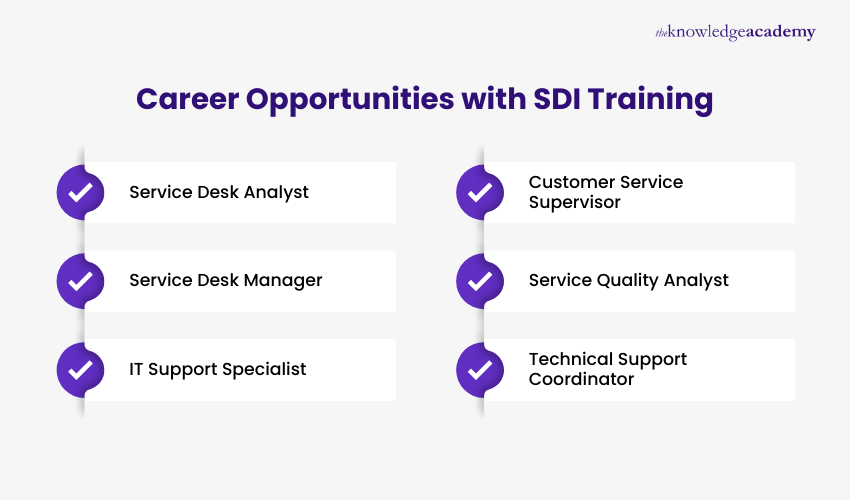
Career Opportunities with SDI Training

The career opportunities after completing SDI Training include:

  • Service Desk Analyst: Handles incident resolution, customer communication, and service request management aligned with SDI operational standards.
  • Service Desk Manager: Oversees team performance, service delivery quality, and continuous improvement activities using SDI frameworks.
  • IT Support Specialist: Applies SDI-aligned service behaviours, troubleshooting workflows, and customer interaction techniques in technical support environments.
  • Customer Service Supervisor: Utilises SDI communication models and service measurement methods to guide frontline customer service teams.
  • Service Quality Analyst: Evaluates service desk performance, identifies improvement areas, and supports SDI-led service excellence initiatives.
  • Technical Support Coordinator: Coordinates service requests, prepares performance reports, and ensures structured communication across IT support channels.
Show more blue-arrow

SDI Training FAQs

SDI is a global leader in service desk standards, offering guidance, training, and certification to improve service quality, customer experience, and operational performance in IT support environments.

You’ll gain skills in customer service, incident management, communication, team leadership, performance monitoring, and service desk optimisation, aligned with globally recognised best practice standards.

This training is ideal for Service Desk Agents, Team Leaders, Managers, and IT Professionals aiming to improve support services and align with industry best practices.

The prerequisites for the Service Desk Institute (SDI) Training are based on the course specifications and the target group of professionals it serves. Check the respective course page of the course that you are planning to take to know about its prerequisites.

The duration of these Service Desk Institute Course varies. Please visit our course pages for specific information.

Yes, The Knowledge Academy offers 24/7 support via phone & email before attending, during, and after the course. Our customer support team is available to assist and promptly resolve any issues you may encounter.

They enhance service desk consistency, customer satisfaction, team performance, and continuous improvement by aligning with globally recognised frameworks and performance benchmarks.

The SDI Service Desk Analyst course is ideal for beginners, covering the foundational skills needed to deliver excellent front-line support.

You’ll learn core service desk principles, best practices, communication strategies, metrics management, and how to deliver high-quality IT support.

Topics covered in the Service Desk Institute (SDI) Certification include incident management, service requests, customer service, SLAs, KPIs, service improvement, automation, reporting, and support leadership.

SDI Training standardises practices, boosts agent confidence, improves response times, and ensures consistent, high-quality service aligned with business goals.

No special software is needed. Course materials are accessible online or provided on-site, depending on the chosen delivery format.

Prior experience is not mandatory. These courses are suitable for both newcomers and experienced professionals seeking formal structure and certification.

SDI Training supports the development of service desk professionals by offering structured learning, building confidence, encouraging customer-focused thinking, and equipping them to manage incidents, enhance processes, and lead teams with greater effectiveness.

Yes, after completing this Service Desk Institute (SDI) course you will receive a certificate of completion to validate your achievement and demonstrate your proficiency in the course material.

Yes, we provide corporate training for this course, tailored to fit your organisation’s requirements.

The Knowledge Academy provides flexible self-paced training for Service Desk Institute (SDI) Certification. Self-paced training is beneficial for individuals who have an independent learning style and wish to study at their own pace and convenience.

Yes, many SDI courses include interactive sessions, case studies, and practical exercises to apply learning in real-life service desk scenarios.

While formal projects aren’t always included, practical exercises, real-world case studies, and team activities are part of the training experience.

Yes. It helps small businesses build a structured support function, enhance customer satisfaction, and scale operations efficiently using best practices.

Yes, SDI certification demonstrates your expertise, boosts credibility, and opens doors to higher-level roles in IT support and service management.

Career opportunities after completing the Service Desk Institute Certification include roles such as Service Desk Analyst, Senior Analyst, Team Leader, Service Desk Manager, IT Support Manager, and positions within ITSM or ITIL-based environments.

The Knowledge Academy in Paraguay stands out as a prestigious training provider known for its extensive course offerings, expert instructors, adaptable learning formats, and industry recognition. It's a dependable option for those seeking this course.

Please see our SDI Training available in Paraguay

The Knowledge Academy is one of the Leading global training provider for SDI Training.

The training fees for SDI Training in Paraguay starts from $2795

Show more down

Why we're the go to training provider for you

icon

Best price in the industry

You won't find better value in the marketplace. If you do find a lower price, we will beat it.
icon

Trusted & Approved

Recognised by leading certification bodies, we deliver training you can trust.

icon

Many delivery methods

Flexible delivery methods are available depending on your learning style.
icon

High quality resources

Resources are included for a comprehensive learning experience.

barclays Logo
deloitte Logo
Thames Water Logo

"Really good course and well organised. Trainer was great with a sense of humour - his experience allowed a free flowing course, structured to help you gain as much information & relevant experience whilst helping prepare you for the exam"

Joshua Davies, Thames Water

santander logo
bmw Logo
Google Logo
cross

Exclusive Deals Big Savings This March!

Grab up to 40% OFF and level up your skills this spring! march-madness

WHO WILL BE FUNDING THE COURSE?

close

close

Thank you for your enquiry!

One of our training experts will be in touch shortly to go over your training requirements.

close

close

Press esc to close

close close

Back to course information

Thank you for your enquiry!

One of our training experts will be in touch shortly to go overy your training requirements.

close close

Thank you for your enquiry!

One of our training experts will be in touch shortly to go over your training requirements.