


 Top Rated Course

We may not have the course you’re looking for. If you enquire or give us a call on + 1-866 272 8822 and speak to our training experts, we may still be able to help with your training requirements.
What is a Sales Funnel? Stages, Benefits and How It Works
Charlotte Wilson 15 July 2026A Sales Funnel is a marketing term that maps the customer journey from awareness to purchase, helping businesses attract leads and improve conversions. It's a visual representation of the customer journey. By understanding where customers drop off, companies can refine their marketing and sales strategies to close more deals.

Training Outcomes Within Your Budget!
We ensure quality, budget-alignment, and timely delivery by our expert instructors.
Table of Contents
Every successful sale follows a journey and the Sales Funnel is like its map. From the first spark of interest to the final buying decision, a Sales Funnel shows how prospects move closer to becoming customers. It helps businesses understand behaviour, spot drop‑offs and guide leads with purpose instead of guesswork.
In this blog, we break down What is a Sales Funnel, explore its key stages, and explain the real benefits it brings to modern sales and marketing strategies. So read on and take this journey to the destination of high sales and sustained business!
Table of Contents
1) What is a Sales Funnel?
2) Why is the Sales Funnel Important?
3) How Does a Sales Funnel Work?
4) What are the Sales Funnel Stages?
5) What are the Benefits of a Sales Funnel?
6) B2C Sales Funnels vs B2B Sales Funnels
7) Best Practices for Building a Sales Funnel
8) Conclusion
What is a Sales Funnel?
A Sales Funnel describes the path potential customers take from initial awareness to making a purchase. It outlines the stages involved in moving prospects through a company’s sales process, with the number of stages varying depending on the sales model used.
A well-designed Sales Funnel guides prospects smoothly towards conversion. However, gaps or inefficiencies can cause leads to drop off at different stages, much like water leaking through a sieve, resulting in lost sales opportunities.
Why is the Sales Funnel Important?
A Sales Funnel is important because it provides clear insight into how potential customers think and behave at every stage of the buying journey. This understanding helps you focus on the right marketing channels, deliver more relevant messages and apply only the most effective tactics to convert prospects into customers.
How Does a Sales Funnel Work?
As the name implies, a Sales Funnel starts with a large number of leads and gradually narrows them down into a smaller group of paying customers. Here's a simple B2C e-commerce example that illustrates the process:
a) Visitor: A user lands on the website through a search engine result, social media post, or online advert.
b) Lead: While browsing, the visitor signs up for the email list or shares contact details.
c) Engagement: The lead is nurtured through emails, texts or calls featuring relevant content or offers.
d) Prospect: Continued interaction encourages the lead to revisit the site and explore specific products or deals.
e) Customer: Targeted messaging, strong product value or incentives like discount codes prompt the final purchase.
What are the Sales Funnel Stages?
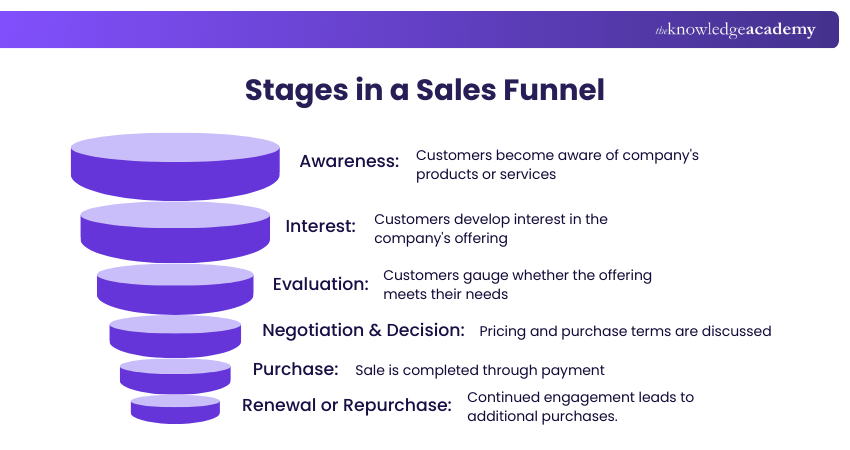
The Sales Funnel refers to a visual representation of the customer journey, starting from the moment a prospect discovers the brand to the point they make a purchase. Each stage of the funnel plays a vital role in guiding potential customers toward conversion. Let’s explore the six core stages:
1) Awareness
Potential customers first discover a product or service through marketing activities such as Social Media, Content Marketing or advertising. At this stage, they begin to recognise the brand and understand how its offering could address their needs or challenges.
2) Interest
Prospects engage with informative content such as webinars, case studies, or landing pages to learn more about the product. They explore its features, benefits, and value, assessing whether it could be a suitable solution.
Learn about proper structured approaches to Sales by signing up for the Sales Bootcamp Course now!
3) Evaluation
At this stage, prospects actively compare your product or service with competitors, assessing features, pricing, credibility, and support. This phase is critical for building trust and clearly differentiating your offering from alternative options.
4) Negotiation and Decision
Discussions around pricing, terms, contracts or custom requirements take place as prospects move closer to a final decision. Sales teams play a key role by addressing objections, offering reassurance, and guiding prospects towards purchase.
5) Sale
The prospect commits and completes the transaction, officially becoming a customer. A smooth and positive buying experience at this stage helps set the tone for the long-term relationship.
6) Renewal or Repurchase
After the sale, businesses focus on maintaining engagement through support, follow-ups, and added value. Strong post-sale relationships encourage repeat purchases, renewals, and customer advocacy over time.
What are the Benefits of a Sales Funnel?
A properly organised Sales Funnel brings a range of significant advantages to the table, which aid in the effective engagement of customers, the simplification of processes, and the enhancement of conversions for enterprises. Here are the key benefits:
1) Better Customer Retention
By understanding how customers move through each stage of the funnel, businesses can introduce targeted strategies that strengthen relationships. Personalised follow-ups, timely check-ins, and proactive support help improve satisfaction and long-term loyalty.
2) Data-driven Insights
Sales Funnels generate valuable insights into customer behaviour, preferences, and challenges. This data helps refine marketing efforts, improve sales strategies, and enhance offerings. When combined with a CRM system, it enables a complete, up-to-date view of each customer and supports more personalised engagement.
3) Enhanced Targeting
A Sales Funnel helps businesses concentrate their marketing efforts on well-defined buyer personas. This ensures time and resources are focused on high-quality leads, while messaging and offers are tailored to match specific customer needs.
4) Improved Lead Nurturing
With a clear funnel structure, businesses can nurture leads through consistent and meaningful interactions. Ongoing communication via email, social media, and personalised outreach builds trust and increases the likelihood of conversion.
5) Increased Referrals
Customers who reach the final stages of the Sales Funnel and have positive experiences are more likely to recommend the business to others. Case studies and testimonials from satisfied customers act as strong social proof and strengthen brand credibility.
6) Streamlined Sales Pipeline
A well-defined funnel provides visibility across the entire sales process, making it easier to spot bottlenecks and inefficiencies. This allows sales teams to prioritise valuable opportunities, manage leads effectively, and use resources more efficiently.
Learn to develop good negotiation skills and accelerate sales by signing up for our Sales Negotiation Training now!
B2C Sales Funnels vs B2B Sales Funnels
The content a potential buyer engages with and the steps they take to make a purchase are greatly determined by the whether you sell to consumers or to other businesses. Here are the key differences between Business-to-Consumer (B2C) and Business-to-Business (B2B) Sales Funnels:
Here are the key distinctions in more detail:
a) Buying Process: B2B Sales Funnels involve longer and more structured buying journeys, often requiring input from multiple stakeholders within an organisation. In contrast, B2C funnels usually centre on a single buyer making a relatively quick decision, such as an online purchase.
b) Target Audience: B2B funnels are aimed at professionals within organisations, including executives, Managers and procurement teams. B2C funnels focus on individual consumers and often appeal to personal needs, preferences, and lifestyle choices.
c) Decision-making: B2B purchasing decisions are typically based on detailed research, evaluation and internal agreement. B2C decisions, on the other hand, are more likely to be influenced by emotions, brand familiarity, or impulse buying.
d) Content and Messaging: B2B Sales Funnel content is generally analytical and value-driven, highlighting efficiency, return on investment, and long-term benefits. B2C content is more engaging and emotive, focusing on enjoyment, convenience, or personal gain.
e) Sales Cycle Length: B2B sales cycles tend to be longer due to complex approval processes and budget planning. B2C sales cycles are usually shorter, as consumers often move from interest to purchase more quickly.
f) Relationship Building: B2B funnels place strong emphasis on developing long-term relationships and partnerships. B2C funnels often prioritise individual transactions, though repeat purchases and brand loyalty still play an important role.
Best Practices for Building a Sales Funnel
By following these proven best practices, you can design Sales Funnels that engage and convert prospects, thus supporting sustainable growth and long-term success:
a) Define Clear Buyer Personas: Build detailed buyer personas to gain a strong understanding of your audience’s needs, motivations, and challenges at each funnel stage.
b) Optimise Top-of-Funnel Content: Focus on producing high-quality content such as blogs, videos and infographics to capture attention early. Optimising the content for search engines can increase visibility.
c) Establish Metrics and KPIs: Identify and monitor key performance indicators across the funnel to uncover bottlenecks. Regularly tracking metrics like traffic, leads, conversions and acquisition costs supports data-driven optimisation.
d) Nurture Leads Through the Interest Stage: Guide the prospects forward using targeted email campaigns, personalised content, and social media interactions.
e) Leverage Word of Mouth and Referrals: Encourage referrals by delivering strong customer experiences and actively collecting reviews and testimonials. Positive recommendations can speed up conversions.
f) Continuously Refine and Improve: Review the funnel performance regularly using analytics, customer feedback and market insights. Experiment with new channels and content and draw inspiration from successful industry examples to keep improving results.
Conclusion
Understanding What is a Sales Funnel is quite useful for companies to direct their prospective customers without any obstacles from the stage of interest to the final purchase. By taking the correct approach, your Sales Funnel can not only result in better conversions but also in creating and sustaining relationships of longer duration.
Gain the knowledge to handle difficult situations with customers by signing up for our Start Positive Conversations With Challenging Customers Training today!
Frequently Asked Questions
What is Sales Funnel Leakage?

Sales Funnel leakage is a term that describes the situation where potential buyers are lost because they leave the buying journey at various points. The reasons for this could be unclear communication, lack of proper interaction, or difficulties in the entire process.
What is the Difference Between a Sales Funnel and Marketing Funnel?
A marketing funnel comes before the Sales Funnel and focuses on attracting visitors and building brand awareness. In contrast, a Sales Funnel takes those prospects who are already aware and leads them through the process of converting into paying customers.

Charlotte Wilson


Soft Skills and Business Training Manager
Charlotte Wilson is an expert in soft skills development, with over 14 years of experience helping individuals and teams improve communication, productivity and emotional intelligence in the workplace. Her training content is focused on enhancing interpersonal effectiveness and fostering positive, collaborative environments across all levels of an organisation.
View Detail

 If you wish to make any changes to your course, please


