


 Top Rated Course

We may not have the course you’re looking for. If you enquire or give us a call on + 1-866 272 8822 and speak to our training experts, we may still be able to help with your training requirements.
What is a PESTLE Analysis? A Complete Guide
The Knowledge Academy 12 February 2026PESTLE Analysis examines political, economic, social, technological, legal, and environmental factors to help organisations assess risks and plan strategically. It provides a structured, big-picture view for decision-making, market entry, and Risk Management. It is often used alongside SWOT Analysis for a more comprehensive assessment.

Training Outcomes Within Your Budget!
We ensure quality, budget-alignment, and timely delivery by our expert instructors.
Table of Contents
Related Courses

Markets shift, laws evolve, technologies advance and social expectations change faster than ever. To stay ahead, organisations need more than instinct. This is where PESTLE Analysis comes in as a powerful tool to drives businesses towards future-ready decisions. From Politics and Economics to technology and social trends, PESTLE helps organisations decode all the external factors shaping their success.
In this blog, we’ll comprehensively explore What is PESTLE Analysis, why it matters, and how it can transform your strategic planning into a competitive advantage. So read on and see the business world and its future through a sharper lens!
Table of Contents
1) What is a PESTLE Analysis?
2) Elements of PESTLE Analysis
3) Why do I Need to Conduct a PESTLE Analysis?
4) How to do a PESTLE Analysis?
5) Advantages of PESTLE Analysis for Businesses
6) Disadvantages of PESTLE Analysis for Businesses
7) Best Practices for Conducting PESTLE Analysis
8) Conclusion
What is a PESTLE Analysis?
A PESTLE Analysis evaluates external factors that can influence an organisation’s strategy and performance, including political, economic, social, technological, legal and environmental elements, along with wider market trends.
When used alongside a SWOT analysis, it helps organisations assess external conditions that may shape opportunities and threats. A PESTLE Analysis is a practical tool for conducting well-rounded market research and understanding the external forces currently affecting an organisation.

Elements of PESTLE Analysis
PESTLE is built around six key external factors that shape the environment in which organisations operate. By assessing each element, businesses can identify risks, anticipate opportunities, and align strategies with market and regulatory expectations.
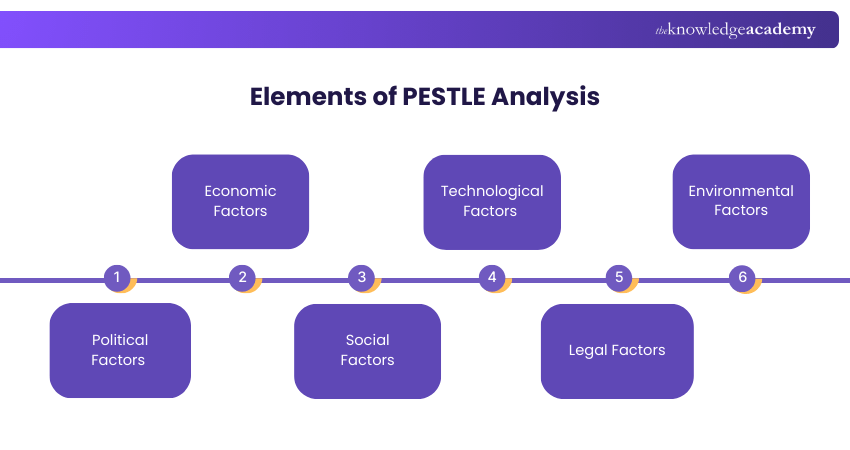
1) Political Factors
These are about how the government affects businesses. They include stability, trade rules, taxes, and spending. When governments change their plans, it can change business conditions. This makes political factors important for planning ahead.
2) Economic Factors
The economy affects how well businesses do. Things like interest rates, inflation, jobs, exchange rates, and costs all matter. Watching these helps companies stay prepared and steady through good and bad times.
3) Social Factors
This looks at people and their habits. It covers culture, age groups, education, lifestyles, and attitudes. Knowing these helps businesses adjust products, services, and marketing to what customers want.
4) Technological Factors
This is about new technology and how it changes work. It includes innovation, automation, artificial intelligence, and research. It also covers new ways of making and delivering goods. Keeping up with technology helps companies stay ahead.
5) Legal Factors
These are the laws businesses must follow. They include work rules, consumer rights, safety standards, and trade limits. Legal rules are not optional. Breaking them can lead to penalties.
6) Environmental Factors
This is about caring for the planet. It includes climate change, cutting carbon use, and reducing waste. Businesses are expected to act responsibly and follow green practices to keep trust and meet expectations.
Bridge the gap between business needs and tech solutions with ease. Sign up for our BCS Practitioner Certificate in Requirements Engineering today!
Why Do I Need to Conduct a PESTLE Analysis?
The recent years have brought rapid change and uncertainty, from global health crises and natural disasters to economic instability, inflation and geopolitical conflict. These external forces have had a direct impact on organisations across every sector, regardless of their size or maturity.
A PESTLE Analysis can help you make sense of this uncertainty by gauging external influences that could affect your organisation's performance and direction. Rather than reacting to change, it enables you to anticipate challenges and develop strategies to reduce potential risks.
How to do a PESTLE Analysis?
Start by bringing together people from different parts of your business to share ideas. Having many views helps you spot all outside factors that may affect you. Working together at the start gives the analysis a solid base.
Then speak with outside groups like customers, suppliers, distributors and advisers. They can give useful insights about market trends and risks. Mixing inside and outside views makes the analysis stronger and more accurate.
Finally, back up each point with research and facts. Rate each factor for how likely it is and how big its effect could be. Keep refining and ranking until you have a clear list for all six areas.
Advantages of PESTLE Analysis for Businesses
A big part of learning What is PESTLE Analysis is gaining a deep insight into its benefits. Using it offers several clear advantages for organisations: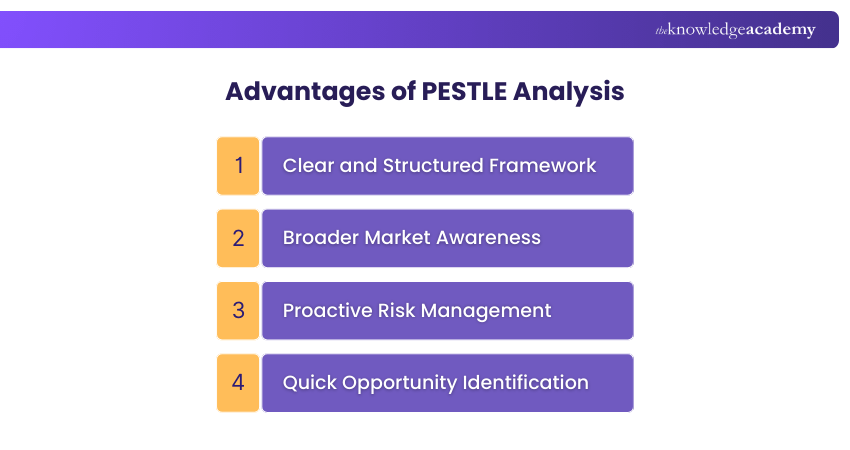
1) It provides a simple, easy-to-use framework that can be smoothly integrated into strategic planning.
2) The analysis also helps teams develop a broader understanding of the external business environment and how current events may influence organisational decisions.
3) It enables organisations to anticipate potential threats, plan risk and mitigation strategies
4) It helps identify emerging opportunities that can be leveraged for growth
Disadvantages of PESTLE Analysis for Businesses
Although a PESTLE Analysis is a valuable strategic tool, it does have some limitations:
1) The depth of the analysis can vary widely, making it easy to either oversimplify insights or rely on incomplete information.
2) On the other hand, collecting too much data can make the process overwhelming.
3) This can lead to a sort of analysis paralysis where it becomes difficult to decide on next steps.
4) PESTLE focuses only on external factors and does not evaluate internal strengths or weaknesses.
Explore how to identify, assess, and evaluate Information Risks with our BCS Practitioner Certificate in Information Risk Management Training – Sign up today!
Best Practices for Conducting PESTLE Analysis
A PESTLE Analysis has the most significant impact when applied early in strategic planning. To gain maximum value, apply the following best practices:
1) Carry out the PESTLE Analysis during the pre-planning phase alongside a SWOT Analysis.
2) Use PESTLE findings to shape the SWOT by narrowing down external opportunities and threats.
3) Analyse each PESTLE factor in detail to uncover advantages to leverage and risks to manage.
4) Review the analysis regularly; ideally every three years or whenever the SWOT is updated.
5) Monitor market trends and current events annually to support timely strategic adjustments.
Conclusion
A proper understanding of What is PESTLE Analysis is essential because it helps organisations read the signals that shape their future. By understanding the political, economic, social, technological, legal, and environmental forces, leaders can plan with confidence and adapt faster. When used wisely, it becomes less of a framework and more of a strategic compass for sustainable decisions.
Register with our Business Analysis Courses and learn for lasting business excellence
Frequently Asked Questions
How Does a PESTLE Analysis Help a Business to Succeed?

A PESTLE Analysis helps a business succeed by providing a clear understanding of the external market forces shaping their operations. By keeping the analysis focused, the organisation can extract meaningful insights, apply findings effectively and monitor changes regularly to stay competitive.
Where Does PESTLE Analysis Fit into Strategic Planning?
PESTLE Analysis fits at the early stages of strategic planning. This is where organisations assess the external factors that may influence their future decisions. It informs direction-setting, supports risk identification and feeds into tools like SWOT to shape realistic, well-informed strategies.
What are the other resources and offers provided by The Knowledge Academy?
The Knowledge Academy takes global learning to new heights, offering over 3,000+ online courses across 490+ locations in 190+ countries. This expansive reach ensures accessibility and convenience for learners worldwide.
Alongside our diverse Online Course Catalogue, encompassing 19 major categories, we go the extra mile by providing a plethora of free educational Online Resources like Blogs, eBooks, Interview Questions and Videos. Tailoring learning experiences further, professionals can unlock greater value through a wide range of special discounts, seasonal deals, and Exclusive Offers.
What is the Knowledge Pass, and how does it work?
The Knowledge Academy’s Knowledge Pass, a prepaid voucher, adds another layer of flexibility, allowing course bookings over a 12-month period. Join us on a journey where education knows no bounds.
What are related courses and blogs provided by The Knowledge Academy?
The Knowledge Academy offers various Business Analysis Courses, including BCS Practitioner Certificate in Requirements Engineering, BCS Business Analysis Diploma Oral Preparation Workshop, and BCS Practitioner Certificate in Digital Product Management. These courses cater to different skill levels, providing comprehensive insights into Business Analysis Services.
Our Business Analysis Blogs cover a range of topics related to PESTLE Analysis, offering valuable resources, best practices, and industry insights. Whether you are a beginner or looking to advance your Business Analysis skills, The Knowledge Academy's diverse courses and informative blogs have got you covered.

The Knowledge Academy


Global Training Provider
The Knowledge Academy is a world-leading provider of professional training courses, offering globally recognised qualifications across a wide range of subjects. With expert trainers, up-to-date course material, and flexible learning options, we aim to empower professionals and organisations to achieve their goals through continuous learning.

Upcoming Business Analysis Resources Batches & Dates
Date
 BCS Certificate in Business Analysis Practice
BCS Certificate in Business Analysis Practice
Mon 26th Oct 2026

 If you wish to make any changes to your course, please


