


 Top Rated Course

We may not have the course you’re looking for. If you enquire or give us a call on + 1-866 272 8822 and speak to our training experts, we may still be able to help with your training requirements.
Conditional Probability: Formula, Steps to Calculate & Examples
Lily Turner 09 February 2026Conditional Probability is the likelihood of an event happening, assuming that another related event has already occurred. It helps us understand how the occurrence of one event influences the chances of another event. It calculates the probability based on new information, and it is important to adjust the probability accordingly.

Training Outcomes Within Your Budget!
We ensure quality, budget-alignment, and timely delivery by our expert instructors.
Table of Contents

Have you ever tried to predict something, but you already knew a little bit about the situation? That’s exactly where Conditional Probability comes into play! It helps us determine the likelihood of an event happening when we have extra information about something else that has already occurred.
In this blog, we’re going to dive into the world of Conditional Probability, breaking down the formula, showing you exactly how to calculate it, and giving you examples that are fun and easy to understand. Let’s make predicting events more exciting and a lot less confusing! Ready to learn how it works? Let’s get started!
Table of Contents
1) What is Conditional Probability?
2) Conditional Probability Formula
3) How to Calculate Conditional Probability?
4) Conditional Probability Examples
5) Practical Uses of Conditional Probability
6) Properties of Conditional Probability
7) Connecting Conditional Probability and Bayes' Theorem
8) Comparing Conditional Probability with Joint and Marginal Probability
9) What is the Difference Between Probability and Conditional Probability?
10) Conclusion
What is Conditional Probability?
Conditional Probability is a concept that analyses how the probability of one event's occurrence affects the occurrence of its succeeding one. In simple words, it's the way of influencing one event over the latter.
For example, if today it is cloudy (assuming it is event A), then the probability of occurrence of rain tomorrow (event B) is directly influenced by the preceding day of event A (when the day was cloudy). Conditional Probability is denoted as P(A∣B).

How to Calculate Conditional Probability?
Conditional Probability is the chance of one event happening, given that we know another event has already occurred. It helps us determine how the probability of an event changes when we have additional information about another event.
Key points to calculate Conditional Probability:
Conditional Probability: Focuses on the probability of one event happening, given that another event is already true.
Formula:
a) P(A∣B): Probability of event A happening given B.
b) P(A∩B): Probability that both A and B happen at the same time.
c) P(B): Probability of event B happening.

Requirement: The probability of event BBB must be greater than zero (i.e., P(B)>0)
Steps:
a) Find the joint probability P(A ∩ B) — the probability both events occur.
b) Find the probability P(B) — the probability of event B.
c) Use the formula to calculate P(A∣B)
Conditional Probability Formula
The Conditional Probability is expressed as:
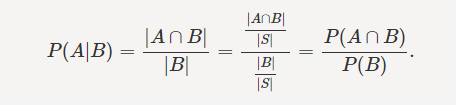
This means that if the Probability of event A, given that event B has already occurred, is equal to the probability of both A and B occurring simultaneously (A ∩ B), which are divided by the probability of event B.
Conditional Probability Examples
The one example is already explained earlier the other examples are:
1) Rolling a Die
Suppose you roll a fair six-sided die. If you want to find the probability of rolling a 6, given that the number rolled is even, you first identify all the even numbers: 2, 4, and 6.
1) The total number of even outcomes = 3 (2, 4, and 6)
2) The favourable outcome = 1 (rolling a 6)
Thus, the Conditional Probability is 1/3.
2) Marbles in a Bag
Imagine you have a bag containing 3 red marbles and 2 blue marbles. You want to find the probability of drawing a blue marble, given that the marble drawn is not red.
1) The total number of non-red marbles = 2 (since only blue marbles remain)
2) The number of favourable outcomes = 2 (both are blue)
Thus, the probability is 2/2 = 1 (certainty).
3) Multiple Conditional Probabilities
Suppose you have a standard deck of 52 cards. If you want to find the probability of drawing a heart, given that the card drawn is red, follow these steps:
1) The total number of red cards = 26 (13 hearts + 13 diamonds)
2) The number of favourable outcomes = 13 (hearts)
Thus, the Conditional Probability is 13/26 = 1/2.
Optimise data for accurate forecasts with our Predictive Analytics Course register today!
Practical Uses of Conditional Probability
Conditional Probability is used in several applications, ranging from medicinal to finance disciplines. A few practical uses of Conditional Probability are:

1) Finance Applications: Conditional Probability is used by investors to analyse investment risks under the given market conditions. This ability helps to make seamless and data-driven decisions.
2) Medical Diagnostics: Healthcare professionals utilise the applications of Conditional Probability to evaluate the probability of diseases based on the symptoms and test results.
3) Machine Learning Models: Bayesian inference, Naive Bayes, and other similar ML models use Conditional Probability concepts to enhance their prediction capabilities, helping them boost their work in applications like spam detection.
Properties of Conditional Probability
There are numerous properties of Conditional Probability. A few of its primary properties are described below:
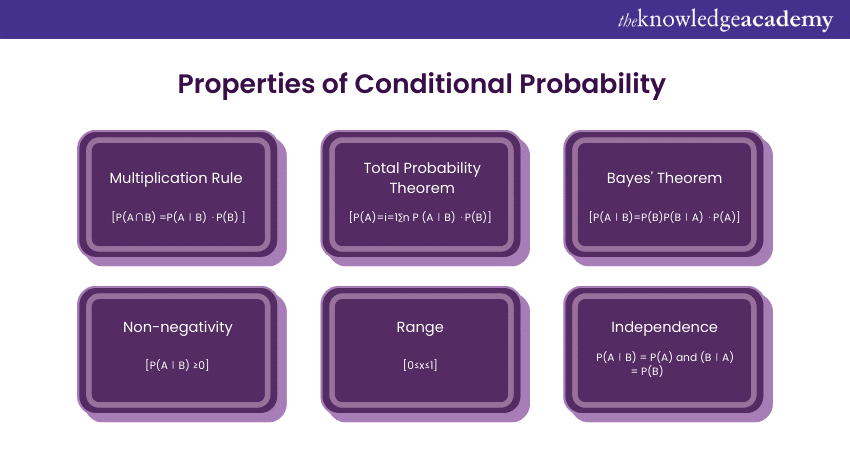
1) Multiplication Rule: The joint probability of events A and B occurring simultaneously can be expressed as

2) Total Probability Theorem: If B1, B2 …, Bn are mutually exclusive and exhaustive events, then the probability of any event A can be expressed in the form of
3) Bayes Theorem: The Bayes theorem provides a mathematical framework to redefine probabilities based on new evidence. It is denoted using the formula:

The Bayes Theorem formula is largely useful in reverse reasoning and is widely applied in fields such as statistics and machine learning.
4) Non-negativity: Conditional probabilities are always non-negative. This means:
P(A∣B) ≥0
5) Range: The value of Conditional Probability ranges from 0 to 1, which is
0≤x≤1.
6) Independence: If events A and B are independent, then

Connecting Conditional Probability and Bayes' Theorem
Bayes Theorem and Conditional Probability are closely connected concepts pertaining to Probability theory. The Bayes Theorem offers numerous ways to update probabilities on the basis of new evidence. It allows you to perform the reverse conditional probabilities, helping find P(B|A) when you already have P(A|B), P(A) and P(B).
The formula for Bayes Theorem is given as:

Develop insightful predictive models with our Data Mining Training- book your seats now!
Comparing Conditional Probability with Joint and Marginal Probability
Conditional, joint and marginal probability are largely interconnected. Where marginal probability gives us a broader overview of the formula, joint and conditional probabilities offer deeper insights into the relationship between events. It is important to understand their critical functions with respect to statistical analysis.
a) Joint Probability: Joint Probability refers to the probability of two events happening together. For instance, the probability of flipping a coin and rolling a die at the same time is a joint probability.
b) Marginal Probability: Marginal probability is the probability of the occurrence of a single event, irrespective of the other evolving factors. It can be derived from the joint probability by summing up all the possible outcomes of the other event(s).
Analyse data using decision trees- register today for our Decision Tree Modeling Using R Training!
What is the Difference Between Probability and Conditional Probability?
Probability refers to the likelihood of a single event occurring without considering any other events. It is a fundamental measure that determines the chance of an event happening, such as rolling a specific number on a die or drawing a particular card from a deck. Probability is calculated based on the total number of possible outcomes.
Conditional Probability, on the other hand, measures the likelihood of an event occurring given that another event has already happened. It examines how the occurrence of one event influences the probability of a second event.
Conclusion
We hope you understand Conditional Probability. This powerful tool enables seamless predictive analysis by allowing you to evaluate events systematically while incorporating prior occurrences. Moreover, gaining insight into its formula, practical applications, and properties enhances your data-driven decision-making skills. Whether you are working in finance, Independent Events in Probability, or Machine Learning (ML), mastering these concepts can significantly improve your analytical capabilities.
Extract progressive insights from textual data- kickstart your Text Mining Training now!
Frequently Asked Questions
How Can Conditional Probability Be Used to Determine Unconditional Probability?

You need to use the Total Probability Theorem concept by adding all possible probabilities under multiple given conditions. Then, you need to multiply each Conditional Probability by its corresponding event probability and add these results together. This way, you can find the unconditional probability from its counterpart.
What are the Rules of Conditional Probability?
Conditional Probability rules include:
1) The Multiplication Rule links the probability of two events.
2) Bayes' Theorem calculates reverse probabilities by updating with new information.
3) Independence means one event doesn't affect the probability of the other.
What are the Other Resources and Offers Provided by The Knowledge Academy?
The Knowledge Academy takes global learning to new heights, offering over 3,000+ online courses across 490+ locations in 190+ countries. This expansive reach ensures accessibility and convenience for learners worldwide.
Alongside our diverse Online Course Catalogue, encompassing 19 major categories, we go the extra mile by providing a plethora of free educational Online Resources like Blogs, eBooks, Interview Questions and Videos. Tailoring learning experiences further, professionals can unlock greater value through a wide range of special discounts, seasonal deals, and Exclusive Offers.
What is The Knowledge Pass, and How Does it Work?
The Knowledge Academy’s Knowledge Pass, a prepaid voucher, adds another layer of flexibility, allowing course bookings over a 12-month period. Join us on a journey where education knows no bounds.
What are the Related Courses and Blogs Provided by The Knowledge Academy?
The Knowledge Academy offers various Data Science Courses, including Probability And Statistics For Data Science Training, Predictive Analytics Course, and Text Mining Training. These courses cater to different skill levels, providing comprehensive insights into Regression Analysis.
Our Data, Analytics & AI Blogs cover a range of topics related to data science, analytics, and artificial intelligence, offering valuable resources, best practices, and industry insights. Whether you are a beginner or looking to advance your technical skills in data analysis and machine learning, The Knowledge Academy's diverse courses and informative blogs have got you covered.

Lily Turner


Senior AI/ML Engineer and Data Science Author
Lily Turner is a data science professional with over 10 years of experience in artificial intelligence, machine learning, and big data analytics. Her work bridges academic research and industry innovation, with a focus on solving real-world problems using data-driven approaches. Lily’s content empowers aspiring data scientists to build practical, scalable models using the latest tools and techniques.
View Detail
Upcoming Data, Analytics & AI Resources Batches & Dates
Date
 Probability and Statistics for Data Science Training
Probability and Statistics for Data Science Training
Thu 8th Oct 2026

 If you wish to make any changes to your course, please


