


 Top Rated Course


We may not have the course you’re looking for. If you enquire or give us a call on + 1-866 272 8822 and speak to our training experts, we may still be able to help with your training requirements.
Adobe Experience Manager vs Sitecore: Understanding the Differences
Richard Harris 21 February 2026Explore the distinctions between Adobe Experience Manager and Sitecore to make informed choices in your digital journey. Uncover the unique features and capabilities that set Adobe Experience Manager vs Sitecore apart, guiding you towards the ideal platform for your digital needs.
Home
 Resources
Office Applications
Adobe Experience Manager vs Sitecore: Understanding the Differences
Resources
Office Applications
Adobe Experience Manager vs Sitecore: Understanding the Differences
Resources
Office Applications
Adobe Experience Manager vs Sitecore: Understanding the Differences

Training Outcomes Within Your Budget!
We ensure quality, budget-alignment, and timely delivery by our expert instructors.
Table of Contents
Adobe Experience Manager (AEM) and Sitecore stand out as two formidable contenders in terms of digital experience platforms. Both platforms are robust solutions that empower organisations to deliver seamless and engaging digital experiences. In this comprehensive blog, we'll delve into the critical aspects of Adobe Experience Manager vs Sitecore to help you decide which platform aligns better with your needs.
Table of Contents
1) What is Adobe Experience Manager (AEM)?
2) What is Sitecore?
3) Differences between Adobe Experience Manager and Sitecore
4) Reasons to choose AEM
5) Reasons to choose Sitecore
6) Conclusion
What is Adobe Experience Manager (AEM)?
Adobe Experience Manager, often abbreviated as AEM, is a comprehensive content management solution that empowers businesses to create, manage, and optimise digital experiences across various channels. Developed by Adobe, AEM combines web content management, digital asset management, and online community features to provide a unified platform for creating and managing digital content.
AEM offers a user-friendly interface that enables content creators, marketers, and developers to collaborate seamlessly. The platform leverages Adobe's creative tools, facilitating the integration of rich media and interactive content into digital experiences. Adobe Experience Manager Features make it renowned for its scalability and flexibility, making it suitable for businesses of all sizes.
What is Sitecore?
Sitecore is a versatile digital experience platform that goes beyond content management to offer a comprehensive suite of features for personalised marketing and e-commerce. Sitecore delivers personalised and contextually relevant experiences to users across various touchpoints.
Sitecore provides a unified platform that combines web content management, marketing automation, and analytics. It enables organisations to tailor content based on user behaviour, ensuring a more engaging and targeted experience. Sitecore's modular architecture and extensibility make it a preferred choice for businesses seeking a customisable and scalable solution.
Ready to take your skills to the next level? Join our Adobe Trainingand become an expert. Sign up today!
Differences between Adobe Experience Manager and Sitecore
Delve into the nuanced differences between both platforms to grasp their unique features and functionalities.
1) Management of content
AEM and Sitecore excel in content management but approach it differently. AEM emphasises a flexible and component-based approach to content creation. Content is created and managed using a building-block methodology, allowing for high customisation.
On the other hand, Sitecore offers a content tree structure that enables users to organise and manage content hierarchically. The platform's intuitive interface simplifies content creation and management tasks, making it a preferred choice for organisations with diverse content needs.
2) Customisation
When it comes to customisation, Sitecore is often praised for its flexibility. The platform's modular architecture allows developers to create customised solutions tailored to business requirements. Sitecore's focus on personalisation and targeting further enhances its customisation capabilities, enabling businesses to deliver highly tailored experiences.
AEM, too, offers significant customisation options. The platform leverages Adobe's Creative Cloud, seamlessly integrating creative assets into digital experiences. AEM's component-based architecture enables developers to build custom components for unique design and functionality.
3) Digital marketing strategies
Sitecore strongly emphasises digital marketing, providing a suite of tools for creating and executing personalised marketing campaigns. Its marketing automation features and analytics and personalisation capabilities empower marketers to deliver targeted content to specific audiences.
AEM, being part of the Adobe Marketing Cloud, also excels in digital marketing. The platform integrates seamlessly with Adobe Analytics and Adobe Target, offering a comprehensive solution for creating and optimising marketing strategies. AEM's dynamic content delivery capabilities contribute to creating personalised and targeted marketing campaigns.
4) Technological solutions
Both AEM and Sitecore leverage modern technologies to deliver robust digital experience solutions. Sitecore, built on the .NET framework, is preferred for organisations investing in Microsoft technologies. Its modular architecture and extensive API support enable seamless integration with third-party systems and technologies.
AEM, on the other hand, is built on Java and relies on Apache Sling for content delivery. The platform's architecture is designed to support microservices, making it suitable for organisations embracing a microservices-based approach to development. AEM's compatibility with Java technologies positions it as a versatile solution for enterprises with diverse technology stacks.
5) Marketing suite
While both platforms offer a comprehensive set of marketing tools, Sitecore is often recognised for its integrated marketing suite. Sitecore's marketing automation, analytics, and personalisation features work cohesively to create and optimise marketing campaigns. The platform's ability to provide a unified view of customer interactions enhances marketing teams' ability to make data-driven decisions.
AEM, as part of the Adobe Marketing Cloud, provides a powerful marketing suite with integrated analytics and optimisation tools. The seamless integration with other Adobe products, such as Adobe Analytics and Adobe Target, ensures a holistic approach to marketing strategies.
Stay at the forefront of adobe skills with our Adobe Experience Manager Training- Join today!
6) Delivery across multiple channels
In the era of multichannel experiences, both AEM and Sitecore recognise the importance of delivering content seamlessly across various channels. AEM's responsive design capabilities and adaptive content delivery ensure that digital experiences look and function flawlessly across desktops, tablets, and mobile devices.
Sitecore, too, excels in delivering content across multiple channels. Its ability to create and manage content for different devices and touchpoints contributes to a consistent and cohesive brand experience. Sitecore's Experience Editor simplifies the process of optimising content for other channels, ensuring a smooth and efficient multichannel delivery.
7) Adaptability
Adaptability is a crucial factor in choosing a digital experience platform, considering the evolving nature of technology and business requirements. Sitecore's modular architecture and extensibility make it highly adaptable to changing business needs. The platform's ability to integrate with third-party systems and technologies ensures a seamless and future-proof solution.
AEM, with its emphasis on scalability and flexibility, is also designed to adapt to evolving business requirements. The platform's support for microservices architecture and compatibility with Java technologies positions it as a scalable solution for enterprises with growing and changing needs.
8) Seamless Integration
Integration capabilities are paramount for a digital experience platform to function effectively within an organisation's existing ecosystem. Sitecore's extensive support for integrations, especially within the Microsoft technology stack, makes it a preferred choice for enterprises with a Microsoft-centric IT infrastructure.
AEM, being part of the Adobe ecosystem, seamlessly integrates with other Adobe products, including Adobe Creative Cloud, Adobe Analytics, and Adobe Target. The platform's support for standard protocols and APIs ensures smooth integration with third-party systems, making it adaptable to diverse technology environments.
9) Community of developers
The developer community plays a crucial role in the ongoing support and development of a digital experience platform. Sitecore boasts a vibrant and active developer community. The availability of documentation, forums, and community-driven resources contributes to the platform's continuous improvement and innovation.
AEM also has a robust developer community, supported by Adobe's commitment to providing resources and support. The platform's extensive documentation and online forums enable developers to collaborate, share knowledge, and address challenges collectively.
10) Key flagship products
Both AEM and Sitecore offer additional products and solutions to complement their core digital experience platforms. AEM's flagship products include Adobe Target for personalisation and Adobe Analytics for in-depth analytics and insights. These products, when integrated with AEM, create a comprehensive digital marketing suite.
Sitecore's flagship products include Sitecore Experience Commerce for e-commerce capabilities and Sitecore Experience Cloud for a unified view of customer interactions. These products extend Sitecore's functionality, making it a comprehensive solution for organisations looking to integrate e-commerce seamlessly into their digital experiences.
11) Support from community and partners
The support ecosystem around a digital experience platform is instrumental in ensuring its success within an organisation. Sitecore benefits from a robust network of partners and a global community of developers and users. The availability of certified Sitecore partners enhances the platform's implementation and support capabilities.
AEM, backed by Adobe's global presence, offers extensive support through its network of partners and a dedicated community. Adobe's commitment to providing resources, training, and support contributes to AEM's reliability as a digital experience platform.
12) Pricing and total cost of ownership
Pricing is a significant consideration for organisations evaluating digital experience platforms. Both AEM and Sitecore operate on a subscription-based pricing model, and the total cost of ownership depends on factors such as implementation complexity, customisation requirements, and ongoing support.
Sitecore is often perceived as a premium solution, and its pricing reflects the platform's extensive features and capabilities. AEM, while also positioned as a premium solution, offers flexibility in pricing based on the specific needs and scale of the organisation. In comparison, Adobe Analytics Features provide extensive capabilities for organisations looking to optimise their marketing strategies.
Unlock the possibilities of career in Adobe with our Adobe Edge Animate Training- Sign up today!
Reasons to choose AEM
Let’s look at some of the reasons to choose AEM for your company:
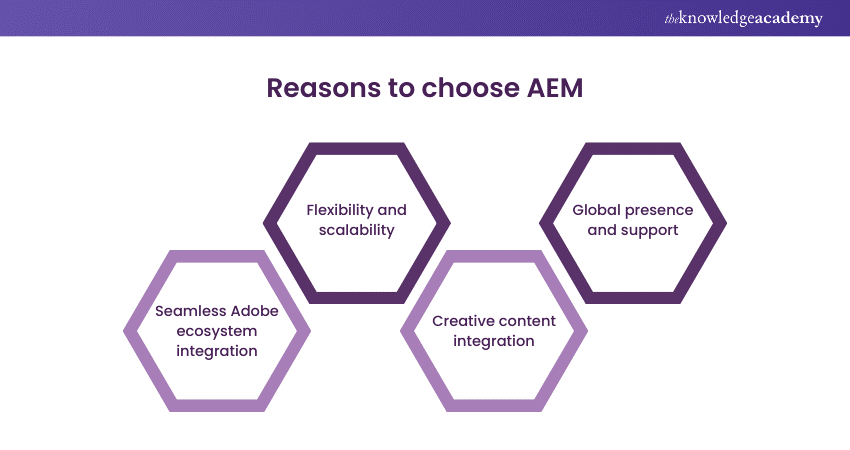
1) Seamless Adobe ecosystem integration: AEM's integration with other Adobe products, including Adobe Creative Cloud, Adobe Analytics, and Adobe Target, creates a seamless and comprehensive digital marketing suite.
2) Flexibility and scalability: AEM's component-based architecture and support for microservices make it a flexible and scalable solution for organisations with evolving digital experience needs.
3) Creative content integration: Leveraging Adobe's Creative Cloud, AEM allows for the seamless integration of creative assets into digital experiences, enhancing the visual appeal and interactivity of content.
4) Global presence and support: Backed by Adobe's global presence, AEM offers extensive support through its network of partners and a dedicated community, ensuring reliable assistance for implementation and ongoing maintenance.
Unlock the possibilities of Adobe skills with our Adobe Muse Training– Sign up today!
Reasons to choose Sitecore
Let’s look at some of the reasons to choose Sitecore for your company:

1) Integrated marketing suite: Sitecore's comprehensive marketing suite, including marketing automation, analytics, and personalisation, makes it a preferred choice for organisations focusing on targeted and personalised marketing strategies.
2) Versatility with Microsoft technologies: Sitecore's compatibility with the .NET framework and its seamless integration within Microsoft technology ecosystems make it a versatile solution for enterprises with a Microsoft-centric IT infrastructure.
3) Modular architecture for customisation: Sitecore's modular architecture and extensibility provide developers with the flexibility to create custom solutions tailored to specific business requirements, ensuring a high degree of customisation.
4) Active developer community: Sitecore boasts a vibrant and active developer community, contributing to continuous improvement, innovation, and the availability of resources for troubleshooting and development.
Master the skills to work with adobe with our Lightroom Course– Sign up today!
Conclusion
Organisations should carefully evaluate their requirements, conduct thorough assessments, and leverage trial versions to experience firsthand the capabilities of both platforms. Whether it's the adaptability, customisation, or marketing prowess, Adobe Experience Manager and Sitecore have proven themselves to be robust solutions for crafting exceptional digital experiences in the modern digital landscape. If AEM doesn’t align with your specific needs, exploring Adobe Experience Manager Alternatives could provide a more tailored fit.
Learn more about Adobe audition with our Adobe Audition Course– Join today!make it renowned for its scalability and flexibility, making it suitable for businesses of all sizes.
Frequently Asked Questions
Which platform, Adobe Experience Manager vs Sitecore, is more suitable for extensive customisation?

Both AEM and Sitecore provide robust customisation options, but their approaches differ. Sitecore is known for its modular architecture, allowing developers to create highly tailored solutions by adding or modifying modules. On the other hand, AEM leverages a component-based design, offering flexibility in creating and customising components for unique design and functionality. Both platforms cater to businesses with diverse customisation needs, and the choice depends on the specific requirements and preferences of the organisation.
How do Adobe Experience Manager and Sitecore differ in terms of pricing models?
Both AEM and Sitecore operate on a subscription-based pricing model. Sitecore is perceived as premium, reflecting its extensive features. AEM, while also premium, offers flexibility based on organisational scale and needs.
What are the other resources and offers provided by The Knowledge Academy?
The Knowledge Academy takes global learning to new heights, offering over 3,000+ online courses across 490+ locations in 190+ countries. This expansive reach ensures accessibility and convenience for learners worldwide.
Alongside our diverse Online Course Catalogue, encompassing 19 major categories, we go the extra mile by providing a plethora of free educational Online Resources like Blogs, eBooks, Interview Questions and Videos. Tailoring learning experiences further, professionals can unlock greater value through a wide range of special discounts, seasonal deals, and Exclusive Offers.
What is Knowledge Pass, and how does it work?
The Knowledge Academy’s Knowledge Pass, a prepaid voucher, adds another layer of flexibility, allowing course bookings over a 12-month period. Join us on a journey where education knows no bounds.
What are related Adobe courses and blogs provided by The Knowledge Academy?
The Knowledge Academy offers various Adobe Courses including InDesign Course, Adobe Connect, Adobe Dreamweaver and Adobe acrobat. These courses cater to different skill levels, providing comprehensive insights into Adobe Experience Manager Skills.
Our Office Application Blogs covers a range of topics related to Adobe and graphic skills, offering valuable resources, best practices, and industry insights. Whether you are a beginner or looking to advance your App and Web Development skills, The Knowledge Academy's diverse courses and informative blogs have you covered.

Richard Harris


Senior Full Stack Developer and Technology Educator
Richard Harris is a highly experienced full-stack developer with deep expertise in both frontend and backend technologies. Over his 12-year career, he has built scalable web applications for startups, enterprises and government organisations. Richard’s writing combines technical depth with clear explanations, ideal for developers looking to grow in modern frameworks and tools.


 If you wish to make any changes to your course, please


