


 Top Rated Course

We may not have the course you’re looking for. If you enquire or give us a call on +44 1344 203 999 and speak to our training experts, we may still be able to help with your training requirements.
What is Passive Income? A Complete Guide
James Smith 23 February 2026Passive Income is money earned with minimal ongoing effort, typically from investments, rental properties, dividends, or digital products. It enables individuals to build steady revenue streams, diversify financial sources, grow wealth over time, and gain long-term financial independence with limited active involvement.

Training Outcomes Within Your Budget!
We ensure quality, budget-alignment, and timely delivery by our expert instructors.
Table of Contents
Earning money while you sleep might sound like a dream, but it’s possible through smart financial strategies. Understanding What is Passive Income is the first step to building wealth with minimal daily effort.
This blog explains the different types of passive income, how to generate them, and ways to diversify your earnings. You’ll learn practical methods to grow steady revenue streams and achieve long-term financial freedom.
Table of Contents
1) What is Passive Income?
2) Types of Passive Income
3) How Does Passive Income Work?
4) Benefits and Challenges of Passive Income
5) How do you Make Money from Passive Income?
6) Examples of Passive Income as Part of a Business
7) Which Skill is Best for Passive Income?
8) How do I Start a Passive Income with no Money?
9) Common Myths about Passive Income
10) What is the Rule of 72 to Double Money?
11) What is the 7-3-2 rule?
12) Conclusion
What is Passive Income?
Passive Income is money earned with little to no daily effort once the initial work is done. Unlike active income, where you exchange time for money like a job or freelance gig, Passive Income keeps flowing even when you're not actively working.
It often involves an upfront investment of time, money, or skills. For example, writing an eBook, developing a mobile app, or buying rental property all require effort at the start. But once built, they can generate consistent revenue over time.
Key Areas:
1) Income earned with little ongoing effort
2) Not tied to active work hours
3) Requires initial time, money, or skill
4) Examples: rent, dividends, digital products
5) Builds long-term financial freedom
6) Scalable and sustainable income stream

Types of Passive Income
Passive Income may be a result of your own business activity, within a separate business venture, or even from fully non-business-related sources. The regulations of Passive Income and taxes imposed on the same are not similar in every country, and therefore, it is best to check with your taxation officer or other financial advisor. The key types are:
1) Part of Your Business
The Passive Income ideas involves the current business producing skills, knowledge, or resources as a product that customers can purchase without your active involvement. Such could be online courses, eBooks, or an automated service.
2) Separate Business Revenue
The investments in other businesses are also possible sources of Passive Income. This may be in the form of peer-to-peer lending or even in the form of becoming a partner or even a silent partner in a limited partnership. You receive a portion of the gains without any day-to-day management responsibilities.
3) Non-business Related
Personal investments in the form of stocks, rental property, or assets may also be generated as Passive Income. Passive earnings may also be obtained by using high-interest savings accounts or term deposits. It is worth noting that certain tax authorities apply the concept of interest and dividends as portfolio income, and not as traditional passive income.
Learn marketing fundamentals and boost your career with our Introduction to Marketing Training – Sign up now!
How Does Passive Income Work?
Understanding What Is Passive Income starts with knowing that it usually requires an initial investment of money and effort to create a self-sustaining revenue stream. An example of this would be the money that is inherited and invested to earn a dividend, or it could be spent on a vacation property, which earns rental income when not in use.
Intellectual property in the form of selling books or e-books, stock photography royalties, or invention licensing fees, or apps developed by you, are also examples of Passive Income. There are streams that involve capital, whereas there are ones that mostly depend on your time, skills, or creativity.
Common Passive Income Streams
Although there are many passive income ideas that can be used, most of them can be categorised into 4 broad groups:
1) Investments: Investments in stocks, bonds, mutual funds, or other investment instruments that give returns.
2) Bank Interest: Savings or term deposits with high-interest rates.
3) Rental Income: Dividends on properties that you have and rent.
4) Intellectual Property (IP): Royalties or licensing fees or online products based on your ability and creativity.
Create compelling campaigns and drive engagement with our Content Marketing Course – Join today!
Benefits and Challenges of Passive Income
Passive Income has become a popular goal for individuals seeking financial independence, time freedom, or supplemental earnings. But while the idea sounds appealing, it comes with both advantages and obstacles. Let’s break down the key benefits and challenges.

1) Benefits
Here are the benefits of Passive Income:
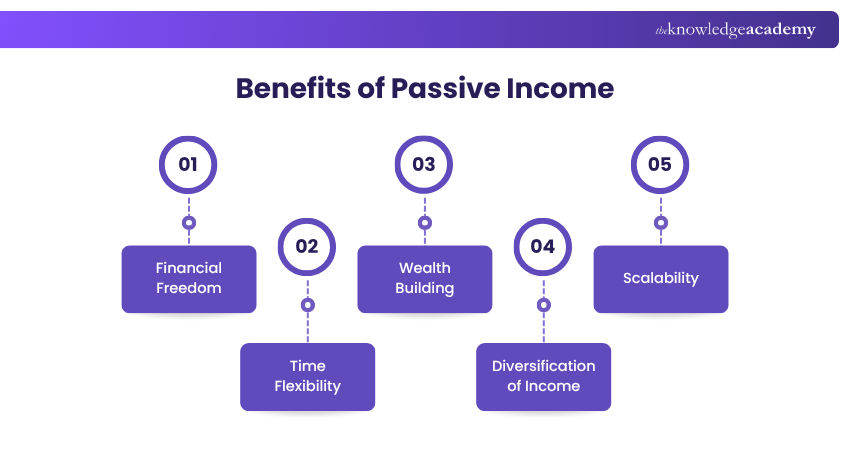
1) Financial Freedom: Passive Income can reduce your reliance on a 9-to-5 job, offering the freedom to make lifestyle choices without being tied to a paycheck.
2) Time Flexibility: Once set up, Passive Income streams often require minimal daily effort, freeing up your time for travel, hobbies, family, or other ventures.
3) Wealth Building: With consistent Passive Income, you can reinvest your earnings to grow your wealth steadily over time, potentially leading to early retirement.
4) Diversification of Income: It provides an extra financial cushion during job loss or economic downturns, adding stability through multiple revenue sources.
5) Scalability: Many Passive Income models, like digital products or online courses, can scale without significantly increasing your time investment.
2) Challenges
Here are some of the challenges of Passive Income:
1) High Initial Effort or Investment: Setting up Passive Income (e.g., buying property, building a blog, or writing a book) often requires upfront time, money, and expertise.
2) Long Wait for Returns: Many passive streams take months or even years before they generate meaningful profits, which can be discouraging for beginners.
3) Market Risk: Investments like stocks, rentals, or cryptocurrencies are subject to market fluctuations, which can impact your expected earnings.
4) Maintenance is Still Required: Truly "set-it-and-forget-it" income is rare. You may need to update content, manage tenants, or monitor performance regularly.
5) Learning Curve: From taxes to tech tools, navigating the setup and legal aspects of Passive Income can be complex without guidance or experienc
Plan, execute, and optimise campaigns effectively with our Strategic Marketing Course – Enrol now!
How do you Make Money from Passive Income?
Earning Passive Income means setting up systems or investing in opportunities that generate revenue with little daily effort. Here are some practical ways to get started:
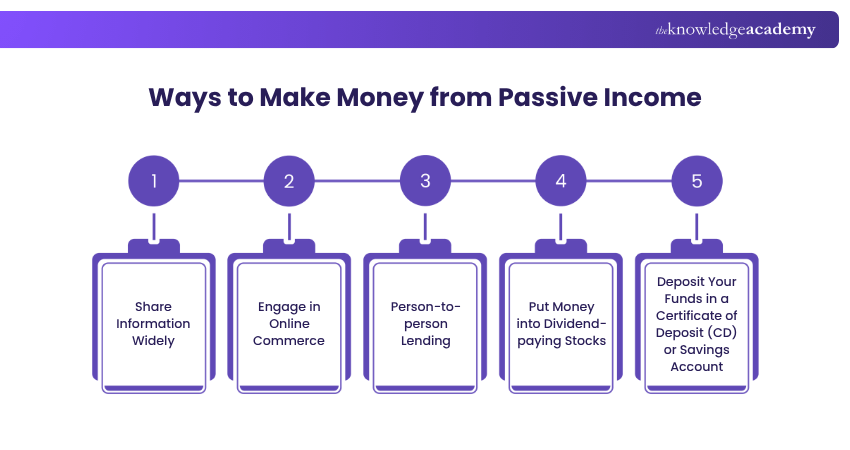
1) Share Information Widely
1) Turn your knowledge into income by sharing valuable information.
2) Create digital content like eBooks, online courses, podcasts, or YouTube videos.
3) Monetise through:
a) Ad revenue (e.g., YouTube ads)
b) Paid subscriptions (e.g., Patreon)
c) Direct sales (e.g., course platforms or eBook downloads)
4) Once created and promoted, content can earn continuously with minimal upkeep
5) Ideal for educators, creatives, or professionals with niche expertise
Example: A photography course you build once can earn money every time it’s downloaded.
2) Engage in Online Commerce
1) Start an online business with minimal overhead using models like:
a) Dropshipping stores
b) Print-on-demand (POD) brands
c) Affiliate marketing websites
2) No need for inventory management or shipping logistics.
3) These models can be automated, reducing daily workload.
4) Earn money when:
a) Customers buy products (you keep the profit margin)
b) Users click affiliate links and make purchases (you earn commissions)
5) Great for entrepreneurs who want a scalable, hands-off income stream.
Example: A niche blog recommending fitness gear with affiliate links to Amazon.
3) Person-to-person Lending
1) Invest in peer-to-peer (P2P) lending platforms to earn interest on your money
2) You loan funds to individuals or small businesses through a secure platform
3) Earn monthly repayments plus interest, creating a steady Passive Income stream
4) Requires minimal effort after initial investment but comes with moderate risk
5) Diversify across multiple loans to reduce risk exposure
Example: On a platform like Zopa or Funding Circle UK, you could invest £1,000 and earn 4–6% annual interest, repaid monthly by borrowers.
4) Put Money into Dividend-paying Stocks
1) Invest in stable, dividend-paying companies listed on stock exchanges
2) Dividends are regular profit payouts made to shareholders (usually quarterly)
3) You can reinvest dividends to buy more shares or withdraw them as income
4) This is a hands-off, long-term income strategy that can grow over time
5) Suitable for investors seeking steady returns with lower effort
Example: Buying shares in FTSE 100 companies that offer quarterly dividends.
5) Deposit Your Funds in a Certificate of Deposit (CD) or Savings Account
1) Choose a low-risk option by using Certificates of Deposit (CDs)
2) These options offer fixed interest rates over a set period
3) Ideal for earning passive, predictable income with minimal risk
4) Returns are generally lower than stocks, but your capital remains secure
5) Great for conservative investors or those new to Passive Income
Example: A £5,000 deposit in a 1-year fixed-rate savings account at 4% interest earns £200 passively.
Examples of Passive Income as Part of a Business
In case you are a business owner, you can make your knowledge, skills, and resources into a passive source of income. Whichever your sector, the knowledge that you have acquired can be an expertise that can be attained through creative means.
1) Profit on Your Knowledge and Skills
Business owners are able to generate income by sharing their skills:
1) Create a YouTube account with tutorials or tips on the industry
2) Offer downloadable products such as patterns, templates, or guides
3) Create eBooks, audiobooks, or audiobitcasts about your experience
4) Introduce online classes to learn skills in your major
5) Sell online products that are in your business segment
2) Capitalise on Your Resources
Your current assets will also earn you revenue without being put in motion:
1) Lease empty office space, parking, or automobiles
2) Turn outsourced services into in-house services that you can sell to others, such as an audio studio or marketing service
3) Affiliate commission transactions by promoting other people's products or services on your website
These strategies enable the owners of businesses to gain some income once the businesses are in operation, which would continue to offer a steady series of passive income in the long run.
Which Skill is Best for Passive Income?
The best skill for Passive Income is content creation and digital marketing. It opens the door to multiple income streams like blogging, YouTube, online courses, and Affiliate Marketing.
1) Low Startup Cost: You can begin with just a laptop and internet.
2) Scalable: A single blog post or video can earn years.
3) Multiple Revenue Channels: Ads, sponsorships, product sales, and affiliate links.
4) Automation-friendly: Once set up, platforms like websites or YouTube run passively.
5) Highly in-demand: Businesses also pay for content creators and marketers, boosting both active and Passive Income options.
Your marketing glow-up starts with our Mobile Marketing Course - Let’s make it unforgettable!
How do I Start a Passive Income With no Money?
You can start a Passive Income with no money. All it takes is time, consistency, and creativity and by using your skills and free platforms:
1) Start a YouTube Channel or Blog: Earn from ads and affiliate links
2) Try Affiliate Marketing: Promote products and earn commissions
3) Sell Digital Products: Offer templates or designs on Gumroad or Etsy
4) Upload Stock Content: Earn royalties from photos or music
Common Myths about Passive Income
Some of the common myths about Passive Income are:
1) “It’s 100% Hands-off”: Most streams need setup and occasional updates
2) “It Works Overnight”: It takes time to build and grow
3) “You Need Lots of Money”: Many options require little or no capital
4) “It’s Only for Tech Experts”: Anyone can learn with the right tools
5) “It’s Guaranteed Income”: All income streams carry some level of risk
What is the Rule of 72 to double money?
Rule 72 is a quick formula to estimate how long it takes to double your money at a fixed annual interest rate. Divide 72 by the interest rate. For example, at a 6% annual return, your money doubles in 12 years (72 ÷ 6 = 12).
What is the 7-3-2 rule?
The 7-3-2 rule is a budgeting guideline suggesting you invest 70% of your income, save 20%, and use 10% for insurance or risk protection. It promotes financial balance, wealth building, and long-term security.
Conclusion
Building multiple income streams doesn’t have to mean working around the clock. By leveraging your skills, resources, and investments, you can create earnings that keep flowing with minimal effort. Understanding What is Passive Income is key to unlocking financial freedom. Start small, stay consistent, and watch your wealth grow steadily over time.
Explore modern marketing strategies and techniques with our Marketing Courses – Join today!
Frequently Asked Questions
What Qualifies as Passive Income?

Passive Income is the money earned with minimal ongoing effort after the initial setup. This includes income from rental properties, dividends, royalties, or profits from a business where you're not actively involved in day-to-day operations. The key is that it generates revenue over time with little intervention.
What is Non-passive Income?
Non-passive Income, also called active income, is money earned through direct effort or labor. This includes wages, salary, tips, commissions, or profits from a business where you play an active role. Unlike Passive Income, Non-passive Income requires continuous time or effort to generate revenue.
What are the Other Resources and Offers Provided by The Knowledge Academy?
The Knowledge Academy takes global learning to new heights, offering over 3,000+ online courses across 490+ locations in 190+ countries. This expansive reach ensures accessibility and convenience for learners worldwide.
Alongside our diverse Online Course Catalogue, encompassing 17 major categories, we go the extra mile by providing a plethora of free educational Online Resources like Blogs, eBooks, Interview Questions and Videos. Tailoring learning experiences further, professionals can unlock greater value through a wide range of special discounts, seasonal deals, and Exclusive Offers.
What is The Knowledge Pass, and How Does it Work?
The Knowledge Academy’s Knowledge Pass, a prepaid voucher, adds another layer of flexibility, allowing course bookings over a 12-month period. Join us on a journey where education knows no bounds.
What are the Related Courses and Blogs Provided by The Knowledge Academy?
The Knowledge Academy offers various Marketing Courses including Marketing Budget Course, Strategic Marketing Training and Video Marketing Training. These courses cater to different skill levels, providing comprehensive insights into Customer Value Proposition.
Our Digital Marketing Blogs cover a range of topics offering valuable resources, best practices, and industry insights. Whether you are a beginner or looking to advance your Business Improvement skills, The Knowledge Academy's diverse courses and informative blogs have you covered.

James Smith


Digital Marketing Manager and Trainer
James Smith is a digital marketing professional with over a decade of experience in SEO, content strategy, paid media and analytics. He has supported both SMEs and global brands in transforming their digital presence. James’s writing and training are rooted in results-driven tactics and the latest marketing trends.
View Detail
Upcoming Digital Marketing Resources Batches & Dates
Date
 Passive Income Course
Passive Income Course
Thu 7th May 2026
Passive Income Course
Thu 30th Jul 2026
Passive Income Course
Thu 29th Oct 2026

 If you wish to make any changes to your course, please


