


 Top Rated Course

We may not have the course you’re looking for. If you enquire or give us a call on +44 1344 203 999 and speak to our training experts, we may still be able to help with your training requirements.
Total Cost of Ownership(TCO): Definition, Components, and Examples
Sophia Ellis 23 February 2026Total Cost of Ownership (TCO) is a full cost of acquiring, operating, and maintaining an asset over its entire lifecycle, including hidden expenses. It includes costs, such as installation, maintenance, repairs, training and more. By analysing TCO, businesses can make smart decisions on products or services for long-term value.
Home
 Resources
IT Infrastructure & Networking
Total Cost of Ownership(TCO): Definition, Components, and Examples
Resources
IT Infrastructure & Networking
Total Cost of Ownership(TCO): Definition, Components, and Examples
Resources
IT Infrastructure & Networking
Total Cost of Ownership(TCO): Definition, Components, and Examples

Training Outcomes Within Your Budget!
We ensure quality, budget-alignment, and timely delivery by our expert instructors.
Table of Contents
Every purchase or investment you make goes beyond the price tag. The real cost often lies in how much you are spending to use, maintain, and replace. This is where Total Cost of Ownership (TCO) comes. It helps to see the complete financial landscape of an asset, not just the upfront expenses, but all the hidden and long-term cost attached to it.
This method is used to measure the full lifecycle cost of a product, service, or asset from purchase to disposal. In this blog, you will learn about what is Total Cost of Ownership, its components, best practices, and more. Keep reading ahead!
Table of Contents
1) What is Total Cost of Ownership (TCO)?
2) How Does Total Cost of Ownership Work?
3) What are the Components of Total Cost of Ownership (TCO)?
4) Industries That Rely on Total Cost of Ownership Analysis?
5) Best Practices for Calculating Total Cost of Ownership (TCO)
6) Real-world Example of Total Cost of Ownership
7) Conclusion
What is Total Cost of Ownership (TCO)?
Total Cost of Ownership means the complete cost of acquiring and utilising an asset throughout its entire life cycle. It does not only include the initial purchase price but, the ongoing expenses related to operation, maintenance and disposal. It is important to consider long-term costs. This includes various matters, such as energy consumption, repairment, downtime, and replacement costs.
How Does Total Cost of Ownership Work?
Total Cost of Ownership begins its work by analysing every direct and indirect expenses linked to an asset. It assesses its expenses covering its entire life cycle. It can include costs, such as operational expenses, repair costs, annual taxes and maintenance charges. By adding all these together, you can view the real long-term value of an investment.
Businesses or companies utilise TCO to decide the worth or value of a business deal, product, or system. This is a crucial part of Return on Investment analysis, since it helps to identify which, choice offers the best value for long-term.
What are the Components of Total Cost of Ownership (TCO)?
To better understand Total Cost of Ownership, let’s look at its important components of below:
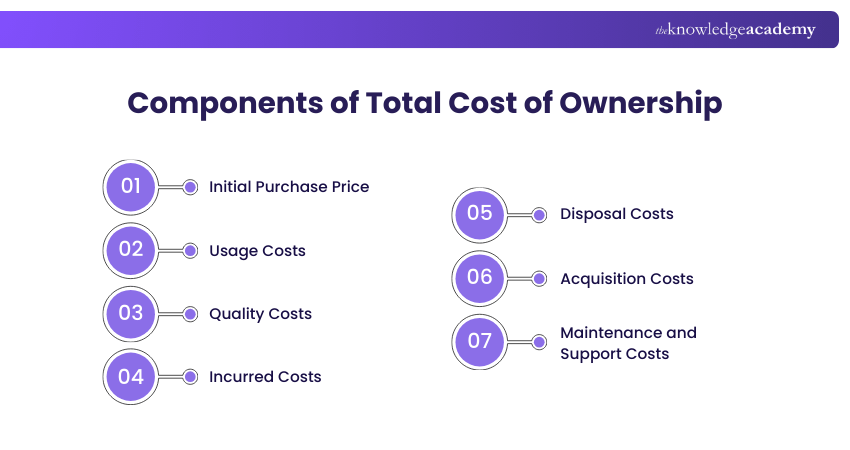
1) Initial Purchase Price
The Initial Purchase Price is the upfront cost of an asset, meaning the amount paid at the very beginning. While this figure is important, it represents only the starting point. A Total Cost of Ownership analysis emphasises that this is not the full cost of owning and using an asset over its entire lifespan.
2) Usage Costs
Usage Costs refer to the ongoing expenses tied to the daily operation of an asset. These include energy consumption, supplies, consumables, and other operational costs. Over time, these expenses accumulate, and a low-priced asset with high usage costs may end up being more expensive in the long run.
3) Quality Costs
Quality Costs refers to the expenses related to ensuring assets performance quality. It can also mean the costs incurred when the asset does not perform well. This includes defects in an asset, scrapped output, customer dissatisfaction etc.
4) Incurred Costs
Incurred Costs broaden the scope of expenses beyond regular usage and quality-related costs. These may include staff transition costs, upgrades, legal expenses, compliance requirements, and risk management activities. Such costs can arise unexpectedly and should be considered in long-term planning.
5) Disposal Costs
Disposal Costs are associated with the end of the asset’s life cycle. Such as, recycling, removal, replacement or disposal of equipment's. It allows an organisation to factor in what happens to an asset after it serves it usage purpose.
6) Acquisition Costs
Acquisition Costs refer to expenses incurred to bring an asset into the organisation and make it fully operational, beyond the purchase price. These may include delivery, configuration, installation, testing, and training.
7) Maintenance and Support Costs
Maintenance and Support Costs refer to the ongoing costs required to keep the asset functioning. This includes scheduled maintenance, repairs, spare parts, software updates etc. These types of costs extend for many years.
Optimise supply chains with SAP Material Management Training – Register today!
Industries That Rely on Total Cost of Ownership (TCO)
Total Cost of Ownership is used across various industries to support smarter financial and operational decision-making. Some well-known industries that rely on TCO include:
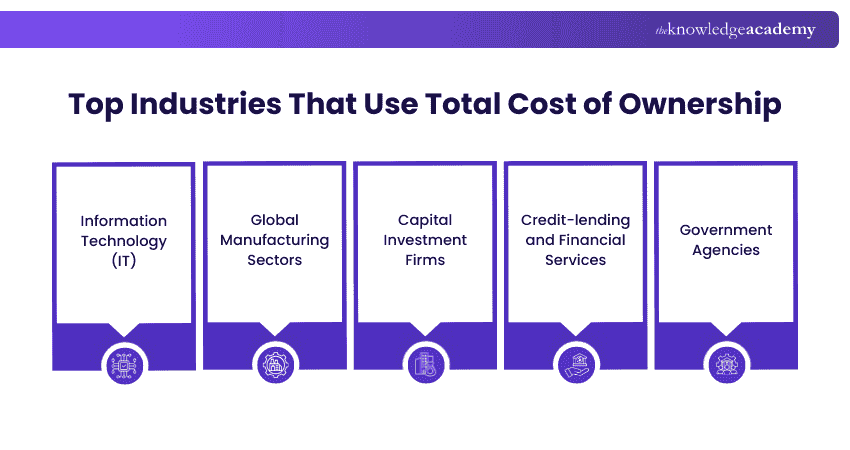
1) Information Technology (IT)
The IT industry widely utilises Total Cost of Ownership to analyse financial impact of deploying new hardware or software. It considers costs, such as installation, maintenance, employee training, system upgrades and replacements. It helps companies to select the optimal performing technologies.
2) Global Manufacturing Sectors
Global Manufacturers rely on TCO to understand the total cost of producing and delivering goods. This includes expenses such as shipping, customs duties, quality control, warehousing, and distribution. Total Cost of Ownership helps businesses choose suppliers and production methods that minimise hidden costs and improve productivity.
3) Capital Investment Firms
In the sector of capital investment, TCO assists to evaluate the viability of an asset over time. It accounts for metrics, such as ROI, rate of return, and potential market risk. By analysing such factors diligently, investors can make informed decisions to balance profit with long-term value.
4) Credit-lending and Financial Services
Financial institutions require TCO to assess a company’s total operating expenses and overall asset value. This helps them to make an estimate for profitability, creditworthiness, and involved risk. This is completed before approving companies for any loans or investments.
5) Government Agencies
Government departments apply TCO to make evaluations on bids, budgets, and maintain assets. This approach ensures cost-effective procurement and long-term sustained efficiency when acquiring large infrastructure, vehicles or equipment.
Streamline Operations with SAP Business ByDesign Training now!
Best Practices for Calculating Total Cost of Ownership (TCO)
Understanding how to calculate Total Cost of Ownership correctly is essential for making sound financial decisions. By following the best practices below, businesses can gain a clearer and more accurate picture of the true cost of an asset over its lifecycle.
1) Look for Hidden Costs
It is important to begin by identifying costs beyond its initial purchase price. This can include training fees, subscriptions and much more. By recognising hidden costs, it helps to avoid surprises during budgeting and ensures accuracy for estimating long-time expenses.
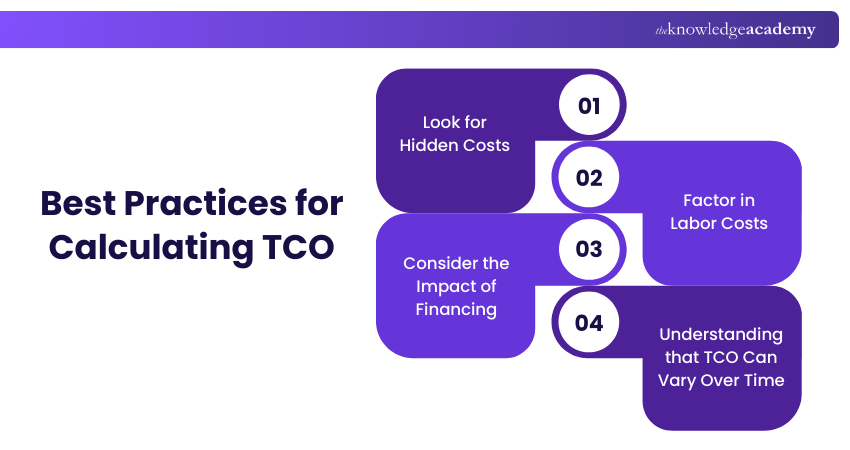
2) Factor in Labor Costs
The costs of labour can affect total ownership. For instance, while a new machine seems expensive, it might require few employees to operate. This results in savings for the long-term. So, it is crucial to analyse how an investment will impact workforce costs and productivity before coming to a decision.
3) Consider the Impact of Financing
The method of financing an asset can substantially affect the overall cost. Paying in cash may eliminate interest charges, whereas loans, leases, or credit-based purchases often include interest rates, processing fees, and service charges. Evaluating financing terms carefully ensures that the true financial impact is understood and factored into the Total Cost of Ownership calculation.
4) Understanding that TCO can Vary Over Time
The cost of ownership tends to evolve over an asset’s life. As equipment or technology starts ageing, maintenance expenses may rise as well. It is sensible to do prior research of the brand’s reputation, and durability to estimate future costs.
Real-world Example of Total Cost of Ownership
For a better understanding of Total Cost of Ownership, a real-world example can provide the necessary insight. For example, a company has decided to invest in a new computer system. The initial cost of purchase is one part of the equation. During the calculation of Total Cost of Ownership, the business will include software licensing, installation costs, employee training, cybersecurity measures and much more.
Through a thorough evaluation of every element involved in the asset, the company gains a complete picture. It provides a view of the computer systems entire expenses and helps to evaluate its long-term benefits.
Conclusion
An insightful understanding of Total Cost of Ownership (TCO) aids organisations or businesses to analyse the true value of their investments. By analysing all cost related to a specific asset, business can make informed and smart decisions. This helps them to sustain log-term value that reduces waste, enhances efficiency, and maximise ROI.
Empower HR excellence with SAP SuccessFactors Training – Join now!
Frequently Asked Questions
What is TCO vs ROI?

Total Cost of Ownership measures the total expense of owning an asset over its entire life cycle. On the other hand, Return on Investment (ROI) evaluates the gain companies benefited after investment. Hence, TCO focus on costs while ROI focused on profitability.
Does TCO include OpEx?
Yes, TCO includes Operation Expenses (OpEx) as well as Capital Expenses (CapEx). It covers costs, such as maintenance, utilities, training, and support over an asset’s lifetime.
What Are the Other Resources and Offers Provided by The Knowledge Academy?
The Knowledge Academy takes global learning to new heights, offering over 3,000+ online courses across 490+ locations in 190+ countries. This expansive reach ensures accessibility and convenience for learners worldwide.
Alongside our diverse Online Course Catalogue, encompassing 17 major categories, we go the extra mile by providing a plethora of free educational Online Resources like Blogs, eBooks, Interview Questions and Videos. Tailoring learning experiences further, professionals can unlock greater value through a wide range of special discounts, seasonal deals, and Exclusive Offers.
What is The Knowledge Pass, and How Does it Work?
The Knowledge Academy’s Knowledge Pass, a prepaid voucher, adds another layer of flexibility, allowing course bookings over a 12-month period. Join us on a journey where education knows no bounds.
What are the Related Courses and Blogs Provided by The Knowledge Academy?
The Knowledge Academy offers various SAP Training, including the SAP Production Planning Training, SAP Material Management Training and SAP SuccessFactors Training. These courses cater to different skill levels, providing comprehensive insights into SAP Consultant Job Description.
Our IT Infrastructure and Networking Blogs cover a range of topics related to SAP, offering valuable resources, best practices, and industry insights. Whether you are a beginner or looking to advance your IT Infrastructure skills, The Knowledge Academy's diverse courses and informative blogs have got you covered.
Upcoming IT Infrastructure & Networking Resources Batches & Dates
Date
 SAP Production Planning Training
SAP Production Planning Training
Mon 11th May 2026
SAP Production Planning Training
Mon 21st Sep 2026
SAP Production Planning Training
Mon 7th Dec 2026

 If you wish to make any changes to your course, please


