


 Top Rated Course

We may not have the course you’re looking for. If you enquire or give us a call on +44 1344 203 999 and speak to our training experts, we may still be able to help with your training requirements.
Understanding Absorption Costing: A Comprehensive Guide
Olivia Taylor 09 February 2026Absorption Costing assigns all direct and indirect manufacturing costs to products, including fixed overheads, giving a full cost per unit. This method ensures compliance with GAAP and is essential for external financial reporting. It also helps businesses assess total production costs and set appropriate pricing strategies.

Training Outcomes Within Your Budget!
We ensure quality, budget-alignment, and timely delivery by our expert instructors.
Table of Contents

Have you ever wondered how businesses determine the true cost of a product? One widely used method is Absorption Costing. This comprehensive accounting approach considers not only direct materials and labor but also all associated overheads, offering a complete view of production costs.
Understanding this method is essential for making informed financial decisions. In this blog, we will break down Absorption Costing step by step and explore why it plays a vital role in effective cost management.
Table of Contents
1) What is Absorption Costing?
2) Key Components of Absorption Costing
3) Absorption Costing Formula
4) Absorption Costing vs Variable Costing
5) Calculating Absorption Costing
6) Benefits of Absorption Costing
7) Drawbacks of Absorption Costing
8) Absorption Costing Examples
9) When can Absorption Costing be Used?
10) What is the Income Statement Under Absorption Costing?
11) Conclusion
What Is Absorption Costing?
Absorption or "full costing" is an accounting process designed to capture all the costs of making a specific product. It's essential for tax filings and other official reports. With Absorption Costing, all manufacturing expenses are allocated to every product, even if every item isn't sold.
Just a heads up, the company's products cover all the costs, including:
a) Labour: This includes the direct factory labour used in making the product and is directly linked to the wages paid during production.
b) Raw Materials: These are used to make the finished product; their costs are also factored into.

Key Components of Absorption Costing
Absorption Costing involves several key components that ensure a comprehensive calculation of production costs. These components are essential for understanding how costs are allocated to each unit produced. Let’s look at what these components are:
Product Costs
Product costs refer to the costs related to producing a product. These expenses include materials, labour, and other costs associated with producing the product. For example, in manufacturing bicycles, product costs would include expenses such as steel for the frame, Employees' salaries, and electricity used in production. The total cost of producing each bicycle consists of the combined costs.
Period Costs
On the other hand, period costs are not directly related to production as they are accumulated over a set period. These expenses include marketing and office salaries, as well as general administrative expenses. Period costs are recognised as expenses when incurred, unlike product costs, which are included in the cost of goods sold.
An example would be the sales team's salaries or the corporate office rent, which are considered period costs for our bicycle factory.
Elevate your leadership skills—join our Management Training for New Managers and lead with confidence!
Absorption Costing Formula
The formula for Absorption Costing is relatively straightforward:
Absorption Costing = Direct Materials + Direct Labour + Variable Overhead + Fixed Overhead
This formula ensures that every cost associated with production is accounted for in the cost of each unit. For example, if a batch of products costs £100,000 and 10,000 units are produced, each unit would absorb £10 in manufacturing costs.
Absorption Costing vs Variable Costing
The key distinction between Absorption Costing and Variable Costing lies in the treatment of fixed overhead costs. Variable Costing is often favoured for internal decision-making, as it clearly highlights the incremental costs of production. Absorption Cost is essential for financial reporting because it aligns expenses with revenue recognition, complying with accounting standards.

Calculating Absorption Costing
Calculating Absorption Costing involves a few key steps to ensure all relevant costs are included. Let’s break down the steps involved into Calculating Absorption Costing:
1) Establish Cost Pools
The first step is establishing cost pools, which group similar costs. For example, all machinery-related expenses, such as maintenance and depreciation, might be grouped into a single cost pool. This step ensures that costs are organised and efficiently allocated to products.
2) Determine Cost Usage
Next, the manufactured products will determine the usage of these cost pools. This involves measuring the resources consumed by each product, such as machine hours or labour hours. For instance, if a product requires more time on a particular machine, it will absorb more of the costs associated with that machine.
3) Compute Costs
Finally, the costs are computed by allocating the cost pools to the products based on usage. This involves dividing the total cost of each pool by the total usage to get a price per resource unit, which is then multiplied by the amount used by each product. This step ensures that each product absorbs a fair share of the total manufacturing costs.
Benefits of Absorption Costing
Absorption Costing is an essential tool that offers several advantages to assist businesses in gaining a comprehensive understanding of their financial performance. These benefits encompass:
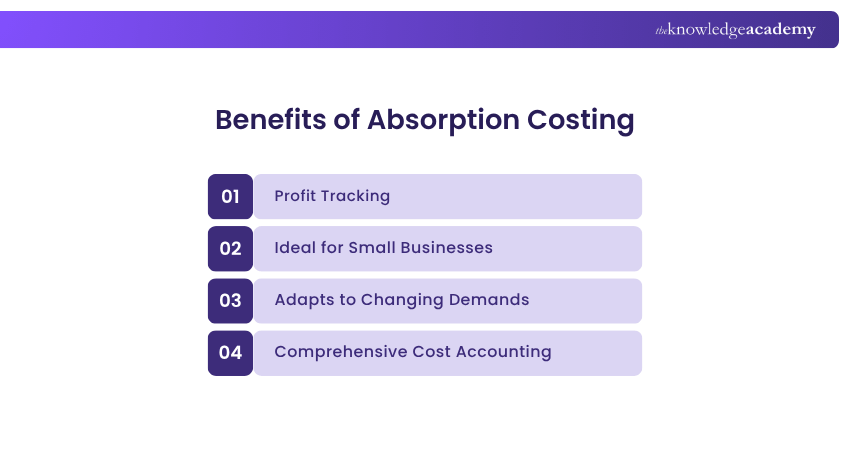
1) Profit Tracking
Absorption Costing gives a company a better understanding of profitability, mainly if all its products are sold during a different period of manufacture. This is important if a company plans to ramp up production in anticipation of a seasonal sales increase.
2) Ideal for Small Businesses
Absorption Costing is more straightforward for small businesses to track since they probably do not have many products. By anticipating and absorbing fixed costs, companies can sell their goods more reasonably and profitably.
3) Adapts to Changing Demands
Absorption Costing is an advantage for companies with constant product demand. It lays out a simple and systematic costing tool for active businesses while considering fluctuating turnover, as costs are already fixed for the products.
4) Comprehensive Cost Accounting
Finally, Absorption Costing provides a comprehensive approach to cost accounting by including all manufacturing costs. This ensures no cost is left out, providing a more accurate and complete picture of a company’s financial performance.
Drawbacks of Absorption Costing
Absorption Costing, while advantageous in some respects, has several drawbacks that can impact businesses. Here are some of the disadvantages of Absorption Costing:
1) Incomplete Data
Absorption Costing collects data, including fixed overhead, to determine a product's cost. This may lead to exaggerating the actual manufacturing cost and requiring more data for an exhaustive study.
2) Misleading Profitability Insights
Another drawback is that Absorption Costing can sometimes provide misleading insights into profitability. Because all costs are allocated to products, determining the true profitability of a product line can take time. This can lead to decisions that may be outside the business's best interest, such as discontinuing a product that appears unprofitable but covers fixed costs.
3) Overhead Cost Over-Allocation
Absorption costs can also lead to the over-allocation of overhead costs. If overhead costs are not carefully allocated, products may absorb more costs than they incur. This can lead to inflated product costs and, ultimately, higher consumer prices. Price Skimming can help businesses maximise profits before adjusting prices over time.
4) Encouragement of Excess Production
This pricing strategy enables higher profitability by overproducing a product. Each extra unit produced costs less since the fixed overhead is applied to the total number of units produced. Profitability is increased when unsold items don't result in the fixed overhead costs being added to expense reports.
Master the art of leading from afar—join our Managing Remote Teams training today!
Absorption Costing Examples
Let's break down Absorption Costing with a real-life example. Picture a company that makes custom furniture. They have direct costs for materials and labour and indirect expenses for rent and utilities. The company uses Absorption Costing to assign all these costs to its furniture. So, if they produce 1,000 chairs and have £50,000 in direct costs and £20,000 in overhead, each chair will include £70 in costs. This method helps the company keep track of all expenses accurately and set the correct prices for its chairs.
For another example, let's consider a small bakery. The bakery includes costs for ingredients, labour, rent, and utilities. It uses Absorption Costing to assign these costs to the cakes and pastries it produces. For instance, if the bakery makes 500 cakes and spends £5,000 on direct costs and £2,000 on overhead, each cake will absorb £14 in costs. This method allows the bakery to precisely monitor all expenses and establish prices for its cakes accordingly.
Get ready for your next role with top Management Interview Questions and Answers. Explore expert insights and ace your interview with confidence!
When can Absorption Costing be Used?
Absorption Costing is used when preparing external financial statements, as it complies with Generally Accepted Accounting Principles (GAAP) and International Financial Reporting Standards (IFRS). It’s appropriate for valuing inventory, calculating cost of goods sold, and reporting profitability in financial accounting and tax reporting.
What is the Income Statement Under Absorption Costing?
The income statement under Absorption Cost includes all manufacturing costs, both variable and fixed in the cost of goods sold. This means fixed overheads are part of inventory costs until the products are sold, which can result in higher reported profits when inventory increases.
Conclusion
Understanding Absorption Costing is like mastering a complex concept. It requires attention to detail and a clear understanding of all the ingredients involved, including the Cost of Sales. This costing method ensures that businesses capture every cost associated with production, leading to more informed financial decisions. Additionally, Activity-Based Costing offers a more granular approach, helping businesses allocate overhead more precisely by tracking resource usage. Absorption Costing, along with accurately tracking the Cost of Sales, is essential for achieving financial clarity and business success.
Step into leadership with confidence—start your journey with our Introduction to Management Course!
Frequently Asked Questions
What is the Purpose of Absorption Costing?

The purpose of Absorption Costing is to allocate manufacturing costs, both fixed and variable to products. This ensures accurate inventory valuation and aligns with the matching principle, where costs are recorded in the same period as the revenues they generate. It is also required for external financial reporting under GAAP and IFRS.
When is Absorption Costing Most Valuable for a Business?
Absorption Costing is most useful when businesses must comply with external reporting standards, such as GAAP, or want a comprehensive view of all production costs. It’s particularly beneficial for long-term decision-making and pricing strategies.
What are the Other Resources and Offers Provided by The Knowledge Academy?
The Knowledge Academy takes global learning to new heights, offering over 3,000+ online courses across 490+ locations in 190+ countries. This expansive reach ensures accessibility and convenience for learners worldwide.
Alongside our diverse Online Course Catalogue, encompassing 19 major categories, we go the extra mile by providing a plethora of free educational Online Resources like Blogs, eBooks, Interview Questions and Videos. Tailoring learning experiences further, professionals can unlock greater value through a wide range of special discounts, seasonal deals, and Exclusive Offers.
What is The Knowledge Pass, and How Does it Work?
The Knowledge Academy’s Knowledge Pass, a prepaid voucher, adds another layer of flexibility, allowing course bookings over a 12-month period. Join us on a journey where education knows no bounds.
What are Related Courses and Blogs Provided by The Knowledge Academy?
The Knowledge Academy offers various Management Courses, including the Costing and Pricing Training, Management Training for New Managers and the Introduction to Managing People Course. These courses cater to different skill levels, providing comprehensive insights into Cost Accounting and Management Accounting.
Our Accounting and Finance Blogs cover a range of topics related to Management, offering valuable resources, best practices, and industry insights. Whether you are a beginner or looking to advance your Management Skills, The Knowledge Academy's diverse courses and informative blogs have got you covered.

Olivia Taylor


Chartered Accountant and Financial Training Specialist
Olivia Taylor is a qualified chartered accountant with over a decade of experience in financial management, auditing and corporate reporting. Having worked with leading firms in both the public and private sectors, Olivia brings clarity to complex financial topics. Her writing focuses on helping professionals build confidence in key areas of accounting, compliance and financial planning.
View Detail
Upcoming Accounting and Finance Resources Batches & Dates
Date
 Costing and Pricing Training
Costing and Pricing Training
Fri 27th Mar 2026
Costing and Pricing Training
Fri 24th Apr 2026
Costing and Pricing Training
Fri 31st Jul 2026
Costing and Pricing Training
Fri 23rd Oct 2026

 If you wish to make any changes to your course, please


